
Never in the last 25 years has America created so many new billionaires. The country is now home to 960 billionaires, but our team at American Inequality uncovered that 64% of the billionaires minted in the last year came from Democrat-controlled states, where both the governor’s office and House Legislature were controlled by Democrats.
As Democrats have tried to position themselves as the champions of the working class and have long promised to tax the rich, their legislative efforts to target extreme wealth have repeatedly stalled.
Welcome to American Inequality where we map the divides shaping our lives.
These visuals are all interactive on web and available with more information below.
A coordinated effort by progressive lawmakers in 7 states to introduce wealth taxes has yielded little results.
In Washington State, Senate Bill 5486 attempted to establish a narrowly tailored property tax on extreme wealth, but ran directly into state constitutional barriers and resistance from business-aligned Democrats.
In Illinois, where Democrats hold a supermajority, House Speaker Emanuel “Chris” Welch recently confirmed that a binding constitutional amendment to implement a 3% surtax on income over $1 million had failed to gain enough traction to even be called for a vote.
In New York, Democratic Governor Kathy Hochul has repeatedly resisted progressive packages from her supermajority like the Fair Share Act that seek to aggressively raise income taxes on the state’s ultra-wealthy residents to close looming budget gaps.
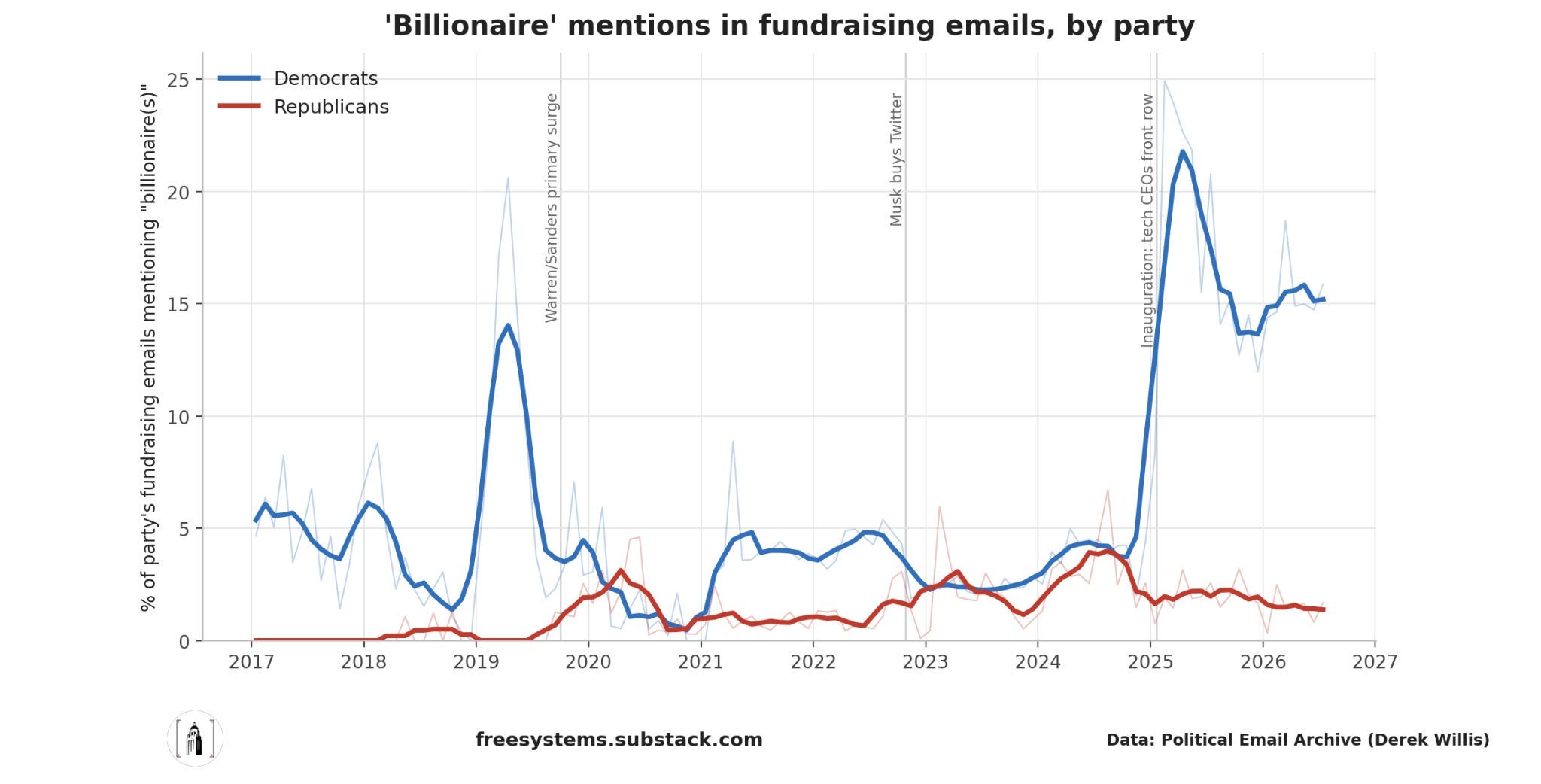
An analysis of 280,000 emails candidate fundraising emails traces the rise of anti-billionaire populism in the Democratic party. As Andy Hall explains, 2025 was an inflection point in the Democratic narrative. Billionaire mentions in emails have tripled that year from the prior one, peaking above 20% of all fundraising emails sent and holding around 15% into 2026. “Anti-billionaire fundraising tactics are now a mainstay of Democratic messaging,” Hall writes.
So what’s causing the impasse? Are these politicians just beholden to wealthy donors? Are these bills really not the right ones to tackle wealth inequality? Is something else stirring under the surface at the local level?
California is currently ground zero for this wealth debate. On November 3rd, voters will decide whether to pass a one-time 5% wealth tax targeting residents with a net worth exceeding $1 billion. Known as Proposition 40, this ballot initiative applies to approximately 200 billionaires and is designed to offset federal healthcare funding cuts. Yet the future of the bill remains uncertain, despite a democratic governor, a 75% majority in both the assembly, and legislature, and strong support from unions, leading economists, and members of Congress.
Opponents and moderate leaders have pushed back with three main arguments against the initiative, but a closer look at the data shows these fears are largely unfounded.
“The billionaires will leave my state, thereby drastically cutting future revenue.”
This argument is wrong because Prop 40 was created in a way that the billionaires wouldn’t have had time to move before it got on the ballot based on the period that it calculates their wealth from
“Billionaires may not leave, but businesses will because founders don’t want to launch their companies here.”
This argument almost never shows up in the data. Since the ballot initiative was announced, venture capital funding flowing to California, far from falling, has surged. According to Pitchbook data, California attracted nearly 90% of the value of all venture capital deals made in the US in the first quarter of 2026.
“Don’t tax my state, we need a national wealth tax.”
Newsom’s claim that “the fight to make the wealthiest Americans pay more in taxes is not one we should be fighting state by state… the fight belongs at the federal level” gets the history completely backward. Local policy replication is exactly how we got the federal income tax in the first place—progressive states proved the model worked at the turn of the 20th century long before Washington codified it in 1913.
Across both parties, billionaire spending has skyrocketed since the Citizens United decision, now accounting for 15% to 20% of all federal election funding in the United States. But a report from the Brennan Center found that nonprofits, shell companies, and Super PACs plowed more than $1.9 billion into the 2024 presidential race, nearly doubling the amount from the 2020 race. $1.2 billion of that $1.9 billion went to Democrats.
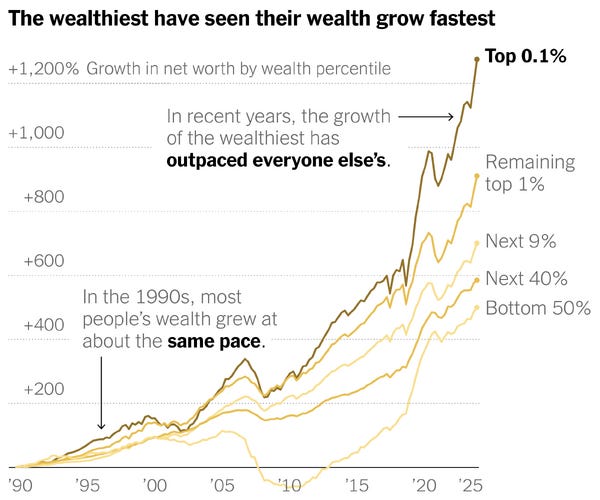
But there are now also more wealthy people in America to be giving more money. This meteoric rise in wealth largely comes from a roaring stock market. 9 of the 10 wealthiest people in America all made their money in tech (Buffet being the only exception) and all have seen their net worth rise more than $100 billion each in the last 12 months.
But billionaires are not the only ones that have seen their wealth rise.
The US added 1,200 millionaires PER DAY in 2025! Over 440,000 people became millionaires in the US last year, accounting for nearly half of the world’s new millionaires. In a new analysis from UBS published on June 30, financial assets like stocks and bonds accounted for 79% of gross wealth in the America, putting it near the top of the rankings for that metric.
When a rising tide lifts all boats, Americans everywhere benefit. But unfortunately we are living in a time when only a few are seeing their wealth rise dramatically and the masses are falling behind. This does not have to be a zero sum game, and America is a nation where we have proven time and again that we can find prosperity for all.
At a time when Congress is passing only 5.5% of bills introduced, and is one of the least productive Congresses we’ve ever seen, pointing to the federal government to take action can feel like kicking the can down the road. So who can take the lead?
As state and federal officials seem unable to act, the battlefield shifts entirely to the local level. Progressive cities and municipalities are increasingly realizing that they do not have to wait for governors or statehouses to act—they can build localized, targeted revenue models that are more designed at funding the social safety net than they are at broad based narratives about chipping away at extreme wealth.
In Los Angeles, organizers circumvented a divided state legislature by passing Measure ULA, a targeted real estate transfer tax that levies a 4% tax on property sales above $5 million and a 5.5% tax on sales above $10 million. In its first year alone, Measure ULA secured tens of millions of dollars to fund direct tenant protections, emergency rental assistance for low-income seniors, and the construction of permanent supportive housing.
San Francisco went directly after elite corporate structures with its Overpaid Executive Tax, which forces companies operating within city limits to pay a tax surcharge if their top executives make more than 100 times the median salary of their local workers.
The governor may be unwilling to act in California, but these issues matter a lot for people. When small-scale stages take the lead, they prove that the ultra-wealthy can contribute to the shared infrastructure of the cities where they made their fortunes.
My Substack Live with Amanda Litman, founder of Run for Something, was a hit on Monday and I’ve got another one coming up next week with David Pakman - Register here or check out the recording.
I spoke with the Washington Post about the Great Generational Wealth transfer and whether it is going to increase inequality - GIFT LINK
The Department of Commerce is trying to sneak by a new policy that will likely shrink the Census and other public data - LINK (only for data nerds)
Awesome map to see historical pictures of basically every single intersection in NYC - LINK
Comments
Nothing yet. Say the first thing.
Sign in to join the conversation.