
December 9, 2006
Are accidental genome shifts the engine of change in evolution? Is species evolution a process of tiny steps?
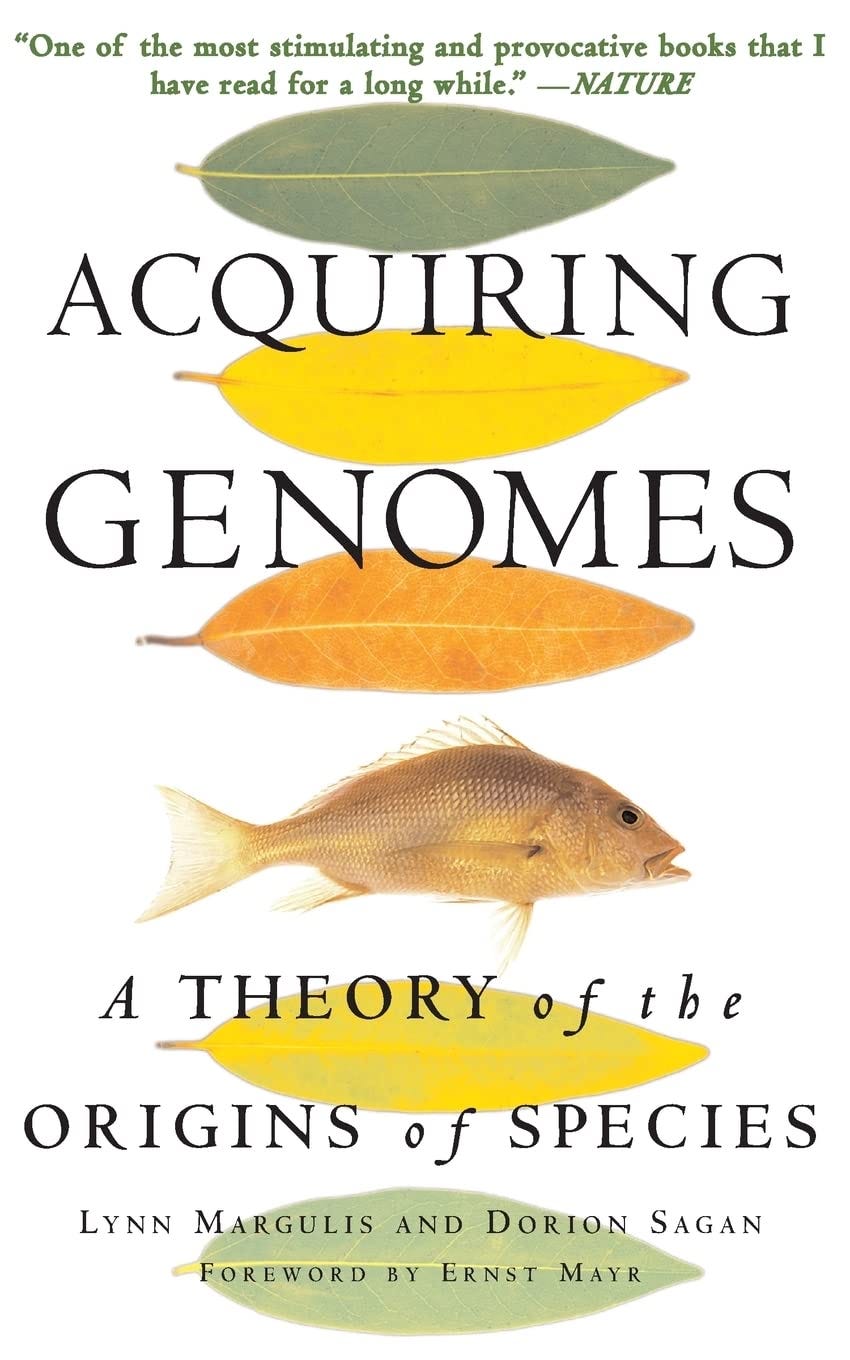
"No," says Dr. Lynn Margulis (Distinguished University Professor in the Department of Geosciences at the University of Massachusetts, Amherst), in her stellar book Acquiring Genomes (written with Dorian Sagan), from their catalog of excellent work, which includes Microcosmos and her remarkable Five Kingdoms (a personal favorite, because it so satisfies the naturalist in me).
And so, what has led us in the wrong direction? What limits scientific practice and thought?
Politics, fragmentation and self-isolation.
From Chapter 7, History of the Heritable p 95,96:
"The stories of how microbes tend to physically join each other, and of their multiple interactions among themselves and with larger associates, have been told many times in the specialized language of the sciences.
Inevitably these stories are poorly known, in part because the sciences themselves are so fragmented.
Even those of us who understand how much already is known about the origin of species are limited to work on our own tiny discoveries, usually one species at a time.
Academic biology departments once joined the zoologists with the botanists. Plants and animals were studied together.
Falling through the cracks at liberal arts institutions, the study of microbes was largely shunted to its own departments, called microbiology, all of which resided in medical or agricultural schools. The main concern with understanding microbes - as disease agents or food contaminants - was in order to kill them.
Since the 1980s many biological science departments have splintered further into molecular versus organismal biology, a move that exacerbates misunderstanding. The relevant information on species origins is scattered across more than a dozen fields, each with its own esoteric language or languages.
Identical organisms are sometimes partitioned into distinct disciplines. Cyanobacteria, for instance, are studied under phycology (or algology, a branch of botany) rather than bacteriology because they were once misnamed "blue-green algae."
Biochemistry, cell biology, geology, and virology are all relevant to deciphering the origins of species. Most of these fields, black boxes to the public as well as to graduate students, remain mysterious even to many scientists who practice evolutionary biology today.
Many of Darwin's fashionable but misguided followers habitually misinterpret even the parts of science they know well. The revelation of much science beyond his century, extended by molecular biology and paleontology, is entirely inconsistent with Darwin's great insight.
But that revelation shows that the luxuriant living diversity surrounding us did not evolve gradually, as the students of the fossil record so vociferously tell us.
Precious little evidence in the sedimentary rocks exists for small steps that connect one species gradually to its descendants.
The "traces of bygone biospheres," in Vladimir Vernadsky's immortal phrase, proclaim the opposite. Punctuated equilibrium is there for all who take the time to see it.
The discontinuous record of past life shows clearly that the transition from one species to another occurs in discrete jumps. In trilobites, snails, seed ferns, horses, lungfish, sharks, and clams, evidence abounds for punctuated change.
In spite of Darwin's own protest of an incomplete record and his claim of a "passage" of one form to another, for example in pigeons, barnacles, and dogs, animal and plant life has evolved in microbe genome-sized steps."
. . . . .
[Books], [Evolution], [The Popular Culture]
Liam

No posts
Comments
Nothing yet. Say the first thing.
Sign in to join the conversation.