
What is this, AE?
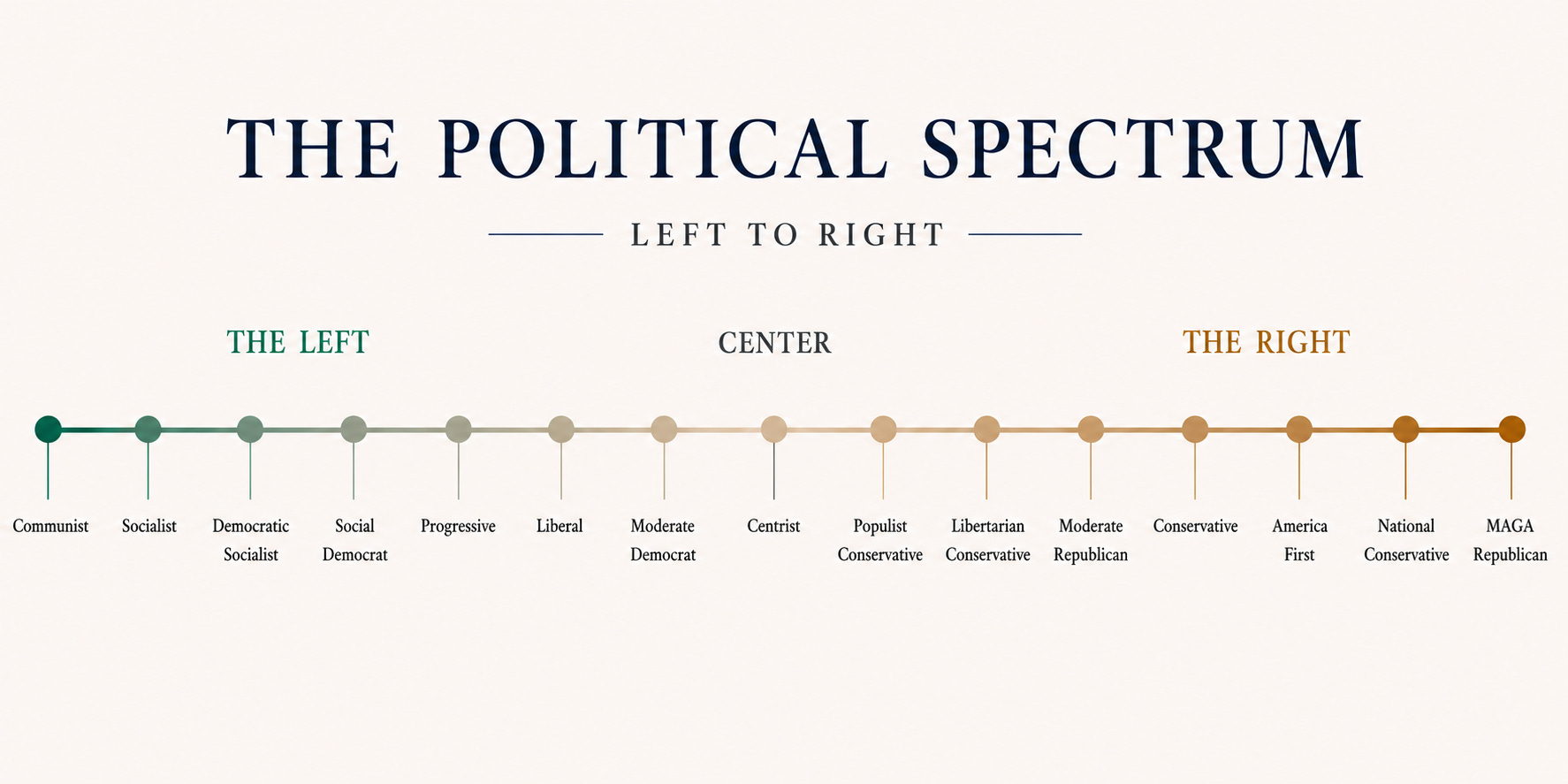
Think of this as a little decoder for all the political labels we hear being thrown around every day. Sure, labels are imperfect and sometimes more confusing than helpful, but politicians, pundits, and the media use them constantly. Oddly enough, nobody really stops to explain what they actually mean.
What am I supposed to do with this?
Well, ideally read the whole thing, since it might give you a clearer picture of ALL the political labels.
But if you want the quick version, start with the label you think fits you best, then check out the ones right above and below it. You might be surprised by how similar some are, or how different they actually turn out to be.
I also hope people use this to see if their political views have changed over time. Because that’s normal too. People change, priorities shift, and views evolve as we experience new things and survive a few election cycles.
What is this even based on?
Admittedly, this is just one way of looking at the political spectrum. There are definitely more labels out there, enough that two people can agree on everything and still argue over the label. But the ones discussed here are the most common and, in my opinion, the least redundant.
These are also the labels used most often by those who follow politics a little too closely, myself included. So while this isn’t some sacred political chart handed down from the heavens, I do think it works as a solid foundation.
And yes, the weirder and more obscure labels will probably get their moment later on.
Oh wait, one quick heads up.
Less than 0.5% of readers are paying, and your support is what makes it possible to keep going.
So if you’ve ever gotten value from my writing… Please consider supporting it.
Be one of the first 100 subscribers and lock in $6 a month for a year.
Now, back to what I was saying…
Believes capitalism should ultimately be abolished entirely
Supports collective or state ownership of most industries and economic systems
Views class struggle as the central force in politics and economics
Often influenced by Marxist, Leninist, or other communist traditions
Rejects private capitalist ownership of most productive industries
Supports centrally planned or collectively organized economic systems
Believes profit-driven economies inevitably create exploitation and inequality
Supports large-scale public ownership of finance, industry, housing, and infrastructure
Believes the state should fundamentally restructure society
Wants the government to invest in:
universal public services
state-led economic planning
guaranteed housing, healthcare, and employment
Strongly class-oriented and labor-centered
Believes workers should collectively control economic production
Supports militant labor organizing and revolutionary worker movements
Frames politics explicitly as workers versus capitalist ownership
Supports fully public and universal healthcare systems
Opposes profit-driven healthcare structures
Often supports:
state-run healthcare
universal public pharmaceutical production
elimination of private insurance dominance
healthcare as a guaranteed social right
Believes corporations and billionaire ownership should not dominate the economy
Views concentrated private capital as fundamentally incompatible with economic democracy
Focused completely on eliminating capitalist systems rather than regulating them
Always anti-imperialist and anti-war
Strongly against American military power, NATO expansion, and corporate globalization
Supports international worker solidarity and anti-colonial movements
Often critical of:
military alliances
defense spending
multinational corporations
Western economic dominance
Claudia De la Cruz (former presidential candidate)
Gus Hall (former presidential candidate)
Abolish or fundamentally replace capitalism
Expand collective or state ownership of major industries
Eliminate concentrated private capital and billionaire ownership
Guarantee universal public housing, healthcare, education, and employment
Build worker control over economic production
Oppose imperialism, militarism, and corporate globalization
Believes capitalism is inherently exploitative and unequal
Supports replacing or fundamentally restructuring capitalism
Believes major industries and essential services should be publicly, socially, or worker owned
More explicitly anti-capitalist than democratic socialists
Often views class conflict as central to politics and economics
Believes profit-driven systems create inequality, instability, and exploitation
Favors democratic control over production, finance, housing, healthcare, and infrastructure
Supports large-scale redistribution of wealth and economic power
Supports major public control of all essential industries and services
Generally favors:
public housing expansion
universal public healthcare
free public education
public ownership of utilities and infrastructure
strong state economic planning
Strongly labor-centered and class-oriented
Believes workers should directly control most economic institutions
Supports militant unionism, workplace democracy, and cooperative ownership
Supports fully public and universal healthcare systems
Often supports:
single-payer healthcare
elimination of major private insurance systems
public pharmaceutical production
healthcare as a guaranteed public utility
Believes large corporations and billionaire ownership structures are fundamentally incompatible with economic democracy
Supports breaking up, nationalizing, or socially controlling major industries
Strongly opposes concentrated private capital and corporate political influence
More focused on replacing capitalist power structures than only regulating them
Generally anti-imperialist and anti-war
Skeptical of military alliances, corporate globalization, and American hegemony
Supports international labor solidarity and global economic justice
Often critical of:
military intervention
defense spending
neoliberal trade systems
Kshama Sawant (Former Seattle City Council member & current congressional candidate for Washington’s 9th District)
Replace or fundamentally transform capitalism
Expand public and worker ownership of major industries
Guarantee universal public healthcare, housing, education, and childcare
Eliminate concentrated billionaire and corporate power
Strengthen unions and workplace democracy
Aggressively redistribute wealth and economic power
Reduce militarism and corporate globalization
Build an economy centered on social need rather than profit
Believes capitalism is fundamentally unequal and should eventually be replaced or deeply transformed
Supports democratic control over major parts of the economy and essential industries
Believes political democracy is incomplete without economic democracy
Skeptical of capitalism as a long-term economic system
Supports expanding public, cooperative, or worker ownership in major sectors of the economy
Believes wealth concentration and private control of essential industries create structural injustice
Supports strong redistribution, universal public programs, and democratic economic planning
Believes government should play a major role in restructuring economic and social systems
Supports large-scale public ownership or public control in key sectors
Generally favors:
universal healthcare
tuition-free public college
universal childcare
public housing expansion
Strongly pro-labor and union-centered
Believes workers should have greater control over workplaces and economic decision-making
Supports expanding union power, workplace democracy, and cooperative ownership models
Supports fully universal healthcare as a guaranteed public right
Often supports:
Medicare for All
single-payer healthcare
removal of profit incentives from healthcare
Believes large corporations exert excessive control over politics, labor, and public life
Supports aggressive regulation, breakup, or public control of major industries
Generally internationalist, but strongly skeptical of militarism, corporate globalization, and interventionism
Supports diplomacy, labor rights, climate cooperation, and international solidarity
Often critical of:
foreign wars
military-industrial influence
corporate trade systems
Brandon Johnson (Mayor of Chicago)
Alexandria Ocasio-Cortez (U.S. congresswoman- NY’s 14th)
Zohran Mamdani (Mayor of New York City)
Guarantee universal healthcare and universal public services
Expand worker and union power throughout the economy
Eliminate concentrated billionaire and corporate power
Treat housing, healthcare, education, and childcare as public rights
Aggressively reduce wealth inequality
Expand democratic control over economic institutions
Protect civil rights, labor rights, and marginalized communities
Reduce militarism and corporate influence in foreign policy
Believes capitalism should exist, but be heavily regulated and balanced by a strong welfare state
Prioritizes economic security, social equality, and universal public services
Believes democratic government should guarantee a high baseline quality of life
Supports a mixed economy with strong state involvement and robust social programs
Believes markets can exist, but should not dominate essential parts of society
Supports high taxation on wealth and corporations to fund universal services
Strongly favors redistribution to reduce inequality and strengthen social stability
Believes government should play a major and permanent role in economic and social life
Supports expansive universal programs and public investment
Generally favors:
universal healthcare
tuition-free public college
universal childcare
paid family leave
strong pension systems
Strongly pro-union and pro-worker
Supports sector-wide bargaining, strong labor protections, and worker participation in economic decision-making
Often supports:
single-payer systems or Medicare for All
heavily public healthcare systems
universal coverage guarantees
strict pharmaceutical regulation
Believes large corporations should be tightly regulated and subordinate to public interests
Supports strong antitrust enforcement, financial regulation, and corporate taxation
Generally internationalist and pro-alliance
Supports organizations like NATO
Supports international cooperation, labor standards, and human rights protections
Often skeptical of militarism and corporate globalization
Bernie Sanders (U.S. senator for Vermont)
Sherrod Brown (Former U.S. senator for Ohio)
Jamaal Bowman (Former U.S. congressman for New York)
Guarantee universal healthcare and strong public services
Maintain a large social safety net and welfare state
Strongly protect labor unions and worker rights
Reduce wealth inequality through taxation and redistribution
Regulate corporate and financial power aggressively
Ensure affordable education, childcare, and housing
Protect democratic institutions and civil liberties
Maintain international alliances and cooperative global institutions
Believes major systemic reforms are needed to address inequality and concentrated power
Views economic inequality as a central political problem
Strongly supportive of grassroots activism and movement politics
More willing to challenge party leadership and political norms
Supports heavily regulated capitalism
Believes corporations and billionaires have too much influence over society and politics
Supports large public investments and expansive social programs
Focused on reducing structural inequality rather than simply expanding opportunity
Believes government should play a major role in reshaping economic and social systems
Supports large-scale federal action on healthcare, housing, labor, and climate
Generally favors:
universal childcare
tuition-free public college
major climate legislation
expanded welfare programs
stronger financial regulation
Strongly pro-labor and union-oriented
More likely to frame labor issues as power struggles between workers and corporations
Supports aggressive workplace protections and higher wage standards
Supports universal healthcare as a major national goal
Often supports:
universal coverage guarantees
expanded public healthcare systems
aggressive pharmaceutical regulation
skeptical of concentrated corporate and billionaire power
Supports aggressive antitrust enforcement and financial regulation
Believes large corporations exert excessive influence over politics, media, and labor
Generally internationalist, but more skeptical of military intervention and corporate globalization
Supports diplomacy, climate cooperation, and human rights-focused foreign policy
Often critical of:
Some foreign wars
Some military spending
Some corporate trade agreements
Elizabeth Warren (U.S. senator for Massachusetts)
Ro Khanna (U.S. congressman for California’s 17th Congressional District)
Pramila Jayapal (U.S. congresswoman for Washington’s 7th Congressional District)
Reduce economic inequality and concentrated wealth
Expand universal social programs
Protect labor rights and union power
Guarantee broad healthcare access
Aggressively regulate corporate and financial power
Address climate change through major federal action
Protect civil rights, voting rights, and marginalized groups
Reduce corporate influence in politics
Pursue diplomacy-first foreign policy and reduce unnecessary military intervention
Clearly center-left but socially progressive
Believes government should actively expand rights, opportunity, and social equality
More trusting of federal power to solve social and economic problems
Strongly supportive of multiculturalism, civil liberties, and modern social movements
Supports regulated capitalism with stronger oversight
More supportive of redistributive taxation and expansive social programs
Believes some inequalities are structural problems
Supports stronger consumer protections and corporate regulation
Believes government should influence some economic and social outcomes
Strong supporter of federal regulation and public investment
Generally favors:
expanded healthcare access
climate policy
civil rights enforcement
student debt relief
Strongly pro-union and supportive of organized labor
Supports expanding worker protections and bargaining rights
More willing to side with labor over corporate interests
Supports higher minimum wages and broader workplace regulations
Supports major expansion of healthcare access through federal action
Often supports:
expanded Medicare and Medicaid
aggressive prescription drug regulation
More skeptical of corporations and concentrated wealth than moderate Democrats
Supports stronger antitrust enforcement and regulation of major industries
Believes corporate influence distorts politics and harms economic fairness
More willing to confront large corporations directly
Generally internationalist and strongly pro-alliance
Places stronger emphasis on:
human rights
climate agreements
international institutions
diplomacy-first foreign policy
Usually skeptical of overly aggressive military intervention depending on the country.
Gavin Newsom (Governor of California)
Kamala Harris (Former vice president of the United States)
Chris Murphy (U.S. senator from Connecticut)
Protect civil rights and voting rights
Expand healthcare access
Defend reproductive rights and LGBTQ protections
Regulate corporate abuses
Support climate action and environmental protections
Strengthen labor and consumer protections
Preserve democratic institutions and constitutional rights
Support international alliances and diplomacy
Center-left, but still very pragmatic and institutional
Supports incremental reforms within the system rather than any major structural change
Prioritizes expanding opportunity, stability, and economic fairness
Supports regulated capitalism and a mixed economy
Supports some taxing on higher earners to fund public investment
Focused on strengthening the middle class and reducing inequality
Still broadly pro-market and pro-business
Believes government should actively improve economic and social conditions
Supports federal investment in infrastructure, education, and healthcare
Generally favors expanding the social safety net
Still cautious of overly large or inefficient bureaucracy
Generally pro-union and supportive of collective bargaining
Supports worker protections and minimum wage increases
Prefers negotiation between labor and business over confrontation
Supports expanding healthcare access through federal action
Strongly supports the Affordable Care Act
Often supports:
Medicaid expansion
lowering prescription drug prices
Supports stronger regulation of monopolies and corporate influence
Believes corporations should be more accountable to workers and consumers
Still supports regulated capitalism and private enterprise
Generally internationalist and pro-alliance
Highly values diplomacy, global cooperation, and international institutions
Supports American global dominance but with emphasis on diplomacy and human rights
Amy Klobuchar (U.S. senator for Minnesota)
Josh Shapiro (Governor of Pennsylvania)
Gretchen Whitmer (Governor of Michigan)
Protect democratic institutions and voting rights
Preserve and expand the social safety net
Expand healthcare access
Support labor protections and middle-class growth
Regulate monopolies and corporate abuses
Protect civil rights and reproductive rights
Invest in infrastructure, education, and clean energy
Maintain strong international alliances
Values pragmatism over ideology
Believes political compromise is always necessary
Believes stability and institutional trust matter most
Supports capitalism and markets
Believes markets generally work, but need some regulation and oversight
Usually favors balanced budgets and moderate spending
Values economic growth by growing small business, and middle-class stability
Government should exist as a stabilizer, but not dominate society
Supports a functional federal government but dislikes excessive bureaucracy
Believes government should:
maintain infrastructure
enforce laws
regulate basic fairness
provide a basic social safety net
Ironically opposes both massive expansion and drastic shrinking of government
Generally pro-union, but not aggressively labor-populist
Supports workers’ rights and fair wages within limits
Favors negotiation between labor and business over confrontation
Usually supports a mixed healthcare system
Wants reforms and expanded access, but not full government control
Often supports:
Obamacare-style systems
lowering prescription costs
Typically skeptical of fully nationalized healthcare
Believes corporations are important for economic growth
Supports regulation against abuses and corruption
Opposes both unchecked corporate dominance and anti-capitalist restructuring
Generally internationalist
Supports alliances like NATO
Favors diplomacy first, backed by aggressive military strength
Usually supports global trade and international cooperation
Democratic-leaning centrists
Joe Manchin (Former U.S. senator from West Virginia)
Mark Warner (U.S. senator from Virginia)
Michael Bennet (U.S. senator from Colorado)
Republican-leaning centrists
Susan Collins (U.S. senator from Maine)
Lisa Murkowski (U.S. senator from Alaska)
Larry Hogan (Former governor of Maryland)
Protect democratic institutions and constitutional order
Maintain peaceful transfers of power
Avoid political extremism
Keep markets functional and competitive
Encourage bipartisan compromise
Reduce government dysfunction
Maintain strong international alliances
Balance fiscal responsibility with social stability
Protect civil liberties and basic rights
This is part of a political series and hopefully clears up some of the confusion around political labels. The right side of the political spectrum is broken down in a separate article and the next move is to go deeper into each of the politicians themselves.
Because honestly, our politicians are usually the biggest offenders when it comes to misusing or completely misrepresenting these labels. It also means a lot of the political information we see is filtered through campaign branding, media spin, or paid political influencers.
Clearing up that confusion is the idea behind AE’s Political Cheat Sheets. Which is an attempt to provide information that gives a clear look at who really represents us, what they seriously believe, and how they actually vote once in office.
Comments
Nothing yet. Say the first thing.
Sign in to join the conversation.