

This is the tenth essay of a multi-part series. Read part one here, or see all of the currently published articles here.
The progressive left’s nearly decade-long reign over American culture was nothing if not explosive. Between the firestorms over free expression and race, the ideological burn through institutions and the education system, the heated culture wars around sex and gender, and the conflagrations — literal and figurative — of political violence, the “woke” years from 2014 to 2023 had more than their fair share of fireworks. Quietly suffusing the atmosphere of the era was a culture of grievance, identity, victimhood, and fragility that provided the flames of radicalism all the oxygen they would ever need. To understand this period of American cultural history, we must examine not only its most incendiary flashpoints, but the very air it breathed.
Ever since the rise of this culture of grievance and identity in the 2010s, commentators and critics have traced its roots to various schools of thought within the leftmost reaches of 20th-century academia, including postmodernism, critical theory, postcolonial theory, and others. In the years since, this origin story has calcified into conventional wisdom. But while it’s true that some older academic frameworks such as intersectionality and queer theory helped inform and shape the currents of the woke era, their role has been largely exaggerated. Upon closer examination, this grievance culture, which merged with and became what we now think of as social justice politics, was born of a confluence of factors far broader than anything found in the bowels of academic theory.
In the 1980s and ‘90s, Americans, seen the world over as bombastic and egocentric, were told that they suffered from a lack of self-esteem. The self-esteem movement took off in California, most notably through the Task Force to Promote Self-Esteem created in 1986. Education systems around the country reoriented themselves around the goal of building up students’ view of themselves. Before long, this ethos had gone mainstream, influencing behavior in the wider culture with a massive surge in motivational speaking and self-help books. Alongside this was the rise of 12-step recovery programs, support groups, and the normalization of therapy. Above all, these shifting attitudes were driven by television programming, which turned processing one’s emotions from something shameful and private into a form of public entertainment. In the final analysis, French poststructuralism was no match for American daytime talk shows. When it came to influence, Michel Foucault and Jacques Derrida could not hold a candle to Oprah Winfrey and Dr. Phil.
The resulting culture was one in which mental health issues were less stigmatized and certain kinds of bullying and bias were less acceptable. It was also a culture in which everyone was more medicated, normal human attributes were more pathologized, and every conceivable danger — real or imagined — was assiduously childproofed. Children and adolescents by the millions were barred from free and unsupervised play, diagnosed with mental disorders and prescribed meds, and handed inflated grades and participation trophies. Kids were treated like cracked porcelain dolls while also being told that they could do or be whatever they wanted. This mixture of emotional fragility and egotism proved particularly combustible, especially when the “sky’s the limit” promises Millennials were raised on turned out to be well-meaning lies.
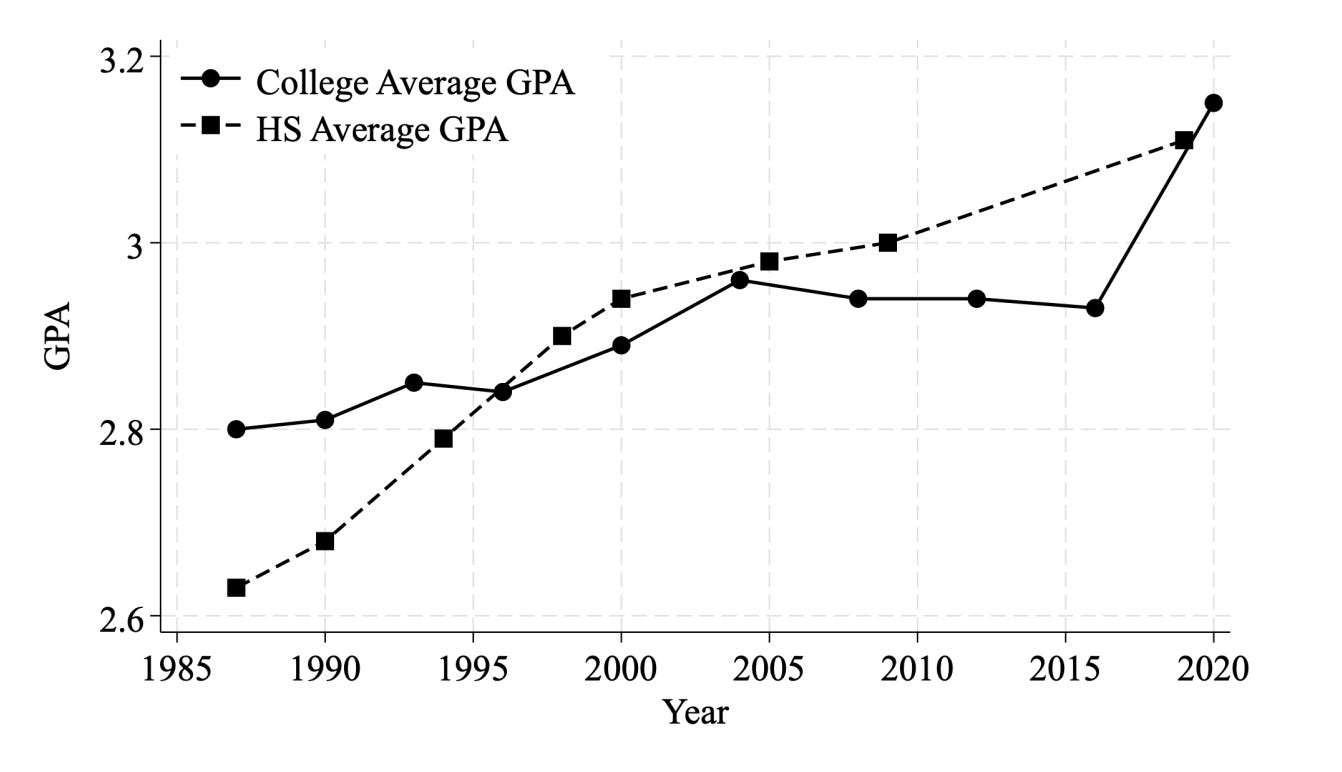
It’s no coincidence that these cultural shifts took shape in the wake of the Great Recession, just as the Millennial generation was entering adult life. Decades of trends and forces converged in the early 2010s. Stymied by economic forces and the lengthening lifespans of their still-working elders, many young people could not actualize themselves through what they achieved in the world. Instead, they sought actualization through their identities and sense of victimhood. They connected with one another through the Internet and stumbled down ideological rabbit holes on platforms like Tumblr, Twitter, Reddit, and Facebook. And as journalism’s business model collapsed, the press became ever more plugged in and reliant on social media, absorbing and spreading the ideas shared across these ecosystems. Many of the threads covered in this series — such as the ideological capture of institutions including universities, K-12 schools, tech platforms, major corporations, nonprofits, and the press — all wove together around these trends, each reinforcing the other and producing a cult of fragility.
The first outgrowth to emerge from this bubbling cauldron has come to be known as “safetyism”: the idea that safety — expanded far beyond physical danger to include being offended, made uncomfortable, or confronted by opinions with which one disagrees — trumps virtually all other considerations. Within culturally left-wing circles, anything or anyone one didn’t wish to see or hear made people feel “unsafe.”
Between 2014 and 2023, the Foundation for Individual Rights and Expression’s (FIRE) Campus Deplatforming Database tracked 368 instances at American universities in which guest speakers or events were cancelled, disinvited, withdrawn, or disrupted by actors on the political left. These speakers ran the political gamut, including George Will, Peter Thiel, Christina Hoff Sommers, Nimesh Patel, Ben Shapiro, Dennis Prager, Charlie Kirk, then-presidential candidate Donald Trump, Vice President Mike Pence, CIA Director John Brennan, Senator Ben Sasse, former Secretary of State Condoleezza Rice, Congresswoman Liz Cheney, former Senator Hillary Clinton, former Secretary of Homeland Security Janet Napolitano, and Secretary of Transportation Pete Buttigieg. FIRE also catalogued an additional 268 attempted university cancellations and disinvitations from the left during this span. The rationale for virtually every case was the same: tolerating people or ideas that did not align with far-left cultural orthodoxies wasn’t just harmful, it posed a kind of emotional danger that students said made them feel physically threatened and unsafe.
In 2016, Trinity College disinvited rapper Action Bronson after more than 1,300 students signed a petition claiming that Bronson’s violent lyrics “would create a psychologically harmful and drastically unsafe space for women, LGBTQIA+ students, and survivors of sexual assault.” Similarly in 2020, a professor at USC was suspended after his use of a Chinese word that sounds slightly similar to a racial slur “harm[ed] the psychological safety of our students”, as his dean put it.
The atmosphere on campus became so uptight and allergic to offense that a number of high-profile comedians, including Jerry Seinfeld, Larry the Cable Guy, and Chris Rock, stopped playing colleges. As Rock said in a 2015 interview, “I stopped playing colleges, and the reason is because they’re way too conservative. Not in their political views [...] but in their social views and their willingness not to offend anybody. Kids raised on a culture of ‘We’re not going to keep score in the game because we don’t want anybody to lose.’ [...] You can’t even be offensive on your way to being inoffensive.”
Students were especially averse to having their opinions challenged — or as they would put it, having their safety threatened. A professor at Northwestern University penned an op-ed in 2015 criticizing campus feminism and what she described as a culture of “sexual paranoia” and “sexual panic” sweeping academe. Two students filed a Title IX complaint against her, alleging that her essay and a tweet she’d posted about it were an attack on them, causing a years-long investigation. Meanwhile at UC Berkeley, a professor citing black-on-black crime statistics during a Black Lives Matter event was enough to earn a formal harassment claim on the grounds that he “made the classroom environment feel unsafe.” It also prompted a groveling apology to the “distressed” students from the dean. In the case of one USC professor in 2023 who told students at a pro-Palestine demonstration that Hamas were murderers and he hoped its members were killed, he was banned from campus for being a threat to student safety.
There was a built-in asymmetry at work. Whereas the “threat” posed by unobsequious professors was largely a figment of students’ infantilism, the threat students’ fickle complaints posed to their professors’ careers was quite real. As one professor detailed in a 2015 Vox piece titled “I’m a liberal professor, and my liberal students terrify me”, under these incentives, higher education was devolving into a purely transactional business exchange:
“This shift in student-teacher dynamic placed many of the traditional goals of higher education — such as having students challenge their beliefs — off limits. While I used to pride myself on getting students to question themselves and engage with difficult concepts and texts, I now hesitate. What if this hurts my evaluations and I don’t get tenure? How many complaints will it take before chairs and administrators begin to worry that I’m not giving our customers — er, students, pardon me — the positive experience they’re paying for? Ten? Half a dozen? Two or three?”
The safetyism running amok on campus also made the jump into the real world in ways that only undermined actual safety. In 2019, Starbucks issued a public apology after an employee at an Arizona location ejected six police officers whose presence they said made a customer feel unsafe. Others took their delusions of unsafety into their own hands. That same year, also in Arizona, a man stabbed a teenager in the back and cut his throat, claiming the teen’s rap music made him “feel unsafe.”
It wasn’t just problematic opinions that imperiled students, but course material itself. At Harvard, law students in 2014 asked their professors not to teach rape law, or in some cases even use the word “violate” in class, because such things could “trigger” distressing memories. That year, the New York Times reported that “Colleges across the country this spring have been wrestling with student requests for what are known as ‘trigger warnings’, explicit alerts that the material they are about to read or see in a classroom might upset them.” Students were triggered by classic literature like The Great Gatsby, Shakespeare, Huckleberry Finn, Greek mythology, and the Bible, as well as images depicting the crucifixion. In one case at Wellesley College, they were even triggered by a sculpture of a man in underwear. These cases were not outliers. A 2016 NPR survey of more than 800 professors found that over half reported having used trigger warnings in classes. As a 2015 report from the National Coalition Against Censorship found:
“There are reported complaints about spiders, ‘images of childbirth’, suicide in a ballet, indigenous artifacts, images of dead bodies, ‘fatphobia’, bloody scenes in a horror film class, and more. One respondent observed, ‘I’m not sure you can teach American literature without issuing a blanket trigger warning for the entire semester.’ [...] Many [university administrators] observe that warnings are being requested for material that students find merely discomfiting, challenging, or offensive to their beliefs. In the words of one, ‘students who have NOT had significant traumatic experiences are using trigger warning requests to avoid engaging with uncomfortable course materials.’”
Trigger warnings spread beyond campus as well. As a 2014 piece in the New Republic catalogued, social media and the blogosphere were filled with earnest trigger warnings about everything from pregnancy, to alcohol, to Chris Brown, small holes, and animals in wigs. The theater world, too, leaned into content warnings. In 2018, a Denver theater company made headlines when it issued trigger warnings before a production including “Adult language”, “Sudden loud noises”, and “Theatrical fog/haze.”
While the idea of trigger warnings became a laughingstock in the broader culture, college students supported requiring professors to issue trigger warnings for material “that might ‘trigger’ difficult emotional responses” by a 65 percent to 27 percent margin even in 2023. Still, some campuses did sour on trigger warnings. In 2021, Brandeis University’s “oppressive language list” included the term “trigger warning” itself because some students, in a chef’s kiss of self-parody, found it triggering.
From a 1997 episode of The Simpsons
Where the precious snowflakes of America could not find a threat to their safety, they instead found grievance, spawning a new class of offenses known as “microaggressions” — casual interactions or attitudes perceived to be discriminatory slights against members of marginalized groups. Of course, since offense-taking is personal and subjective, what counted as a microaggression was constrained only by the limits of the progressive imagination. For example, a pair of Columbia University students started a crowdsourced blog in the early 2010s called the Microaggressions Project. Within four years, it had received more than 15,000 submissions.
It wasn’t just keyboard warriors. Forbes stepped up in 2020 to let everyone know that it was a workplace microaggression to ask a person of color exhibiting anger “Why are you getting so angry?”, or asking a black colleague “Would you mind coordinating lunch?”, or accidentally mixing up a POC colleague’s name. One document used as training material for the Philadelphia court system listed “Environmental microaggressions” including television shows with too many white characters, universities whose buildings are named after too many rich white men, and an “Overabundance of liquor stores in communities of color.” According to university language guides, even expressing sentiments such as “America is the land of opportunity”, “I’m colorblind! I don’t see race,” “I believe the most qualified person should get the job”, “America is a melting pot”, and “Everyone can succeed in this society, if they work hard enough” were deemed microaggressions. But figuring out how to criticize these transgressions was trickier than it seemed. In 2015, a campus group at Brandeis had to apologize and take down an exhibit raising awareness about microaggressions because, yes, some students found it triggering. Microaggressions were evidently so harmful that they could not even be uttered in order to criticize them.
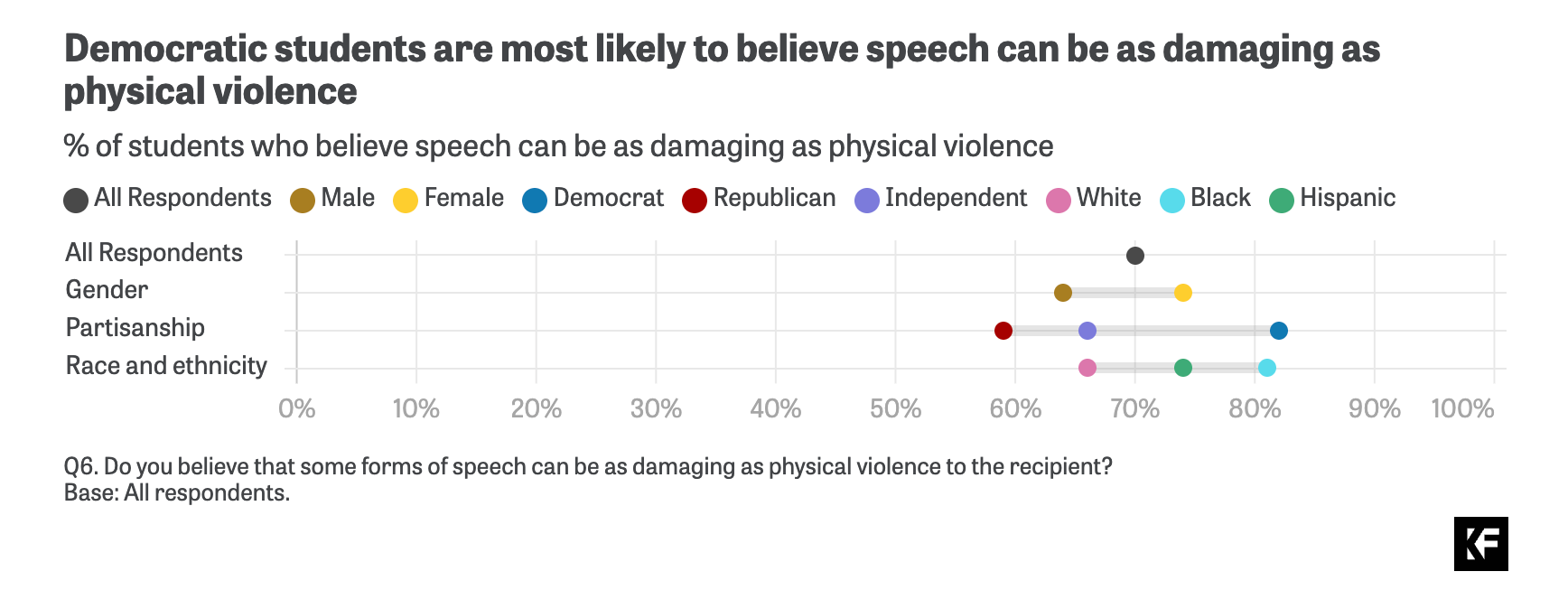
Beset by such treacherous emotional dangers from all sides, students demanded “safe spaces” — havens from which they could be protected from scary ideas. A 2017 poll from the Knight Foundation and Ipsos found that 87 percent of students favored providing safe spaces, defined as “areas of campus designed to be free from threatening actions, ideas, or conversations.” As ripe for ridicule as safe spaces were — and they did become a punchline — the thinking behind them has proven durable. By the end of the woke era, this culture of fragility had indelibly set in. Indeed, data from 2025 shows that 82 percent of left-leaning university students said that “speech can be as damaging as physical violence.”
As safetyism spread and took root in the culture, it became an imperative to make every facet of society “safe” for the sensibilities of educated leftists and their emotionally fragile matrix of overlapping, developmentally arrested neuroticisms. Insecurity demands conformity and continuous affirmation. In practice, this meant the politicization of everything.
Hobbies, fandoms, subcultures, and online communities that were hitherto mostly non-political suddenly found themselves embroiled in social justice activism and controversies. The post-George Floyd racial reckoning hit television particularly hard. From the summer of 2020 through the end of 2022, it seemed there was hardly a television show on air that did not have a “very special episode” — or what we might call a “very special arc” or even whole season — that veered from its established plot, tone, and style, sometimes wildly, to lecture viewers about how racist America was and how oppressed black people were within it. The shift was felt on both sides of the screen. As journalists Peter Kiefer and Peter Savodnik wrote in 2022:
“The result [of the racial reckoning on Hollywood] has not just been a demographic change. It has been an ideological and cultural transformation. We spoke to more than 25 writers, directors, and producers — all of whom identify as liberal, and all of whom described a pervasive fear of running afoul of the new dogma. This was the case not just among the high command at companies like Netflix, Amazon, and Hulu, but at every level of production.
How to survive the revolution? By becoming its most ardent supporter. ‘Best way to defend yourself against the woke is to out-woke everyone, including the woke,’ one writer said.”
Another showrunner told them, “This is all going to end in a giant class-action lawsuit.”
Of course, television was only one domain, and nobody was forced to watch it. There were so many other pastimes to enjoy without being inundated with left-wing activism. One could always read — that is, unless it was something new in the genres of young adult, romance, or fan fiction. Archive of Our Own, known online as AO3, is the largest repository of fan fiction in the world, hosting millions of works and generating annual pageviews in the billions. In 2020, the platform’s progressive users launched a years-long campaign to #EndOTWRacism (referring to the site’s parent company), alleging an epidemic of white supremacy on the platform and demanding that AO3 abandon its famously pro-free expression policies to overhaul its moderation approach and make the site safe for fans of color. Except, these activists could not seem to find many examples.
During those years, simply disagreeing with 2020-style “anti-racism”, or producing content that ran afoul of its strictures was enough to earn the label “white supremacist.” In a lengthy Teen Vogue article in support of the campaign — which likened the problems on AO3 to a bar owner with Nazi patrons and directly scolded readers who disagreed as racists — the clearest instance of “violently racist” content presented was a comment reading: “Diversity consultants are not only wastes of money they are people you pay to create race problems where there weren’t any. Anyone even suggesting they be hired should be driven out of the public square and publicly tarred and feathered.” Still, AO3 capitulated, apologized, and has undergone multiple rounds of site changes to address the concerns of the campaign. Naturally, activists were not satisfied.
Forget reading, what about a good old-fashioned tabletop role-playing game? During the late 2010s and early 2020s, the popular game Dungeons & Dragons, along with its parent company Wizards of the Coast, was mired in their own “racial reckoning” as activists accused the game of propagating racism and bigotry. This led to a cascade of changes culminating in a new revision of the game in 2024 that was widely panned by players.1 It wasn’t just D&D. As a headline in IndigiNews put it: “World of board games faces reckoning for colonial themes.”
Why not just curl up with a nice crossword puzzle then? Because, Americans were told, crosswords were rife with hidden bigotries and the Eurocentric biases of the older white men who wrote and edited them. In response to such critiques, the Times created the New York Times Diverse Crossword Constructor Fellowship in 2022. Surely quilting was a hobby free from politics? You mean that wretched hive of racism and villainy? What about yoga? Culturally appropriative, racist, and in need of decolonization and reorientation to dismantle systems of oppression. CrossFit, then? The workout community and company of the same name underwent its own activist meltdown after its founder criticized the way the George Floyd protests were flouting pandemic quarantine protocols. Denounced as a racist, he apologized but was still forced out of the company he started. Of course, you could always just stay home and work out with a Peloton bike, if creepy sexist dystopias are your sort of thing.2
The list went on and on. Radical politics infiltrated everything from classical music, slammed as white supremacist and “inherently racist”, to genealogy, which, given everything else covered in these archives, was to be expected.
To escape politics, perhaps one just had to go outside. But no, the left-wing activism followed them there, whether they were watching birds, or rock climbing, or even fly fishing — yes, fly fishing. Sports in general, which had long featured a kind of low-grade background conservative politics — complete with troop salutes, jingoistic pomp and pageantry, and jet flyovers — also became more overtly political during this era of cultural progressivism. In 2016, NFL quarterback Colin Kaepernick sat down during the national anthem in protest of police violence. In later games, he switched to kneeling, inspiring thousands of other athletes to do the same in what came to be known as “taking the knee.” In 2017, over 200 players in the NFL alone took the knee in a single day. By the early 2020s, far-left activism had filtered down to youth athletics, and not just when it came to trans issues. One example, as I covered in 2023, was a proposed expansion to Canada’s Greater Toronto Hockey League, an elite youth league that feeds prospects into the NHL pipeline, that would include guaranteed roster spots to racial minority groups.
Even the land itself became politicized. In an uncommon case of the United States importing culture war issues from other countries (in this case, primarily Canada, Australia, and New Zealand), land acknowledgements — statements naming the indigenous tribe(s) that once lived wherever the acknowledgement is being made — caught fire among American progressives and the many domains in which they held influence. Their stated purpose was to recognize the historical harm done to these communities and to serve as a first step to doing better by these peoples’ descendents. In practice, they were almost always empty gestures done for the benefit of the professional-class acknowledgers to signal status and virtue to one another. After all, as happy as progressives were to acknowledge stolen land, they had no intention of giving it back. Graeme Wood’s commentary in a 2021 Atlantic essay is required reading on the subject:
“In David Mamet’s film State and Main, a Hollywood big shot tries to shortchange a set hand by offering him an ‘associate producer’ credit on a movie. A screenwriter overhears the exchange and asks, ‘What’s an ‘associate producer credit’?’ The big shot answers: ‘It’s what you give your secretary instead of a raise.’
The practice of ‘land acknowledgment’ — preceding a fancy event by naming the Indigenous groups whose slaughter and dispossession cleared the land on which the audience’s canapés are about to be served — is one of the greatest associate-producer credits of all time. A land acknowledgment is what you give when you have no intention of giving land. It is like a receipt provided by a highway robber, noting all the jewels and gold coins he has stolen. Maybe it will be useful for an insurance claim? Anyway, you are not getting your jewels back, but now you have documentation.
[...] If you have seen enough of these — I have now watched dozens, sometimes more than one at the same event — you learn to spot them before the speaker even begins acknowledging. In many cases the tone turns solemn and moralizing, and the speaker’s posture stiff, as if preparing to read a confession at gunpoint. One might declare before, say, a corporate sales retreat: We would like to respectfully acknowledge that the land on which we gather to discuss the new line of sprinkler systems is in Mi’kma’ki, the ancestral and unceded territory of the Mi’kmaq. The acknowledgment is almost always a prepared statement, read verbatim, because like all spells it must be spoken precisely for its magic to work. The magic in this case is self-absolution.”
During the late 2010s and early 2020s, land acknowledgements were drafted, adopted, or employed at virtually every level of society. Land acknowledgements were used by localities including Tempe, Phoenix, and Flagstaff, Arizona; Los Angeles County, Sacramento, and San Francisco, California; Denver, Colorado; Chicago, Illinois; Eden Prairie, Minneapolis, and Northfield, Minnesota; New York City, New York; Portland, Oregon; and Philadelphia, Pennsylvania. They were used by state bodies or agencies in Arizona, California, Oregon, and Washington State; by government agencies including NASA, branches of the National Park Service, the US Department of Arts and Culture, and the Library of Congress; and by organizations or events such as the Academy Awards, the Macy’s Thanksgiving Day Parade, the American Civil Liberties Union, the American Library Association, and the 2024 Democratic National Convention.
On college campuses, land acknowledgements became nearly ubiquitous, including at schools such as Arizona State, Colorado State, Columbia, Cornell, Brown, Emory, Harvard, Michigan State, Montclair State, MIT, Northwestern, Oregon State, Penn State, Rutgers, Stanford, UAlbany, UC Davis, UC Merced, Umass Amherst, the University of Connecticut, the University of Delaware, the University of Illinois system, the University of Rhode Island, the University of San Diego, the University of Texas at Arlington, the University of Texas at Austin, the University of Utah, West Virginia University, Yale, and far too many more to list.
Sports, too, were sucked in, with land acknowledgements adopted by professional sports teams including the Chicago Blackhawks, the Buffalo Bills, the Indianapolis Indians, the Montreal Canadiens, the Seattle Kraken, and the Toronto Blue Jays, as well as at events such as the Boston Marathon. In 2023, the NFL even read a land acknowledgement prior to Super Bowl LVII.
From a virtual event held by Microsoft in 2021 that went viral over its land acknowledgement.
Piecemeal attempts to catalogue land acknowledgements have documented scores of additional examples, such as a 2022 study published in the American Education Research Journal that examined 47 university land acknowledgements, and the activist-run website LandAcknowledgement.org, which has a crowdsourced database of more than 150 organizations or events that have issued land acknowledgements.
Almost everyone in left-leaning environments either went along with these rituals or quietly grumbled away from the prying eyes and ears of the social justice stukachi. Those few who openly took issue had to be ready for a fight. In 2022, University of Washington professor Stuart Reges protested the school’s adoption of a land acknowledgement by including a parody version in his winter 2022 syllabus reading, “I acknowledge that by the labor theory of property, the Coast Salish people can claim historical ownership of almost none of the land currently occupied by the University of Washington.” When students complained about feeling “unsafe”, Reges was investigated, disciplined, and warned to watch his behavior moving forward. He sued the university on free speech grounds and won.
Other critiques came from the left. As the National Governance Center noted in 2021, land acknowledgements could be problematic because non-indigenous people may craft them insensitively. However, reaching out to indigenous people and communities for help could also be problematic, as it asks them “to do free emotional labor. [...] Emotional labor is problematic because it’s time consuming and can place additional stress on Indigenous people.”
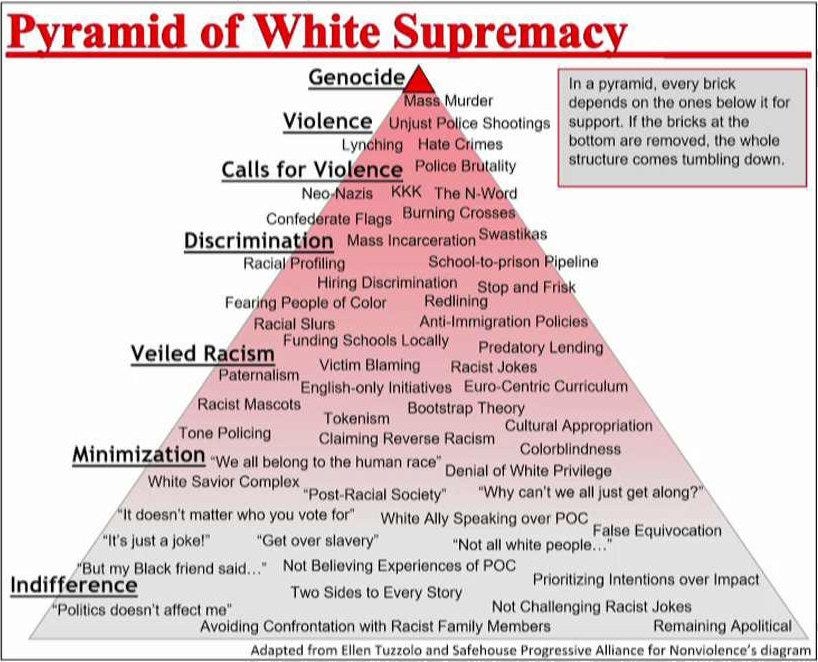
Holdouts in the crusade to politicize every aspect of life had to be shamed and vilified. As such, Americans were told that “white silence was violence” and that standing on the sidelines of the social justice movement’s cultural revolution made one part of the problem. Online and across the institutional landscape, cultural leftists spread various versions of a graphic known as the “Pyramid of White Supremacy”, visualizing the supposed way in which racial discrimination, violence, and even genocide are built atop a base of seemingly benign enabling attitudes and behaviors. On the very foundation of moral defects that lead to racial genocide was “remaining apolitical” and “apolitical beliefs.” This graphic was also used as educational or training material in American high schools, universities, progressive churches, and companies including Google, as well as in the UK to educate Parliamentary staffers.
It was all enough to make anyone reach for a drink — only, social justice controversies roiled the craft beer and wine communities too, complete with all the usual allegations of racism and “confronting demons.”
At a glance, it may be difficult to make sense of these trends without simply concluding that tens of millions of Americans literally lost their minds. But there was a method to the madness — uncoordinated and primarily organic — that shaped the cult of fragility and its effect on society in ways that seem almost inevitable in hindsight. Safetyism, as a psychological phenomenon, an ideological ethos, and an approach to life, was inextricable from the plague of hyper-politicization that swept American culture during the late 2010s and early 2020s. When radical beliefs converge with the perception that anyone who does not share them is a threat to one’s safety, the only logical outcome is, as we have seen, a protracted quest to transform every domain within reach into a safe space for that radicalism. To be sure, safetyism has receded somewhat from its most hysterical peak in 2020 to 2022, but the dynamic it created, whose effects are still felt today, underlies nearly every facet of progressive overreach documented in these archives.
Part XI: Memory-Hole Archive: Identity Worship and Lived Experience
American Dreaming is a reader-supported publication. To receive new posts and support our work, consider becoming a free or paid subscriber.
Subscribe now and never miss a new post. You can also support the work on Patreon. Please consider sharing this article on your social networks, and hit the like button so more people can discover it. You can reach me at @AmericnDreaming on Twitter, @jamie-paul.bsky.social on Bluesky, or at AmericanDreaming08@Gmail.com.
For transparency, I edited the last linked article in this sentence.
This controversy stemmed from a milquetoast 2019 Christmas ad about a husband giving his wife a Peloton bike as a present, which online progressives interpreted as sexist. Under pressure, the company apologized.
Comments
Nothing yet. Say the first thing.
Sign in to join the conversation.