
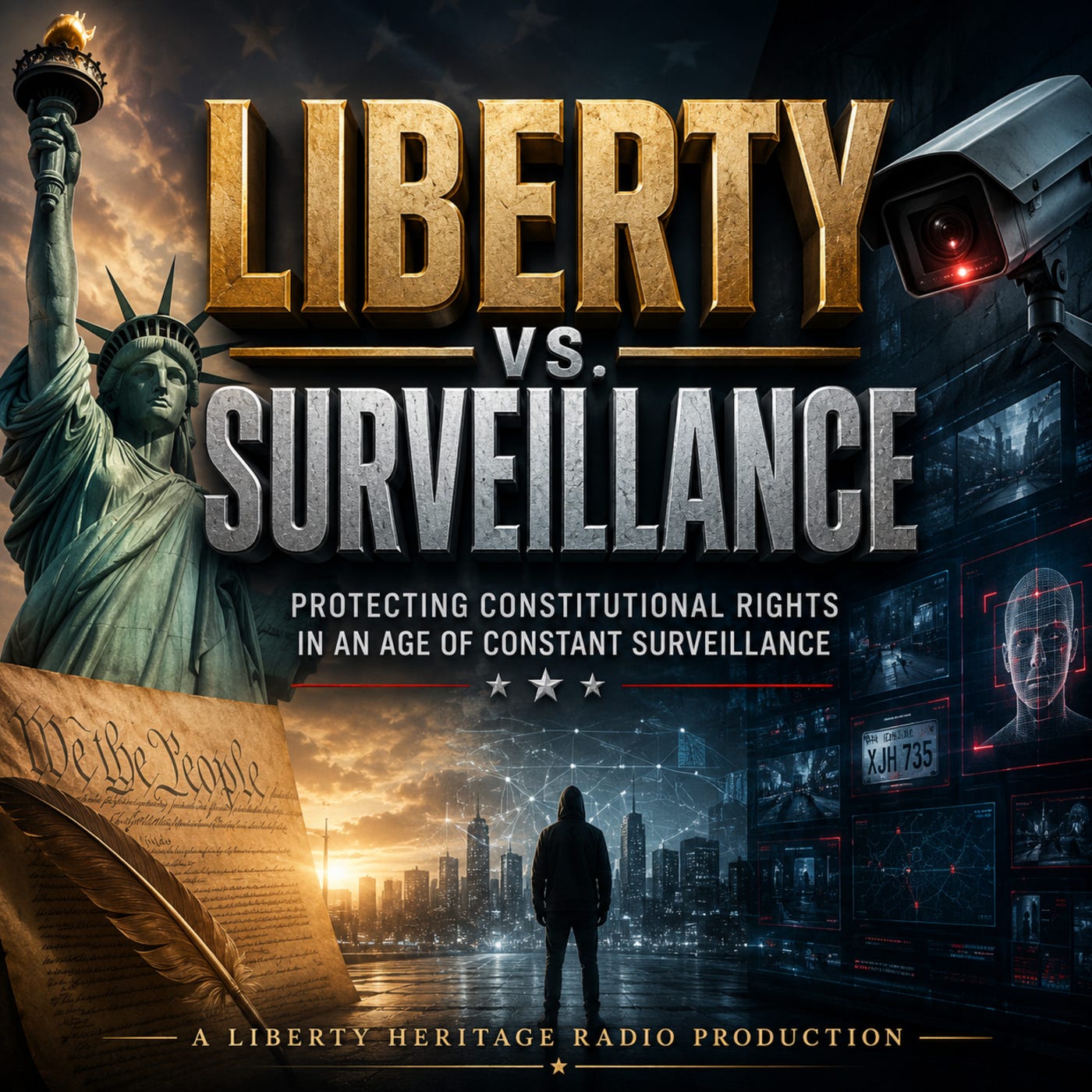
Are advances in artificial intelligence and surveillance technology making America safer, or are they quietly changing the relationship between citizens and their government?
In this special six-part edition of American Considerations, Jason Curtman, a retired police chief, examines one of the most important constitutional debates of our time. From automated license plate readers and artificial intelligence to the Fourth Amendment and personal privacy, this series explores how emerging technologies are reshaping law enforcement while asking whether the rights guaranteed by the Constitution are keeping pace.
Topics discussed include:
The difference between being seen and being systematically tracked.
Why searchable records of a person’s movements raise important constitutional questions.
The Founders’ reasons for including Fourth Amendment protections.
Real-world examples where surveillance technology and camera databases produced false leads involving innocent citizens.
Cases in which law enforcement databases have been misused for personal purposes.
Why constitutional safeguards protect everyone, not just those accused of crimes.
How America can embrace technological innovation without sacrificing its historic commitment to liberty.
This episode is not an argument against law enforcement or responsible technology. Rather, it is a thoughtful discussion about preserving the constitutional balance between public safety and individual freedom in an increasingly connected world.
If you enjoyed this discussion, you’ll want to read Jason Curtman’s book:
Liberty Vs. Surveillance: Artificial Intelligence, the Fourth Amendment, and the Future of Freedom
Available now in Kindle eBook and paperback, this thought-provoking book examines both the remarkable benefits and the potential dangers of modern surveillance technology. It argues that while technology can be an invaluable tool, no advancement should ever automatically outweigh the personal rights, freedoms, and liberties guaranteed by the United States Constitution.
Available on Amazon:
Liberty Vs. Surveillance on Amazon
What happens when technology designed to protect freedom begins testing its limits?
Artificial intelligence, automated license plate readers, cloud-based databases, and nationwide information sharing have transformed modern policing in ways that were unimaginable just a generation ago. These technologies have helped recover stolen vehicles, locate missing persons, identify dangerous criminals, and solve cases that might otherwise have remained unsolved.
But every advance in technology raises an equally important constitutional question.
How much liberty should a free people surrender in the name of security?
Written by former police chief Jason Curtman, Liberty vs. Surveillance is not an attack on law enforcement or technology. It acknowledges the legitimate benefits these systems have provided while asking a question that lies at the heart of the American experiment:
Should any governmental benefit, no matter how worthwhile, ever supersede the constitutional liberties guaranteed to every citizen?
Liberty Vs. Surveillance argues that the answer is no.
Drawing from Supreme Court decisions, historical documents, government records, statutes, public contracts, sworn testimony, company publications, investigative reports, and other primary sources, this book examines the constitutional implications of artificial intelligence, digital surveillance, automated license plate readers, and the rapidly expanding collection of personal data.
Inside, you'll discover:
• How artificial intelligence has transformed automated license plate readers into sophisticated vehicle recognition systems.
• Why the Fourth Amendment was written and why its protections remain just as important today.
• The difference between ordinary public observation and persistent digital surveillance.
• How modern surveillance networks collect, retain, search, and share information.
• The growing role of private companies in managing government surveillance data.
• The constitutional questions courts are only beginning to address as technology advances faster than the law.
This is not a partisan argument. It is a constitutional one.
Rather than appealing to fear or political rhetoric, Liberty vs. Surveillance relies on documented evidence and primary sources to examine one of the most important questions facing America today: whether technological capability should ever become a substitute for constitutional restraint.
Whether you are a law enforcement professional, attorney, judge, legislator, public official, student of constitutional law, or simply an American who values liberty, this book provides a carefully researched examination of the principles that have protected freedom for more than two centuries.
Because once a constitutional liberty is surrendered, history teaches that it is rarely reclaimed without a struggle.
The question is not whether surveillance technology can make us safer.
The question is whether any benefit is worth sacrificing the freedoms the Constitution was written to protect.
Comments
Nothing yet. Say the first thing.
Sign in to join the conversation.