

As we celebrate another Fourth of July holiday this week, it’s worth acknowledging, as I detailed in the previous post, that Americans today enjoy far too little liberty and justice. We have become slaves to our passions and dependent on the capricious decisions of the rich and powerful. In this post we will discuss how we got into this mess. Ironically, it is a consequence of seeking liberty. Unfortunately, we declared our independence from the wrong thing, and chased after the wrong kind of freedom.
A Revolutionary People
America was born out of revolution. We all know the story of overthrowing tyrannical King George and the British. However, to truly understand our nation’s founding, it is important to see the American Revolution in the context of the broader Western cultural rebellion in which the Declaration of Independence was inspired and developed: the overthrow of Medieval Catholic European civilization by Protestantism and Modern Enlightenment Liberalism.
That revolution is primarily known for its focus on tearing down two institutions in the name of liberty: the monarchy and the Catholic Church. As Enlightenment philosopher Denis Diderot famously said, “Man will never be free until the last king is strangled with the entrails of the last priest.” Both the French and American Revolutions were a part of this movement. However, the revolution unleashed by separating from the Catholic Church was never limited to rebellion against kings and priests. Rather, it led directly to the rejection of traditional authority and societal standards of all kinds, including the classic understanding of the family.
For example, in Mary Wollstonecraft’s 1790 work A Vindication of the Rights of Women, she rails against not only the monarchy and the Church, but against the idea of husbands and wives, fathers and mothers. Women shouldn’t be seen as spouses and bearers of children, she argued, they must be understood as humans and citizens of the state first. She believed that family roles were restrictive and that viewing oneself according to various biological functions and genetic relations (such as a mother, father, brother, sister, son, or daughter) was limiting and enslaving in the same way as being the subject of a monarchy. As such, we should abandon those relationships in the name of liberty.
Notice how this view reflects a completely different understanding of the meaning of life as compared to the classical Christian position we have previously discussed. According to Catholicism, the meaning of life is love, and we reflect the image of God as we use our free will to live in proper relationship to others, including being a good husband and wife. We are by nature children of God, as well as potential mothers and fathers of children of God. By living in family we reflect the Trinity, and as such, family is the context in which are most free to live out our natures. Living in family is how we thrive, and breaking up the family leads only to pain and heartache as we lose our freedom and become ruled by our animalistic passions.
Enlightenment liberalism not only rejects this view, but preaches the exact opposite message. According to thinkers such as Thomas Hobbes, John Locke, and Jean-Jacque Rousseau, humans are not, by nature, communal. Rather, the original state of our existence is one of radical individualism, in which each person is basically a free-floating atom, not indebted or duty bound to any other atom. However, because individuals end up fighting with other individuals over limited resources, these theorists argued, people voluntarily enter into contracts with each other in order to survive, and this is the basis for all society and relationships. We both might want a piece of land, for example, but rather than fight and kill each other over who will control the whole field, we make an agreement in which you will grow grain on one side and I’ll raise cattle on the other and we will provide each other some of the crops and meat each side produces. We might even install an arbiter to ensure that this transaction takes place and that you don’t steal my cattle. This is called Social Contract Theory,1 and it is the idea behind the idea that governments “derive their just powers from the consent of the governed,” as the Declaration of Independence put it. In other words, the only reason we would ever enter into relationships with others, including allowing people to rule over us, is if we chose to voluntarily enter into that situation in order to gain some benefit from it. Governments can exist, but only to protect my individual liberty.
Again, this is different from the Medieval Christian understanding of the nature of community and the role of government. As I have written elsewhere, Catholicism teaches that we are by nature social, and families naturally produce clans and tribes and larger societies, and these are all good. Indeed, larger societies, and the leaders that help guide them, are there for our benefit, helping us live out our calling to love God and love each other. Enlightenment liberalism, however, sees government and relationships in general as more of a necessary evil.
This is a key point, because Social Contract Theory provides the justification for not only entering into relationships, then, but also getting out of them in the name of individual liberty. For example, I might think the land sharing agreement and the government I installed to protect it is helpful to me for now, but what if things change and the government itself starts stealing my cattle? Then I am fully within my rights to dissolve the contract and overthrow everyone trying to limit freedom. According to enlightenment thought, if we find ourselves in a relationship that we did not voluntarily enter into, or in which one side of the agreement is abusing their power, then in the name of freedom we may, indeed must, revolt. This was the basis of both the American and French political revolutions.2
A New Definition of Freedom
Notice as well, then, that Enlightenment liberalism developed not only on the basis of a new understanding of human nature and government, but also, as a corollary, on a new understanding of freedom. For a Medieval Christian, liberty was the ability to live the life God created us to live. Just as a free acorn is one which is allowed to grow into an oak tree, free humans are those who can live out their natures as men and women created in the image of God. To be enslaved is to not be allowed to do the good for which we were created.
For Modern man, however, liberty has nothing to do with the good or with being created. It is rather to simply be unrestrained. In this view, freedom is the ability to do whatever I want without hindrance. Any barrier to my desires is seen as an oppressive force that must be thrown off in the name of liberty. Those barriers might be governments and churches that make rules that I don’t like, but it doesn’t stop there. After all, wives, husbands, and children also put demands on me, as do many forms of traditional morality, especially regarding sex. Therefore, to be truly free, I may need to throw them off as well. Enlightenment philosopher Charles Fourier argued, for example, that the greatest freedom among men will come from giving full reign to our passions, especially passionate attraction.
Which leads us back to the story of Mary Wollstonecraft. She ran with a crowd that included anarchist philosopher William Godwin and famous revolutionary war pamphleteer Thomas Paine. Godwin, with whom Wollstonecraft had an affair and became pregnant, taught that marriage was wrong because it made the woman a “possession” of a man and “enslaved” male sexuality. Although he did eventually marry Wollstonecraft for a short time before she died, Godwin represents the beginning of what would become known as the “Free Love” movement. He carried on affairs and had illegitimate children throughout his life, living out his axiom that to submit to monogamy would be going against liberty.
The Free Love movement of the time had another famous advocate in poet Percy Shelly. His exploits included seducing Wollstonecraft and Godwin’s 16-year-old daughter, Mary, as well as her stepsister Claire. Both girls ran off with the poet, who abandoned his pregnant wife to carry on the affairs. Mary eventually married Shelley and became famous as the author of Frankenstein. Claire eventually ran off with another famous poet and free love advocate, Lord Byron, bearing a daughter with him who died after Byron refused to care for the child. If that sounds like the plot of a poorly written soap-opera, well, you may be right, but it also happens to be history. Percy Shelley and Lord Byron are celebrated as two of greatest poets in British history, but they were two of the worst men, narcissists who left a trail of broken lives in their wake. Claire wrote, “under the influence of the doctrine of free love I saw the first two poets of England…become monsters of meanness, cruelty, treachery – under the influence of free love Lord B became a human tiger slaking his thirst for inflicting pain upon defenseless women who under the influence of free love loved him.”
And it was all done in the name of revolution and freedom! The cads saw themselves as courageously standing strong against the tyrannical dictates of tradition and blazing the way toward a libertarian utopia that was the very opposite of Christian.
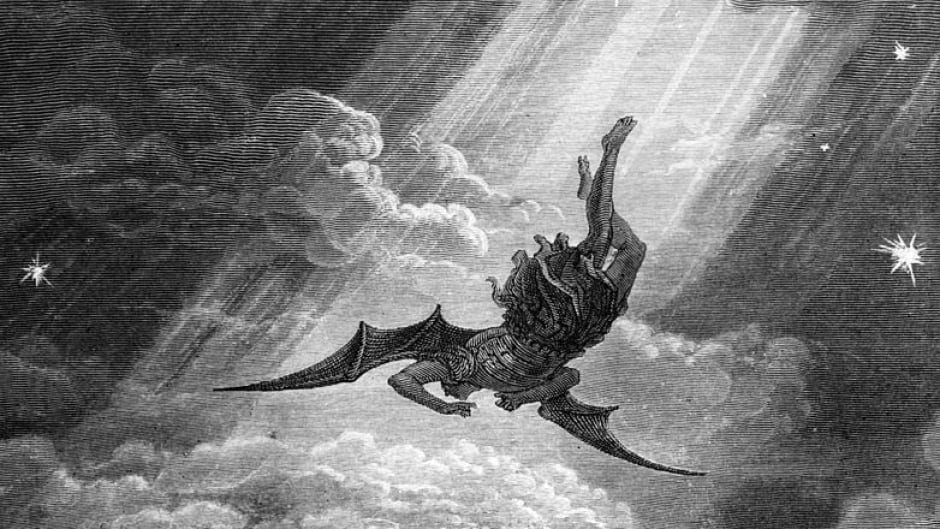
Godwin and Shelly were especially clear about this in their commentary of John Milton’s Paradise Lost. Rather than interpret that epic poem about Adam and Eve and the fall of mankind in the traditional sense, both men made Satan the revolutionary hero. “Nothing can exceed the grandeur and the energy of the character of the Devil as expressed in Paradise Lost,” Shelley wrote, noting that Satan is the source of passion and creativity in the story, while God represents hierarchy and authoritarianism. Telling Eve to turn her back on God was bravely calling her to freedom, according to Shelly. In a later poem, The Revolt of Islam, he explicitly makes Satan the liberator of women through his heroine Cyntha, an earthy messenger of the Devil who defies gender roles and overthrows the male hierarchy. He explained that he wrote to poem “in the view of kindling in my readers a virtuous enthusiasm for… doctrines of liberty and justice,” and to create a counter-myth to the hegemonic story of Christianity. Shelly saw himself (and Satan) as offering a new future for women in which there would be no sex distinctions and being female would have no connection to marriage or motherhood.
Shelley’s diabolical vision has largely been realized in contemporary America. We have broken down every roadblock to “liberty” that stood in our way, from religion to the family to now even the body. What the libertarian thinkers failed to acknowledge, though, is that allowing your passions full reign does not make one free, it makes one a slave. As Edmund Burke wrote at the time in opposing the revolutionary spirit of people like Wollstonecraft, “It is ordained in the eternal constitution of things, that men of intemperate minds cannot be free. Their passions forge their fetters.” In the name of liberty we have given ourselves over to our passions and become enslaved to “shameful lusts” (Romans 1:26). This has opened the door to all kinds of injustice, a problem which Protestantism was not only unable to adequately address, but ultimately made worse.
Our only hope is to repent and return to the path modernism so foolishly abandoned. True liberty and justice demand it.
[If you are interested in creatively addressing our cultural moment, please consider supporting my new television series Libertyville. It is a contemporary take on the Sodom and Gomorrah story and we are very close to being able to shoot the pilot, but we could really use your help. Learn more here and here.]
Thank you for reading American Babylon. This post is public so feel free to share it.
Social Contract theorists differed in the details of their overall philosophy, but the individualistic nature of the idea is consistent throughout.
There is an ongoing debate among historians about where the founding fathers stood on the scale from “Medieval Catholic” to “Modern Atheist Liberal.” None were Catholic or Atheist, so most scholars can at least agree that they were all somewhere in the Protestant / Deist / Enlightenment Liberal middle ground; the debate is generally over how many of classic Medieval sensibilities they held on to, and how clearly they foresaw or desired the modern liberal state. However, for our purposes, it really doesn’t matter what the founders foresaw or desired. I simply want to look at what happened. Because that, it seems to me, is largely beyond dispute: America now primarily lives according to Enlightenment ideas, many of which, as we will see throughout this series, are diabolically anti-Christian.
Comments
Nothing yet. Say the first thing.
Sign in to join the conversation.