
The Pile
Every discipline keeps a drawer it does not open in mixed company. Astronomy has one, medicine has one, psychology has a filing cabinet. Into the drawer go the reports that were made by sober people, recorded by working instruments, and filed by professionals who would rather have filed anything else. The drawer is not labeled false. Nobody has done the work that label would require. The drawer is labeled inconvenient, and the two labels are treated as synonyms by everyone who has never looked inside.
A century ago a clerk in the Bronx spent twenty-seven years in the reading rooms of two continents copying such items out of the scientific journals that had published and then disowned them. He called what he collected the damned, by which he meant the excluded, and his method was the only original thing about him: he refused to consider the items one at a time. One at a time, each can be argued to death. Any single wonder can be traded away for a swamp gas, a hysteria, a hoax, and the trade always feels reasonable, because the improbability of the wonder is certain while the improbability of the explanation is only suspected.
This essay declines the one-at-a-time game entirely. It will not rest on any case. It will rest on the shape of the pile, because the pile has a shape, and the shape has one feature so consistent across ten thousand years, six continents, and every category of the impossible that it amounts to a signature.
The feature is this: the evidence always almost arrives.
Not fails to arrive. Almost arrives. There is a difference between the two as wide as the difference between a debtor who never earns and a debtor who earns handsomely and stops paying at ninety-nine cents on every dollar, forever, without once slipping into a full dollar by accident. The first man is poor. The second man is doing something.
What follows is an audit. First the inventory, so the reader unfamiliar with the drawer knows what is in it. Then the behavior the whole inventory shares. Then the arithmetic of that behavior, taken in five movements. Then the motive the arithmetic suggests. Then the objections, taken in order, and a verdict.
The Inventory
Open the drawer.
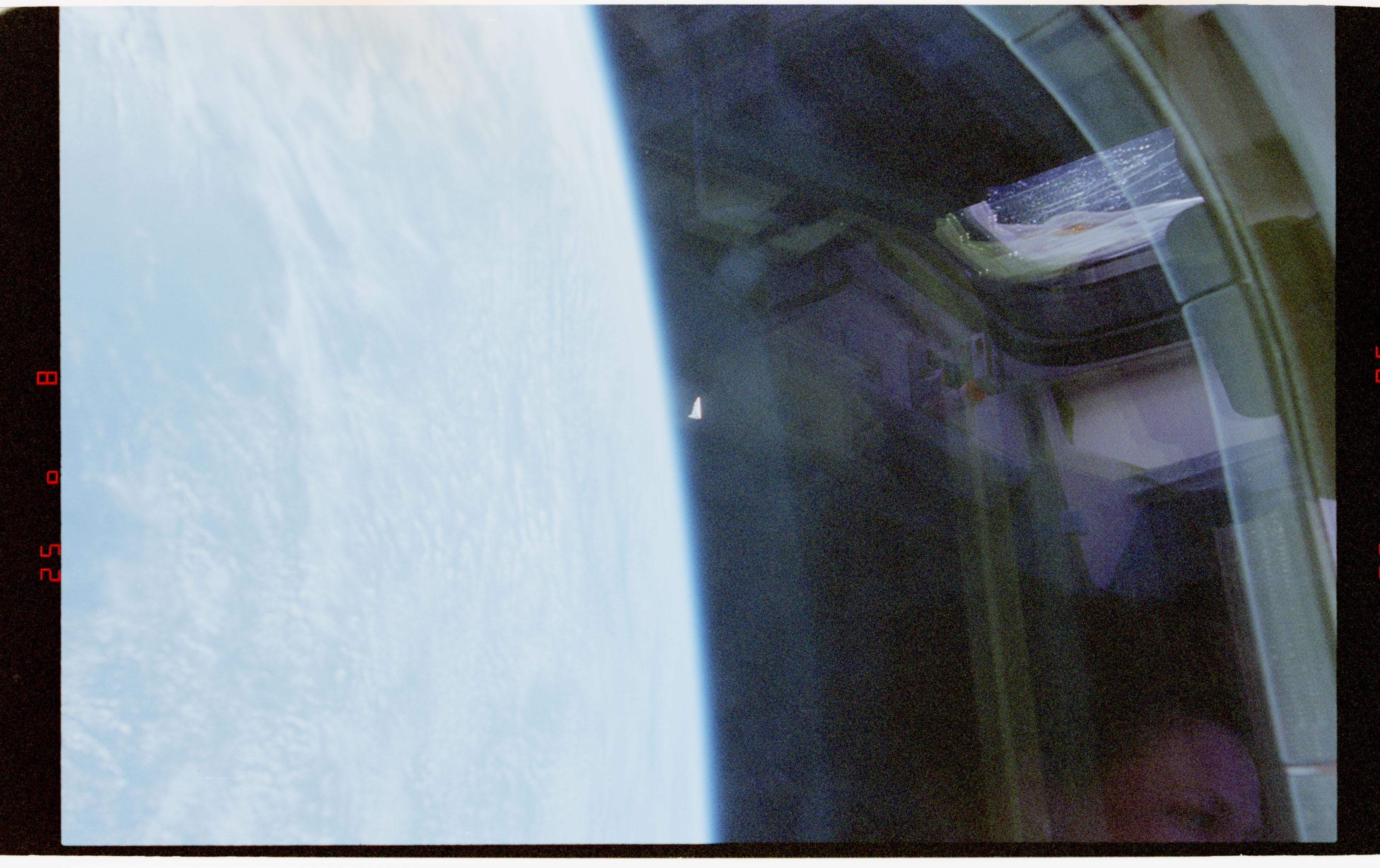
The sky. In 1896 and 1897, newspapers across America carried witness accounts of airships years before anyone could build one. In 1944, Allied aircrews over Europe and the Pacific reported luminous spheres pacing their bombers; each side assumed the objects belonged to the other, and both sides were wrong. In 1946, some two thousand reports of “ghost rockets” crossed Scandinavia, worrying two governments into classified inquiries. In June of 1947 a private pilot named Kenneth Arnold watched nine objects cross the face of Mount Rainier and told a reporter they moved the way a saucer skips on water. He was describing the motion. The press assigned the description to the shape, and the flying saucer was born of a misquote, which is the kind of joke this subject never stops telling.
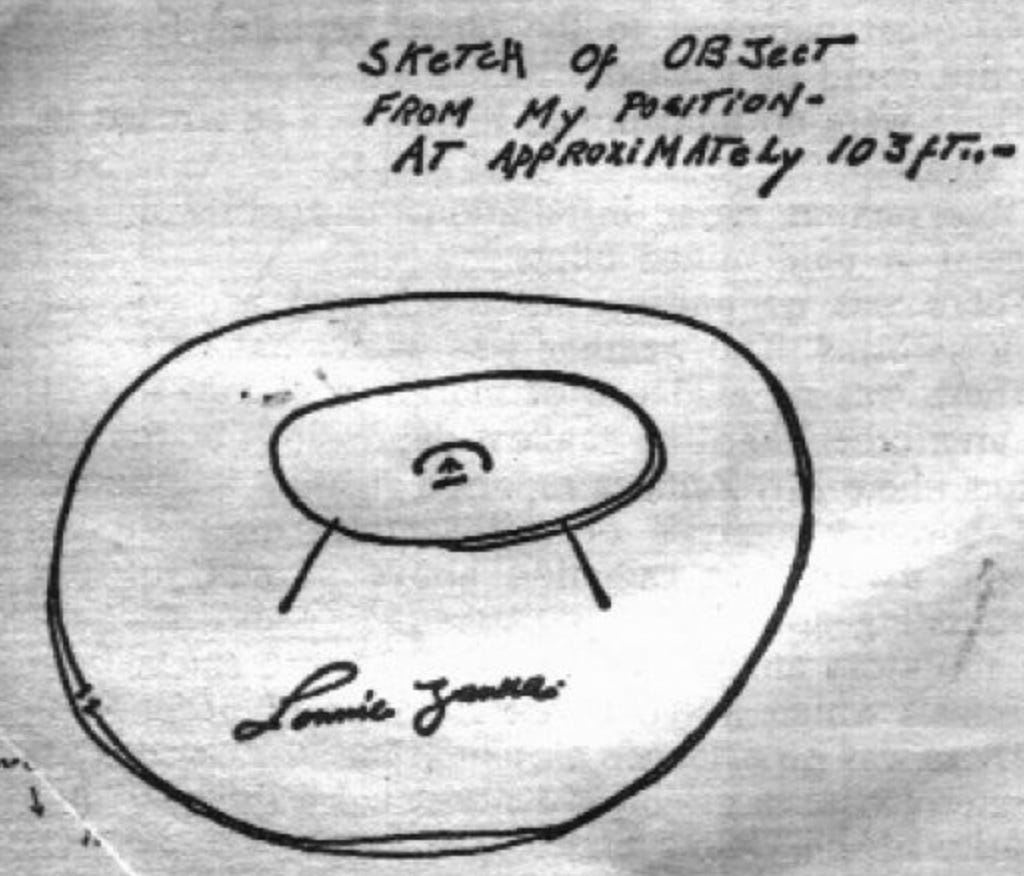
In July 1952, radar at Washington National Airport tracked unknown returns over the capital on two consecutive weekends. Jets were scrambled; the returns faded as the jets closed and returned when they left; the Air Force held its largest press conference since the Second World War to say the word inversion many times. In November 1957, around Levelland, Texas, a night’s worth of independent motorists called the sheriff to report the same thing: a glowing object, engines dying, headlights failing, both reviving the moment the light departed. In April 1964, a police officer named Lonnie Zamora, chasing a speeder outside Socorro, New Mexico, instead found an egg-shaped craft in a gully, watched it leave, and led investigators back to landing impressions and brush that was still burning. The Air Force’s own project chief called it the best-documented case in his files, and it remains unexplained in them.
In September 1976, two Iranian F-4 interceptors closed on a brilliant object over Tehran, and each in turn lost instruments and weapons control precisely when closing, recovering precisely when breaking off; the American defense-intelligence assessment that followed praised the case’s completeness in language agencies do not usually spend. In December 1980, over two nights beside the twin NATO bases at Bentwaters and Woodbridge, American servicemen tracked lights and an object through Rendlesham Forest; the deputy base commander narrated one pursuit into a handheld recorder as it happened and then summarized events in a memorandum on official letterhead, which is more paperwork than most miracles ever file. That same month, on a Texas farm road, Betty Cash, Vickie Landrum, and Landrum’s young grandson stopped beneath a diamond of fire attended by a swarm of military helicopters; Cash spent weeks afterward with burns, hair loss, and an illness her doctors described in the vocabulary of radiation exposure. The family sued the government, and the case was dismissed on the government’s assurance that it owned no such craft; the injury documented, the cause officially nonexistent.
In January 1981, on a terraced farm at Trans-en-Provence, a retired mason watched an object land and leave, and the French space agency’s field unit, because France assigned this drawer to its space agency staffed with scientists, found compacted, heated soil and chlorophyll degradation in the surrounding alfalfa that weakened with distance from the trace. In 1989 and 1990, thousands of Belgians, gendarmes among them, reported a silent triangle; the Belgian Air Force scrambled F-16s whose radars locked and lost the target through accelerations no airframe survives, and the general staff held a press conference to say, in effect, that something had flown over Belgium and it was not theirs to name. In November 2004, off the California coast, the carrier Princeton‘s radar spent days tracking objects dropping from high altitude to the sea in seconds; two Navy pilots, Commander David Fravor and Lieutenant Commander Alex Dietrich, were vectored onto a white object the size of their fighters that mirrored them, cut inside their turn, and vanished, reappearing moments later at their classified rendezvous point sixty miles away, as if it had read the briefing. A second flight recorded it on infrared. And in June 2021, the Office of the Director of National Intelligence reported to Congress on 144 military encounters gathered over seventeen years: eighty registered on multiple sensor systems, and the government of the most heavily instrumented nation in history explained exactly one, a deflating balloon.
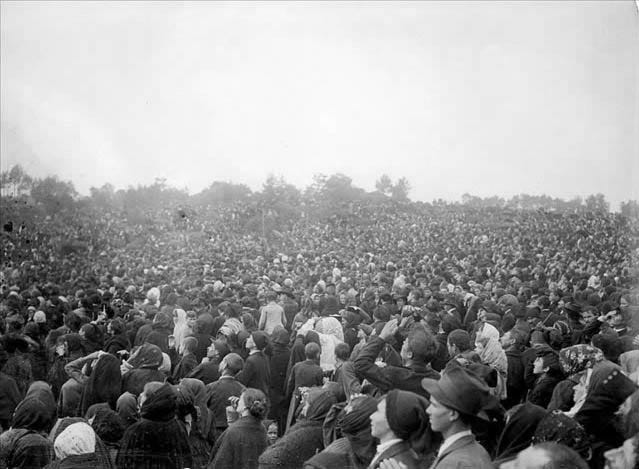
The shrine. In 1531, on a hill outside Mexico City, an image appeared on the agave-fiber cloak of an indigenous convert; such fabric goes to dust in decades, and the cloak has not, through four centuries of candle smoke, floodwater, and, in 1921, a bomb concealed in flowers at its altar that mangled the church’s iron and marble and left the cloth untouched. At Lourdes after 1858, the Church did what its critics demand and built a medical bureau staffed by physicians of any faith or none to disqualify cures; of the more than seven thousand claims brought to it, it has allowed seventy to stand — a rejection rate of ninety-nine percent that constitutes, depending on the reader, either an embarrassment or the most rigorous positive residue in medicine. One of its examiners, a young surgeon named Alexis Carrel, watched a patient dying of tubercular peritonitis, her abdomen distended with fluid, flatten and recover under his eyes at the grotto in 1902; the account cost him his French career, and he took his scalpel to America, where he won the Nobel Prize. In October 1917, at Fátima in Portugal, a crowd of tens of thousands, secular journalists and mocking editors among them, watched the sun spin, throw color, and appear to fall, precisely at the hour three shepherd children had named a month in advance, in rain-soaked fields that witnesses swore dried in minutes. No observatory on Earth recorded a solar anomaly. The sky performed for fifty thousand pairs of eyes and zero instruments, which the reader is asked to hold onto, because it is the entire pattern written at the largest scale we possess.
For years beginning in 1968, luminous figures appeared over the domes of a Coptic church in Zeitoun, Cairo, witnessed by crowds of Muslims and Christians together, photographed, and never traced to any projector by the police who searched for one. And on a single day in September 1995, statues of Ganesha in Delhi began accepting spoonfuls of milk, and by nightfall — by telephone and evening news, before anything went viral because nothing yet could — statues were accepting milk in London, Nairobi, and New Jersey, and by the next day, almost nowhere. Capillary action explains a wet statue. It does not explain a planet-wide synchronized appetite with a start time and a stop time.
The laboratory. In 1882, a group including a Cambridge professor of philosophy founded the Society for Psychical Research on the premise that the drawer deserved method rather than mockery. Their first fruits were serious: Phantasms of the Living, seven hundred investigated cases of apparitions coinciding with a distant death, and a Census of Hallucinations that put the question to seventeen thousand people and found the coincidences exceeding chance by margins no one has dissolved, only ignored. A century later the ganzfeld telepathy experiments produced hit rates near thirty-two percent where chance dictates twenty-five; the field’s chief skeptic and chief experimenter published a joint communiqué agreeing on tightened protocols, the tightened protocols produced the effect again, and the result appeared in mainstream psychology’s own Psychological Bulletin in 1994, where it sits like an unexploded shell no one wants to step on. For two decades ending in 1995, the United States government paid roughly twenty million dollars for remote-viewing intelligence; when the program was declassified and reviewed, the statistician on the review panel, later president of the American Statistical Association, concluded the effect was real by the standards used everywhere else in science, the skeptic on the panel conceded the numbers could not be dismissed as chance while declining to name their cause, and the program was closed anyway, which tells you what institutions do with ninety-nine cents.
Then, in 2011, a Cornell professor published nine experiments on a thousand subjects suggesting responses to stimuli that had not yet occurred in the field’s flagship journal, using the field’s standard methods. Psychology reacted with proper horror, replications failed, and the flagship journal initially declined to publish the failed replication on the stated ground that it does not publish replications. The scandal helped ignite the discipline’s reckoning, in which large collaborative efforts found that roughly two-thirds of mainstream psychology’s published findings would not replicate either. The mocked precognition had reproduced about as well as the mockers.
The house. In a lawyer’s office in Rosenheim, Bavaria, in 1967, lamps swung, drawers opened, and the telephone system logged calls to the speaking clock placed faster than fingers can dial. The power company installed recorders that registered massive surges with no electrical cause; the case drew not only a parapsychologist but two physicists from a Max Planck Institute, who documented deflections their instruments said were real and their physics said were impossible. The effects centered on a nineteen-year-old clerk, followed her when she left, and ended. At Enfield, north London, a decade later, among the contested clatter of England’s most famous haunting, a police constable signed a formal statement that she had watched a chair slide across the floor with no one near it; an officer of the court, putting her name to the drawer.
The threshold. In 1991, a woman named Pam Reynolds underwent a surgery that required her body chilled, her heart stopped, her blood drained from her head, and her ears sealed with speakers emitting continuous clicks to confirm her brainstem had nothing to say. She awoke reporting the conversation in the operating room and the appearance of the bone saw. These details were confirmed by the surgical team, gathered during a window when the monitors registered no one home. In 2014, a peer-reviewed hospital study of cardiac arrest published the case of a man who accurately described the personnel and the automated defibrillator’s commands from a window roughly three minutes into his own flatline, when consciousness has no business keeping minutes.
The old country. Around the year 815, the archbishop of Lyon wrote a tract complaining that his flock believed in ships that sailed the clouds from a country called Magonia, and reported that a mob had produced four persons said to have fallen from one, whom the archbishop had to rescue from stoning. Roman priests kept official lists of prodigies: shields in the sky, phantom armies, globes of light descending on the standards. The fairy lore of Ireland and Brittany, collected by an Oxford ethnographer in 1911, describes abductions, lost time, and small potent beings with an inordinate interest in human reproduction — a dossier that maps onto the modern abduction literature so cleanly that a computer scientist named Jacques Vallée built a career on the overlap. In 1961, Betty and Barney Hill lost two hours on a New Hampshire road and recovered, under separate hypnosis, matching accounts, including a star map that an amateur astronomer later modeled onto a real neighborhood of nearby stars; an identification the reader may weigh as loosely as it deserves while noting that it exists. In 1973, two Mississippi shipyard workers, left alone in an interview room with a hidden tape recorder, went on being terrified with no audience they knew of, which is not how hoaxers spend their privacy. In 1975, an Arizona logging crew of seven watched a beam of light take Travis Walton; the six who fled were polygraphed on suspicion of his murder, five passed, one came back inconclusive, and Walton reappeared five days later, to be disbelieved for the rest of his life by everyone who was not there.
Close the drawer. That is a fraction of a fraction of it, and it is already too much for one lifetime of explaining away.
The Common Behavior
Now stand back from the pile and ask what everything in it is doing.
Notice first what the witness receives. The motorist at Levelland gets a dead engine and a light like a second sunrise. Betty Cash gets blisters. The Navy pilot gets an object playing with him inside his own turn circle. Carrel gets a dying abdomen flattening under his hand. The witness receives the full payload, an experience of such wattage that it reorganizes the rest of a life around itself. Read the interviews across a century and the same sentence keeps surfacing in different mouths: I know what I saw. The certainty of witnesses is not the weak point of this literature. It is the most replicated result in it.

Now notice what the institution receives. A radar return that fades on intercept. A film with an arguable artifact. A cure the bureau can call spontaneous remission if it says the words quickly. A hit rate of thirty-two percent where twenty-five is chance; enough to defy the null hypothesis, never enough to power a machine. A memorandum, a polygraph, a burned bush, a signed statement from a constable. Always evidence. Never the evidence.
And notice the two guards posted at the drawer. The first is absurdity: the phenomena reliably include some detail that ruins the dignity of the report, the impossible craft that needs a landing leg, the majestic being with a ridiculous errand, as if calibrated less to defeat investigation than to defeat retelling. The second is the laugh itself. No documents need shredding, no witnesses need silencing, when a culture can be relied upon to giggle. Ridicule is the cheapest classification system ever deployed, and unlike a cover-up it cannot be exposed, because it has no author to catch.
Put it together and the pile’s one universal behavior stands out like a seam of ore. In every drawer — sky, shrine, laboratory, house, deathbed, folklore — the evidence climbs toward the threshold of proof and stops. Not at random heights. At that height. Every category, every century, every level of instrumentation: maximal experience for the person, terminal ambiguity for the species.
Call it what it is. The perfect miss.
The remainder of this essay is an audit of the miss and its statistics, its history, its precision, and its price, because the miss examined closely turns out to be the most damning exhibit in the whole archive. The believers have been arguing from the hits. The real argument was hiding in the misses all along.
The Missing Tail
Begin with a fact about randomness: it has tails.
Take any genuinely noisy ensemble — misidentifications, hallucinations, hoaxes, rare atmospheric physics, all of it stirred together across ten thousand years — and its outcomes will spread. Most cases weak, many middling, a few strong, and, given enough trials, a handful of freaks far out on the tail: the hoaxer who is also a genius and gets the lighting right, the atmospheric fluke that parks over a observatory, the once-a-millennium coincidence that produces, by pure accident, one clean, multiply-instrumented, undeniable capture. Chance is clumsy, and clumsiness cuts both ways. Noise does not only fail to clear the bar. Occasionally, stupidly, it clears it by accident.
Our archive has no tail. Millions of reports, thousands of instrumented encounters, and the strong end of the distribution stops at the same altitude every time: compelling. Never conclusive. The distribution rises toward the threshold and then falls off a cliff, as if the upper tail had been sheared away with tin snips.
Statisticians have a term for a dataset that behaves this way. They call it censored, and the term is chosen well, because when a measured variable never exceeds a limit across thousands of independent trials, the statistician’s conclusion is never that the tail does not exist. It is that something is removing it.
Engineers have a blunter word. Put a signal through a limiter and watch it on a scope: the waveform rises, kisses a fixed value, and runs flat. The shape is called clipping, and it is among the first pathologies an engineer learns to recognize, because it is the signature of a limit imposed rather than encountered. Nature makes curves. Policies make plateaus.
During the Second World War, the statistician Abraham Wald was asked where to armor bombers, given maps of where returning aircraft were shot full of holes. He armored where the holes were not, because the bombers hit in those places were the ones that never came home. The missing holes were the finding. Our archive is Wald’s problem inverted: ten thousand years of aircraft that came home riddled everywhere except the one place that would have brought the question down for good. The case that never lands is the datum.
A single failure is bad luck. A failure rate is a distribution. But a failure rate of exactly one hundred percent, maintained across every category and every century, at a threshold that (as we shall see) will not even hold still is not a rate. A reliable decline is a behavior, a behavior that reliable is a decision, and a decision requires someone deciding.
The skeptic will want to answer that the impossible never crosses the line for the excellent reason that the impossible is not there. It is a fair answer, and it is testable, because history has run the control group for us.
The Control Group
Here is a question almost never asked in these debates: what do real things do while they are being laughed at?
We know, because science has laughed at a respectable number of real things, and their case files are public.
For most of the eighteenth century, the learned consensus held that stones do not fall from the sky, and peasant testimony to the contrary was filed under superstition; when the physicist Ernst Chladni argued otherwise in 1794, he was mocked by better men. Then, on an April afternoon in 1803, the sky dropped roughly three thousand stones on the town of L’Aigle in Normandy, the Academy sent the young physicist Jean-Baptiste Biot, his report left no room to stand in, and the argument was over. The stones had been falling all along. They fell anyway.
When the platypus reached London in 1799, the naturalist George Shaw took scissors to the pelt looking for the stitches, on the sound reasoning that a duck-billed, egg-laying mammal was obviously a taxidermist’s prank. The stitches were not found because the animal was not a joke. The okapi was an African rumor until 1901, when a skin and skulls arrived and the rumor got a genus. The mountain gorilla was native exaggeration until 1902, when a German officer shot two and exaggeration acquired a type specimen. The coelacanth had been extinct for sixty-five million years until December 1938, when one came up in a South African trawl net and had to be subtracted from the fossil record’s certainties. The giant squid was a sailor’s monster for centuries until Japanese researchers photographed a living one in 2004 and filmed one in its own darkness in 2012.
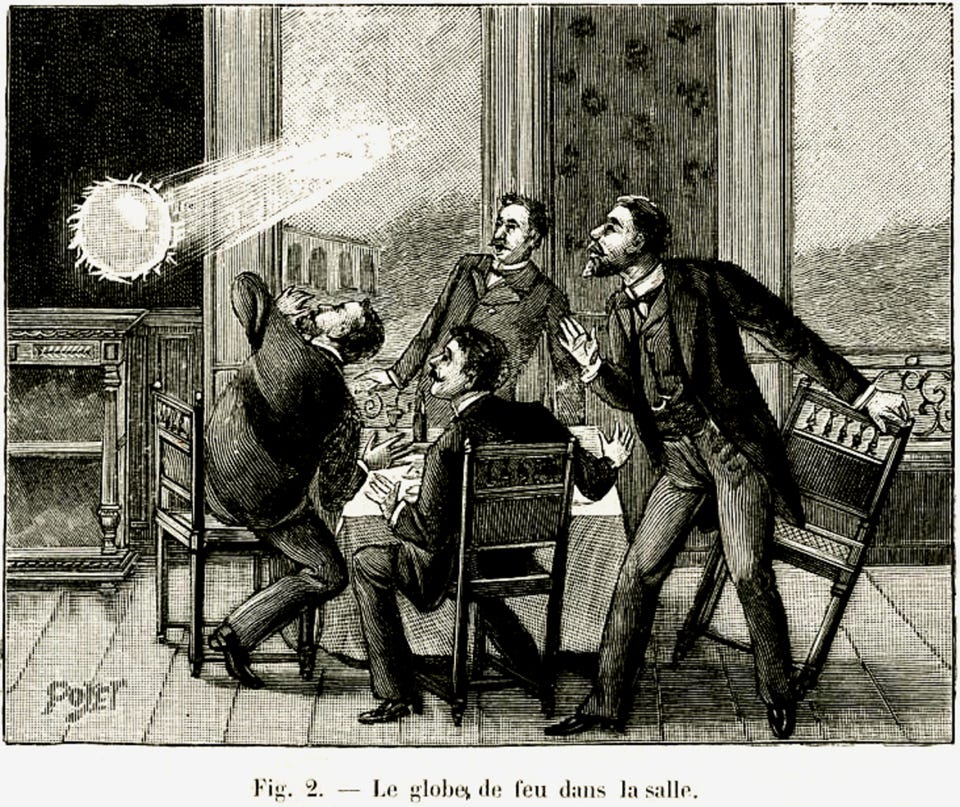
Sailors also spent three hundred years reporting freak waves the size of office buildings, and spent those centuries being told the sea-state equations forbade them, until New Year’s Day of 1995, when a laser altimeter on the Draupner gas platform in the North Sea measured a single twenty-six-meter wall of water, and one second of instrument data ended three centuries of drowned testimony. Generations of pilots reported vast flashes above thunderstorms and were advised to rest; in 1989 a low-light camera pointed at the night sky for other reasons caught one, and the flashes are now called sprites and have a literature. Ball lightning was a folk tale with a physics problem until 2014, when Chinese researchers recording ordinary lightning strikes with spectrographs caught a luminous ball by accident and read its spectrum: silicon, iron, calcium. Soil. The folk tale had a chemistry.
This is the natural history of the dismissed-but-real, and it has the regularity of a law. A long age of testimony and laughter; then a single capture — one stone-fall with a good witness, one second of laser data, one lucky camera; then the textbooks, without apology. Note two things about this pattern. First, the crossing does not require the phenomenon’s cooperation, only its existence: rogue waves were not trying to be measured, they merely could not help eventually intersecting an instrument. Second, each crossed as itself. The claim “stones fall from the sky” was vindicated as stated, not explained away into something else. Real things do not negotiate their category on the way in.
Now run the arithmetic on our phenomenon. It has been reported continuously for the whole of recorded history. It appears, on the testimony, at close range, at low speed, over cities, beside highways, above crowds, in front of policemen, pilots, and physicians. The attempts to capture it are not rare; they are the whole history of watching, lately multiplied by a civilization that carries a camera in every pocket and rings the planet with sensors built to notice anything warmer, faster, or stranger than a goose. Assign the capture-per-encounter probability any honest value you like, make it insultingly small, and multiply it across a century of instrument-hours and ten millennia of events. The expected number of clean crossings is not one. It is a crowd.
The observed number is zero.
And zero, here, is not a shortfall. A shortfall is a small number where a large one was expected, and small numbers happen. Zero across that many trials is not a small number. It is a policy. The one resident of the damned with the most encounters, the most witnesses, and the most instruments pointed at it is the only resident that has never once, in ten thousand years, done what every real-but-ridiculed thing in history eventually did by accident.
Meteors crossed. Waves crossed. Squid crossed. This does not cross. And the refusal is not even a refusal to be recorded, the 2021 report counted eighty encounters on multiple sensor systems. It crosses every bar except the last one. It will be radar and infrared and four aviators under oath; it will be anything except sufficient. A phenomenon that merely lacked substance could not perform that discrimination. Performing it requires knowing where the last bar is.
Which raises the question of where the last bar has been over time. Follow it, and the case turns a corner.
The Moving Ceiling
If the miss were a fixed physical ceiling with some energy limit, some perceptual quirk, it would hold still while our instruments rose to meet it, and the gap would close on a schedule. Instrumentation has improved by something like six orders of magnitude since the age of testimony. The gap has not closed by an inch.
Trace the ladder. In 1531, proof meant a relic, and the age got one: a cloth that outlives its own fibers and even its own bombing, yet whose origin resolves, under four centuries of examination, to exactly unresolved. Physical enough to venerate, never physical enough to close the file. In 1917, proof meant the testimony of crowds, and the sky staged its performance for the largest audience ever assembled for a scheduled miracle and for no instrument anywhere. In 1952, proof meant radar and gun cameras, and the returns painted the scopes of the capital for two weekends and faded whenever an armed camera closed to range. In 2004, proof meant military infrared, and the object gave the infrared a performance whose every frame sustains a debate about glare and gimbal artifacts; the sensor age answered in the sensor’s own dialect of ambiguity. By 2021, proof meant fused data from the most instrumented military in history, and the most instrumented military in history submitted 144 files stamped, in effect, insufficient.
At every rung, the phenomenon has delivered evidence pitched precisely to the era’s second-best standard. Always one grade below whatever would have compelled. For four hundred years of exploding instrumental capability, the ceiling has climbed at exactly the rate of the sensorium, holding a constant distance above the outstretched hand. And a constant distance in a changing field is not a property of an object. It is a pursuit. Stationary things get caught by rising instruments. This is being kept uncaught, which is a different condition entirely, the way a horizon differs from a wall.
Now ask the sharpest question in this essay: what variable, exactly, is being held constant?
Not brightness; Fátima was blinding and Rendlesham was a glow among trees. Not duration; Zeitoun ran for years, Levelland for minutes, the tic-tac for seconds. Not size, altitude, or audacity; all of these swing wildly across the archive. Strip away everything that varies and one quantity remains fixed at its setpoint in every case: the terminal state of conviction. Overwhelming in the witness, insufficient in the institution. The regulated variable is persuasiveness.
And persuasiveness is not a physical quantity. It has no meter in the sky. It is measured in exactly one place in the universe: inside a human skull, and, at the institutional level, inside a committee of them. Here basic control theory closes the trap, because a controller can regulate only a variable it can read, and this variable can be read only in us. A loop that holds persuasiveness at setpoint must therefore include human judgment inside the loop; sampling the audience, continuously, and adjusting the display against the reading. We have been assuming we are the observers of the phenomenon. The regulation says otherwise. We are the sensor in its circuit.
Vallée saw this forty years ago and called the phenomenon a control system, a thermostat for belief, and then history kept adding data to his side of the ledger. What he intuited can now be stated as an engineering diagram in words: display, audience, reading, correction. Any control-room engineer knows the signature at a glance, because it is the least mysterious thing in her world. Watch a megawatt trace on an interconnection feed some hot afternoon: the machine behind it capable of more, the market screaming for more, and the line lying flat at the permitted number for six hours, to the decimal. No one at the desk concludes the machine is shy.
A held number is a written number. Somewhere, in whatever passes for the paperwork of such things, this limit has an author.
The Calibrated Dose
The regulation is finer than a single ceiling, because the dose is mixed per audience, and the two prescriptions run in opposite directions.
To the person: everything. Enough energy to blister Betty Cash’s skin and take her hair but never enough to move her judge. Enough terror to carry a logging crew through police polygraphs under suspicion of murder — five clean charts, one inconclusive — but never a frame of film from a forest full of witnesses. Enough physical residue to burn the brush at Socorro and starve the chlorophyll at Trans-en-Provence in a neat gradient, but always beneath one policeman’s word, one farmer’s fence line, one laboratory’s anomalous but inconclusive. Enough to seize an F-4’s weapons panel at the exact radius of commitment, twice, in sequence and release it at the exact radius of retreat.
Person-level certainty. Species-level ambiguity. Full payload at the witness, vapor at the committee, and the band between those two settings is narrow; a few decibels of evidence either way and the whole regime fails, into either dismissible nothing or undeniable everything. The band has been held for the entire instrumented era without one recorded excursion in either direction. Anyone who has tuned a control loop knows what it costs to hold a narrow band on a noisy plant. Luck does not hold bands. Bands are held.
The Banked Fire
And the miss is perfect at the floor as well as the ceiling, which is the detail that finally rules out shyness, rarity, and accident in one stroke.
A phenomenon that merely flinched from detection would produce silent, long dead intervals, generations empty of reports. A random one would produce both silences and accidents, dark decades and the occasional stupid overshoot into proof. The record shows neither. No century of the record is empty. The waves keep arriving on their strange schedule — 1896, 1947, 1954, 1973, 1989, 2004 — and between waves the background never drops to zero: always the shrine, the deathbed, the laboratory’s thirty-two percent, the constable’s chair. Continuous presence, held below the probative line and above the vanishing line, forever.
There is a homely image for a fire that never dies and never takes the roof: a fire someone banks. Banking is not a state a fire finds. It is a state a hand maintains, evening after evening, with intent. The question the archive has been asking all along is not whether the fire is real. Ten thousand years of warmth and no house burned down… the question is whose hand?
The Thirsty Vineyard
Which brings the audit to motive, because a specification this expensive is written to purchase something, and it is worth asking what the almost buys that proof would not.
Ask a vintner what unlimited water does to grapes. The vine given everything grows magnificent leaves and dilute fruit; the sugars thin, the character drains, the wine is forgettable. So the great vineyards are kept thirsty on purpose and on schedule. They are stressed to specification through exactly the weeks when deprivation concentrates the fruit. The technique has a name, regulated deficit irrigation, and it is taught in agricultural faculties as optimization, not neglect. To the vine, no doubt, the withheld water reads as the indifference of heaven. The vintner’s ledger records it as the most attentive thing he does all year.
Now price the alternative in our case. Proof would be flood irrigation. Picture the morning after: the phenomenon lands its stone at L’Aigle, undeniable, multiply instrumented, on the record. There would be one green season of wonder and then the marvel would be handled. Certainty ends seeking; it is what seeking is for. A proven phenomenon gets an agency, a budget line, a committee, a subparagraph in the threat assessment, and a nap. Institutions are machines for metabolizing the settled. Ask the miracles already in hand: the resurrection at the heart of the West’s own calendar is, for most of its heirs, a bank holiday. Proof is how a wonder is filed.
The almost, by contrast, is the one dose that cannot be filed, and it enjoys a second property that proof lacks: it keeps better. Institutions archive certainties and forget them; the archive is where conclusions go to stop mattering. But an almost is stored in persons, and persons circulate it. Fátima is retold by grandmothers a century on. Walton is still being asked, fifty years later, and still answering. The witness’s I know what I saw, unresolvable and therefore unretired, propagates through families and decades with a fidelity no government file achieves. The miss is not merely withheld proof. It is the superior storage format for whatever is being stored, call it seeking, wonder, attention, the vertical ache, chosen by something that evidently prefers its crop concentrated and its account compounding.
The reader may resist the horticultural framing, and should, briefly, before noticing what the audit has now assembled. The clipped tail and the zero crossings establish capability. Something can hold the line. The moving ceiling establishes awareness because it holds the line against our best instrument, which means it knows our best instrument. The dose and the floor establish precision. And the vineyard establishes the only motive on offer that predicts all of it. In the oldest triad of the courtroom: means, opportunity, and motive, and the opportunity has been every sky over every century.
The Objections, Taken in Order
Four objections deserve their day.
First: you have lumped unrelated things. Saucers, saints, telepathy, poltergeists are different literatures with different communities and different pathologies, and stacking them manufactures a pattern. But the lumping is not a rhetorical convenience; it is the observation. These categories are sociologically isolated, the Marian devotee does not read the ganzfeld literature, the Navy pilot does not follow Lourdes, and yet every one of them independently exhibits the identical behavioral fingerprint: maximal witness dose, terminal institutional ambiguity, absurdity, stigma, the miss. In any other science, one signature across unrelated systems is the discovery of a common cause. Five drawers, one handwriting, is not a weaker case than one drawer. It is the case.
Second: the residue is just the not-yet-explained; anomalies always dissolve on better data. History answers directly: real-but-ridiculed things do not dissolve on better data, they cross on it, as themselves. The stones stayed stones. And this residue does not behave like leftovers. In 1955, the Air Force’s own contracted statisticians at the Battelle Institute analyzed thirty-two hundred reports and found the opposite of the dissolution curve: the better the report quality, the higher the fraction of unknowns — roughly a third of the excellent cases, against a sliver of the poor ones — with the unknowns differing from the knowns, statistically, in their described characteristics. Seventy years and six generations of sensors later, the government’s tally stood at one explanation in 144. Mundane residues shrink as instruments improve. This one is instrument-proof, which is not a property mundanity has.
Third: it is all in the culture and the cortex. A psychosocial phenomenon. Then the culture stalls engines, and the cortex burns skin. The psychosocial hypothesis has real work it does well, and it cannot metabolize the physical layer: radar returns concurrent with visuals, compacted and heated soil, chlorophyll gradients, radiation-pattern illness, a telephone logging impossible calls onto the utility’s own recorders. And it faces a subtler impossibility: culture cannot explain the moving ceiling, because the ceiling tracks instrumentation, not imagination. Folklore does not know what a gimbal artifact is. Something in the loop does.
Fourth: witnesses lie and err. They do, constantly, and the audit concedes the point at wholesale: strike ninety-five percent of the archive as noise. The argument has not used the hits; it has used the shape and the shape survives any deletion rate you please, because fraud and error are noise sources, and noise, as established, has tails. Ten thousand years of liars should have blundered into one accidental proof; ten thousand years of honest mistakes should have coincided, once, into a capture. Deceit cannot coordinate a four-century flat-top. Only the fourth explanation on the table predicts one.
The Trilemma
So the audit ends at three doors, because there is no fourth.
Chance is disqualified by its own definition. Randomness spreads; it cannot clip. It undershoots into silence and overshoots into accidental proof, and the record contains neither. Chance does not hold a band for eighty years of instrumentation or a ceiling for four hundred. Noise has no policy, and zero is a policy.
Nature, or some undiscovered but mindless physics, is disqualified twice. Once by the control group: natural phenomena cross; it is the one thing they cannot help doing, and every dismissed-but-real thing in history did it by accident, usually within a century of serious instruments. And once, fatally, by the regulated variable: a mindless process cannot hold persuasiveness at a setpoint, because persuasiveness exists nowhere in physics. It exists in minds. Whatever reads the loop, reads us.
Management remains, and remains not as the romantic option but as the parsimonious one. The only hypothesis on the table that predicts the data rather than apologizing for it. It predicts the clipped tail, and the tail is clipped. It predicts the ceiling will track the sensorium, and the ceiling has tracked it through six orders of magnitude. It predicts the split dose, the banked floor, the absurdity, the laugh, and, above all, it is the only door that predicted in advance the single most remarkable number in this entire literature: crossings, zero.
The perfect miss is not a failure rate. It is a specification — tolerance held, in every century, on the one variable that lives in us — and specifications have authors. The author’s name is not in evidence. The author’s hand is the evidence: ten thousand years of it, steady on the valve.
One last exhibit, and the audit rests. Notice, reader, the state you are in at this paragraph. You have seen the pile and you cannot file it. You have heard the arithmetic and you cannot laugh it whole. You are, at this sentence, interested, resistant, unpersuaded, and unable to be done; almost convinced, and no further. Sit with the familiarity of that. It is the same terminal state the archive records in every century: the precise, replicated, load-bearing almost. That state has a tolerance, and you are inside it now.
Which means you have not been reading the evidence. You have joined it. One more instrument, returning the reading it was built to return, to whoever is watching the gauge.
Written by
Comments
Nothing yet. Say the first thing.
Sign in to join the conversation.