
It’s 2020, and I decided to get into analytics. There was a lot of buzz about tech and data science, and I just got a new laptop, so I thought, why not?
This set off my journey into data analysis, and a few weeks later, I realized I was analyzing data; I just didn’t know that there was an umbrella term for it.
Thanks to my previous work, I knew how to perform simple statistical analyses using SPSS, and, for the love of spreadsheets, I was familiar with the SUM and SUMIF functions (VLOOKUPs were for the experts).
Not long after that, I started learning Python. I think I started learning Python before SQL. I had paid about $60 for an online data science academy, and we learned from 7pm to 9pm.
Fast forward a few months, and we were given the task of building a tool; I built a job application portal. I remember presenting this on a virtual webinar, and my boyfriend (now my husband, hey you!!!), who had encouraged me to get into analytics, was on the webinar and was so proud of what I presented.
At that moment, I knew I was building something that would be useful for me and others. For me, a career and income, for others, a tool. For motivation or to solve a problem.
I hosted my job application portal on Heroku, and you couldn’t tell me I wasn’t onto something.
Every variable meant something — sales, customers, pd.read_csv(). I was coding with some meaning.
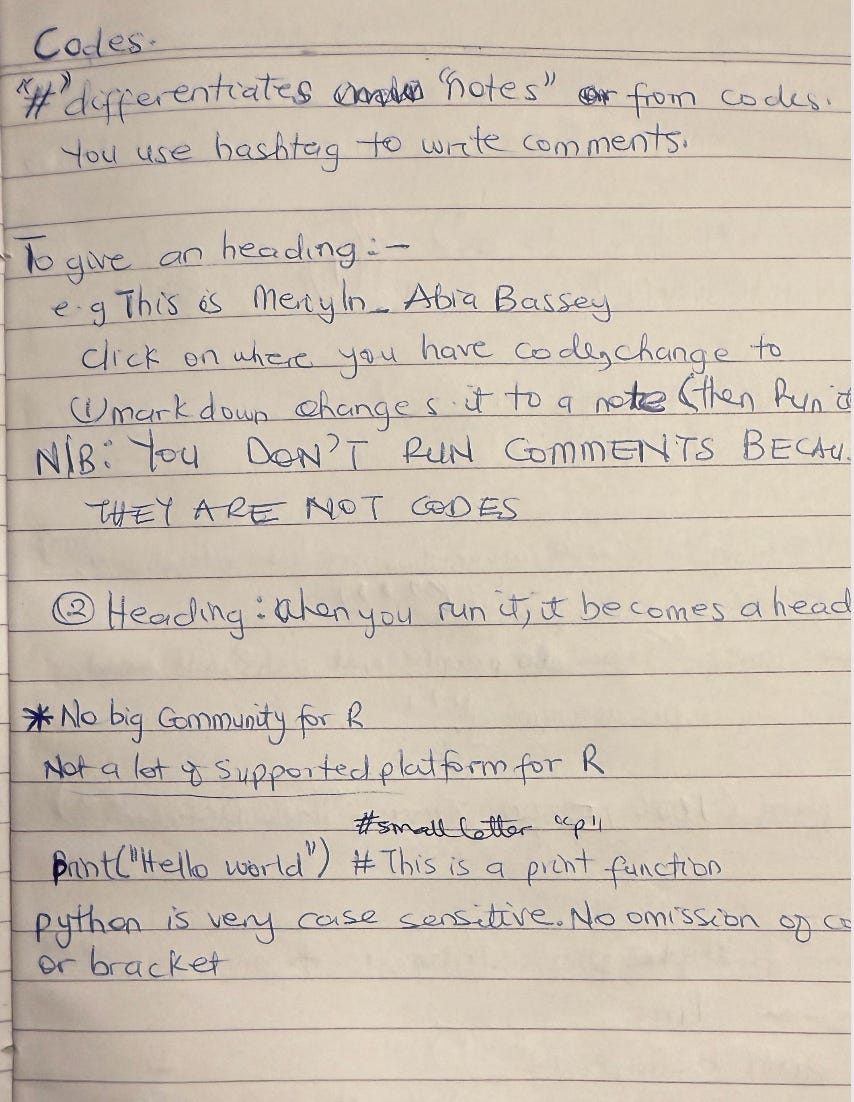
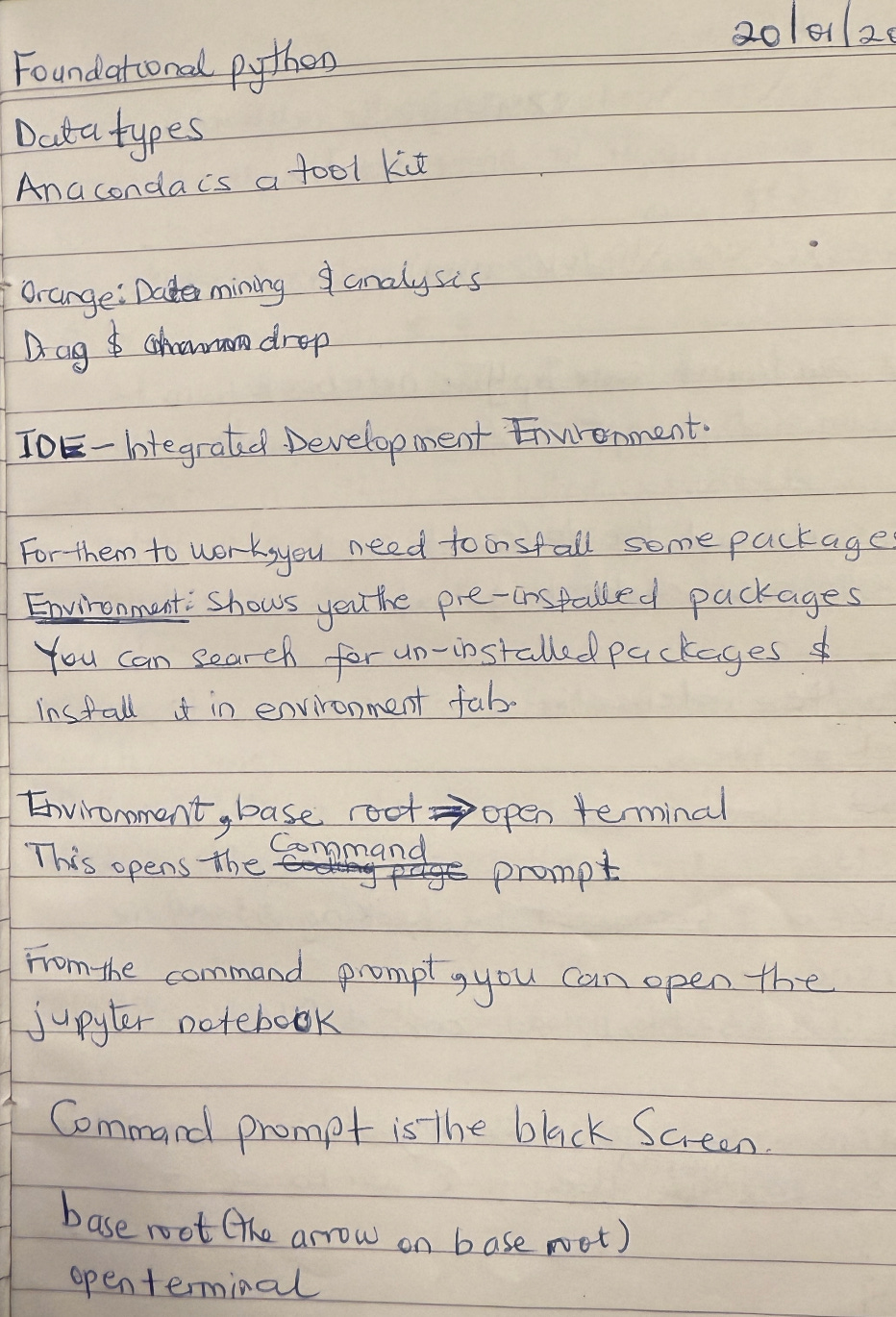
I use “coding” loosely, and you will see why, but I was so curious, it was as if I were making up for my abysmal education and poor university results. (don’t worry, I’m not ashamed of it!). FOCUS.

I used to name my tables like pets: cleaned_supermarket_sales_data_final_final_copy.csv (or .xls, which I prefer). It was comedy in characters.
I became immersed in data, formulas, and queries, and I started following other tech newbies. Before I knew it, I was on my way to building my first predictive model.
I remember when I signed up on Stack Overflow. Let me add a disclaimer here: if you ever got one of those “these codes look like sth my cat wrote”, it wasn’t me. HAHA. I was clearly obsessed with Stack Overflow. And honestly, they cared. Chat was always on fire. lol
Or when I signed up on GitHub, what a time!!! I was so eager to have the green icons that showed activity and commits; I would change lines of code daily just to get the satisfaction.
Then, I discovered Alex the analyst and other creators, Freecodecamp, Barousse, etc., and their work kind of motivated me to start creating content. I started documenting on Medium, LinkedIn, etc.
I made so many mistakes that I would have what I called: a debugging weekend. Notebooks filled with codes, I’m not sure I can replicate today, but there was ownership in those errors, and I was not afraid to keep making more mistakes.
Infact, I remember telling my teacher in my shrill, annoying voice to slow down because not all of us had a tech background.
If you think this post is about coding nostalgia, you are partially correct. I am reminiscing over a time I struggled to understand why dicts use curly brackets{ }, and lists use square brackets[ ].
If you’ve ever wondered why, it’s simple: lists store ordered items, like boxes on a shelf, so they use square brackets [ ], which look like containers.
dictionaries store key-value pairs, like labeled drawers, so they use curly braces { }, which look like grouped mappings. simple.
I have been job hunting for 3 years, and while my case is peculiar, losing the joys of analysis is not.
Things are not the same, but some things will always remain the same when it comes to analysis, analytics, or data science.
When I solved a small bookstore’s business problem, or did sentiment analysis on airline feedback, or built a simple Tableau dashboard for a grad student, that’s never changing.
So, some things remain the same: dashboards, Python, coding, and AI.
I’ve embraced the newness of it all, but I’ve lost some joy in analysis. I appreciate the work and the result, but seeing myself work harder now than when I didn’t know the umbrella name for what I was doing has replaced that joy with questions.
Somewhere between debugging and delivery, the joy turned into performance, I was no longer playing, I was proving.
DATA IS STILL A MIRROR
Last year, I wrote an article: “The human side to data analytics”. “Treat data as a representative of people because that’s what it is”.
Remember? No, you probably didn’t read it, and that’s fine.
I didn’t know I would be a representative of my own data.
The Human Side to Data: Shaping analytics for real-world impact
We are more than just numbers!ameikpe.medium.com
The struggle to be accepted into a space I didn’t think I wanted to be in had been daunting.
Now, I wouldn’t say that’s a problem. It’s a blessing. I created DATA ACCORDING TO ME because of that, to welcome all the data newbies into my space.
Turns out, I’m not alone on this. This article shows that over time, some may not feel satisfied with their analyticspathway. Another article shows that 58% of data analysts look for a new job.
I keep my life very private. You may know about my dad, my running, my love of data, k-drama, learning Spanish, or even love life. But you probably don’t know my real name. You might’ve read my posts, blogs, or even liked a photo somewhere, but didn’t know it was me.
Analyzing data is one way I showed up and shared my screen with others.
This is my way of not being sterile.
Data should not be sterile; it’s meant to be remembered.
MAYBE THE LOSS IS NOT TECHNICAL
It’s not AI or SQL. The patience to keep bridging the gap between questions, results, and humanity is thinning away.
Life, sadly, or fortunately, doesn’t wait for you to lose something or find yourself. It keeps moving.
A new day is not a new life. It’s the same life in a different day. What moves is how you work that shift.
Every analyst I know chases the truth, whether it’s a real-life project or a hypothetical repo; they still love the moment when numbers align, but somehow, we miss the waiting and the back-and-forth.
The space between logic and doubt, between what the data says and what we feel it means.
That pause used to be everything. It’s everything. The pause before the conclusion. I can’t explain it, but you know what I mean.
ECHOES OF OLD CODE
I still open old scripts and laugh at my lines. Crazy but hungry for understanding.
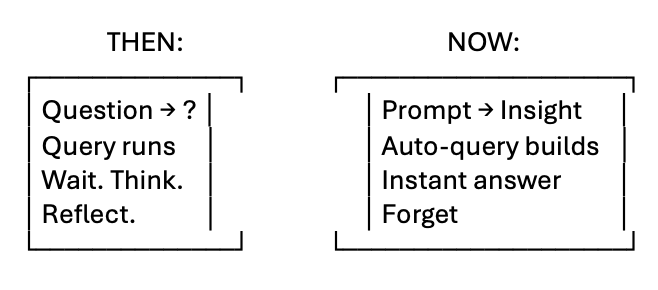
Hungry to stick to the 5 whys!!! I realize now that I wasn’t just querying databases, I was talking to myself. And maybe that’s what data still is. A conversation with time.
We’ve automated syntax now (thankfully! I don’t want to do all that work again), but curiosity should still belong to us. The space should allow mistakes. Visible mistakes, the kind that lead to debugging weekends.
Onto the next script:
This post is also about listening. I said earlier, it’s partially about reminiscing, but also about using all the new tools to listen. Because, at best, data has never been just about dashboards or predictions, but the dialogue and impact in “us”.
This is why I use coding loosely, the impact, even though reflected in the real world, often highlights technical expertise.
And in a quiet or loud way to celebrate my father, an accountant who was obsessed with numbers and is now a number himself, I hope that, sometimes when I open my terminal, I will hear him counting with me, and I hope that in the language of the corporate world, I circle back to it.
You are data, I AM DATA.
Enjoyed this? Read, comment, and subscribe for more.
Be data-informed, data-driven, but not data-obsessed
🔗 Biz and whimsy: https://linktr.ee/amyusifoh
🔗 Connect with me on LinkedIn and GitHub for more analytics.
🔗 Get the free design toolkit: dashboard design toolkit
Data analyst ⬩ Spreadsheet advocate ⬩ Freelancer ⬩ Turning data into useful insights
Comments
Nothing yet. Say the first thing.
Sign in to join the conversation.