


The soldiers stopped at the water. Across the strait, on the island the Britons called Mona, the far shore had filled with people. Women moved through the ranks in dark clothing, hair loose, torches raised. Among them stood men with their arms lifted, calling down something the legionaries could not understand and did not want to hear. For a moment the line would not advance. Tacitus, writing decades after, says the men stood as though their limbs were bound, until their commander shamed them across. Then the killing began, and the sacred groves were cut down, and the altars were left soaked.
That scene, from the year 60 or 61 CE, is one of the fullest things we have about the Druids. Notice who is holding the pen. The Celtic Druids were the learned class of the ancient Celtic peoples of Gaul, Britain, and Ireland, active from at least the third century BCE: priests, judges, teachers, healers, astronomers, and counselors to kings, held together by an oral tradition they refused to commit to writing. Almost every word of that description reaches us through Greeks and Romans, many of whom were writing about a people their armies were busy conquering. The Druids themselves left nothing. What survives is the view from the other side of the water.
Who were the Celtic Druids?
Across Gaul, Britain, and Ireland, the Druids sat at the top of Celtic society alongside the warrior nobility. They were not simple priests. The Greek geographer Strabo, writing around the turn of the first century, described a learned class in three functions: the bards, who were poets and singers; the vates, who were diviners and students of the natural world; and the Druids proper, who handled justice, religion, and moral philosophy. One person could be a healer, a lawyer, a teacher, and a political broker at once.
The name itself is argued over. The most common reading traces it to a Proto-Celtic root meaning roughly “oak-knower” or “oak-seer,” pairing a word for oak with a word for knowing or seeing. A second reading favors “strong-knower,” from an older root meaning strong. Pliny the Elder, writing in the first century CE, leaned on the oak connection, linking the name to the Greek word for oak. Both readings still circulate, and the disagreement is a fair warning about how much of this rests on reconstruction.
Julius Caesar, whose account in Book VI of his Gallic War remains the single most detailed source, claimed the discipline began in Britain and crossed to Gaul, so that serious students sailed to Britain to study it. He also recorded a worldly detail that explains some of the order’s pull: Druids were exempt from military service and from taxes, privileges that drew recruits. Whether the British origin is fact or secondhand Roman belief is impossible to settle now, which is the recurring problem with everything Caesar tells us.
Seven myths about the Druids, and what the evidence actually says
Before going further, it helps to clear away the picture most people carry, because much of it was assembled long after the last ancient Druid was gone.
1. The Druids built Stonehenge. They did not. Stonehenge was raised by Neolithic communities beginning around 3000 BCE, roughly two thousand years before any Druid. The link was first floated by the antiquarian John Aubrey in the seventeenth century and cemented by William Stukeley, whose 1740 book handed the monument to the Druids in its very title. Excavations under the Stonehenge Riverside Project, led by Mike Parker Pearson between 2004 and 2009, returned the site to its actual builders and their settlement at Durrington Walls.
2. Druids burned people alive inside giant wicker men. This rests on one source, Julius Caesar, who never witnessed it and likely borrowed from the lost Greek writer Posidonius. No wicker effigy for mass sacrifice has ever been excavated. Many historians read the image as propaganda, written to mark the Gauls as savages and Roman conquest as a civilizing favor.
3. Druids wore white robes and cut mistletoe with golden sickles. That entire picture comes from a single passage in Pliny the Elder. It may record a genuine rite. Almost everything draped over it since, the flowing beards and moonlit ceremonies of popular art, is decoration added during the Romantic revival of the eighteenth and nineteenth centuries.
4. Modern Druids preserve an unbroken ancient tradition. There is no surviving line of descent. Modern Druidry is a revival, and a striking amount of its supposed ancient lore was forged outright by the Welsh poet Edward Williams, who went by Iolo Morganwg and staged his first Gorsedd ceremony on Primrose Hill in 1792. The scholar Griffith John Williams later exposed the inventions, though some are still repeated as genuine.
5. All Druids were men. Irish tradition names female Druids, the bandruí, among them Bodhmall and Tlachtga, and a Gallo-Roman inscription from Metz records a woman named Arete with a Druidic title. Roman silence on female Druids may say more about Roman habits of overlooking women than about Celtic practice.
6. The Celts were one people. A serious body of scholarship doubts that “Celtic” ever named a single ethnic group. Simon James, in Atlantic Celts: Ancient People or Modern Invention?, argues that the idea of a unified insular Celtic identity is largely an eighteenth-century construction, and John Collis has traced how the concept was reshaped from the sixteenth century onward.
7. Druids climbed a fixed ladder of Bard, Ovate, and Druid grades. Ancient writers describe functional roles, the bards, the vates, and the Druids, as Strabo lays them out. The tidy three-degree system that modern Druid orders advance through is a recent invention, not an attested ancient curriculum.
What did the Druids actually do?
Religion was the visible part. Diodorus Siculus, writing around 36 BCE, claimed that no sacrifice the Celtic gods would accept could proceed without a Druid present, casting them as the necessary middlemen between people and powers. But the order’s grip on daily life ran through law as much as ritual. Caesar reports that Druids arbitrated disputes of every kind, from inheritance to murder, and that their sharpest weapon was exclusion: an offender barred from the sacrifices became an outcast, shunned and stripped of standing. Once a year, he says, they gathered at a sacred place in the territory of the Carnutes, reckoned the center of Gaul, to settle the cases brought before them.
Their teaching was famously long. Caesar puts the training at up to twenty years, all of it memorized, since the doctrine was never written down. Politically they could reach the highest tables. The one Druid named in antiquity, Diviciacus of the Aedui, was a working statesman who addressed the Roman Senate and stayed as a guest of Cicero, who credited him with skill in divination and natural philosophy. Their calendar knowledge was real and testable: the Coligny calendar, a bronze lunisolar table from Roman Gaul recovered in 1897, lays out a five-year cycle of lunar months with intercalary corrections, the kind of astronomy that does not survive on guesswork.
They were healers too, working with herbs and with mistletoe, which Pliny says they prized as an all-healing plant and an antidote to poison. And they read the future by method: the flight and cries of birds, the behavior of sacrificial animals, and, in later Irish accounts, more elaborate rites. Irish tradition preserves names for some of these, such as neldoracht, a divination from clouds, and the tarbhfeis, in which a seer was wrapped in a bull’s hide to dream a true answer. Ogham, the notched tree-alphabet, is sometimes tied to Druidic divination, though surviving inscriptions date only to the fourth and fifth centuries CE, well after the classical Druids, so any earlier use is guesswork.
What did the Druids believe?
At the center sat a single idea: the soul does not die. Caesar wrote that the chief aim of Druidic teaching was to convince people the spirit passes from one body to another, and that this belief made Celtic warriors fearless, since death was only a door. Greek and Roman writers, including Alexander Cornelius Polyhistor and Diodorus, called the doctrine “Pythagorean.” Later scholars such as J. A. MacCulloch and T. W. Rolleston cautioned against the comparison: the Celtic afterlife carried none of the moral bookkeeping of the Greek version, no cycle of punishment, more a continuation than a sentence.
That afterworld had many names in Irish myth, among them Tír na nÓg, the Land of Youth, Mag Mell, the Plain of Delights, and Tech Duinn, the house of the dead. The lavish princely graves of the European Iron Age, like Hochdorf and Vix, were stocked with weapons, jewelry, chariots, and full feasting gear, the equipment of someone expected to keep living somewhere. Worship happened outdoors, in the sacred grove the Celts called a nemeton; Strabo even records a Galatian meeting place named Drunemeton, the oak-grove of the Druids. The oak was the king of trees, and mistletoe growing on it was treated as sacred and rare.
The gods themselves reach us mostly through Roman relabeling, the habit of matching foreign deities to Roman ones. Teutates, Esus, and Taranis appear as a grim trio in later commentary. Lugus was a pan-Celtic figure so prominent that the city of Lyon, the Roman Lugdunum, still carries his name. Cernunnos, the antlered god, sits among animals on the Gundestrup cauldron and other finds, suggesting fertility and the wild. Epona, the horse goddess, was adopted so warmly by Roman cavalry that she crossed into the Roman calendar of her own accord. What the Druids actually taught about any of them is lost with their voices.
Did the Druids celebrate Samhain and the Celtic festivals?
The four great Gaelic festivals divided the year. Samhain, on November 1, marked the end of summer and the start of the dark half, a threshold night when the boundary with the otherworld was thought to thin; it is the ancestor of Halloween. Imbolc, on February 1, opened spring with the first stirrings of the season and the lambing ewes. Beltane, on May 1, lit the bonfires of early summer for protection and purification. Lughnasadh, on August 1, named for the god Lugh, opened the harvest with gatherings and thanksgiving for the first grain.
Here a caution matters. These festivals are attested mainly in later Irish sources, written down by Christian monks centuries after the pre-Christian world they describe. The seasonal calendar is real and old, but how closely the recorded customs match what ancient Druids actually did, and how much the Druids personally directed any of it, cannot be confirmed. The popular image of robed Druids presiding over Samhain is a reconstruction layered on thin evidence, not a documented fact.
Did the Druids really practice human sacrifice?
This is the charge that has shadowed the Druids for two thousand years, and the place where the sources are loudest and least trustworthy. Caesar gives the wicker man, criminals preferred as victims but innocents used when criminals ran short. Diodorus describes a darker method of prophecy, a victim struck above the diaphragm so the seer could read the future in the fall and the convulsions. Strabo repeats similar reports. A tenth-century commentary, the Commenta Bernensia, sorts the killing by god: drowning for Teutates, hanging for Esus, burning for Taranis, a pattern scholars call the threefold death. Pliny went so far as to write that, for these people, to kill a man was an act of the highest devotion.
Then the counterweight. Many modern historians, among them Nora Chadwick and the classicist J. Rives, argue that the lurid accounts are propaganda, the standard Greco-Roman move of painting a target people as barbarians to justify conquering them. The archaeology refuses to settle it. Britain’s Lindow Man, pulled from a Cheshire bog in 1984, died a violent, possibly ritual death; Ireland’s bog bodies, displayed by the National Museum of Ireland under the title Kingship and Sacrifice, show the same ceremonial brutality, tied by researchers to the making and breaking of kings. At Gournay-sur-Aronde and Ribemont-sur-Ancre in Gaul, the archaeologist Jean-Louis Brunaux read mass deposits of human remains as sacrifice to a war god, while Martin Brown argued they could be the honored dead of battle. The historian Jane Webster put the deeper problem plainly: an individual Druid is almost impossible to identify in the ground. The cruelty in the soil is real. Whose hands performed it, and how often, the evidence will not say.
There is a particular dread in being unable to see the thing that means to undo you.
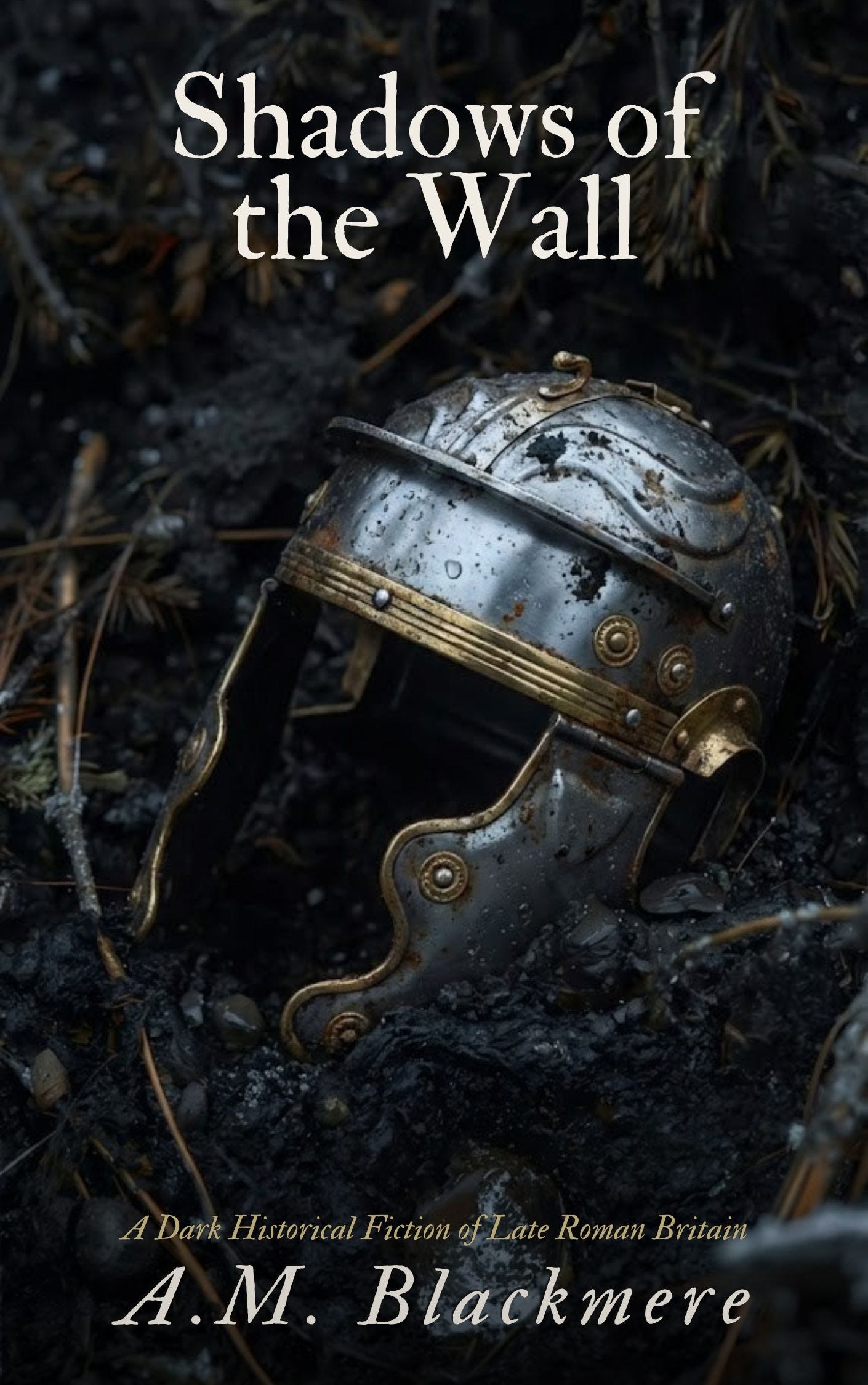
Shadows of the Wall begins where the Roman accounts stop. Its antagonist, Mael, is a Druid who does not fight Rome with spears. He fights with the one weapon the legions can neither see nor answer: the mind. He turns a frontier garrison’s own fear against it, until the soldiers holding Hadrian’s Wall can no longer tell prophecy from coincidence, or the dark beyond the rampart from the dark inside their own heads. Rome could only ever describe the Druid from outside, as a sound in the grove and a curse carried on the wind. This novel puts you inside the silence the sources left behind, and inside the man they were too afraid to understand.
How did the Druids deal with Rome?
The relationship began in politics and ended in extermination. Diviciacus the Aeduan came to Rome around 60 BCE seeking help against rival tribes and the Germanic king Ariovistus, and his appeal gave Caesar part of his pretext for the campaigns that became the Gallic Wars of 58 to 51 BCE. What followed for the Druids was a slow legal strangulation. Suetonius reports that Augustus barred Roman citizens from being Druids; Pliny credits Tiberius with banning their rites in Gaul; and Suetonius says Claudius moved to abolish the order entirely around the middle of the first century CE.
The most violent scene is the one this article opened with: the assault on Mona, modern Anglesey, under the governor Suetonius Paulinus in 60 or 61 CE, with the sacred groves felled afterward. It was interrupted by catastrophe elsewhere, Boudica’s revolt, which forced Paulinus to wheel his army around and abandon the island to fight for the province. A recent reading sharpens the politics. In a 2023 article in the Classical Quarterly, the scholar Tyler Creer argues that Caesar deliberately played down the Druids in his narrative, downplaying how dangerous a unifying, anti-Roman priesthood actually was. Suppression, on this view, was less a moral crusade against savages than the removal of an organizing force. And it was never total. Celtic gods and rites survived inside Romano-Celtic religion for centuries, absorbed rather than erased.
What happened to the Druids?
In the Romanized lands, they faded fast. By the second century CE the Druids had dropped out of the written record in Gaul and Britain, suppressed, absorbed, or driven underground. Ireland is the exception that proves how much Rome mattered, because Rome never came. There the druí survived into the early Christian centuries, losing the priestly office but holding on as poets, the filid, and as judges, the brithemain, until the church and the poets together took over their work.
That is also why the Irish Druids we meet in literature are already losing. Written down by monks centuries later, figures like the druid Cathbad of the Ulster Cycle and the poet-seer Amergin appear as counselors, prophets, and frequently as the foils of Christian saints, magicians whose spells fail against the new faith. They are memories of memories, useful, vivid, and several removes from the men who once trained for twenty years in a grove.
Were there female Druids?
Caesar, so careful about the men, says nothing about women in the order, an omission that fits Roman writing more than it describes Celtic life. Other evidence pushes back. Plutarch recorded Celtic women arbitrating disputes and even mediating between Celts and Carthaginians, the kind of judicial role Druids are known for. Irish tradition is more direct, naming bandruí such as Bodhmall and Tlachtga, and the goddess-saint Brighid carries the fingerprints of a pagan religious figure recast for the church. The Irish epic the Táin gives us Fedelm, a prophetess who meets a queen on the road and foretells ruin.
The hard inscriptional trace is the Metz stone, recording a woman named Arete with a Druidic title, alongside other Gallo-Roman mentions of female seers. Set against these is the Historia Augusta, a late and notoriously unreliable collection that has emperors consulting Gaulish dryades; it is fun to cite and dangerous to trust. The honest summary is that women clearly held religious and prophetic authority in Celtic societies, while whether they held full Druidic rank, equal to the men Caesar described, stays unresolved.
What hard evidence do we actually have?
Strip away the later legend and the witnesses thin out quickly. Caesar wrote the fullest account but was a general justifying a war, often working at second hand. Pliny preserved the mistletoe rite but treated Druidism as magic to be stamped out. Tacitus gave us Mona but wrote it decades after the fact. Behind several of them stands Posidonius, the Greek ethnographer whose firsthand work is lost, surviving only as quotation inside other men’s books. Every layer is an outsider, and most had a reason to shape what they reported.
The physical anchors are few and precious. The Coligny calendar proves the astronomical skill was real. The Stanway burial near Colchester, found in 1996 and nicknamed the “Druid of Colchester,” held a man laid out with medical instruments and a set of metal rods that some read as divining tools, the closest thing we have to a Druid we can stand over. And the ground keeps talking. In December 2025, a hoard of Celtic gold from Anglesey, the Druids’ own island, was reported by the historic-environment archaeologist Sean Derby; tellingly, the find points to farmers, traders, and chiefs moving across Britain rather than to robed priests, a quiet correction to the island’s mythology. Further east, the Glauberg “Celtic Prince,” a fifth-century BCE statue whose carved headdress reads as mistletoe leaves, has been discussed in 2025 and 2026 as a possible warrior-priest, a face to set against the silence, offered as interpretation rather than proof.
Quick answers about the Celtic Druids
Did the Druids really practice human sacrifice?
Roman and Greek writers say yes, in graphic detail. The archaeology is ambiguous: bog bodies like Britain’s Lindow Man and Ireland’s Old Croghan Man show ritual killing, but no find proves Druids performed it or that it was common, and many scholars treat the worst Roman claims as propaganda.
Why didn’t the Druids write anything down?
Caesar reports they thought it wrong to put their teaching in writing, partly to keep it secret and partly because they believed leaning on text weakened the memory. Trainees instead memorized for as long as twenty years.
Did the Druids build Stonehenge?
No. Stonehenge predates the Celts and their Druids by roughly two thousand years. The connection was invented by antiquarians in the seventeenth and eighteenth centuries and has no archaeological support.
Were there female Druids?
Irish literature names bandruí such as Bodhmall and Tlachtga, and an inscription from Metz records a woman with a Druidic title. Roman sources are mostly silent, which likely reflects their own blind spots more than Celtic reality.
Did the Druids invent Halloween?
Not exactly. Halloween descends from Samhain, the Gaelic festival marking summer’s end on November 1. Samhain is attested mainly in later Irish sources written by Christian monks, so its precise ancient and Druidic form is uncertain.
When did the Druids disappear?
In Romanized Gaul and Britain they were suppressed across the first century CE and gone from the record by the second. In Ireland, never conquered by Rome, the druí lasted into the early Christian centuries before the church and the poets absorbed their roles.
Were the Druids good or evil?
Neither label survives contact with the sources. Every surviving account came from an outsider with a motive: a conqueror, a moralist, or an admirer. The honest move is to judge the witnesses, because the Druids left nothing of their own to judge.
The view from the far shore
Stand on the Roman side of the strait one more time. The torches, the loose hair, the raised arms, the words you cannot make out. Everything you have just read was built from that vantage, assembled out of soldiers and senators and naturalists describing men they feared, taxed, ruled, or wanted to explain away.
Somewhere behind all of it stood people who taught for twenty years and wrote down none of it, and who are now precisely as silent as they meant to be. We do not get to hear them. We only get to watch the water, and the smoke coming off the far shore, and to wonder what they were saying as the line finally came across.
A.M. Blackmere writes dark historical horror set on the edges of empire. Shadows of the Wall, a novel of the Druid Mael and the garrison he unmakes from the inside, is available now. Subscribe for more from the dark side of the ancient world.
Thanks for reading A.M. Blackmere! This post is public so feel free to share it.
Comments
Nothing yet. Say the first thing.
Sign in to join the conversation.