

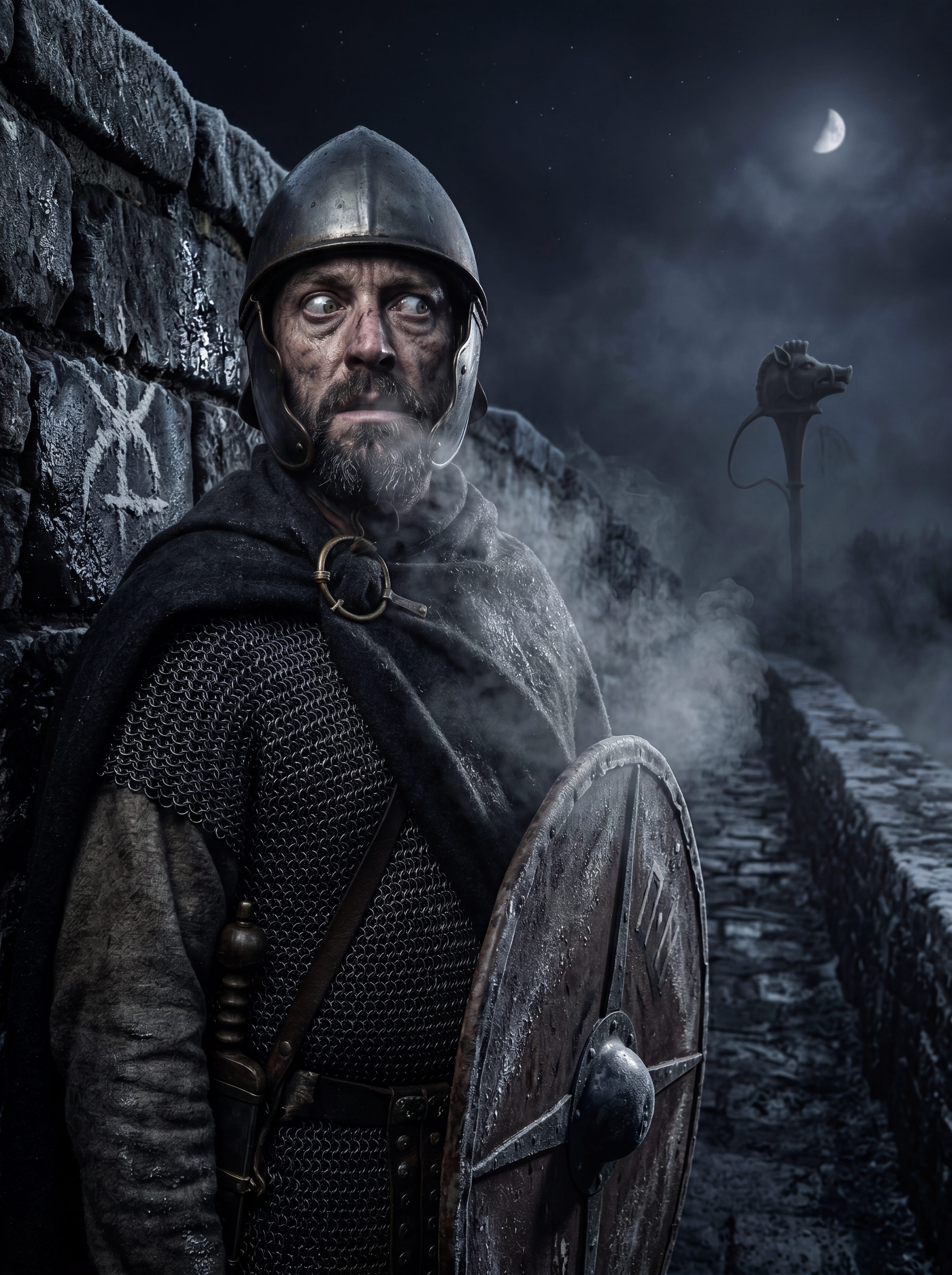
Picture a sentry on the northern wall, somewhere past the middle of the night, in the worst part of a British winter. He is not Italian. He is from the Rhine or the Low Countries, a long way from any home he remembers, and he has been awake too long. The fort behind him is undermanned and half-rotted. The land in front of him is black. Then the sound starts. Not a war cry. Something slower. A tune he knows, a marching song or a child’s rhyme, coming back to him out of the dark in a voice that is almost right and not quite human, the pitch sliding where it should hold, the words bent at the edges. He has heard it before. He will hear it again tomorrow, a little closer.
This is how you take a wall without storming it. The people on the far side of Rome’s northern frontier understood that a frightened man defeats himself, and they were very good at frightening men. What follows is a field guide to how they did it, and how much of it is true.
Most of what reaches us about Rome’s northern enemies came through Victorian paintings and twentieth-century film, and very little of it survives contact with the evidence. Clear these away first:
1. There were no “Picts” yet. The word Picti, the painted ones, does not appear in writing until 297 CE, in a speech by the Roman orator Eumenius. The peoples who fought Agricola and Hadrian were Brittonic tribes the Romans called the Caledonii, and later the Maeatae. Putting Picts on Hadrian’s Wall in the second century is like seating Vikings at the court of Charlemagne. Close, and wrong.
2. They were probably not blue. The woad story rests on a single word in Julius Caesar, vitrum, which means glass, not the plant. Woad makes a caustic, scarring tattoo ink and a poor body paint. Copper and iron earth pigments are the likelier source of any blue-green coloring.
3. The garrison was not Roman. The men on the wall were auxiliaries drawn from Gaul and Germania, Tungrians and Batavians, with their own gods, their own war cries, their own dread. The night frontier was often a contest between two kinds of foreigner.
4. The Ninth Legion was not swallowed by the mist. The legend of the lost Ninth is fiction, popularized by a nineteenth-century historian and a much-loved 1954 novel. Tiles stamped with the legion’s mark turn up in the Netherlands into the 120s CE. It was transferred, not annihilated.
5. The carnyx was not a trumpet. It was something far stranger, and it is where the field guide begins.
Start with the instrument, because the sound came before the spear. The carnyx was a war horn of bronze taller than the man who carried it, the tube rising straight up and ending in the open jaws of a boar or a serpent. Held upright, the bell could stand four meters in the air, about thirteen feet, so the cry seemed to fall on the enemy from above their own heads.
The best-studied British example is the Deskford carnyx, pulled from a peat bog in Banffshire in 1816. Metallurgical work by the archaeologist Fraser Hunter found it was forged from brass containing close to nineteen percent zinc. That number matters. Zinc brass was Roman military metal. The native smiths were melting down Rome’s own bronze to forge the thing that would unnerve Rome’s own soldiers. The Deskford bell even carried an articulated wooden tongue on a spring, built to clatter as the instrument sounded.
For a long time the carnyx was dismissed as a Gaulish curiosity. Then in 2004 a hoard at Tintignac in France gave up seven of them at once. In the winter of early 2026, archaeologists in West Norfolk announced the most complete carnyx ever found in Europe, its delicate ears and eyes still intact. The instrument is no footnote. It was widespread, and it was British.
What did it sound like? The trombonist John Kenny and the European Music Archaeology Project rebuilt and played a working reconstruction, and the voice they recovered is unsettling. A five-octave range, wider than most orchestral brass. Deep drones. Dissonant splits. Shrieks shaped to mimic an animal. Its overtones are deliberately inharmonic, which is a technical way of saying the sound is wrong in a manner the human ear cannot ignore. Play that in a narrow northern valley at night, multiply it, bend it off the rock faces, and you have an instrument tuned to the part of the brain that listens for predators. The carnyx was built to find the animal under the soldier.
Rome ran on passwords. Each night a watchword was issued on a small wooden or bone tablet called a tessera, carried along the line by an officer, the tesserarius, whose whole task was to deliver the night’s code and make the sentries repeat it back. Polybius describes the system in careful detail. It was elegant and disciplined, and only as strong as the silence around it.
Now consider the geography. The forts sat among the people they were watching. The Romans hired native scouts. Native laborers came and went through the gates. Children of mixed parentage grew up in the shadow of the walls. The watchword was not a secret kept across an ocean. It was a secret kept across a few hundred yards of frozen ground, among people who heard Latin spoken every day.
No surviving source describes the northern tribes mimicking Roman passwords to cut a sentry’s throat. Nothing in the evidence makes it impossible, and a great deal makes it plausible. We know the soldiers sang. Suetonius records the filthy marching songs Caesar’s men bawled at his triumph. We know the wall garrison was Germanic and Gaulish, throwing a mix of Latin chants and their own tongues into the dark, night after night, as routine as the changing of the guard.
Imagine that routine handed back to you. The same tune, learned by an enemy who has listened for months, returned across the treeline slowed and broken, the Latin slightly wrong, a child’s rhyme sung in a voice that has no business knowing it. You cannot fight a song. You can only stand on the wall and feel the discipline drain out of your hands.
This is the ground my novel stands on.
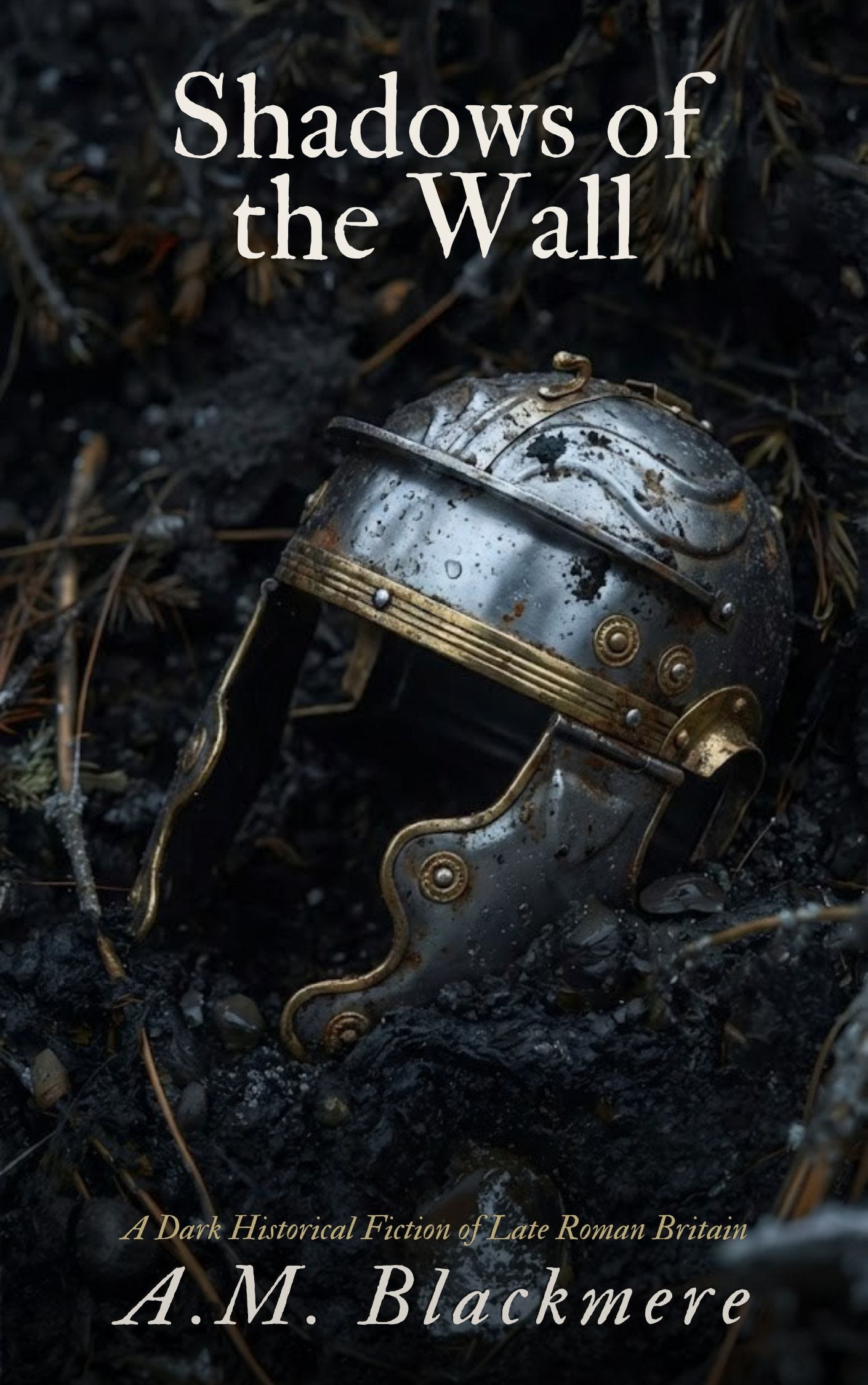
Shadows of the Wall opens on a dying frontier fort, bone-fine ash on the parapet and a commander who has stopped believing in rescue. Its antagonists do not charge. They arrange the Roman dead in mockery of Roman order. They sing the voices of lost children out of the fog. They mark the fort for death in ash. Two of them stay with you after the book is shut: Mael, a druid who speaks Latin more elegantly than the men he is unmaking, and Brude mac Uird, who drills his silent warriors on Rome’s own parade-ground discipline and turns the empire’s great gift back on it. The history in this guide is real. The novel is what it feels like from inside the wall.
Return to the ash on the parapet. Calcined bone, burned until it whitens, is mostly hydroxyapatite, and it has been ground for pigment since deep antiquity. Bone black and bone white were ordinary materials in the ancient world, used in wall painting and in burial. Cremation was common in Iron Age and Roman Britain, which means burned human bone was neither rare nor hard to come by.
Add the second ingredient: Roman fear. The Roman mind treated magic as a physical force, as real and dangerous as fire. The archaeology of Britain is thick with defixiones, curse tablets, thin sheets of lead and pewter scratched with hexes and dropped into sacred water. Roger Tomlin’s study of the tablets from the spring at Bath records hundreds of them, calling on underworld gods to twist the guts of a thief or a rival. To a Roman auxiliary, a curse was not a quaint belief. It was a weapon that killed at a distance.
So picture the sentry at dawn, finding a symbol he cannot read drawn on the stone of his own fort, in a gray ash too fine and too pale to be soot. He does not know what it says. He knows it was put there in the night while he watched, and he did not see it done. He knows the dead were burned to make it. No account places this on Hadrian’s Wall. None was needed. Every ingredient lay ready: the bone, the fire, the fear. A storyteller only has to strike them together.
The most direct message was the body. Headhunting was woven into Celtic war religion. Classical writers such as Posidonius and Strabo describe warriors taking and keeping the heads of the slain. A Roman head on a stake at the edge of a patrol route was a sentence in a language every soldier could read: this is what the land does to you.
The deeper horror sat under the violence. The bog bodies of northern Europe show that ritual killing here could be patient and deliberate. Lindow Man, found in a Cheshire peat bog and dated to roughly the first century, died three times over. He was struck on the skull hard enough to drive bone into his brain, garroted, and had his throat cut, then laid face down in the water. His stomach held mistletoe pollen and a scrap of burnt bread. Whatever else it was, it was ceremony.
Set that against the Roman way of war, which was engineering. Straight roads and a fort plan so standardized you could march from Syria to the Tyne and still know where the granary stood. The legions conquered by imposing order on chaos. The answer from the north was to take Rome’s dead and feed them back into chaos on purpose, arranging the bodies as an argument against the very idea of order. You built a wall to keep the dark out. We will show you the dark was always inside it.
We are not guessing at the fear. We can read it. The waterlogged ground at Vindolanda, just south of the wall, preserved hundreds of thin wooden writing tablets, the everyday paperwork of the frontier. One of them, Tablet 164, is an intelligence note on native cavalry. The Roman writer calls the Britons Brittunculi, wretched little Britons, a sneer. Read past the sneer and the note is careful, almost worried, about how the natives fight, how many they are, and how they refuse to do anything the expected way.
Another, Tablet 154, is a strength report for the First Cohort of Tungrians. On paper the unit had 752 men. Present and fit for duty: 265. The rest were scattered, sick, or laid up with inflamed eyes. That is the real frontier. A handful of unwell foreigners holding a line drawn across a country that did not want them, writing home for more beer and warmer clothes, listening to the dark.
Did the Picts fight the Romans at Hadrian’s Wall?
Not under that name. The word Picti is not recorded until 297 CE. The Romans who built and manned the wall fought Brittonic peoples they called the Caledonii and the Maeatae.
What is a carnyx?
A tall Iron Age war horn of bronze, held upright with an animal-headed bell. Reconstructions show a range of around five octaves and a deliberately harsh, animal-like sound. It was used across Celtic Europe, Britain included.
Were the soldiers on Hadrian’s Wall Roman?
Mostly auxiliaries from Gaul and Germania, such as the Tungrians and Batavians, rather than Italian legionaries in plate armor.
Did the Britons really paint themselves with woad?
Probably not. The evidence is one ambiguous Latin word, and woad is a poor, caustic body paint. Mineral pigments are the more likely source of any color.
What happened to the Ninth Legion?
It was most likely transferred to the European mainland, not lost in Scotland. Tiles stamped with its mark appear in the Netherlands into the 120s CE.
Go back to the man on the wall. Nothing has come for him yet. The spears may never come, and that is the point. Brute force is loud and brief. It can be answered. You form a line and you hold it. You cannot form a line against a song in the dark, or a symbol drawn in ash, or the slow certainty that the people out there know your password and your dead.
The ash on the parapet was never really about the dead it was made from. It was a message to the living, written in the one ink a Roman could not argue with. He is still up there, listening. Now you know what he was hearing.
A.M. Blackmere writes historical horror grounded in the real and the buried.
Shadows of the Wall is available now.
Thanks for reading A.M. Blackmere! This post is public so feel free to share it.
Comments
Nothing yet. Say the first thing.
Sign in to join the conversation.