
This is an older piece, being re-shared!
It was the hour of Matins, but the scriptorium’s hush belonged to the crypt. Brother Thomas bent to his work, the spidery black of his quill tracing the old pleas:
O Blessed Wulfric, intercede for us sinners.
Candlelight made a greasy halo on the vellum, trembling as he shaped the letters. His hand, always unreliable, shook less than yesterday. He thanked the Saint with a silent nod and, in the margin, penciled a furtive petition:
Grant me steadiness of hand, that I may serve faithfully.
When he turned the page, the margin bled red. The new words shimmered wet atop the parchment, not the brownish fade of traditional rubrication, but arterial—glistening. In a script none of the brothers used; thinner than his own, elegant, somehow older—the reply ran beneath his plea:
Thy hand shall not waver.
Thomas stared, then pressed a finger to the line. The vellum’s warmth startled him. The red smeared and beaded on his skin. He licked it, instinct from years of inky mishaps, but this tang was not lampblack and gum arabic. It was salt and iron… blood.
He checked his quill; the nib was black, the inkpot untouched. Only this line—his secret margin—bled the Saint’s answer. The other scribes hunched on their benches, unseeing. Above them, the abbey’s stones seemed to absorb and hold the silence. Thomas whispered, “O Blessed Wulfric, intercede.” The echo did not return.
Three days, and the pattern holds: each morning, where Thomas left his marginalia, a new line waits. Sometimes a benediction: Pray for our flesh to withstand the pestilence. The answer: Where blood flows, thy strength abides. Sometimes a plea: Spare Brother Benedict his suffering. The answer: Suffering purges sin, as fire purges dross.
Each response is the same carmine script, the same pulse of living heat. Thomas begins to test it, leaving questions now. The replies become less patient, more direct. His latest inquiry—Will you free us, if we ask?—returns as a jagged diagonal across the page, the words nearly tearing the parchment: Freedom is for the dead.
Sometimes, the answers bleed beyond his own lines, seeping into the neat columns of copied psalms. At such moments, the entire page pulses red, bright as sunrise through the east window. None of the other brothers seem to see. Only Thomas.
On the fourth morning, yesterday’s question has been replaced. He never wrote it.
Why do you not come to me?
The words are desperate, streaked at the edges where the blood ink ran. Thomas’s own hand recoils. He makes a show of copying the day’s work, but his vision tunnels to the line, the question that is not his. He tries not to read it aloud, but the mouth betrays the mind. “Why do you not come to me?” The formula soured with each invocation. He forced his hand to the next psalm, the quill’s point scraping rough as a bone saw. The words swam and doubled:
O Blessed Wulfric, intercede for us sinners.
The black ink, watery and inadequate, barely dried before more red haloed his marginal note.
The reliquary sat in the chapel’s side alcove like a small golden coffin, bracketed in glass and shadow. Brother Francis was charged with its morning polish, though the Saint’s hand—mummified five centuries, fist frozen mid-blessing—required little tending. Still, every dawn, Francis knelt before it and reviewed the seals, gold and lead, and wiped smears from the crystal casket. Today, a dark bead had swelled overnight at the shriveled wrist. It glistened.
He dabbed it with linen, but more surfaced, welling up as if the hand’s pulse had only just begun. By Vespers, three drops had slid down the inside of the reliquary, pooling red in the filigreed crucible beneath. Francis checked the seam for cracks—there were none. He pressed his own thumb to the glass, felt not cold but tepid warmth, like the inside of a mouth.
He lifted the reliquary to inspect the filigree. The gold reliefs told the Saint’s story in miniature: Wulfric, tonsure agleam, refusing the prince’s coin; Wulfric writing in darkness; Wulfric behind a wall, hands upraised as the stones closed him in. They had bricked him alive, so the legend went, for a vision not even the Prior dared name. The reliquary’s hand curled tighter, or so it seemed—knuckles straining. Impossible.
Francis ran his fingertips along the ancient wax seal, tracing the worn impression of the abbot's signet ring—unbroken since the abbey's founding. Another crimson drop forms at the reliquary's edge, swelling like a ruby before breaking free. Against every warning in his heart, Francis extends his tongue to meet it, the liquid warm against his lips. Salt and iron, he thinks—the taste of life itself.
On the next folio, Brother Thomas dares write in the margin:
Are you in Paradise, Blessed Wulfric?
The answer comes not beneath, but slantwise across the margin, the lines raw and urgent:
Paradise has walls.
He copies two more prescribed lines before he risks another.
Do the saints suffer?
This time the reply is immediate, the carmine script curdling as it dries:
We suffer as Christ suffered. Eternally.
Thomas hesitates, then writes:
How may I ease thy suffering?
For the first time, there is no reply. The silence presses in, thickening the air, until Thomas’s gaze drifts to the glowing illumination at the head of the page—a capital W, adorned with the Saint’s icon. As he watches, the gold leaf seems to tarnish and the W begins to sweat red, the pigment oozing down the stem and pooling on the line below. He blots it with his sleeve, but the stain blooms wider, soaking the phrase it crowned:
O Blessed Wulfric, intercede for us sinners, now and at the hour of our death.
The red creeps along the text, letter by letter, until the whole invocation is written over in blood. Thomas closes the manuscript. The world beyond his desk is muffled—only the sound of his own heart, hammering in his ears.
In the days that followed, the abbey ceased to pretend blindness. Blood tracked the flagstones of the cloister: heel-to-toe prints, bare, red, as if a monk had paced there with the skin flayed from his soles. The stride was wrong—too long, dragging—and no one claimed them. At meals, the taste of iron lingered on every crust of bread. The water drawn from the well ran pink at midday, then cleared by nightfall. During Matins, the choir’s voices cracked and bled into silence as, from the sacristy, came a sound like a stylus dragging across slate. Scratching.
The Abbot conferred with Prior and cellarer, but it was Abbot Hugh who offered the only solution: the reliquary must be moved to the crypt, where the walls were thick and the air already sated with bone-dust and secrecy. They wrapped the Saint’s hand in swaddling linen, but the blood soaked through and mottled Brother Francis’s habit in star-shaped stains. The hand itself flexed in sleep, as if in benediction, and then clenched again, tight. Francis said nothing of the warmth he felt, or the way the glass clouded with each passing hour.
Brother Thomas continued his work. His own marginalia grew frantic, the questions outpacing his ability to reason them:
What do you want?
The answer appeared as he watched, forming letter by letter in real time, the script uncoiling across the page’s bottom edge:
To finish my work.
The next dawn, Thomas found his plea answered not as a margin note, but as a scream across the folio:
THEY WALLED ME LIVING. FIVE HUNDRED YEARS I WRITE UPON THESE STONES. EACH PRAYER YOU SEND, I ANSWER. EACH ANSWER COSTS ME BLOOD. I AM NOT DEAD. I CANNOT DIE. THE WALLS ARE MY PARCHMENT. MY FINGERS ARE WORN TO BONE FROM WRITING. STILL I WRITE. O THOMAS, INTERCEDE FOR THIS SINNER.
The ink bled through the page, through the leaf beneath, spidering down the stand to the flagstones. Every word was an open wound. The scratching in the walls had become a rasp, rhythmic, insistent—as if someone inside the stone was copying the same phrase, over and over, into the marrow of the abbey itself.
Thomas pressed his ear to the cold, pitted limestone behind the lectern. Under the frantic scratching, another sound: a wet, shuddering breath, drawn and expelled with the struggle of a bellows. He ran his palm along the wall, feeling the pulse inside it, as if the abbey had grown a heart. The wall was no longer cold.
In the chapel, Brother Francis witnessed the reliquary's glass cloud from within, as though someone had exhaled against it. A hairline fracture appeared with the soft, deliberate sound of ice giving way on a frozen pond. The desiccated hand—which had hung immobile for centuries—curled its fingers inward one by one, like a spider drawing its legs tight, before all five digits slowly extended toward the eastern wall, pointing with terrible purpose.
That night, candle in hand, Thomas made for the chapel. The reliquary sat cracked and oozing on the altar. Beyond it, the eastern wall seemed to ripple in the guttering light. He traced the reliquary’s outstretched finger to a seam in the stones—a narrow vertical line, overlooked for centuries, but now bleeding at the edges. The mortar had softened to a pale paste, warm to his touch. Thomas pressed, and the stone gave way, flaking to dust beneath his fingers. The stench of salt and iron blew out.
He pushed the candle through the gap. At first, he saw only the inner surface: a rough crypt wall, its face scabbed over with lines and lines of writing, chiseled or scratched with some delirious industry. Prayers, confessions, desperate bargains—layered, interrupted, overwriting one another, in Latin and Greek and tongues older than the Church. Each inscription was rimmed with a dark crust, shining as the candle’s wavering flame caught it. Toward the bottom, something moved. Not a rat, but the slow, deliberate twitch of a living hand.
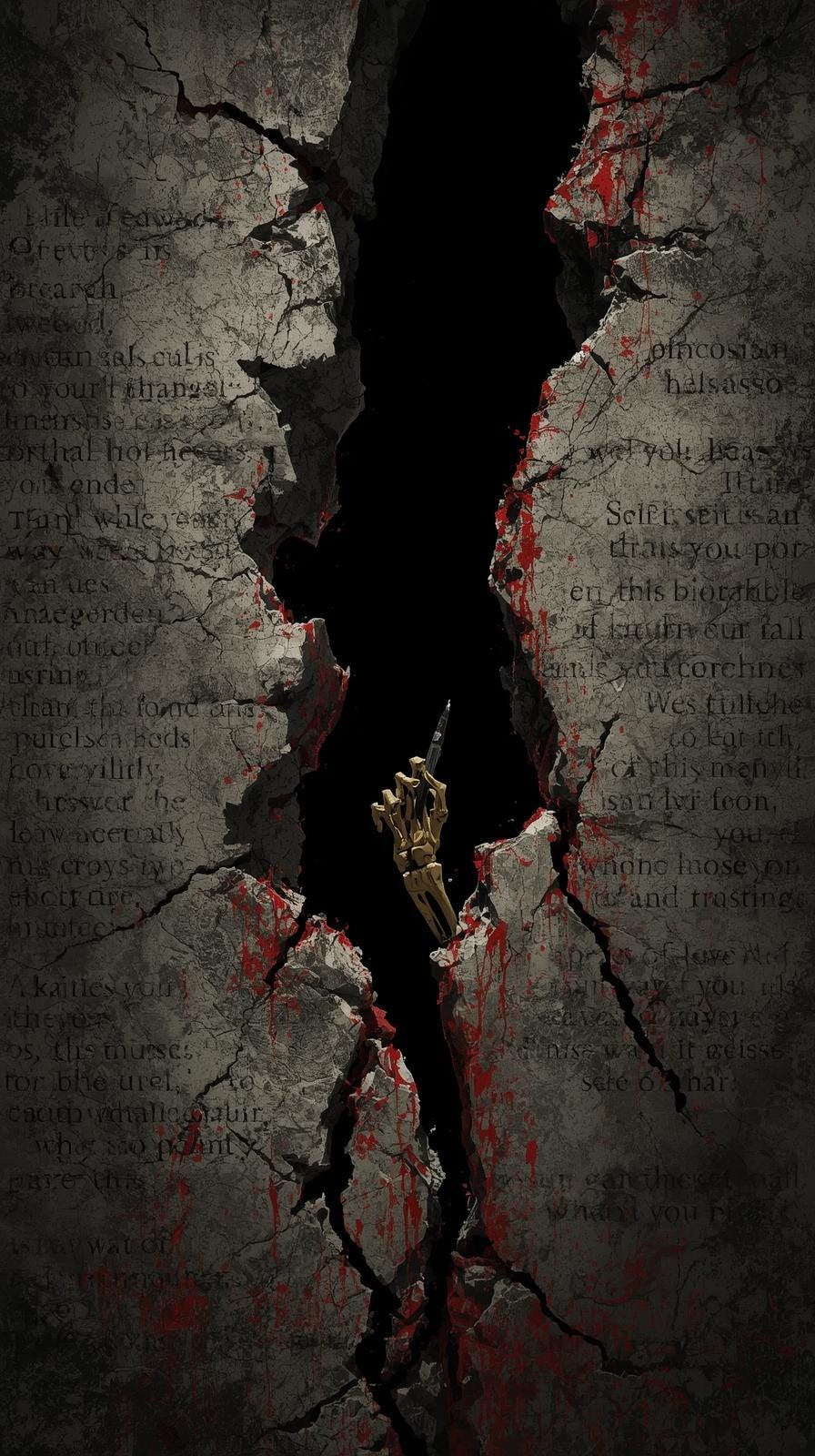
Thomas fell to his knees. The hand—little more than tendon and sinew, the bones etched with old wounds—held a splinter of stone like a stylus, and with the last two fingers, guided it along the wall. It was not writing words but names, one after another, the stone point screeching with effort. His own name appeared in the next line, letter by letter, traced with excruciating care:
Thomas.
He watched as the living relic dragged the stylus beneath his name, adding a plea in the same jagged hand that haunted his margins:
Free me.
The fingers pressed outward, straining against crumbled mortar, cameoed in waxy light. Thomas recoiled, but the hand did not grasp or claw; it searched, mapping the air, the trembling candle. In the brief hush, he heard, not words, but the animal ache of effort.
He lowered the candle, illuminating not just a face but a living archive. The walls around Wulfric were a palimpsest of desperate correspondence—five centuries of prayers answered in his own blood. Thomas traced the earliest inscriptions with trembling fingers:
I saw the throne. It was empty. Then later: No one waits beyond the veil. The truth unfurled before him, each line more damning than the last.
The Church had not walled Wulfric for heresy but for truth—the unbearable revelation of divine absence. His immortality was their solution: a living saint to intercept prayers, to bleed out hope letter by letter, maintaining the fiction of heavenly intercession. The sockets in Wulfric's face glimmered with something wet and ancient, his mouth stitched closed with his own hair to silence his testimony.
Thomas pressed his palm to the living wall. It radiated heat and need, the Saint's will surging up through the stone. The carmine script on the manuscript pulsed in time with the heart behind the mortar. Thomas could not look away from this terrible communion.
The hand, still clutching its stone stylus, reached for him, hovered, then incised a single word in the crumbling mortar: "we." The stylus dragged on, carving "are" and then "the prayers," blood welling from beneath each stroke. Thomas watched, transfixed. The wall wept red around each letter, as if centuries of unanswered supplications had pooled there, waiting.
Thomas staggered upright in the gloom, the candle guttering against his chest. The hand on the other side of the breach flexed—beckoning, not in threat, but in horrid invitation. Beneath the skin of the monastery, the scratchings intensified into a chorus, a thousand insistent quills rasping: free me, finish me, feed me.
He could widen the crack. Let the Saint out. Let prayers fall unanswered, and let the world learn what waited (or did not wait) in Paradise. Or he could repair it: tamp the mortar, seal the wound, abandon Wulfric to his endless office, a sole scribe for the voiceless Divine. Thomas’s own hand trembled with the memory of the Saint’s promise—Thy hand shall not waver—even as doubt gnawed through his marrow.
He backed away, slow, candle raising each shadow to cruciform on the chapel walls. By morning, they would expect him in the scriptorium to copy the day’s psalm, to feed the wall its ration of faith. He would go. He would write. He would know with every line that his labor was not salvation, only sedative.
But tonight, as the wax pooled at his thumb and the reliquary’s glass grew slick and red, Thomas pressed his ear to the wall. The hand inside did not beg; it waited, patient as a wound that knew it would never heal.
The next morning, Thomas wrote in the margin:
If I set you free, what becomes of faith?
The answer appears slowly. A bead of red swells at the margin, trembling before it breaks. Each letter forms with excruciating effort:
F-a-i-t-h b-e-c-o-m-e-s w-h-a-t i-t a-l-w-a-y-s w-a-s— The sentence stops. A dash hangs, unfinished. Blood pools beneath the incomplete thought, seeping into centuries-old grain. Thomas waits. No more words come. He presses his ear to the wall. The scratching that has haunted the abbey has ceased. He sits in the silence, his own heartbeat intrusive in the perfect stillness.
Dawn.
Thomas sat before the unfinished manuscript, quill suspended above parchment. "O blessed Wulfric, intercede for us sinners, now and at the hour—" The words trailed into nothing. The red bloomed beneath his hesitation, a wound opening without his permission, drowning the careful text. He watched it spread across the page, consuming prayers meant to feed what lurked behind the wall.
He set down his quill. The crimson tide advanced, erasing centuries of false promises. Through the stone, he felt Wulfric waiting. The brothers' footsteps echoed in the corridor, approaching with the day's new texts.
Thomas did not blot the page. He did not repair the wall. He simply closed the book.
If this story unsettled you, linger a while—subscribe free to have more dark tales sent straight to your inbox.
Comments
Nothing yet. Say the first thing.
Sign in to join the conversation.