

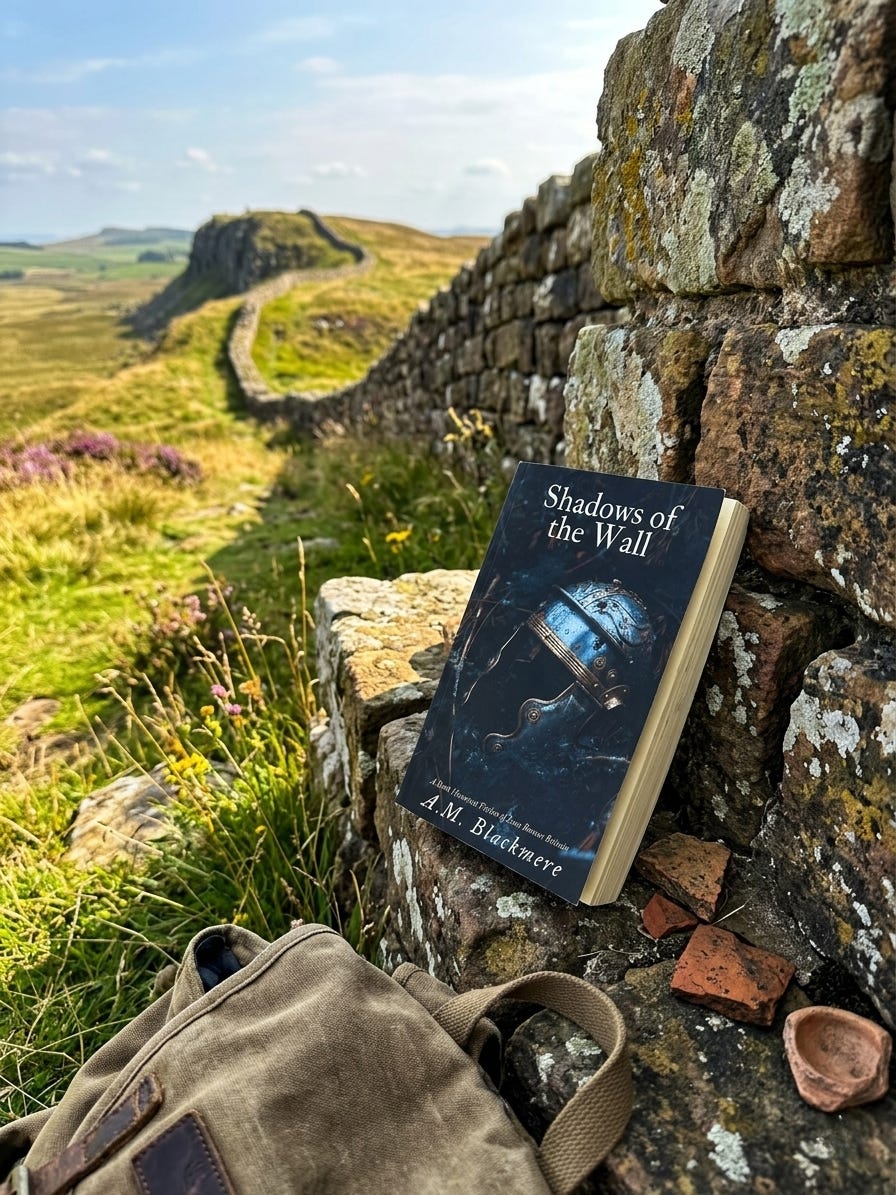
Shadows of the Wall is a historical horror novel set on Hadrian’s Wall in the final years of Roman Britain. It follows a garrison holding a frontier the empire has quietly stopped supplying, where the real threat is an enemy that has learned to mimic them and a collapse that arrives in ledger entries. This piece walks through the themes behind the book and the dread it is built to produce.
What this piece covers:
How empire ends by subtraction: rations cut from halves to quarters, supply lines gone silent, a dead man’s cloak logged as salvage, collapse arriving as daily arithmetic instead of a burning city.
Hadrian’s Wall as the book’s central image, working at once as stone and mortar, as the border with the wilderness beyond it, and as the line between who these men believe they are and the world pressing in to remake them.
The enemy as mimic: an antagonist that has watched the garrison long enough to wear its shape, speak its language back with the accent slightly wrong, and know the patrol routes and the distance between watchtowers.
The bureaucracy of a dying institution: a quartermaster tallying grain that keeps vanishing, an officer arranging collected teeth in formations, patrol logs kept with precision over nothing, each system of measurement failing in its own way.
A thread about the children, handled here without spoilers, that asks what can be taken from a person beyond property and life, and whether even a child’s identity can be edited by patient hands over enough time.
Grief as the last system still running once rank and empire are gone, the body kept moving by loss, a father’s pull carrying him forward when nothing else does.
There is a particular kind of dread that comes not from what might attack you, but from the growing suspicion that the thing you are defending has already ceased to exist. That the walls still stand is irrelevant. The question is whether anyone is coming to relieve you, and whether the answer matters anymore.
Shadows of the Wall lives inside that question. It is a novel about Hadrian’s Wall in the last years of Roman Britain, but I did not write it to recreate a period. I wrote it to get at something I think most people have felt, and few novels are honest enough to hold:
The experience of maintaining a structure, a duty, a loyalty, an identity, long after the structure has stopped maintaining you.
I want to walk through the themes that drive this book. Not the plot. If you want the plot, it will be waiting for you between the covers. What I want to give you here is the texture of what you will feel when you read it, and why I think it will stay with you.
The Empire Doesn’t Fall. It Subtracts.
We are taught to think of civilizational collapse as spectacle. Burning cities. Barbarians at the gate. The dramatic last stand.
Shadows of the Wall refuses that version of events. In this novel, empire ends in ledger columns that no longer add up. In a granary that leaks. In a cloak stripped from a dead man and entered as salvage in a quartermaster’s log. In rations cut from halves to quarters. In the slow, procedural discovery that your supply lines have gone silent and no one bothered to tell you.
I wrote every scene of garrison life with the understanding that collapse is not a single catastrophic event but a daily subtraction. Each morning is a smaller version of the one before. The men still patrol. The records are still kept. The rituals persist. But the substance behind them thins until you can see daylight through it.
This is the first thing the book will do to you. It will make you feel the weight of holding a position that the world has already abandoned.
Identity Is a Wall, and Walls Come Down
The Wall is the novel’s central image, and it works on every level at once. It is stone and mortar. It is the line between civilization and wilderness. It is the psychic boundary between who these men believe themselves to be and the world that is pressing in to remake them.
I am interested in what happens to a person when every external marker of identity is removed. Rank. Purpose. Nation. Family. The armor, literal and otherwise. The novel tracks a process of stripping that is neither redemptive nor nihilistic. It is simply what happens. The question the book poses is not whether a man can survive the loss of everything that defined him, but what, if anything, remains when the definitions are gone.
If you have ever held a title, a role, a relationship, or a belief that you mistook for the whole of yourself, and then watched it dissolve, you will recognize this territory.
The Enemy That Mirrors You
The antagonists of this novel are not savages howling at the gates. I had no interest in writing them that way. The threat in Shadows of the Wall is something far more disorienting: an enemy that has studied you, absorbed your methods, and learned to wear your shape.
This is a book about mimicry as a weapon. About the terror of hearing your own language spoken back to you with the accent slightly wrong. About discovering that the people on the other side of the wall have been watching you for so long that they know your routines, your weaknesses, your patrol schedules, and the precise distance between your watchtowers.
The horror here is not violence. It is recognition. The moment you realize the boundary between yourself and the thing you defined yourself against has become permeable. That the wall you built to keep the other out has, in fact, been teaching the other exactly how to become you.
Counting, Sorting, and the Failure of Control
I filled this novel with men who count things. A quartermaster with an abacus, tallying grain that keeps vanishing. An officer who collects teeth and arranges them in formations. A patrol log maintained with religious precision despite having nothing to report. Ledger after ledger, inventory after inventory, the bureaucratic machinery of a dying institution grinding forward on pure habit.
The counting is the point. Every character in the book, Roman and otherwise, is engaged in the same project: imposing order on entropy. Drawing lines around chaos and calling those lines civilization. The novel watches each system of measurement fail in its own way. The numbers stop obeying. The ink bleeds. The categories collapse.
This is not a theme about the futility of order. It is about the fact that order is always a story, and every story has an expiration date.
What Happens to the Children
I will say nothing about the specifics of this thread. It is the part of the novel that will cut the deepest, and it deserves to arrive without warning.
What I will say is this: the book is concerned with the question of what can be taken from a person beyond their possessions, their freedom, and their life. It is concerned with the rewriting of human beings at the most fundamental level. With the discovery that identity, even the identity of a child, can be edited, redirected, and repurposed by patient hands over sufficient time.
This is the theme that kept me up at night while writing it. It is the one that, if I did my work properly, will keep you awake too.
Grief as the Last Thing Standing
Strip away the rank. Strip away the empire. Strip away the walls, the weapons, the gods, the ledger books. Strip away the certainty that your sacrifice has meaning or that the world you served will remember your name.
What survives?
In Shadows of the Wall, the answer is grief. Not as sentiment. Not as weeping or melodrama. Grief as a physical compulsion. As the last engine still running when every other system has failed. The body moves because the loss moves it. The legs carry a man forward because somewhere, in a direction he cannot name, the thing he lost is still calling.
This is, I think, the most honest thing the book has to say. That love, when it has nothing left to protect, becomes grief, and grief, when it has nowhere left to go, becomes motion.
The Thematic Experience
If you read Shadows of the Wall, here is what to expect.
You will feel the cold. Not as a setting detail, but as a condition of existence. You will feel the weight of duty performed without hope of recognition or relief. You will feel the slow dissolution of certainty, the creeping awareness that the structure you have spent your life defending was never as solid as you believed.
You will watch men try to hold a line that no longer exists. You will watch an enemy dissolve the boundary between self and other until the distinction ceases to matter. You will sit with the quiet horror of realizing that the world does not end with a bang or a whimper but with a ledger entry that no one will ever read.
And underneath all of it, you will feel the pull. A father’s pull. The kind that survives the death of nations.
This is not a book about ancient Rome. It is a book about what it costs to stand at the edge of something that is ending, and what it means to keep standing after it has ended, and what happens to a human being who discovers that the only wall worth defending was never made of stone.
Shadows of the Wall is available now. If any of this spoke to you, I think you will find it was written for you.
Comments
Nothing yet. Say the first thing.
Sign in to join the conversation.