
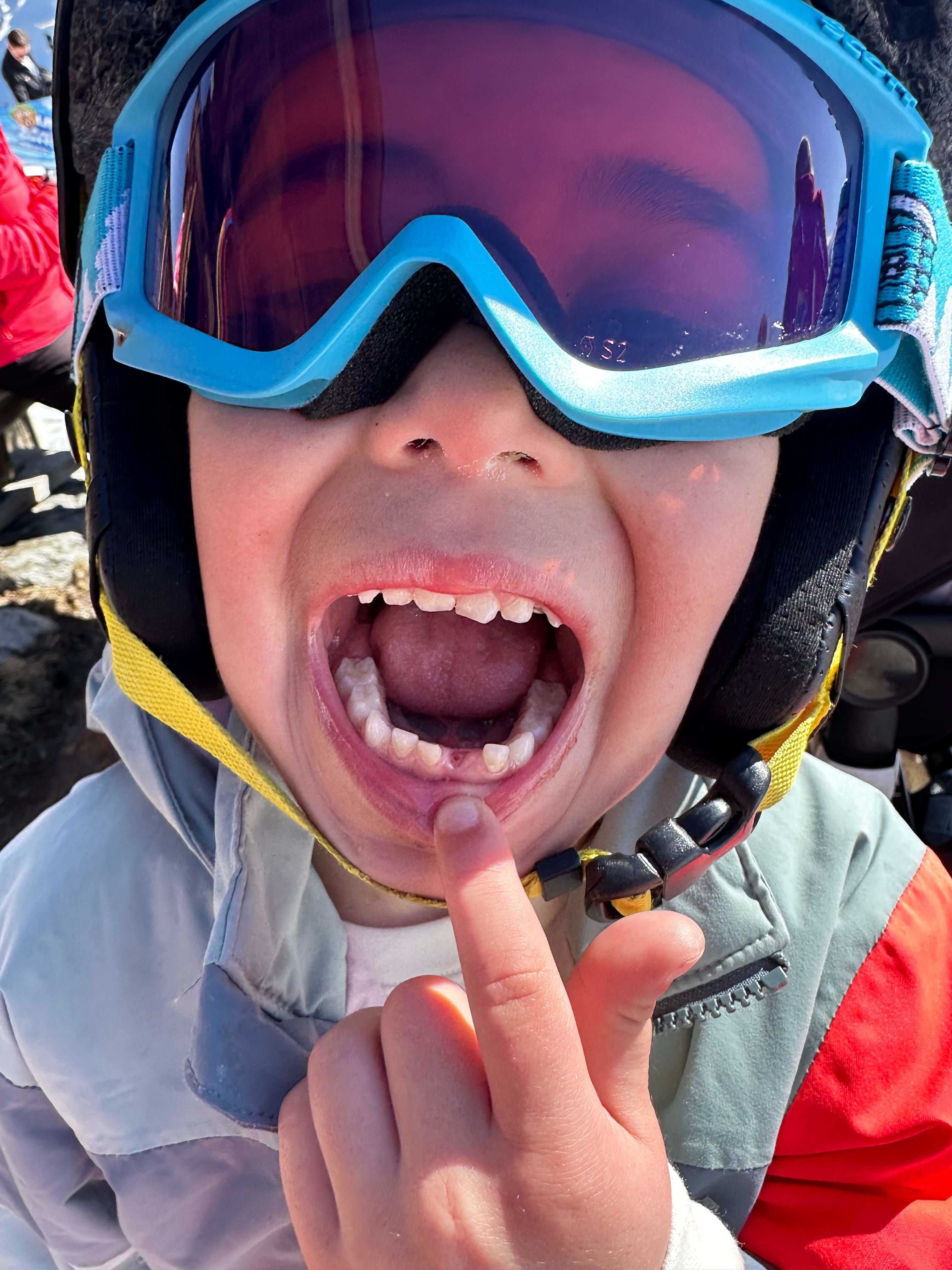
April 6, 2026 - I’m fresh off a late-season daddy-sons ski trip, complete with disappearing teeth and moguls that brought out far too little fear in my boys and far too much in me. I’ve been thinking a lot about how learning to understand their emotions on these intensive trips is helping me in my day job as a coach and designer of leadership programs. This piece grew directly out of that reflection.
Last Wednesday I woke up to one of those calendars that requires double espressos well before 10am.
Seven hours of Zoom meetings. Four coaching sessions. Everything stacked before 6 pm. Because of that, I had to hire a babysitter to pick up my boys from the bus stop, which I hate not doing myself. I’d prepped them, coordinated with her, and built the whole day around making it work.
Then I pounded my espresso (sadly not an espresso martini) and the day started.
My first meeting was a no-show.
So was my second.
And ten minutes before my final one, the one that had made the babysitter necessary in the first place, it got postponed too.
Needless to say, I was pissed.
I had spent a ridiculous amount of energy trying to make work and family fit together without dropping either one. I organized the day a week in advance (and that says a lot when I prefer looking at my calendar the night before). And in that moment, it felt like no one on the other end of Zoom gave two shits about any of that.
So of course, I canceled the babysitter, (still paid her, of course), and picked up my boys myself. They were tired from a long week of school and immediately asked for ice cream. I said no. A mini-meltdown followed.
And I snapped.
I didn’t scream but my voice carried enough edge that it was obvious (to me) I wasn’t responding to them. I was reacting through them.
I had been angry at my clients all day, but I didn’t send a single nastygram. I was, in fact, remarkably gracious with grown adults who had inconvenienced me far more than my children had.
So why can I absorb adult inconsistency with poise, but snap at my boys for a far more understandable meltdown?
For a while I assumed I just needed to use the same emotional regulation skills at home that I use at work. Daycare comes with a lot more supervision. Home, unfortunately, does not.
At work, most of us operate inside a structure that helps us hold it together. There are roles, expectations, scripts, and a certain amount of emotional distance. Even when work is hard, the game is legible.
At home you’ve got tired kids, sibling nonsense, a stressed partner, your own exhaustion, and some ancient part of you suddenly feeling disrespected, helpless, overstimulated, or out of control.
A client canceling on me is annoying.
My child whining about ice cream after I’ve bent over backwards all day to make life work can feel weirdly personal. Not because my son has done something worse. But because fatherhood touches parts of me work often doesn’t.
I think this is the distinction that matters. Fatherhood is not just another place to apply emotional regulation. It’s the place many of us first realize how conditional that regulation actually is.
I can tell you with 100% certainty I’ve never had a meltdown at work. I’ve had a million difficult conversations. I’ve coached through conflict. I’ve listened and worked with big egos. But then I helped birth some new egos…
Having children exposed parts of me (my childhood wounds, my fears, etc.) that work had never really reached. A deeper discomfort with helplessness. My impatience when things take too long. My tendency to get sharp when I feel like I’m failing.
That’s the part I think a lot of dads miss.
When we get dysregulated at home, we often treat it as proof that we’re bad at fatherhood. I certainly did.
But through conversations with hundreds of dads I began to challenge this notion that it was failure. Perhaps it was merely (painful but useful) feedback…
Feedback that shows us where our nervous system gets hijacked, where our ego is too brittle, where our self-worth is too tied to competence, obedience, or order.
My kids did not invent those things in me. (They just gave them nowhere to hide!) And that’s not exactly comfortable.
This is where I think fatherhood and leadership connect in a much more interesting way than the usual “parenting teaches patience” cliche.
Yes, of course it does. But I think the deeper thing is this: fatherhood becomes an emotional laboratory. And like Peloton, you’ve (supposed to) get on that bike every. single. day.
A toddler meltdown is not just a parenting inconvenience. It’s feedback. Co-parenting tension is not just relational friction. It’s feedback.
The part of me that wants everyone to stop needing things from me for ten minutes is not evidence that I’m broken. It’s evidence that I’ve reached a threshold I need to understand better.
Leadership training taught me how to manage people.
Fatherhood started teaching me how much more I need to understand to manage myself. And if I’m willing to study that instead of just feel ashamed of it, something interesting happens.
The growth doesn’t stay trapped at home. It comes back with me to work.
The more dads I interview, the more I hear versions of the same thing: fatherhood surfaces emotional triggers, identity conflicts, and limits they didn’t know they had.
And if a dad is willing to really work on what fatherhood exposes, his leadership gets better too. But not just because he becomes “more patient.” It’s more nuanced than that.
Fatherhood can make a man more able to recognize what emotion is actually doing in a room.
At work, emotion (hopefully) doesn’t reveal itself as a toddler-style meltdown. It shows up as defensiveness in a meeting. Resentment after being left out. Anxiety before a big presentation. A teammate going quiet. A leader overcontrolling because fear is masquerading as urgency.
If we don’t know how to recognize emotion, in ourselves or in others, we miss a huge part of what’s actually going on.
That’s why I keep coming back to this idea that emotions are not obstacles to good leadership. They’re key to it. The more nuanced we get with them, the more intelligence we have available to us.
Fatherhood, for better or worse, gives us a loud place to practice that.
It teaches us to notice when fear is turning into control. When disappointment is turning into sharpness. When stress is pushing us into fight-or-flight instead of curiosity, steadiness, or repair. Or when your deskmate is merely hangry because he hasn’t eaten in 6 hours and is on his third cup of coffee.
So yes, fatherhood can make a man less defensive, less controlling, and better at repair. But the deeper upgrade is that it expands his range. He stops seeing emotion as noise and starts engaging it as data.
I’ve seen this in myself.
When I look honestly at moments like the ice cream incident, the lesson is not “be nicer next time,” it’s getting curious about what my lack of calm is trying to show me.
I’m not saying every hard moment at home is some sacred growth opportunity wrapped in a tantrum.
Sometimes it’s just messy. Sometimes you’re fried. Sometimes your kids are fried. Sometimes everybody needs a snack and a nap and a different dad to come in for the fourth quarter.
But I do think many of us waste fatherhood’s hardest moments by only feeling guilty about them.
We don’t study them. We don’t ask what they reveal. We don’t treat them as curriculum. And maybe we should.
Because the question isn’t whether fatherhood will expose our emotional limits. It will.
The question is what we do when it does. Do we bury ourselves in work, where we feel more competent? Do we tell ourselves that once things calm down we’ll become more available? This is a leadership lab for a reason. It’s messy. It doesn’t come with a workbook and a TED Talk.
It took me ages to dive into this perspective, rather than just beating myself up. And it brought my leadership to the next level. I’m convinced it can for all of us, too.
No posts
Comments
Nothing yet. Say the first thing.
Sign in to join the conversation.