
Notice: article contains major plot spoilers for Persona 4 and its expanded re-release, Persona 4 Golden. Other Persona games are mentioned, but will remain unspoiled.
Notice: article contains images potentially unsuitable for viewing at work.
Debuting on the PlayStation 2 in 2008, developer Atlus’s Persona 4 is a Japanese role-playing game featuring a murder-mystery storyline rooted in psychological concepts. Its basic premise is fairly simple on the surface - protagonist Yu Narukami and his friends (later dubbed the Investigation Team) discover an alternate world only accessible to certain people inexplicably granted the power to pass through televisions. They soon come to realise that this ‘TV World’ is linked to the bizarre serial murder case in their hometown, which has already resulted in the unexplainable deaths of two victims.
During a particularly long introductory chapter, we’re introduced to the town of Inaba - inspired by Japan’s real-life ‘Fuefuki City’ and named after the myth of the ‘Hare of Inaba’, the first of many allusions to Japanese mythology and Shintoism throughout the game. Inaba is presented as a historically quiet, rural town suddenly undergoing a major shift in the months prior to this story’s beginning - being thrust into the modern era by the advent of widespread internet access, a sharp uptick in media attention as a result of the topical serial murder case, and the recent arrival of major department store chain Junes threatens the future of its community’s once beloved shopping district.
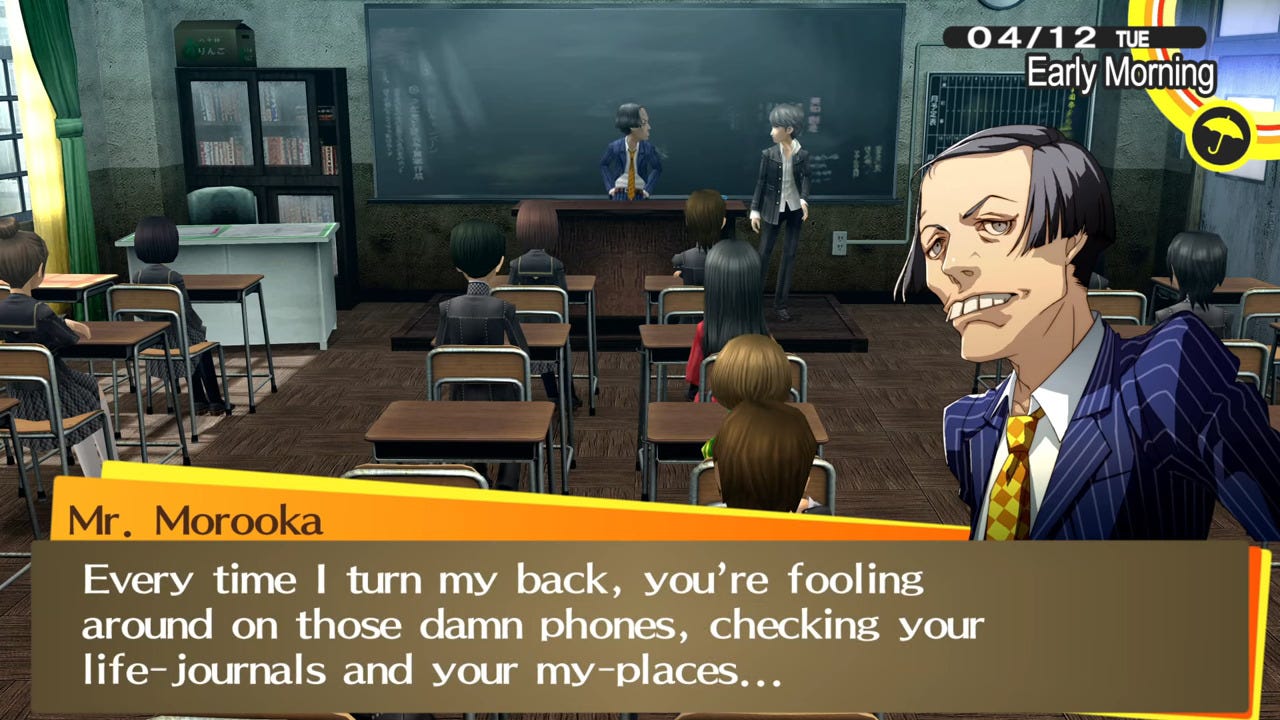
Alongside the town, we’re also given our first introductions to many of the game’s major characters, receiving glimpses into the personalities, relationships and dynamics between the majority of the main cast, even those that become relevant much later into the plot. However, if you’re already forming images of these characters in your head as you’re watching, you might be falling for one of Persona 4’s most cunning tricks.
See, while Persona 4’s main theme is ‘truth’ - and it’s easy to spot the links to its murder-mystery plot - some of the narrative’s most interesting insights into the topic come about when it’s using ‘truth’ as an avenue to explore its secondary theme - ‘identity’. As a franchise named after the psychological theories of Carl Jung, explorations into notions of identity are nothing new to the Persona games - however, the technicalities behind Persona 4’s plot place it in an interesting position to deliver a unique spin on the topic.
Soon after the death of the serial murder case’s second victim, our Investigation Team embarks on their first full expedition into the TV World, and they quickly discover the true circumstances behind the two murders - if someone is left in this alternate world, they will eventually come to face a physical manifestation of their ‘shadow self’. Shadows aren’t a new topic to the series, again borrowing from the works of Jung, and are typically summarised as the opposite of a persona. While a persona encapsulates all the aspects of the psyche that a person may present to the people around them, a shadow refers to the aspects of their personality that they subconsciously repress within themselves.
This is where the true secret of Persona 4’s narrative materialises - the player doesn’t learn until much later, but the TV World actually exists within the collective unconscious; a world created as a byproduct of the subconscious thoughts of humanity. Eventually, it’s spelled out even further that this also extends to the shadow selves faced inside that world - they are not merely products of a person’s own suppressed feelings or desires, but also a manifestation of the negative traits projected onto them by the public.
Our first full example of an encounter with a shadow self soon arrives, as a pattern is quickly discovered - the town’s rumoured Midnight Channel, a late-night TV show said to be only visible by staring into an unplugged television on rainy nights, appears to be foreshadowing the next victim in the serial murder case.
Pursuing this line of thinking leads the team to the next potential disappearance - their classmate Yukiko Amagi. Yukiko was prominently featured in the opening chapter, but in truth, you’ve caught her at a really unfortunate moment. She’s the daughter to the owner of one of Inaba’s major attractions, a traditional Japanese hot-spring inn named the Amagi Inn. Just as pressure starts to build up on Yukiko to prepare herself to inherit the business, disaster strikes as word quickly spreads that the murder case’s first victim had been staying at the inn on the night prior to her untimely death. The resulting surge in visitors takes a harsh toll on all the staff, but Yukiko in particular as she becomes the primary target of unwanted media attention.
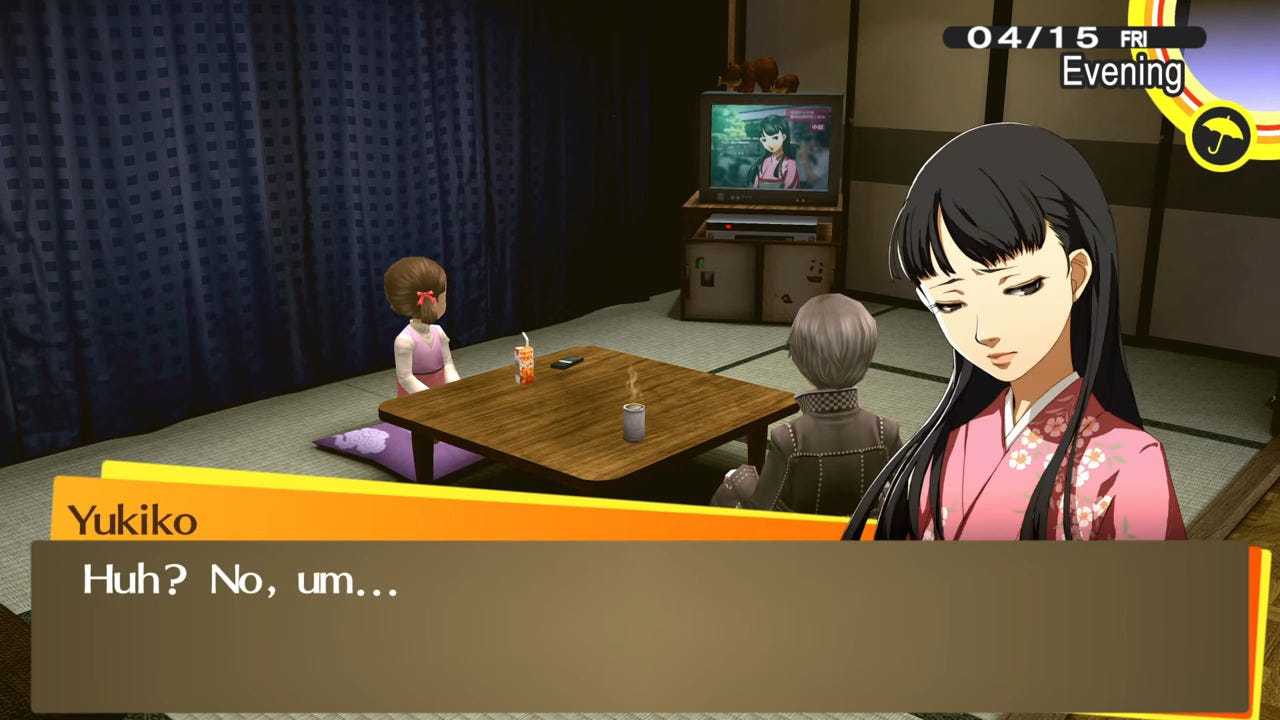
And so, it’s very easy to form a profile of the kind of person Yukiko might be - a young woman suffering under the burden of tradition and her family’s wishes, desperate for an escape from the life forced upon her. As expected, another disappearance occurs in the case, and it’s exactly who the team had predicted - Yukiko Amagi is reported missing.
Following a non-ideal first impression, the story’s hero Yu leads the team as he sets out to attempt to rescue his new acquaintance. Once again, she’s been thrown inside the TV World. Putting many questions as to the culprit’s methods aside, they begin to ascend to a castle’s top floor where Yukiko is trapped, already in the midst of a confrontation with her shadow self.
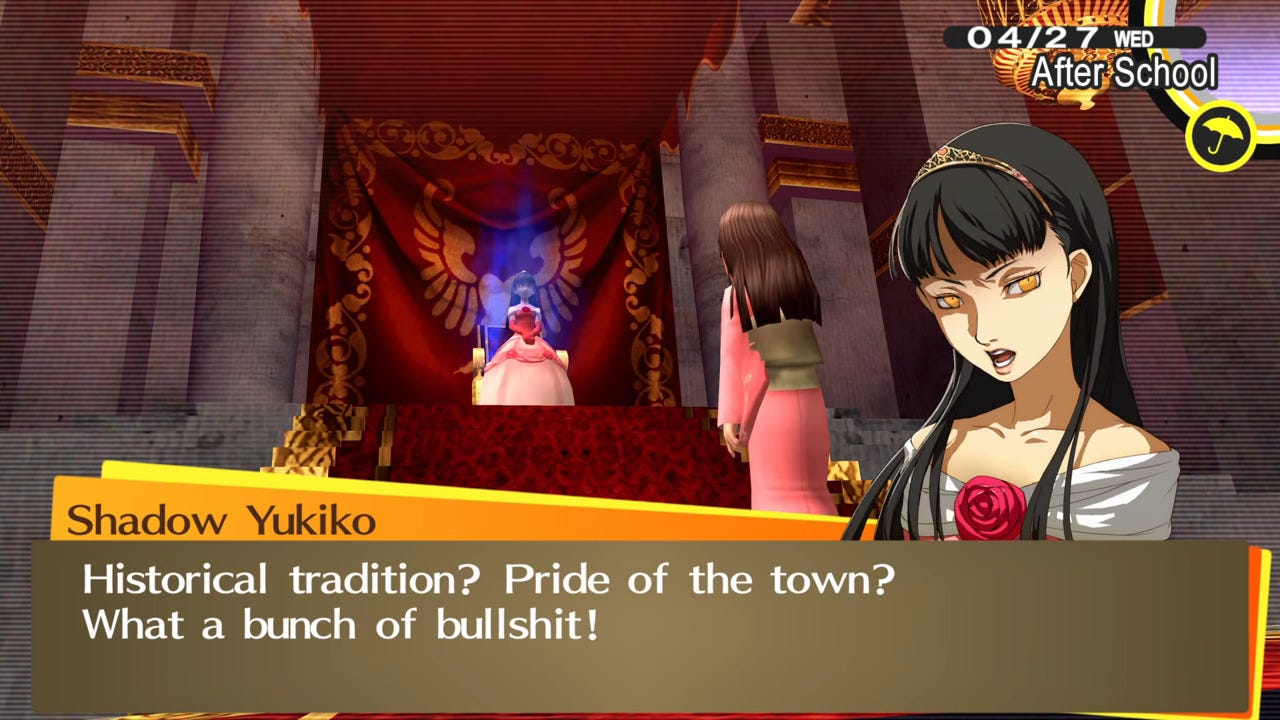
Upon reaching her, the player is faced with two Yukikos, the real Yukiko, and a fake Yukiko conveniently displaying all the traits the player had been misled into believing about her - an ungrateful princess trapped in her castle, just begging for someone to come along and free her from the life she’s been forced into.
Shadow Yukiko proclaims to be revealing hidden truths about Yukiko, but in reality, the majority of the traits it embodies are conclusions that the player had already reached on their own. Therefore, I don’t think it’s a stretch to say that what we’re really seeing here is Yukiko indirectly confronting the views held by the people around her - including the player themselves - and highlighting the impact that the prevalence of those misconceptions has on her emotionally.
This is the first of many instances where Persona 4 meticulously curates the information presented to the player in an effort to manipulate their own mentality, only to challenge that mindset later on. These tricks play a major role in making the ‘shadow self encounters’ more engaging on a personal level, without requiring any active interaction from the player - while still feeling totally natural if you’re not specifically looking out for them.
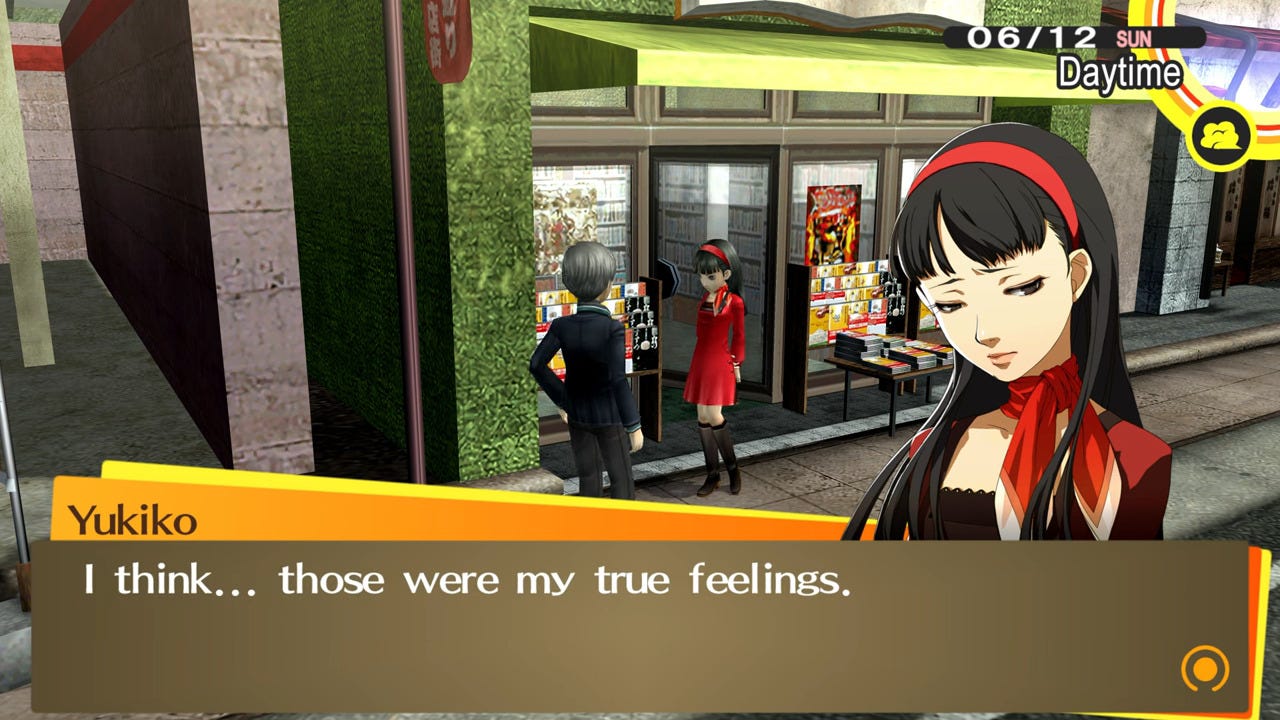
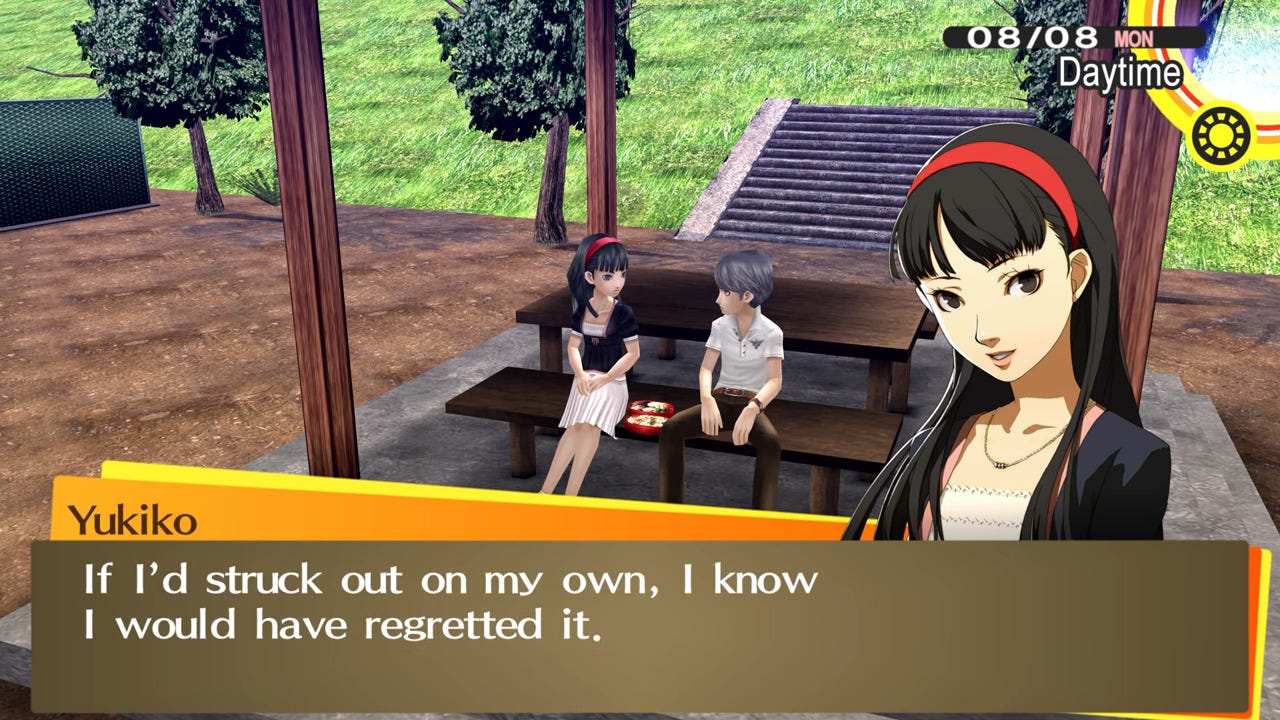
In fact, it becomes clear that Yukiko herself even misunderstands the source of her shadow’s traits, and she can be seen attempting to convince herself that they really were her ‘true’ feelings - sentiments that she must take action on in order to be more ‘true’ to herself. Obviously, this is a decision that Yukiko later comes to regret, even prior to learning the truth behind the TV World.
Skipping ahead in the investigation, the target of the third rescue operation presents an intriguing twist on the formula used thus far. The most recent victim Rise Kujikawa is interesting because she’s actually the character that the player has been exposed to the longest - being introduced even before any prior victims.

Rise Kujikawa, otherwise known by her stage name Risette, is a celebrity. While players may have had reservations about passing judgment too harshly on characters they’ve directly interacted with over the course of the game, such restraint doesn’t come quite so naturally when presented with a manufactured personality like those of TV stars and pop idols that you’ll never expect to meet.
Persona 4’s TV imagery really starts to come into play here. Television broadcasting is notorious for exposing its viewers to a constant stream of personalities, often in a performative sense, and promoting the formation of parasocial relationships over incomplete understandings of the people behind them.
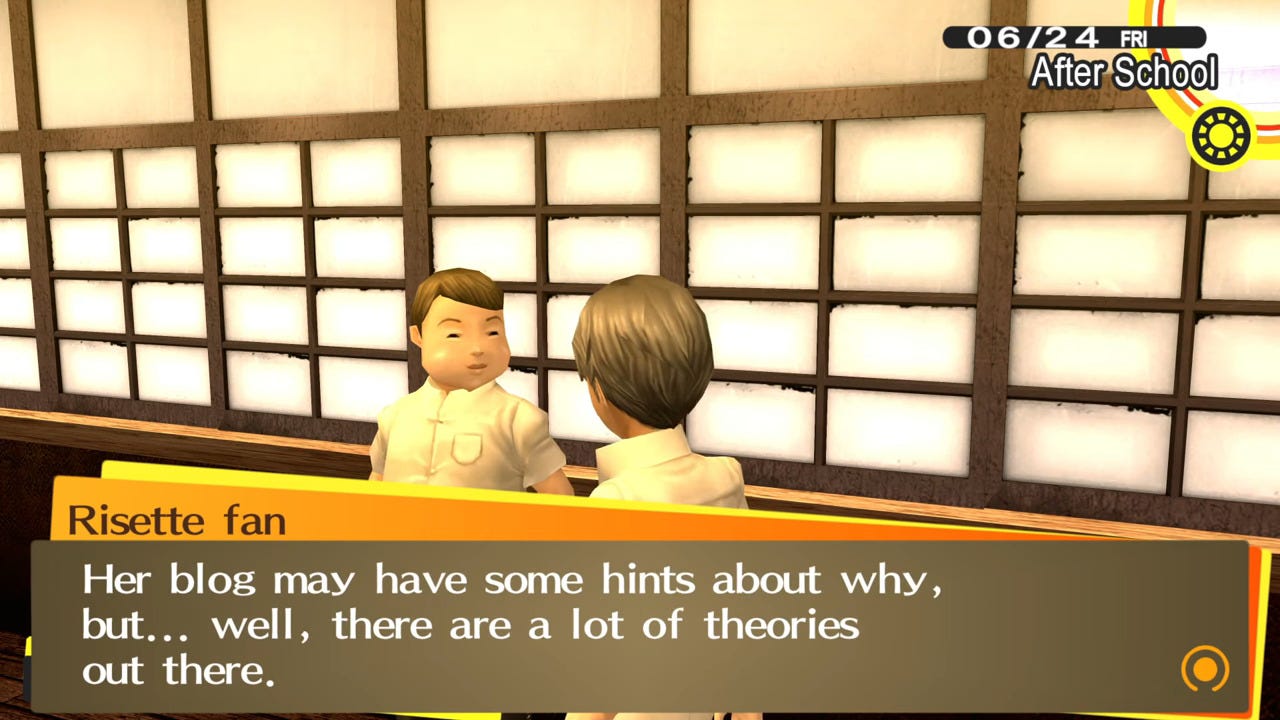
Due to Rise’s unexpected hiatus and sudden move to her quiet hometown of Inaba, her ardent fans and the local media are abuzz with rumours, leaving them scrambling for scraps of information on her personal life. Most turn out to be wildly off-base as is to be expected with celebrity gossip, but as they closely correspond with the player’s limited knowledge of Rise as a person, there’s no real choice but to accept them as fact for now.
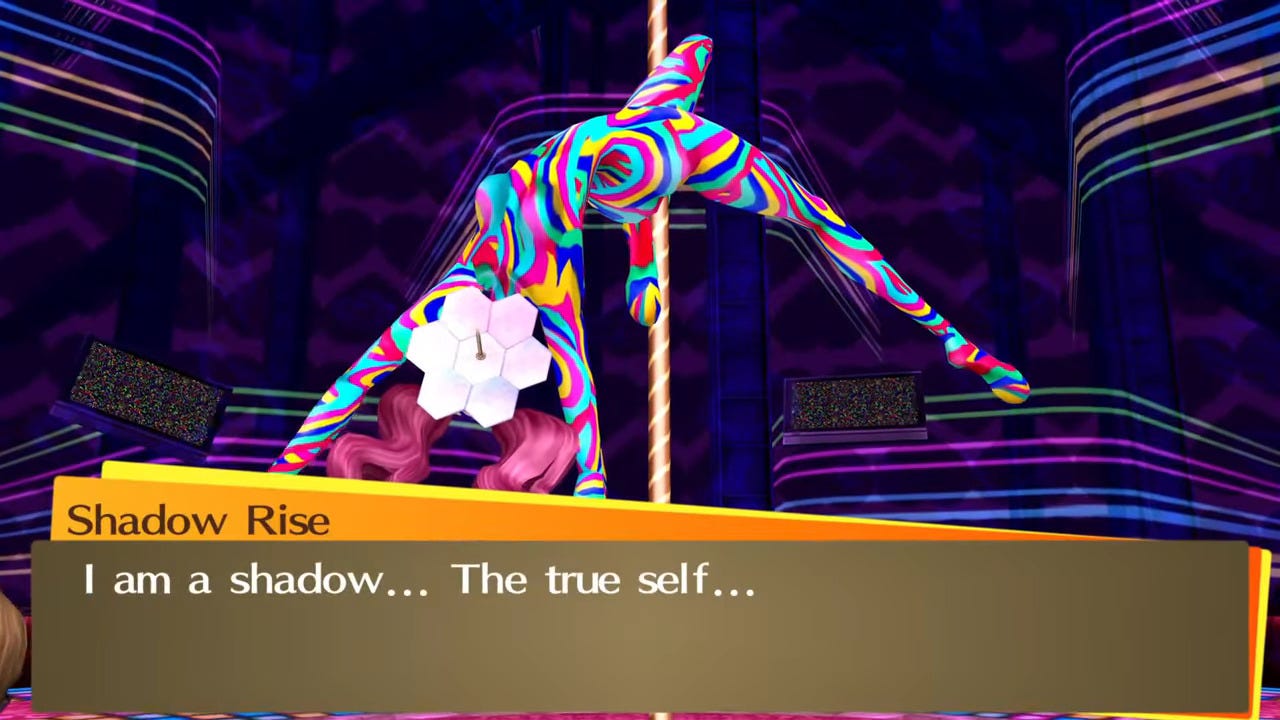
As is tradition by this point, Rise becomes the latest victim in a string of unexplained disappearances. The team finds her in the TV World, yet again confronted by her shadow self.

Once again, Shadow Rise is an embodiment of everything we’ve been able to learn about her up to this point - a successful idol having risen to the top through a constant appeal to male sexuality, abruptly growing tired of her avid fanbase and abandoning them, leaving behind more questions than answers.
The only difference this time around is that this personality was never a secret - Risette is a character willingly played by Rise over the years - the only surprise left to her is just how far the gap has widened between her celebrity persona and her ‘true’ feelings. It immediately becomes clear that she had lost control over how people viewed her, and as a result, lost sight of who she truly was as an individual.
Assumptions of and speculation into the everyday lives of TV personalities and public figures has become a deeply ingrained facet of human culture in modern society. It’s rare to see such a literal depiction of the ‘two faces’ of a celebrity, and seeing this behaviour confronted so directly is a compelling way to provoke thought into the realities behind the lives and scenarios we see portrayed in the media.
With Rise’s unusual circumstances also comes a unique viewpoint into the notion of what a ‘true self’ personally means to her. After some contemplation, she arrives at the conclusion that it’s OK to have different sides to yourself - to play a character, to fulfill a role, to fit a personality - and portraying yourself in multiple ways isn’t a declaration of one’s authenticity. The vitally important part is that you must remain aware that you’re doing this in order to prevent losing sight of who you really are.
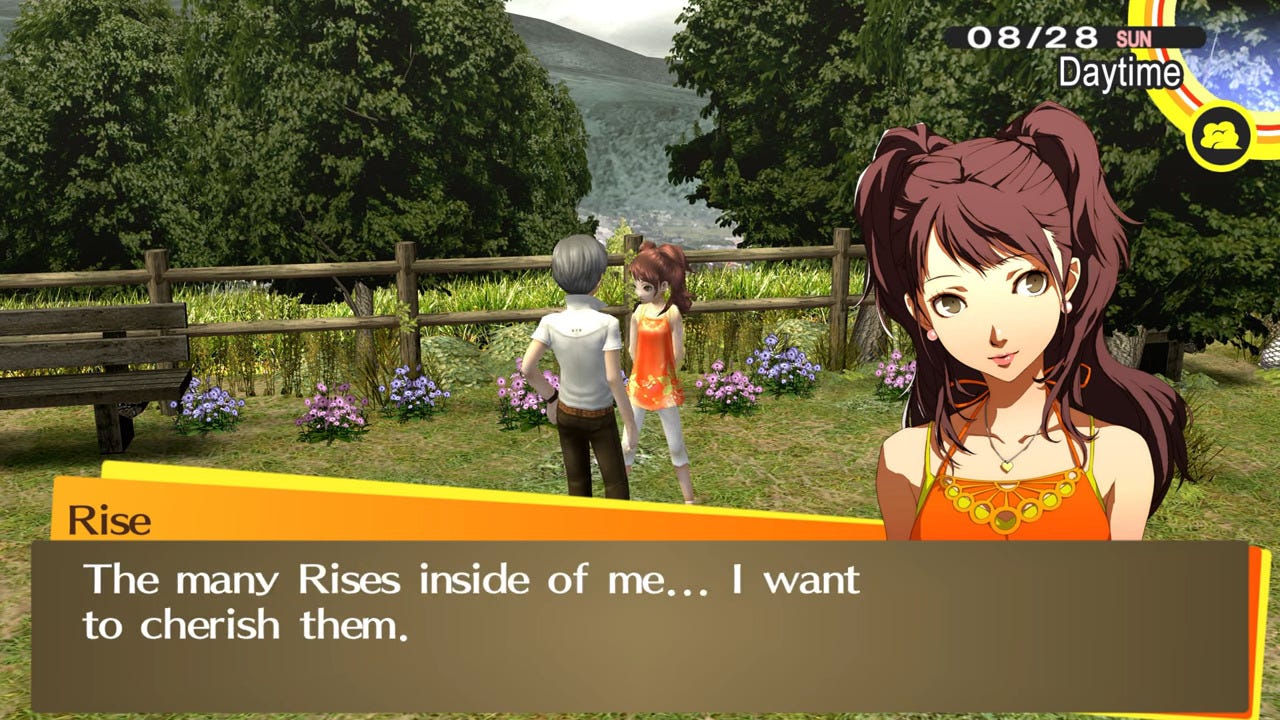
This insight might bring clarity to the behaviours of not just celebrities, but anyone we meet - surface-level observations never provide us with the full picture of who someone might be as a person. The importance of keeping an open mind in regards to aspects of people that we might not discern at a glimpse becomes a vital attitude to keep in mind for further developments in Persona 4’s narrative.
Returning to the issue at hand, the rescue of Rise marks the team’s third successful operation… or does it? Immediately following the news of her safe return home, the plot takes a swift turn as another corpse appears in Inaba, leaving behind a crime scene closely resembling those of the first two victims. Soon after the news breaks, a suspect emerges, inexplicably claiming responsibility for all the incidents thus far.
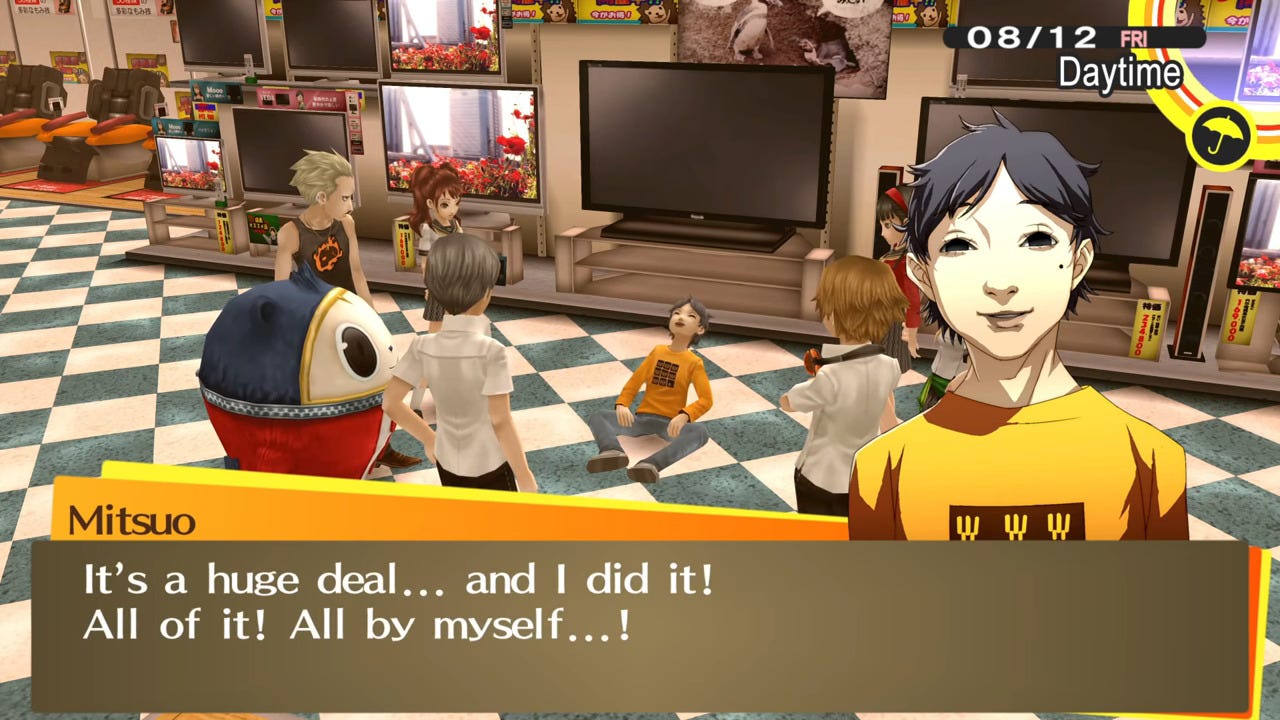
Anyone with an ounce of critical thinking skill will see right through him here - and they’d be correct. In truth, Mitsuo Kubo’s only crime was a copycat murder intended only to draw attention to himself - the unexpected twist arrives when residents of Inaba appear fully satisfied in accepting Kubo as the sole culprit in the case.
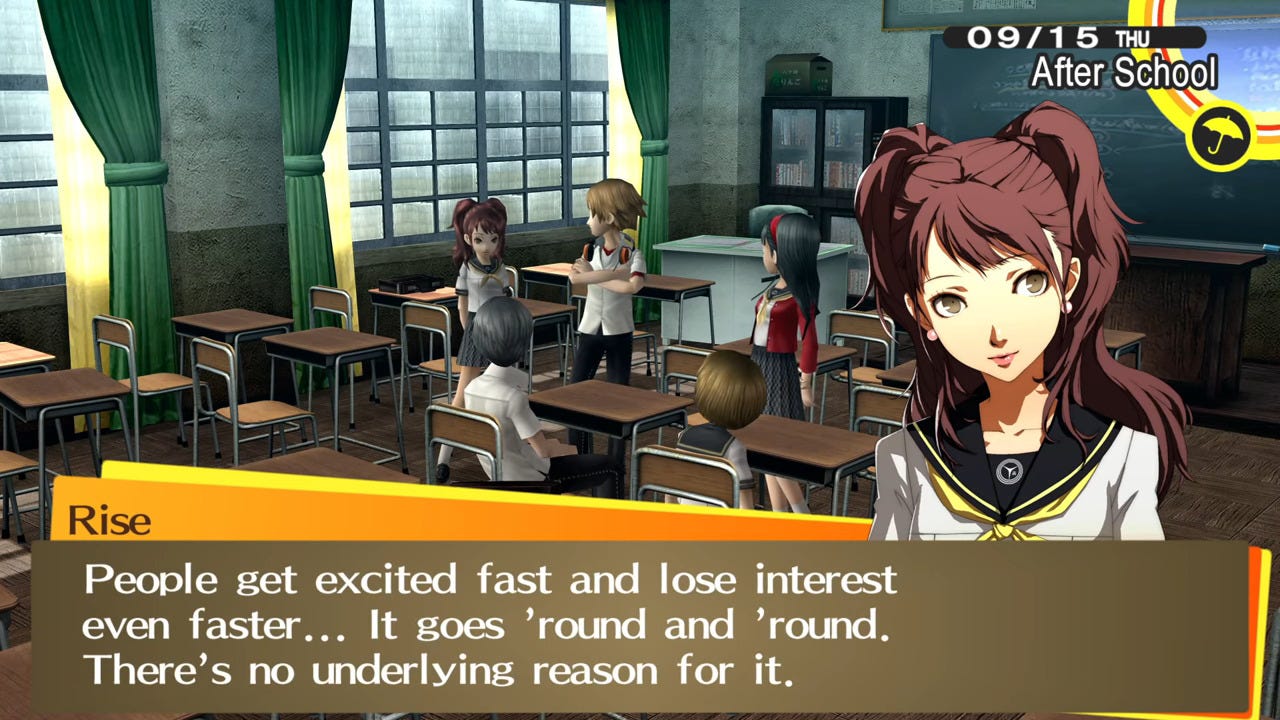
Let’s take a look into the state of Inaba at this moment in time. Following immense pressure on the local understaffed police department, a rushed statement is released pinning full responsibility for the serial murder case wholly on Kubo - news breaks on TV, and the community’s anxiety surrounding the case immediately settles down. Talking to the local residents additionally reveals a number of other small changes occurring in the small town - most notably, acceptance of Junes has risen.
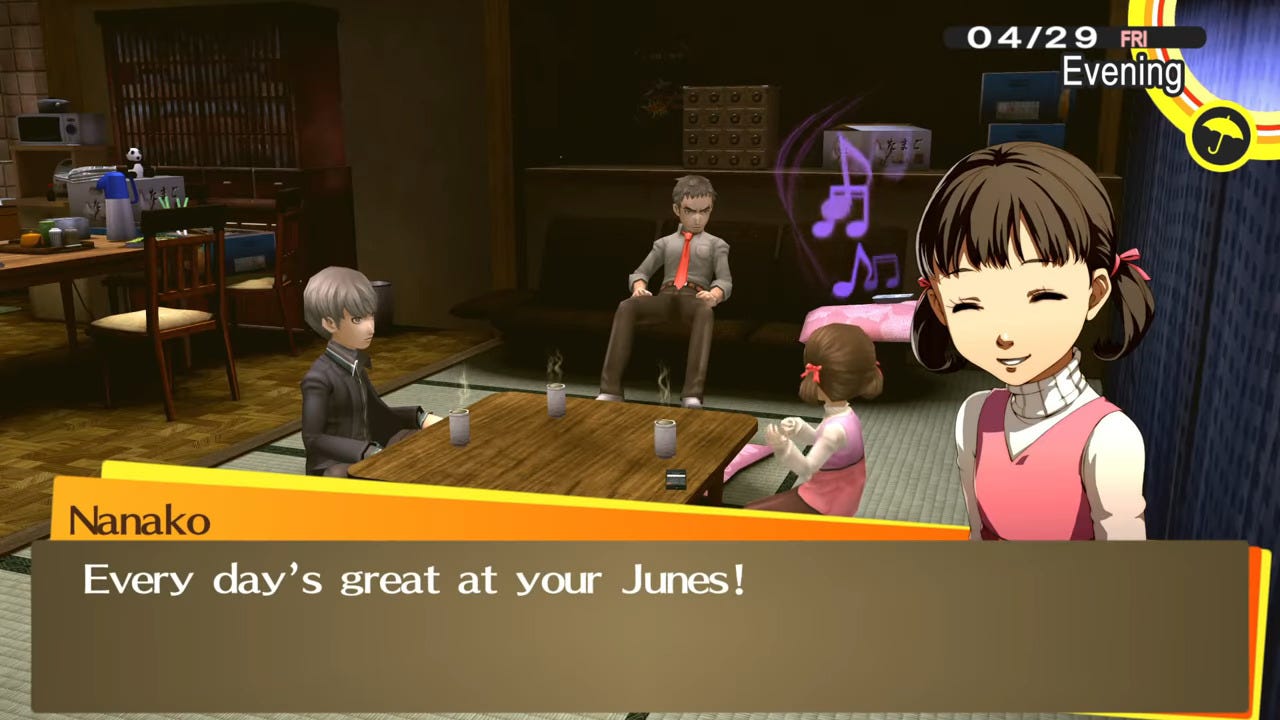
Many who previously feared the impact the new department store would have on their local shopping district now welcome its arrival - there’s a notable shift in the value placed on ‘convenience’, a topic that quickly becomes a recurring theme from now on. Citizens will point out the dwindling customer bases of their favourite local businesses, while praising Junes’s selection and pricing in the same breath - displaying a general apathy toward the corporatisation of their community, as if it were always an inevitability.
By this point, the player has invested significant effort in revitalising Inaba - even beyond rescue operations and investigating the murder case, Persona 4 offers a variety of opportunities for the player to support the town. The game has deep roots in Shinotism, a Japanese religion historically characterised by a heavy emphasis on community, and there’s no better example than the fox inhabiting Inaba’s timeworn shrine.
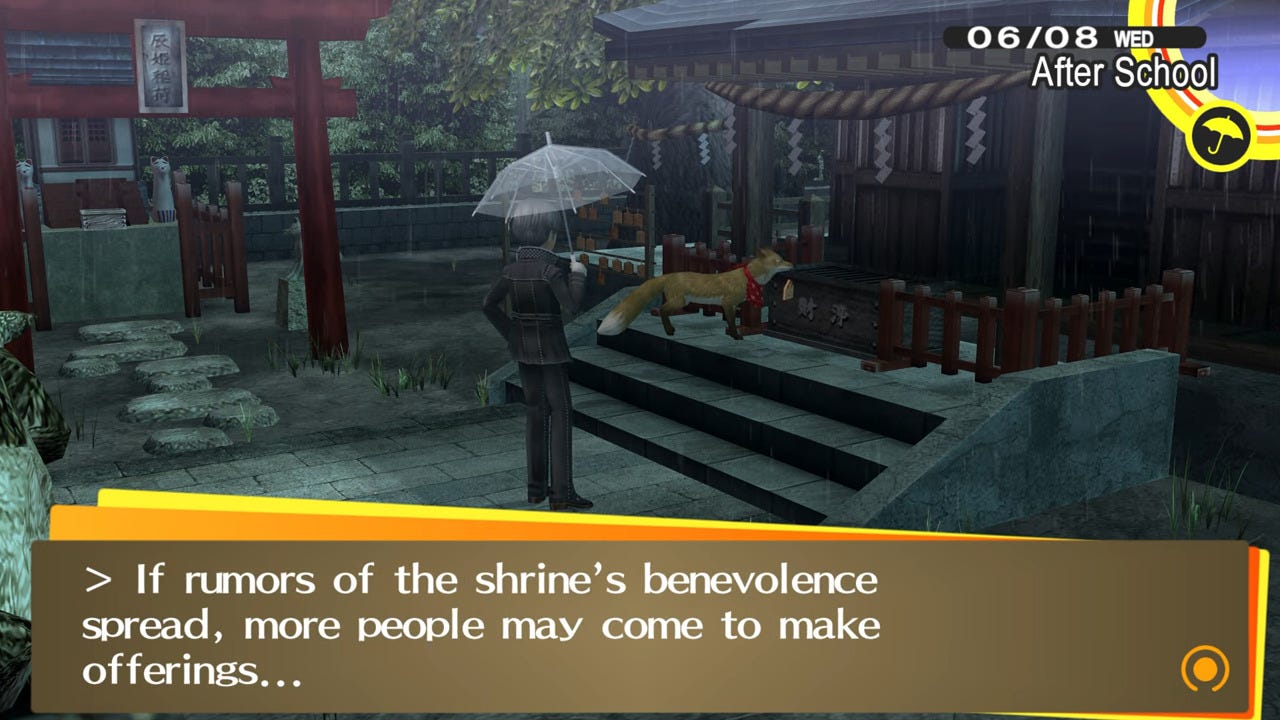
In spending time with the fox, the player is given a series of wishes left by hopeful visitors to the shrine, with the incentive that they may return to leave donations if their wishes come true - these involve quests ranging from small errands like finding a lost wallet or helping a child make friends, to larger endeavors like catching a coveted fish for an elderly fisherman or helping out a retired small business owner after Junes’s unbeatable selection brings his shop’s patronage to a halt.
Gradually, all these little assignments build up to give the player a more personal involvement in the town they’ll spend the year in over the course of the game. Further developments in the serial murder case have much wider repercussions on Inaba’s populace, so this connection assists in providing weight to the challenges they’ll face and decisions they’ll make over the coming few months.
Developments in the case provide no time for questions right now though, as the Midnight Channel warns of yet another disappearance - “Detective Prince” Naoto Shirogane. Naoto has made frequent appearances during the team’s investigation, regularly presenting himself as an arrogant, condescending character seeking to hinder your search for the truth at multiple stages of the journey.
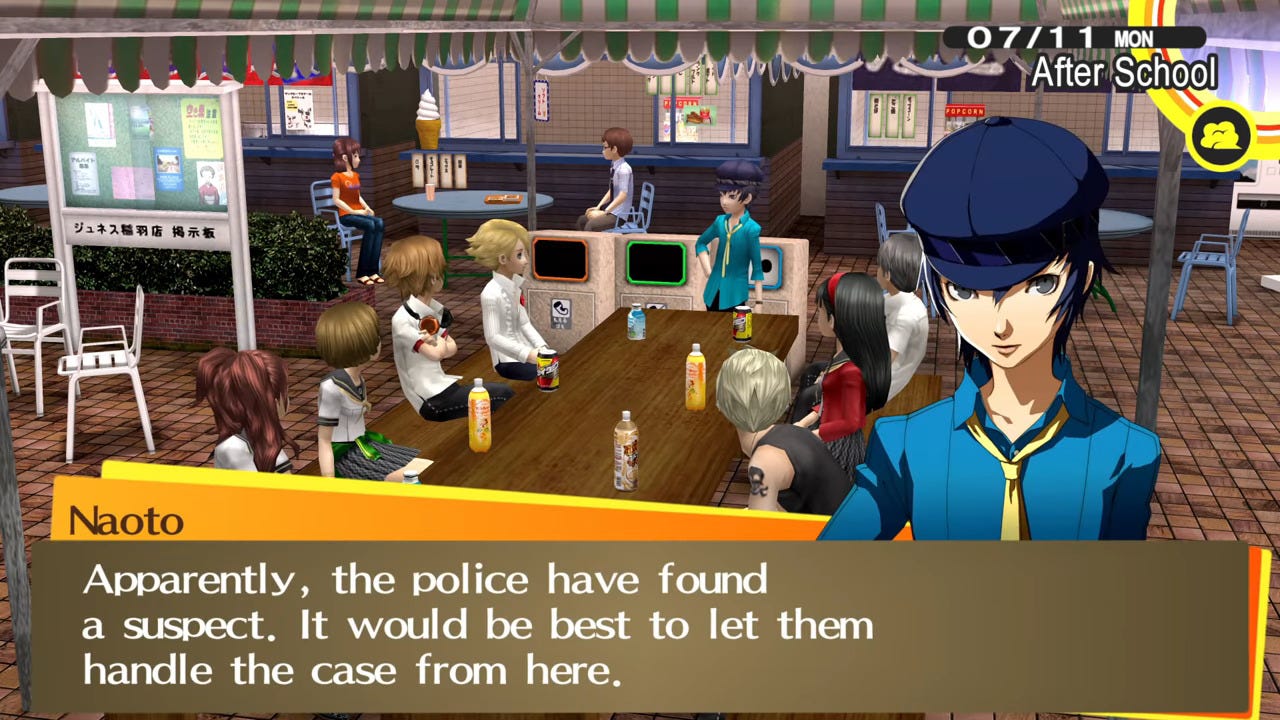
If you’ve been paying any attention at all, it’ll be evident that nobody in this narrative is to be taken at face-value. However, Naoto’s disappearance flips the script yet again, because a number of insights into his personality are observed from people you’ve come to trust - a quirk that later becomes vital to the discussion of the subject matter later presented by Shadow Naoto.
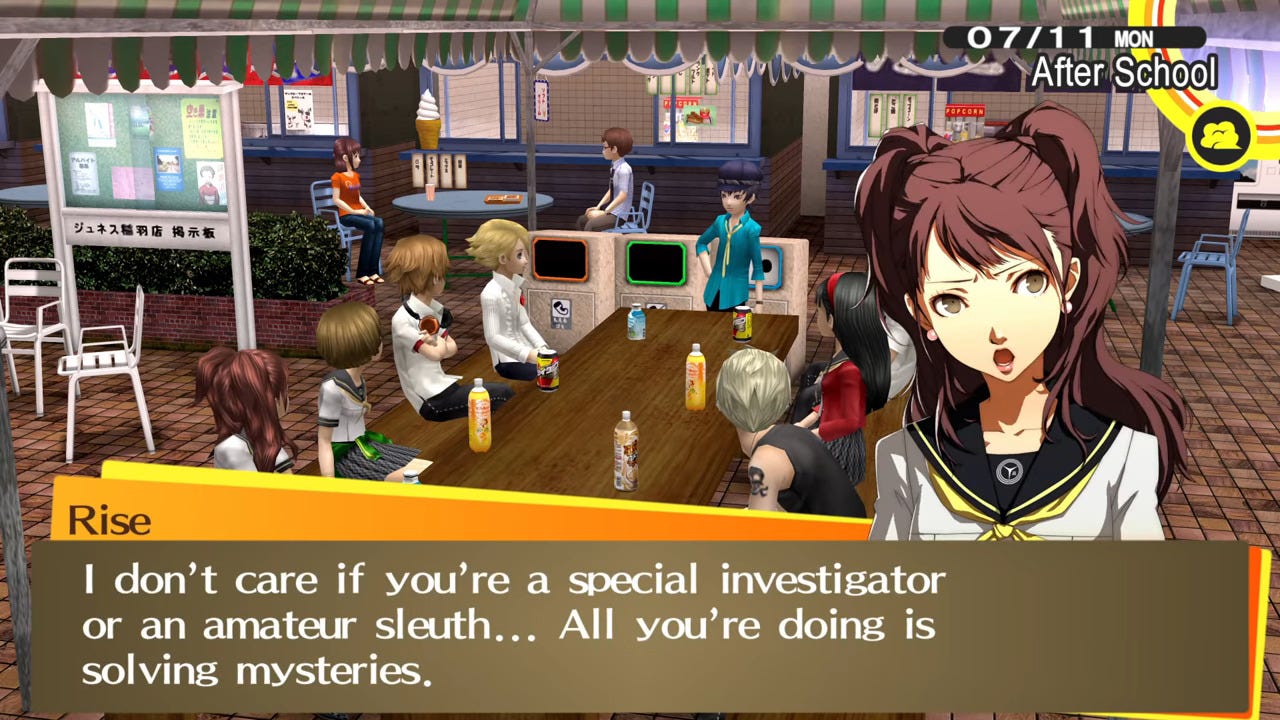
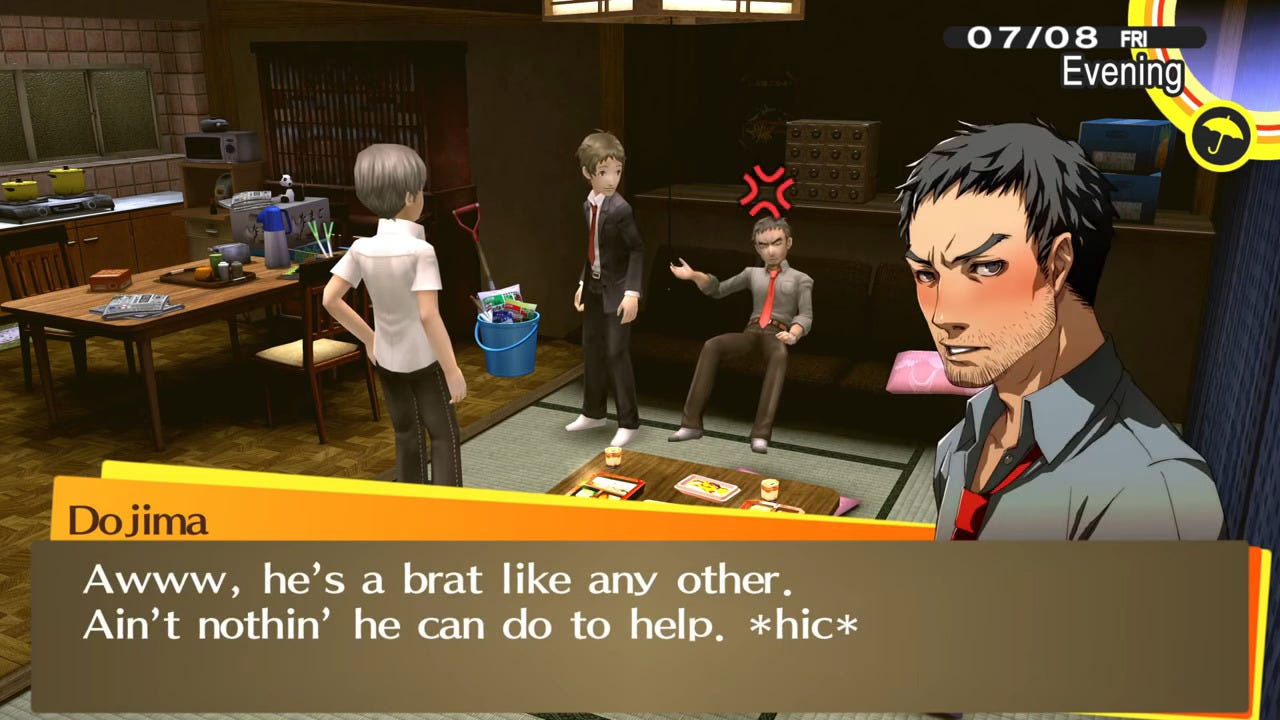
Even if you consider yourself open-minded, it’s a lot easier to slip into prejudice and uninformed preconceptions if they become common beliefs among those in your social circles - requiring active thinking to avoid these pitfalls, an effort that Persona 4 regularly tests if you’re truly making or not.
Unsurprisingly, Kubo’s arrest had zero effect on the case, and yet another prophesied disappearance occurs - Naoto Shirogane appears inside the TV World. Apprehending his shadow self reveals exactly what you’d expect to see.
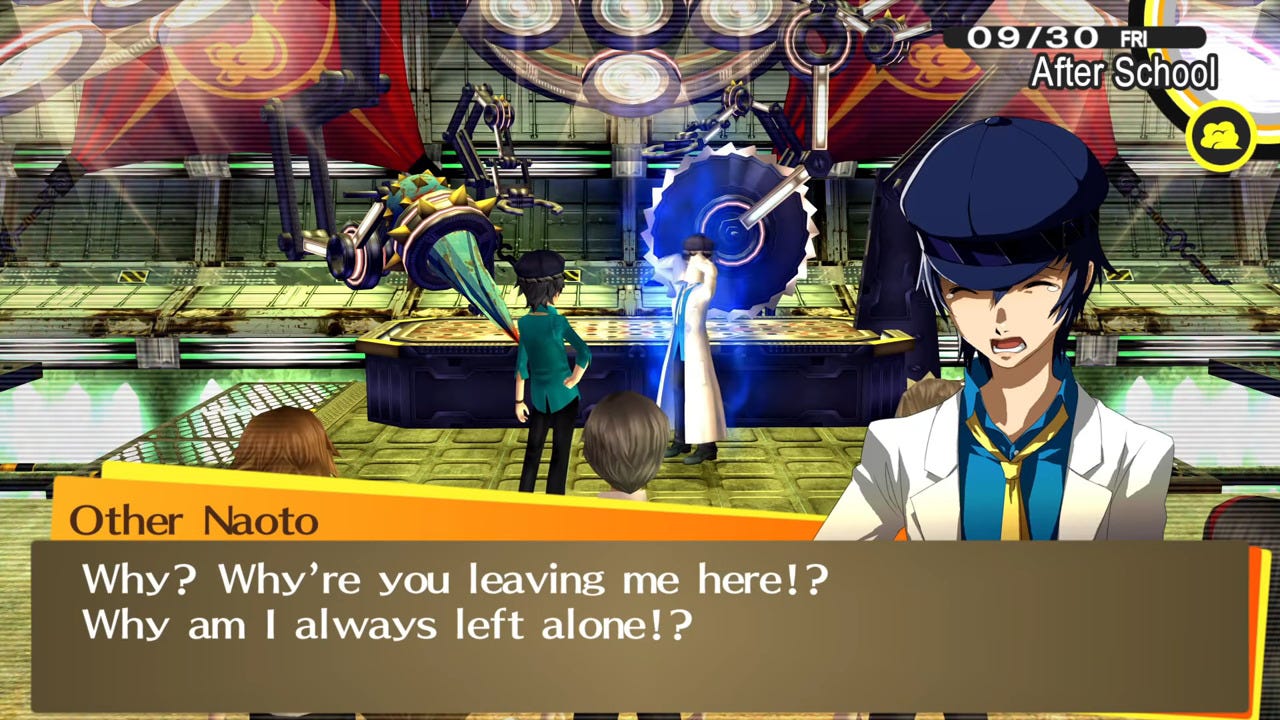
Shadow Naoto’s charade doesn’t last long, and once everyone is present to see, its tone starkly changes as it begins to reveal deeper secrets on Naoto. The truth is, Naoto isn’t a man - or even the typically appropriate age to work in such a field. In reality, she’s just another member of the masses struggling under the weight of discriminatory workplace culture, and her abrasive personality is a direct result of numerous attempts for her efforts to be taken seriously despite an inability to fit into a professional field dominated by older men.
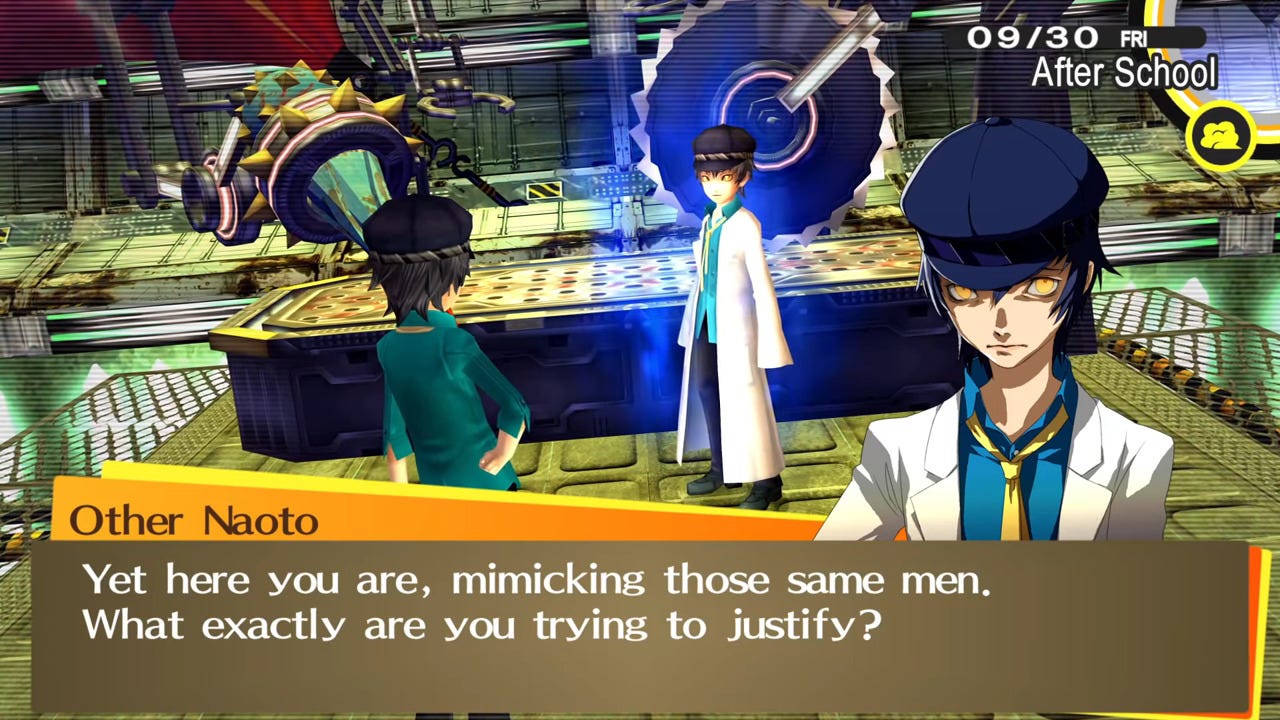
At this sudden revelation, the player may begin to subconsciously consider the environment they’re playing a part in sustaining. While it’s unlikely that they’re actively contributing to discriminatory behaviour, it’s these attitudes that lurk among the population and go widely unchallenged - even when we as individuals may believe that we oppose them. You’re left to consider how easily you slipped into these viewpoints, and the impact this mindset regularly has on the people around you. It’s a powerful critique on a wider societal issue that feels uniquely suited to Persona 4 in its execution.
Rescue operation number five proceeds smoothly, and our newest team member wastes no time in proving her usefulness. Naoto admits that, driven by desperation, she had independently discovered the pattern behind the missing persons cases and intentionally put herself in harm’s way - all for a chance at learning the truth herself.
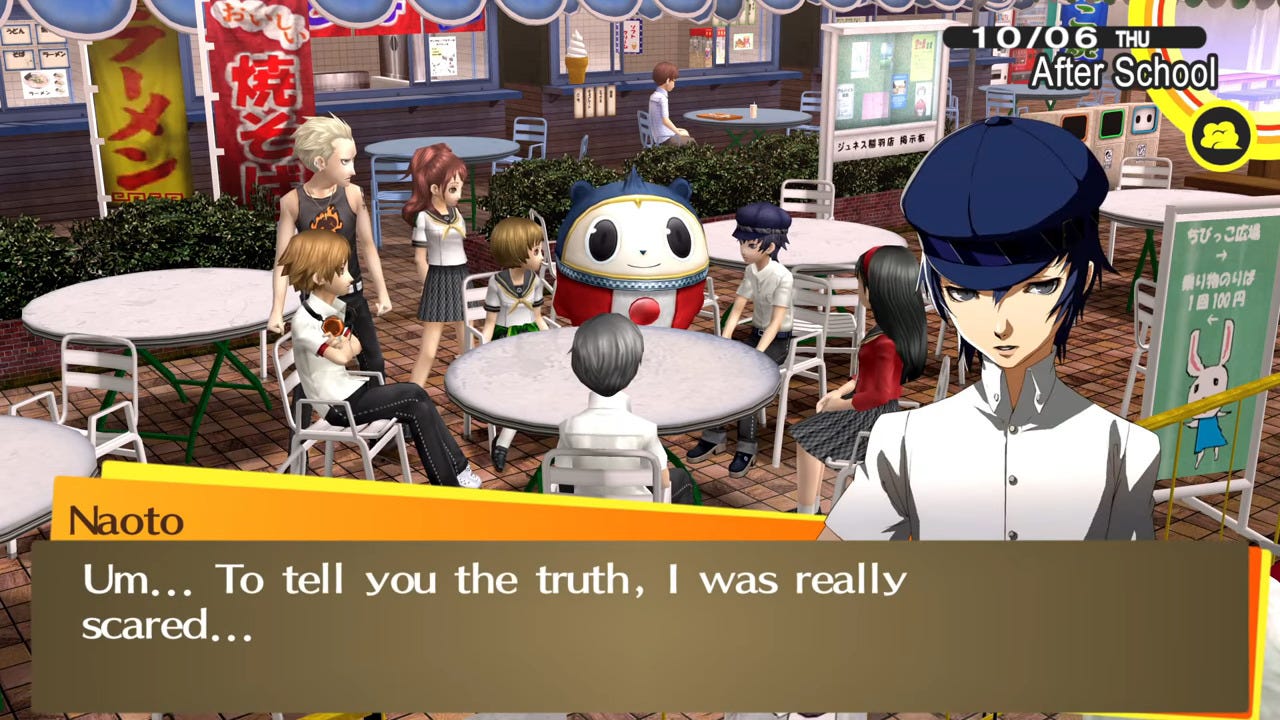
Another successful rescue doesn’t discourage our relentless criminal, though. The Midnight Channel commences broadcasting again, giving us a peek at our next victim - this time a startling shift from prior abductions, the 7-year-old Nanako Dojima - protagonist Yu’s cousin, and a dear friend to the whole team. In our first operation with an actual detective contributing to the cause, Naoto hastily springs into action, organising the facts and leading the team on their most vital mission yet.
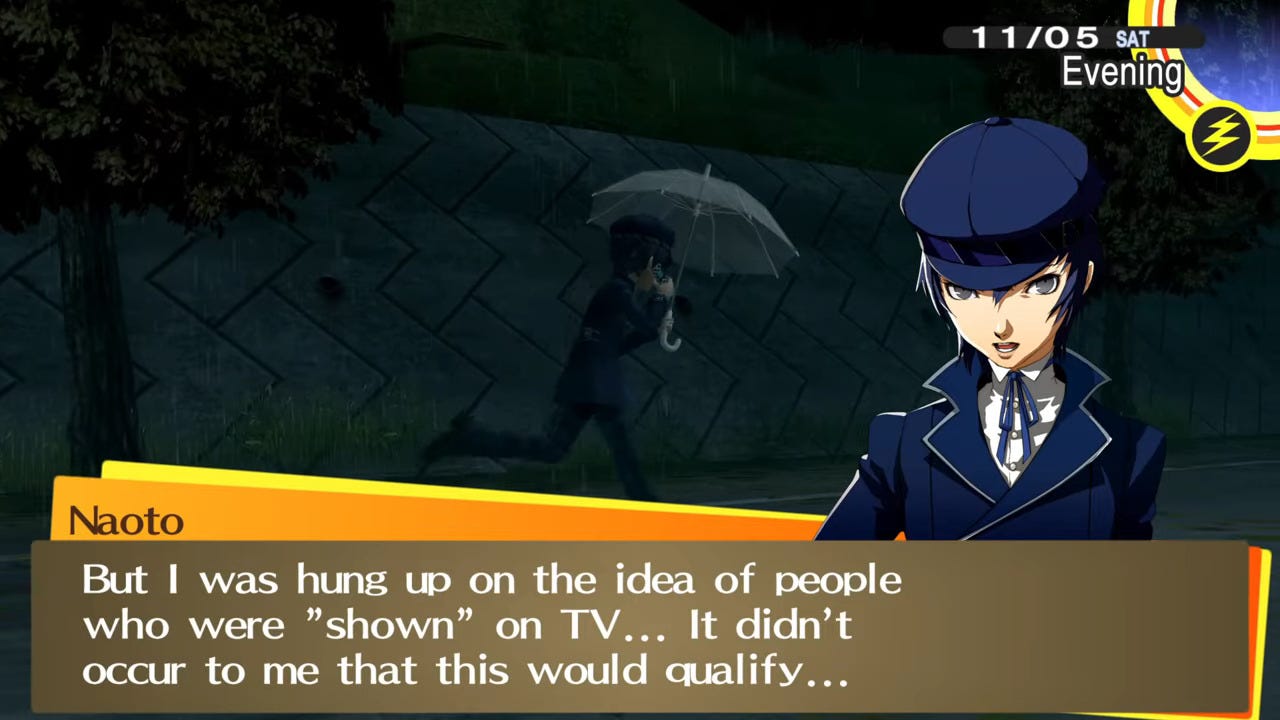
Her impressive swiftness proves to be a major advantage, as our Investigation Team arrives at the scene just in time to finally catch the culprit red-handed. This brings us to the story’s main climax, leading into an extraordinary number of events happening in rapid succession. To summarise - Nanako Dojima, a young child still overwhelmed with grief at the loss of her mother, is abducted by our notorious kidnapper. Learning of this incident, her father - police detective Ryotaro Dojima - springs into action, forsaking the bureaucracy of his incompetent workplace to pursue the suspect himself. A violent car chase ensues, and Detective Dojima is left in critical condition, still oblivious to the location of his only remaining family member.
While the culprit is able to escape to the TV World, his truck leaves behind many clues as to his methods, and a notebook containing personal information on all the prior victims provides undeniable proof of his involvement. Another successful expedition sees the team return safely with victim Nanako, alongside a new suspect - ex-council secretary Taro Namatame.
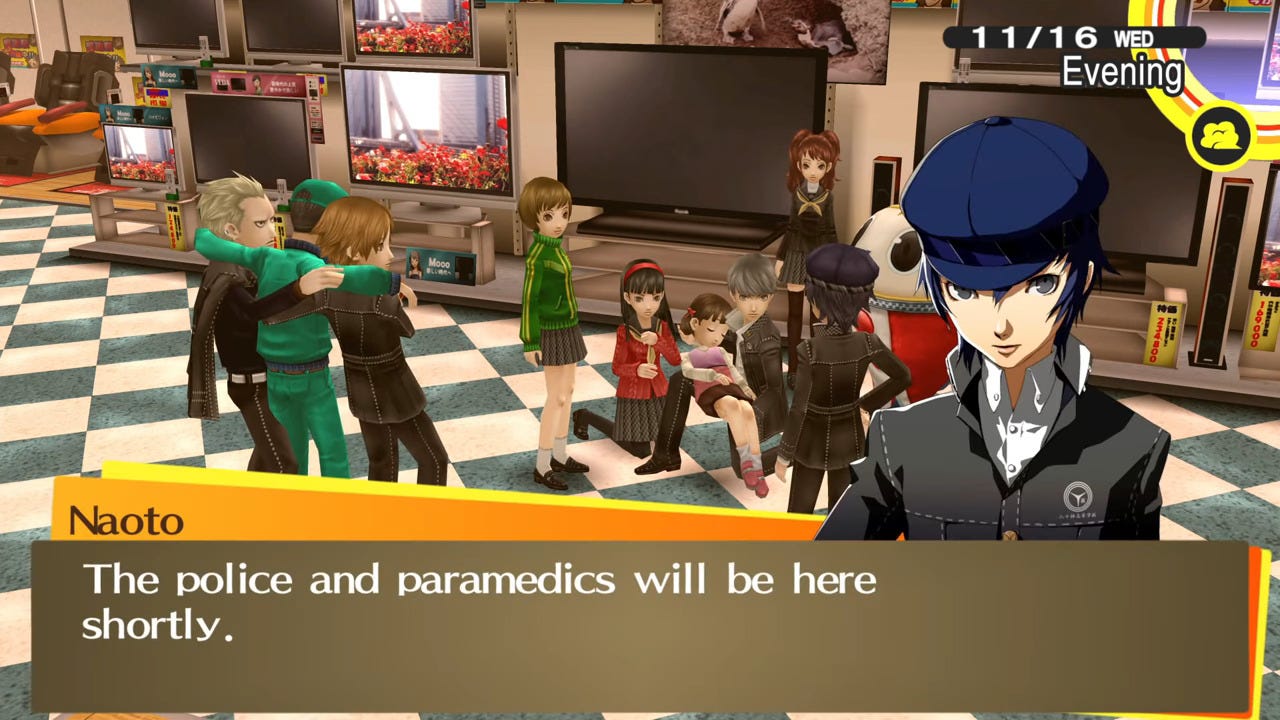
Optimism begins to rise surrounding the outcome of the case, as Namatame’s capture leaves few loose ends to be tied before the crisis burdening Inaba can finally be brought to a close. However, things take a turn for the worse when Nanako unexpectedly passes away from medical complications, becoming the first new casualty related to the case in seven months. Realising that the suspect’s methods are unlikely to yield enough solid evidence to hold up in court, grieving father and detective Ryotaro Dojima impulsively escapes his hospital room to confront the man responsible.
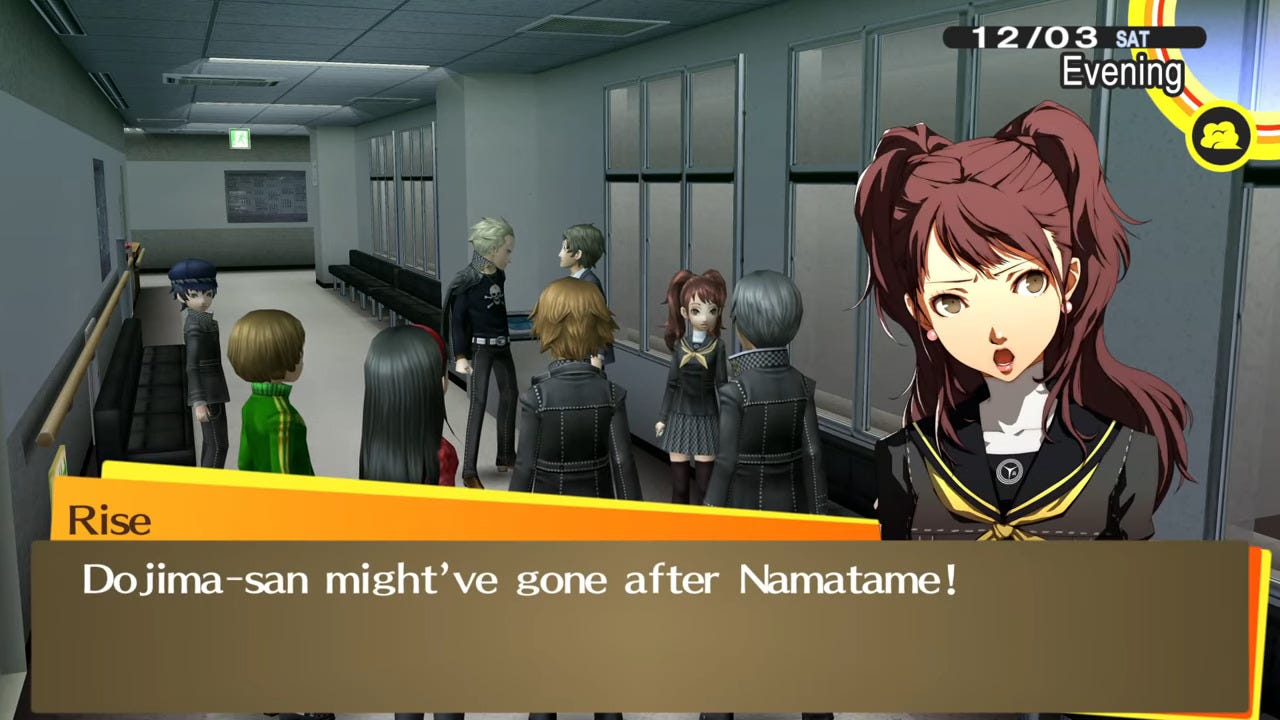
Dojima is quickly escorted from the hallway by hospital security, and those staff becoming occupied leaves the door to suspect Namatame’s hospital room as a major blind spot, a circumstance that the team promptly decides to take advantage of. Discussions on how to proceed are interrupted by a loud thud - quickly confirmed to be the sound of the suspect trying to flee via a large window.
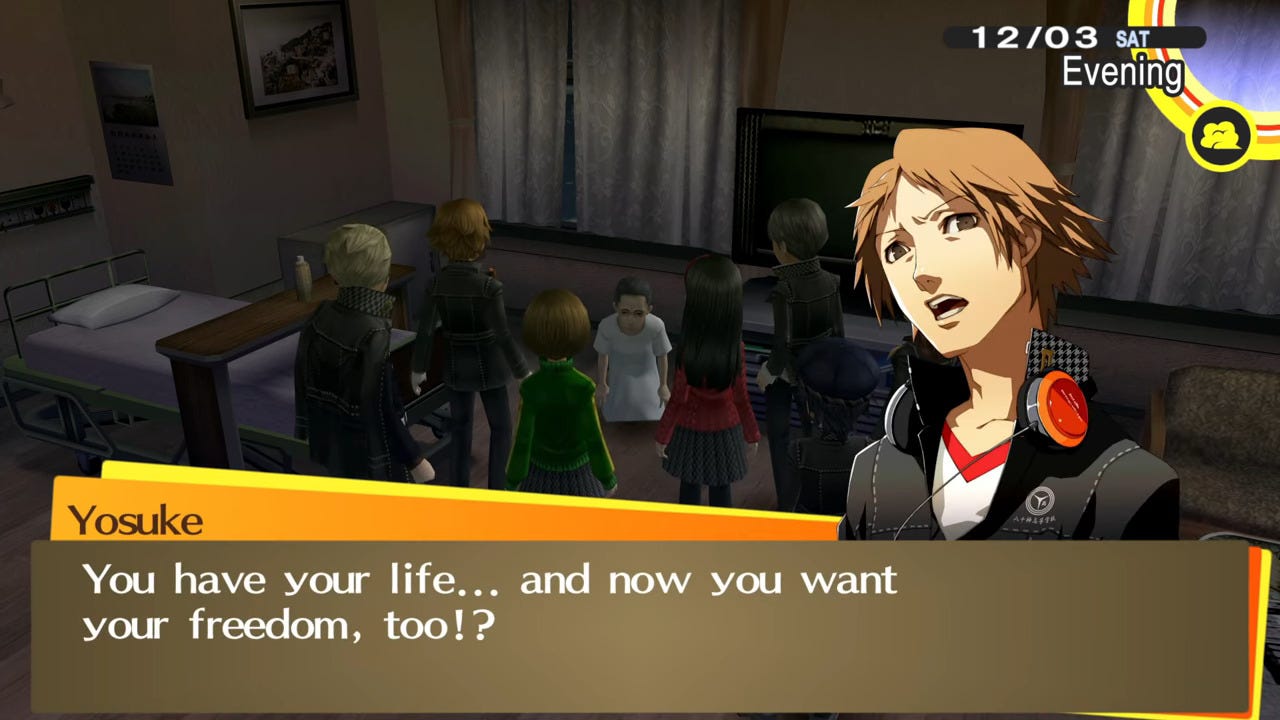
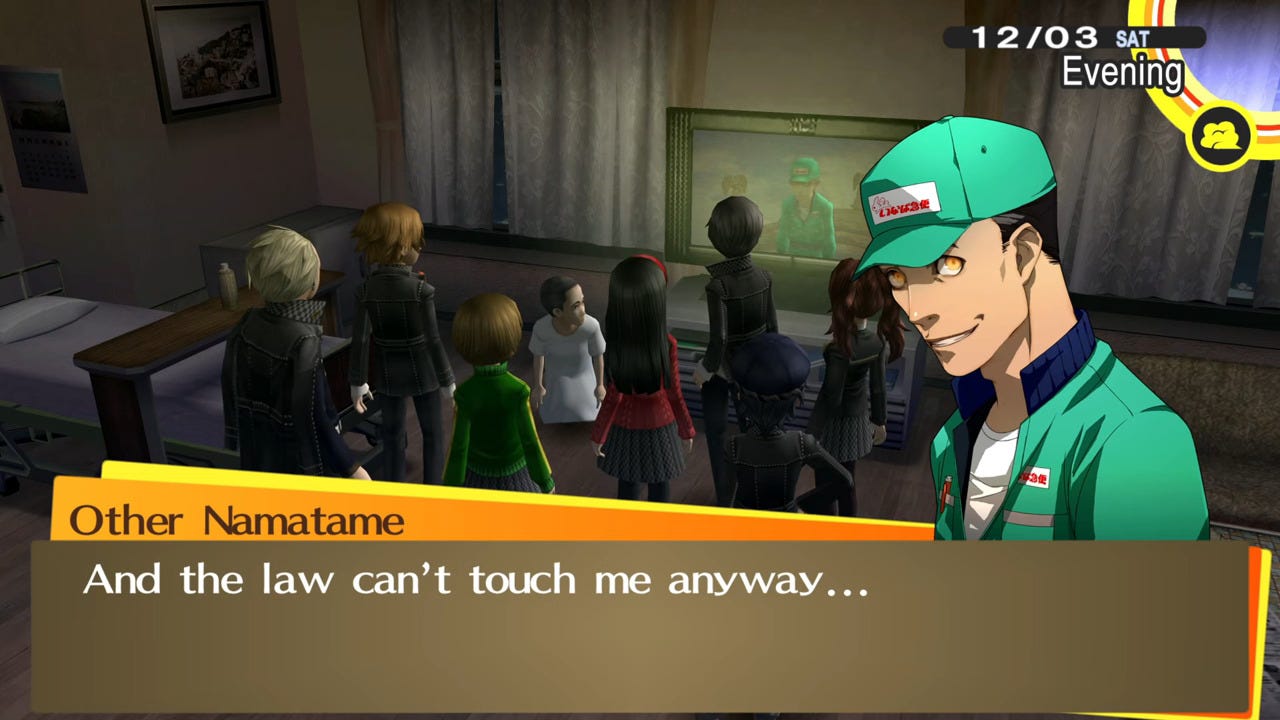
Left unsupervised in the company of the man behind it all, the stakes dramatically rise. Namatame cowers in fear, seeming incapable of displaying any remorse for his crimes. Running out of options, Naoto - the detective responsible for getting us this far - proposes a solution they’ll never be able to take back.
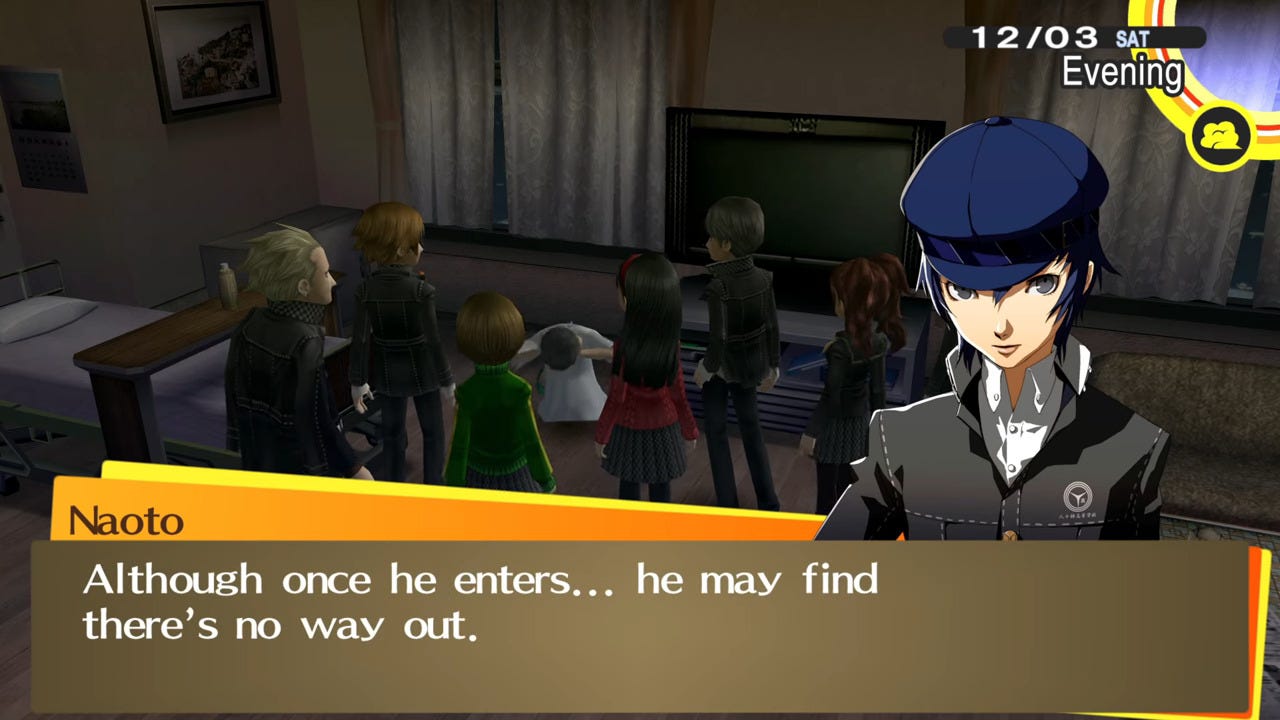
At the idea of throwing our suspect into the TV World, the conversation quickly devolves into age-old moral clichés - does killing a murderer really make us any better than him? Is death truly the worst punishment for such unforgivable crimes? Saddled with all the swirling emotions of anger and resentment in both the player and the Investigation Team alike, the group begins to take sides.
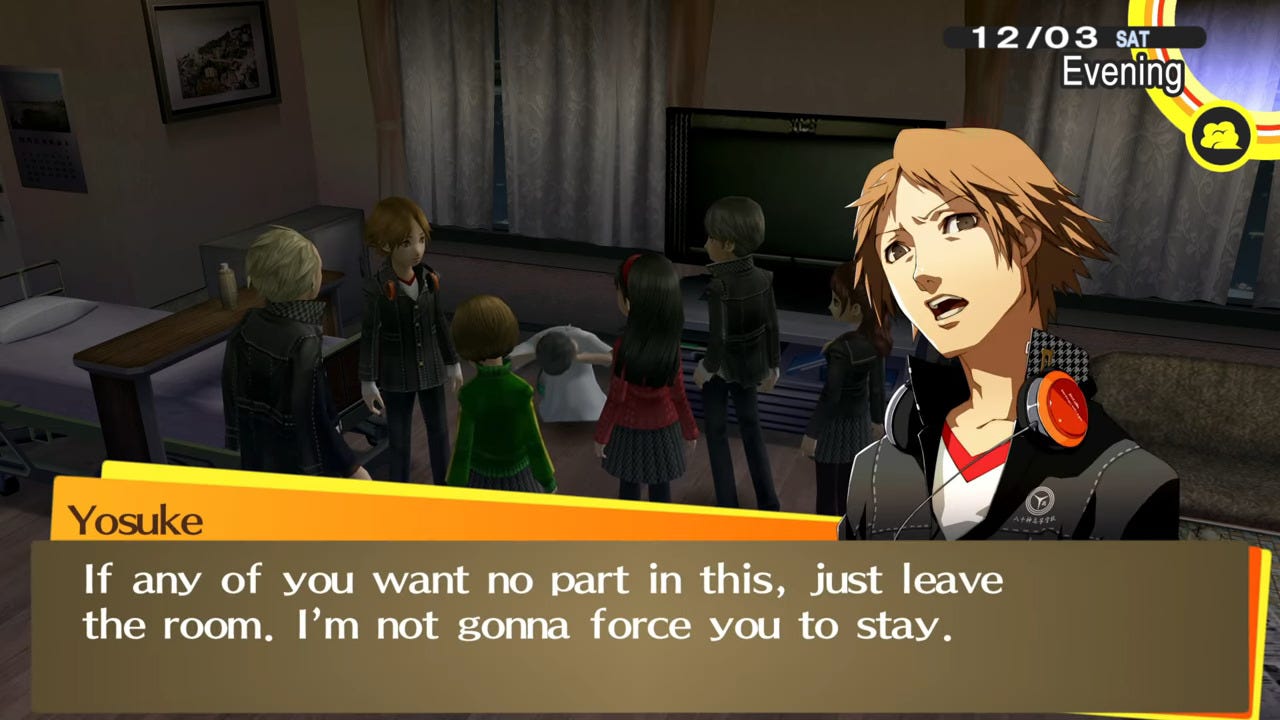
In the midst of this heated dispute, the game finally offers the player an option to intervene - beginning with the option to interject with “Wait a second here…”. Should they choose to do so, they begin walking the path to presenting another viewpoint for discussion - is he even at fault here? If the player is successful in picking the correct options to calm the group down, the truth starts to come out - we can’t say for sure. While Namatame may have been caught in the act at the scene of the crime, there’s still many unaddressed pieces of evidence that just don’t fit the notion of him being the true culprit behind everything.
Persona 4 yet again tries to catch the player out here. It’s the same trick we’ve seen used time and time again already over the course of the story, and yet when applied to a different set of circumstances with a much more tangible emotional weight behind them, the game might just succeed again in proving how easily manipulated a person can be. The ethical and moral challenges should’ve never been the first step, and the necessary inquiries into the full truth had been forsaken in pursuit of an ill-advised sense of justice.
Had the player been misled into killing Namatame - or even faltered in their conviction at any point - it’s entirely possible for the game to come to an abrupt end here, leaving them at an unsatisfying conclusion with no insight into the future consequences of their actions. Proceeding on the correct path, however, we’re once again met with interference as a doctor finally returns to the room and forcibly escorts the team outside.
While we wait for another opportunity to question the suspect, there’s a few questions quietly alluded to in the meantime. Word of mouth regarding recent events rapidly spreads through the distressed community of Inaba and a collective sense of anxiety is once again clear to see among its populace. These residents don’t share the same yearning for the truth that the Investigation Team do, they desire immediate solutions, they want a return to their daily lives without the lingering threat of a violent criminal on the loose.
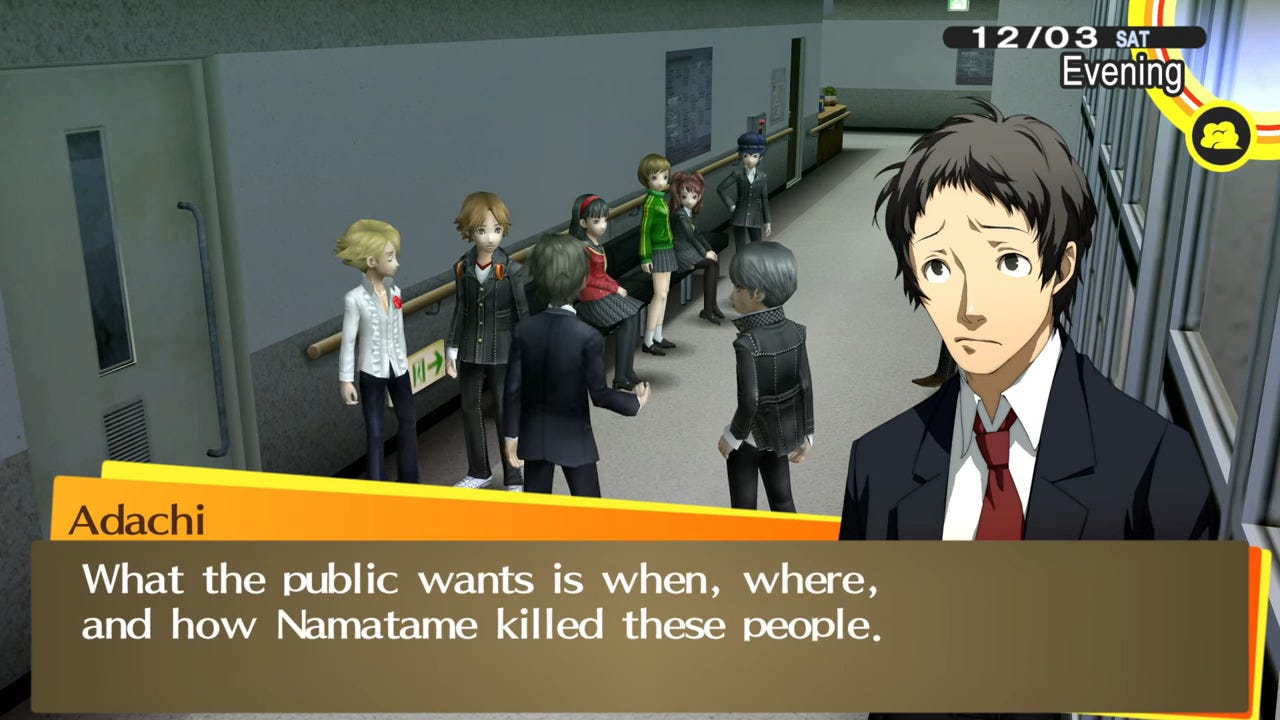
With that in mind, is it really the correct option to reject their wishes in pursuit of the ‘real’ truth? Our suspect is still the one throwing victims into the TV World, regardless of his motive. The murders and disappearances would come to a stop following his arrest, which is all the community needs to hear right now. With the connection we’ve formed to this town and all the efforts we’ve put into revitalising it - is it right to throw it back into turmoil?
It all comes back to the topic of convenience, and the value we place in it. The idea of Namatame being the sole culprit can certainly be considered a ‘convenient truth’ - it’s not completely a lie, and while the ‘full truth’ is yet to be exposed to the public, will Inaba’s community recognise the importance of unraveling all the remaining little mysteries when they could instead have real solutions right now?
Regardless, there’s no moves to be made just yet. Namatame is in no condition to answer questions, and his methods leave behind no valid evidence to build a case against him. Another night passes with many enigmas left to solve, and the next day presents one more chance to shed light on the truth.
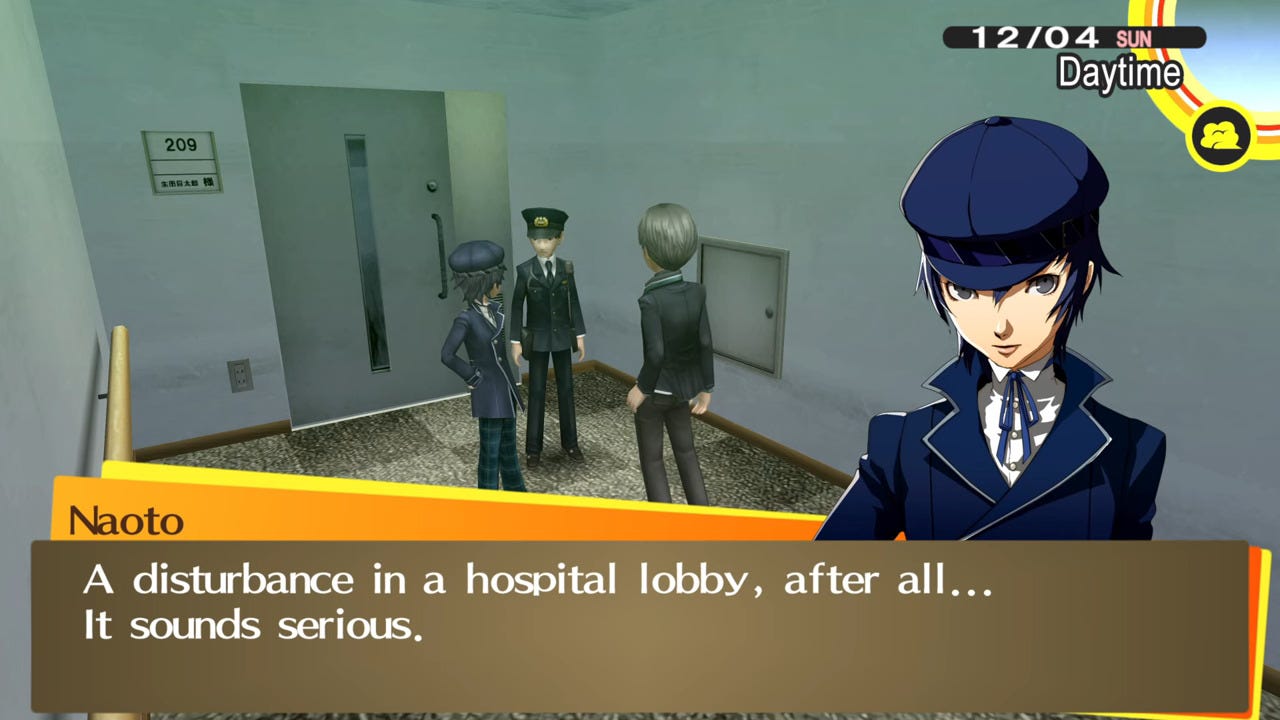
Following a night’s rest to regain his composure, suspect Taro Namatame becomes noticeably more conducive to participating in a discussion. Desperate for answers, the team reassures him that they’re the only ones capable of understanding his story - and the only ones willing to consider his viewpoint as a potential truth.
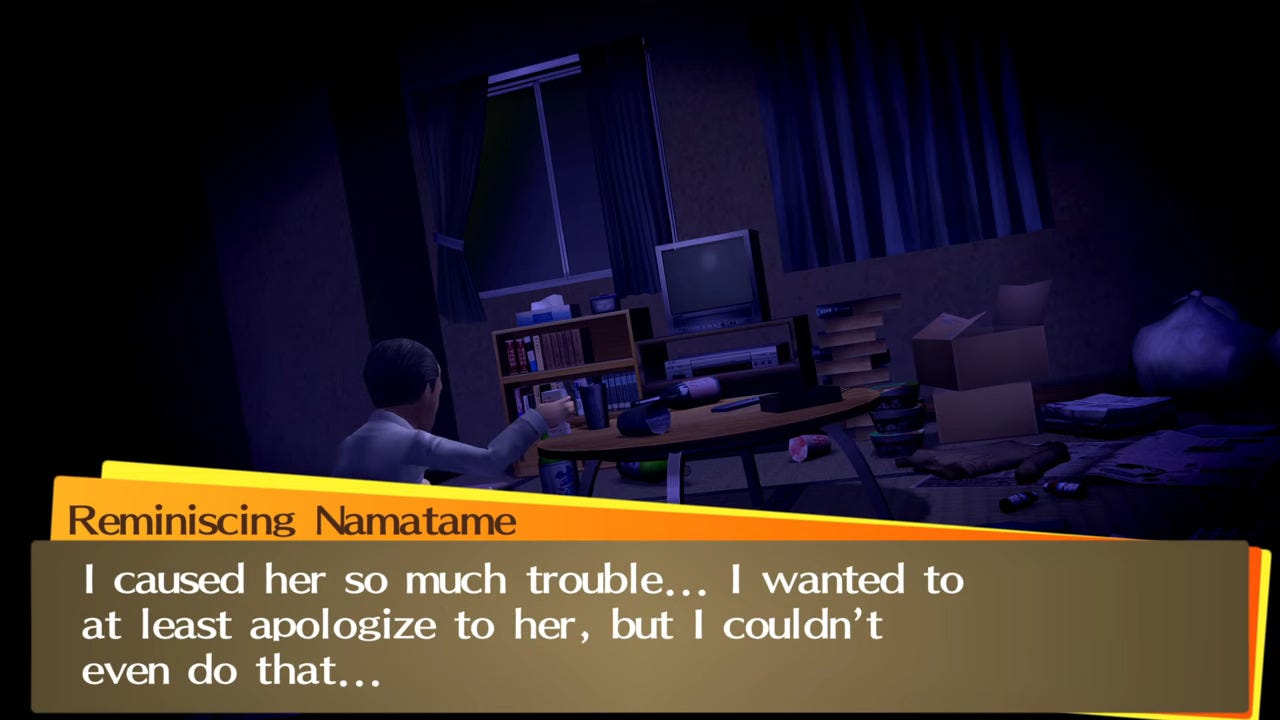
Allowing Namatame’s story to come to light reveals a shocking truth that had gone unseen - as it turns out, our main suspect fell victim to the exact same tricks as we did. In reality, if he is to be believed, the first two disappearances resulting in the victim’s death were not his undertaking. He merely happened to spot the same pattern that set the Investigation Team into motion - the rumoured Midnight Channel foreshadowing the first two murders. Armed with this knowledge and all the grief of his beloved Mayumi’s passing, Namatame deludes himself into believing his newfound ability to enter TVs is a gift to grant him the power to prevent further tragedies, and sets in motion a plan to track down the next victim.
Unfortunately, it works out. Yukiko Amagi makes an appearance on the notorious Midnight Channel, and he uses his family’s delivery business as a means and a cover for his first ‘rescue’ operation, throwing the victim into the TV himself. Due to the actions of another party - the newly formed Investigation Team - following the same trail, Yukiko makes her way out alive, visibly unharmed. Perfect, he proclaims, as in Namatame’s eyes his new gift had allowed him to safeguard a young woman’s life - and so begins a peculiar case burdening the town for months, nurtured by two parties unwittingly participating in a large-scale game of cat-and-mouse, both acting only in the best intentions.
Despite Namatame’s scheme being the more harmful plot in reality, at a more abstract level it’s almost a perfect mirror of the journey the player had taken at this point - placing all their faith into rumours and happenstance, carrying out a dangerous plan without a clear understanding of the circumstances. The relatability between the player and the suspect at this moment in time is palpable, standing in stark contrast to the day prior when prematurely ending his life had been a serious consideration.
Final warning for major Persona 4 spoilers. The next stages of the investigation reveal the story’s true antagonist.
With this new information in mind, the team sets their sights on uncovering a new suspect - the original culprit, the person responsible for the first two murders. Eight months have passed since then, the trail has grown cold, and the group’s original plan to question Inaba’s residents once again regarding sightings of suspicious persons turns up very little new information.
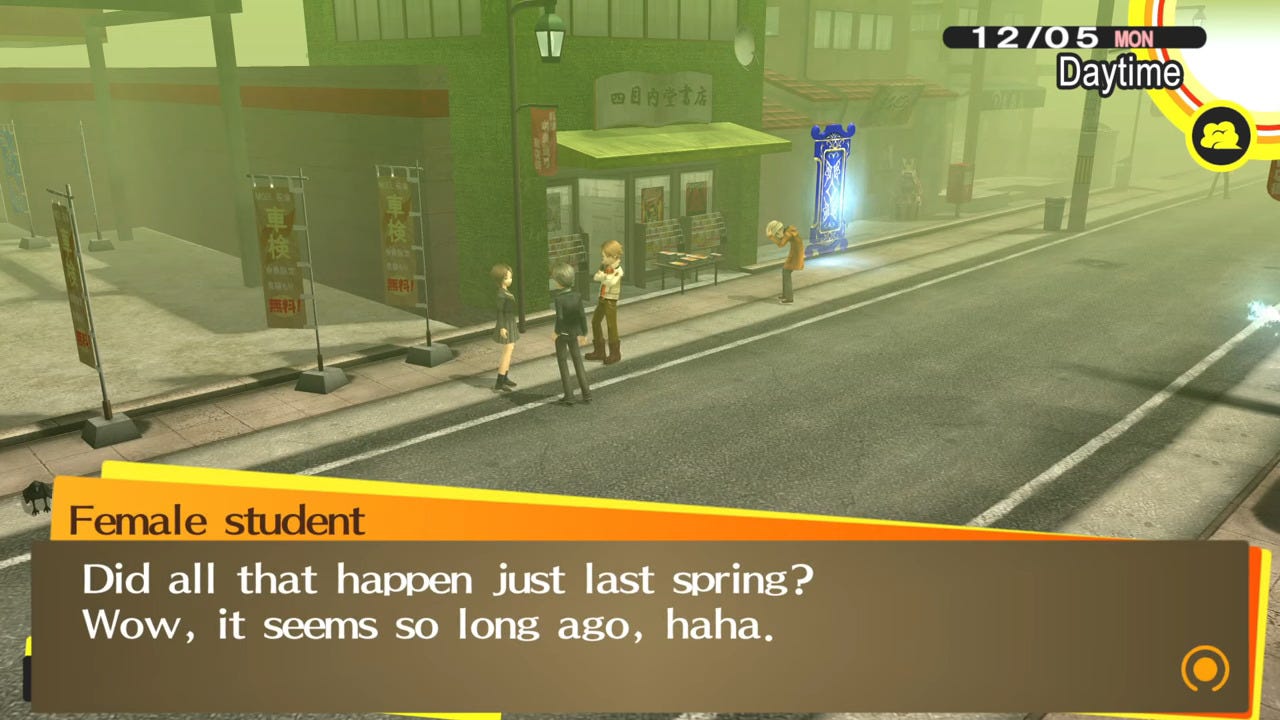
Following a meeting over dinner at the local Chinese diner, compounding all the small fragments of information gathered over the course of the case turns out to form a vague profile, and the player is given the comprehensive list of potential options to pick a suspect from. There’s no repercussions for picking incorrectly, but with further consideration, one otherwise unassuming person does appear capable of fitting all the necessary criteria - police detective Tohru Adachi.
Sure enough, upon confronting Adachi, his friendly facade drops as it becomes apparent that he knows exactly why you’ve arrived to visit him. Foolishly, our culprit drops us our first concrete evidence - and when cornered, swiftly escapes through a TV.
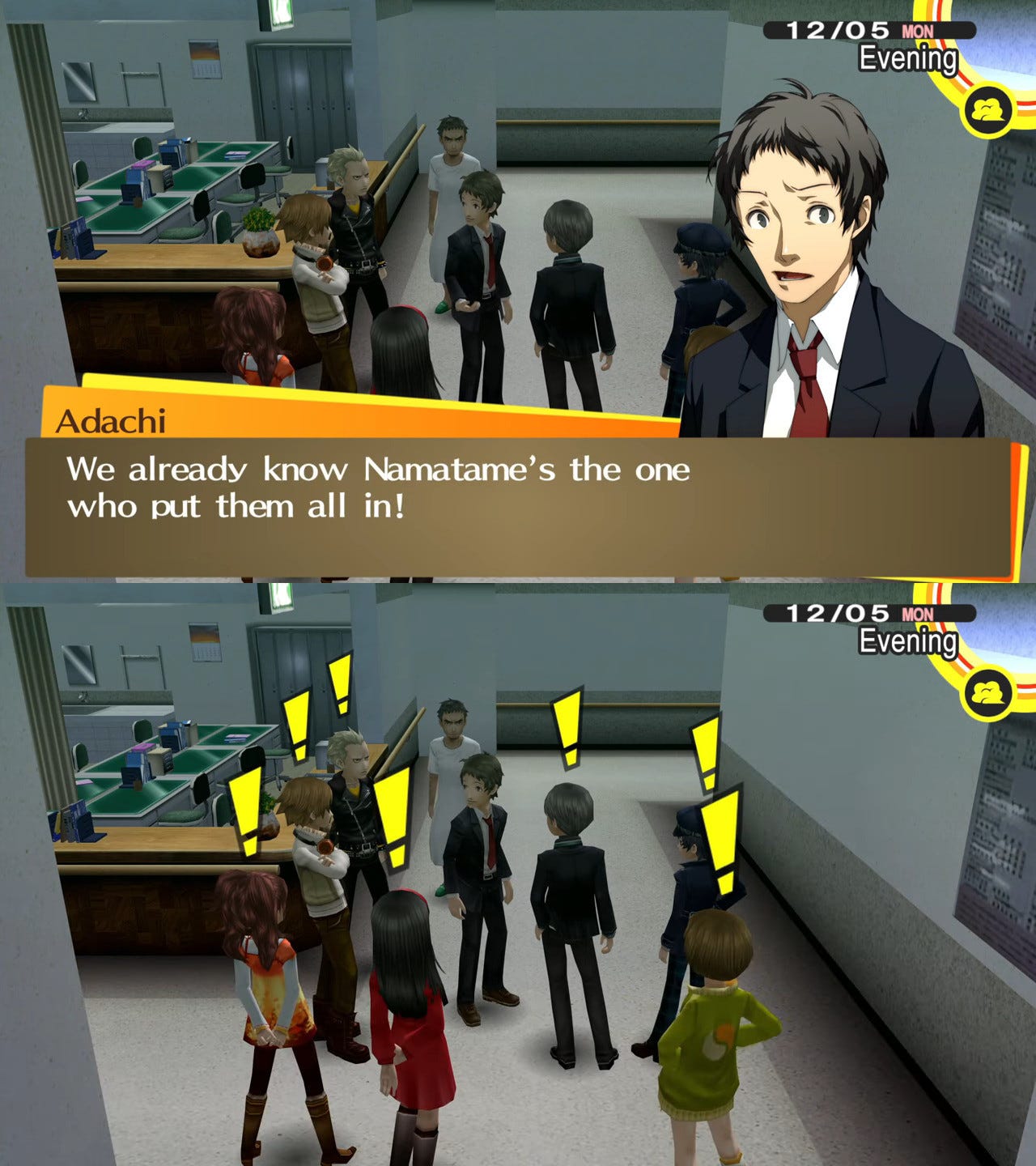
Pursuing yet another suspect into the TV World leads us to uncovering an unsettling predicament. Culprit Adachi has been possessed by Ame-no-Sagiri, the Japanese mythological god of fog - a recurring visual metaphor throughout Persona 4. Commanding suspect Adachi’s body, Ame-no-Sagiri details the consequences of our relentless search for the truth - the TV World is beginning its gradual fusion with reality, starting by saturating Inaba with a dense fog.
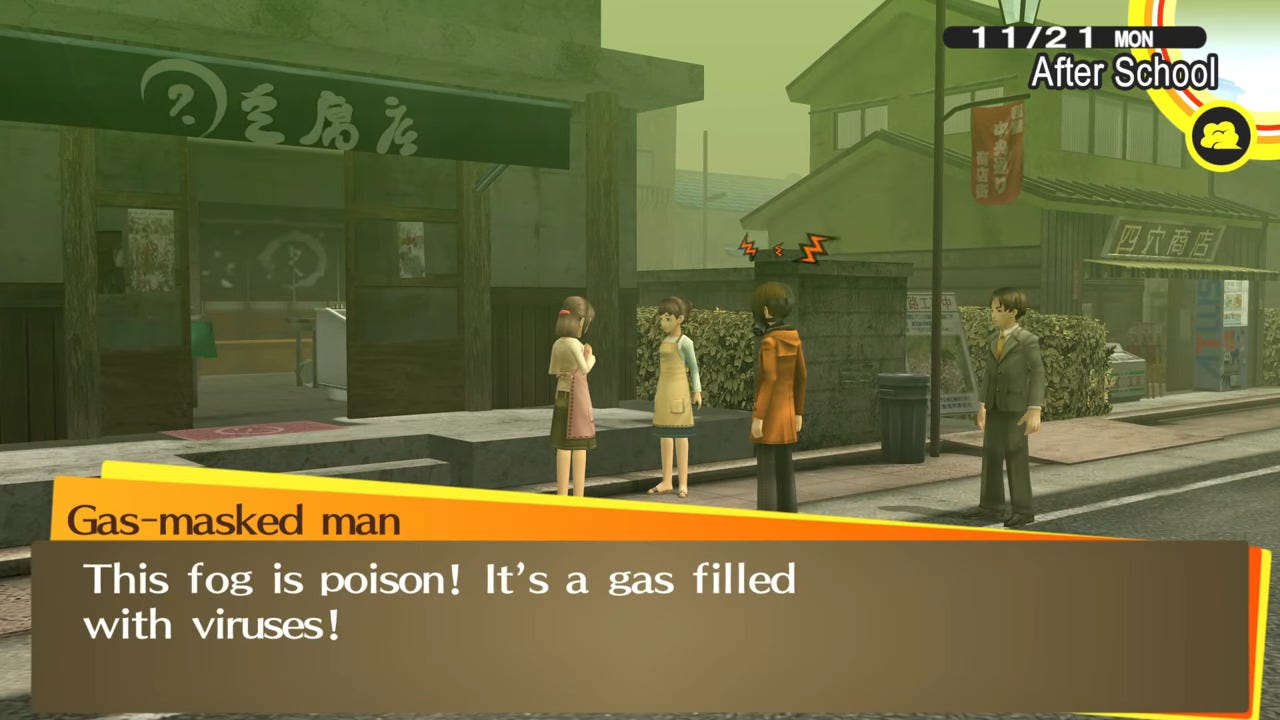
This fog presents the biggest challenge yet for Inaba’s community. Rumours and fearmongering regarding the fog’s chemical makeup and side-effects rapidly spread among concerned residents, with those most detached from reality beginning to anticipate the end of the world. The sight of them represents a major setback for the town, forcibly pulling its populace back into a state of frenzy when they had been so close to peace just days prior. Regardless, the decisions have already been made, so the only option for the team now is to defeat Adachi.
The true culprit’s confrontation inside the TV World reveals a previously unseen side to him. Beneath all the supernatural elements involved, Adachi is an absolutely perfect fit for Persona 4’s narrative, as he’s one of the most ordinary characters among the cast.
The 27-year-old police detective illustrates his fairly typical backstory - he followed the standard path in life, studied diligently through school, attended college, landed a respectable job, and generally did everything anyone expected of him. However, the satisfaction in life he’d been promised simply never materialised - he felt trapped in a dead-end career, living alone in a plain apartment, stuck in an unceasing cycle of making it through each day in anticipation of a future that’d never arrive.
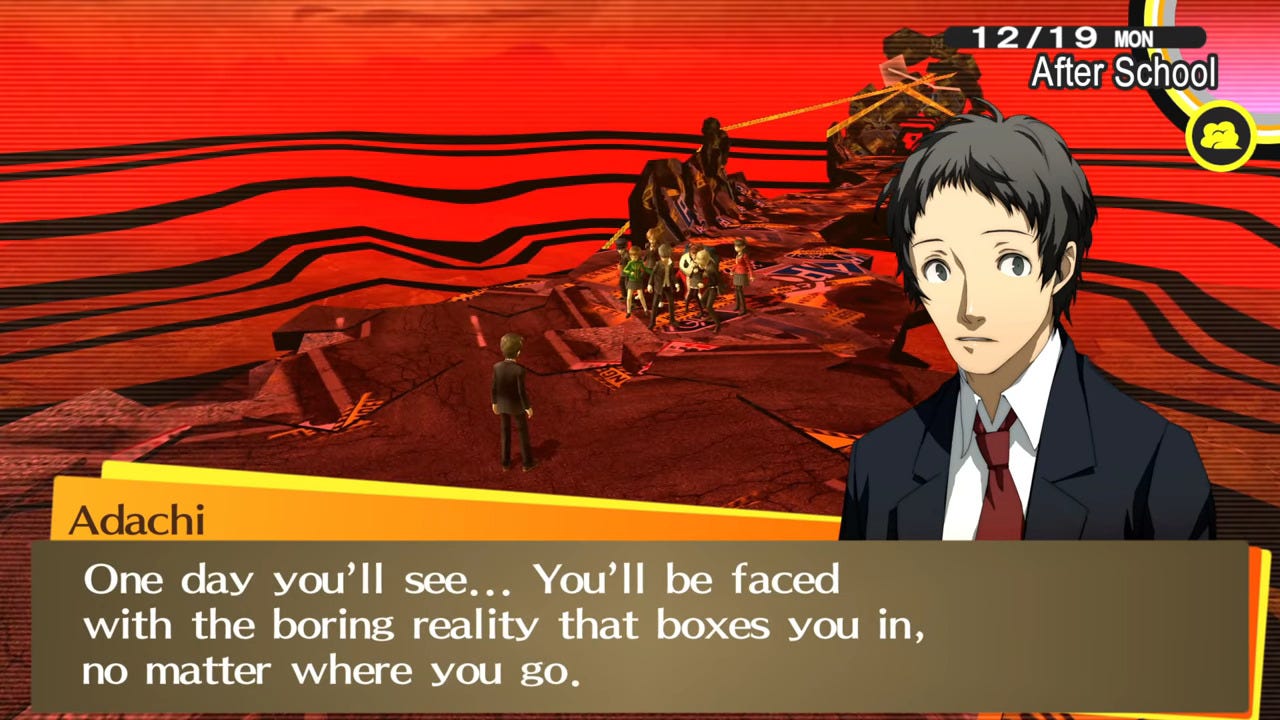
What makes this confrontation so effective is that it’s highly likely that the player knows an Adachi in their real life, or sees part of themself in him - a person who’s well-adjusted by all appearances, living indifferently through each day in the life that had been set out for them, while harbouring a deep sense of loneliness and boredom hidden within themselves. While it’d be irresponsible for the game to insinuate that the player’s friend, co-worker or family member - or potentially even the player themself - might be one step away from committing a tragedy, it’s easy to see why the possibility was so enticing to the Adachi of this story - an unassuming man with an unopposed attitude of casual misogyny and self-centeredness suddenly granted a completely untraceable method to kill whoever he desired.
Adachi’s two victims were a result of the exact circumstances you might’ve expected. The first is Mayumi Yamano, famous TV presenter and romantic interest of previous suspect Taro Namatame, as she’s left in our culprit’s protective custody. Newly aware of his ability to erase evidence and guarantee no consequences, he decides to make unwanted advances on Mayumi.
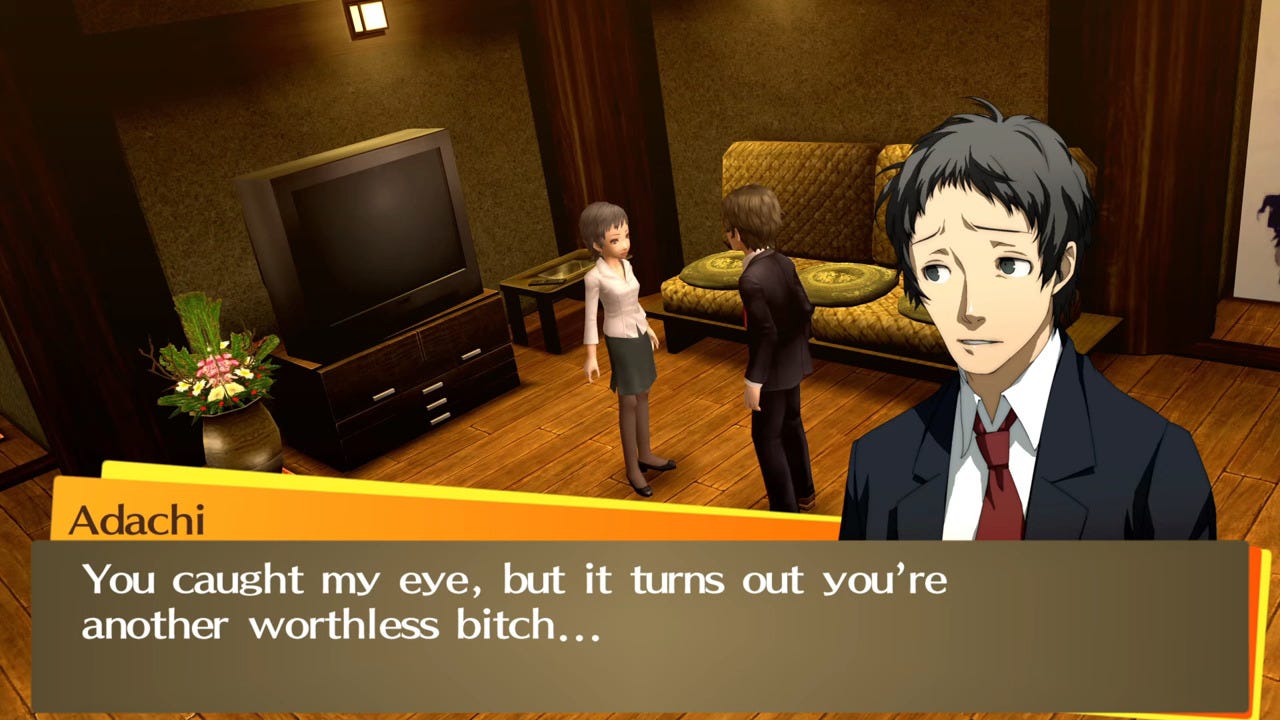
Immediately following the confirmation of Yamano’s death, Adachi decides his next victim in a spur-of-the-moment decision - Saki Konishi, high school student and discoverer of Yamano’s body, arrives at the police station for questioning. Overcome with jealousy at the sight of a high-schooler who seemed to have found enjoyment in her life, Adachi heedlessly begins to harass her.
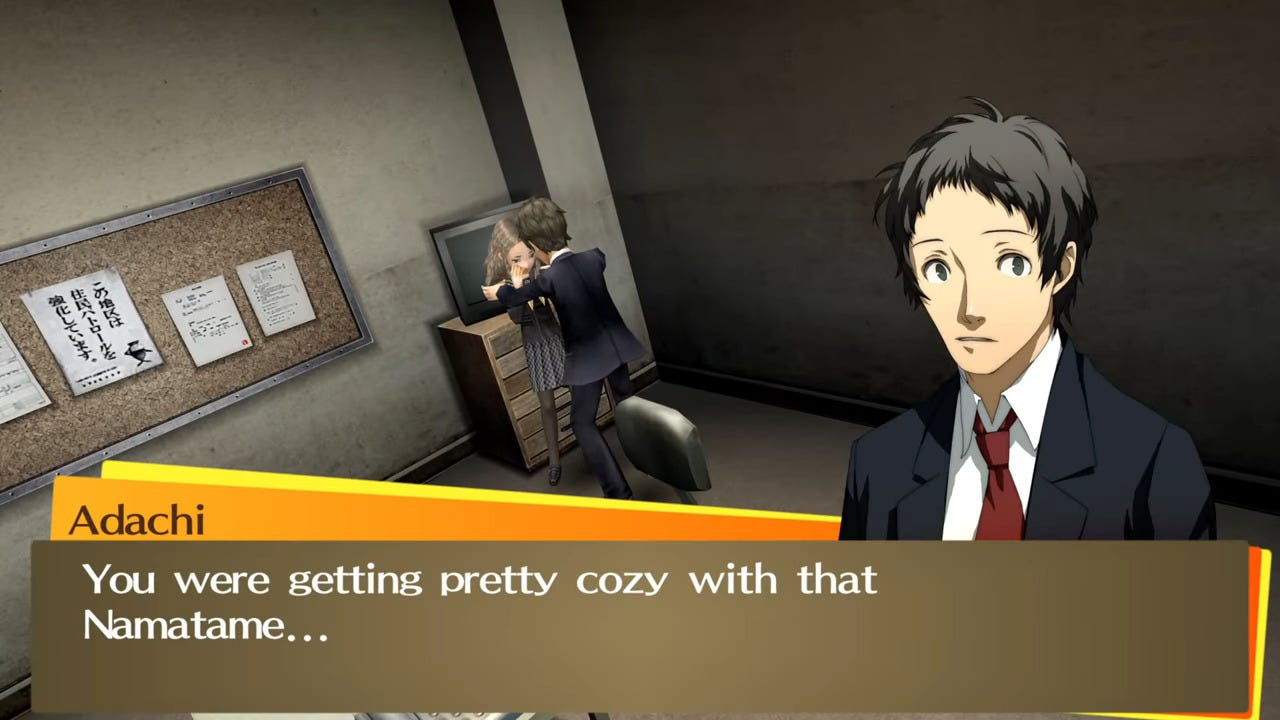
Without placing undue blame on anyone in particular, Tohru Adachi serves as an extreme example of the unsavoury attitudes that might be lurking beneath the surface in ordinary people as a result of a wider unwillingness among society to address the mindsets we’ve developed. Throughout Persona 4 so far, the game has repeatedly promoted active thinking into the everyday sentiments that we typically take our understandings of for granted - and the otherwise unremarkable Adachi makes a perfect vessel to explore the tangible impacts they have on society.
Defeating Adachi in battle sees Ame-no-Sagiri take control of his body once more, this time detailing its involvement in the existence of the Midnight Channel. It presents the idea that human nature doesn’t value truth, and we long for the ability to see only what we wish to see, and believe what we wish to believe. Much like regular television broadcasting, the Midnight Channel was created to facilitate this - only in a more direct manner, as it effectively served as a window to the human subconscious. We saw the victims appear on that channel solely due to the media planting those images in our minds, and they lingered there as we subconsciously longed to see more of them.
Declaring Ame-no-Sagiri to be truly wrong here proves to be a difficult task - Persona 4 has proven time and time again by now that we may be more susceptible to manipulation and false preconceptions than we’d like to admit. Whether it’s from the TV and the mass media, or if it’s simply from the people around us - picking and choosing the facts we want to believe has always been an easier route through life than pursuing the full truth at every opportunity.
This confrontation is Persona 4’s most overt presentation of the narrative’s core themes and messages, and one that serves as an anchor interconnecting all of the various topics discussed thus far. Adachi and Ame-no-Sagiri strongly parallel each other here - the former being a more grounded insight into the effects of society’s mentalities on a single person, while the latter acts as a more abstract representation of the greater issues behind them.
Hazardously proclaiming that humanity has the potential to live without the distractions of the comforting false images, the Investigation Team bravely challenges the god. Ame-no-Sagiri accepts their invitation, and reveals its true form for one final battle.
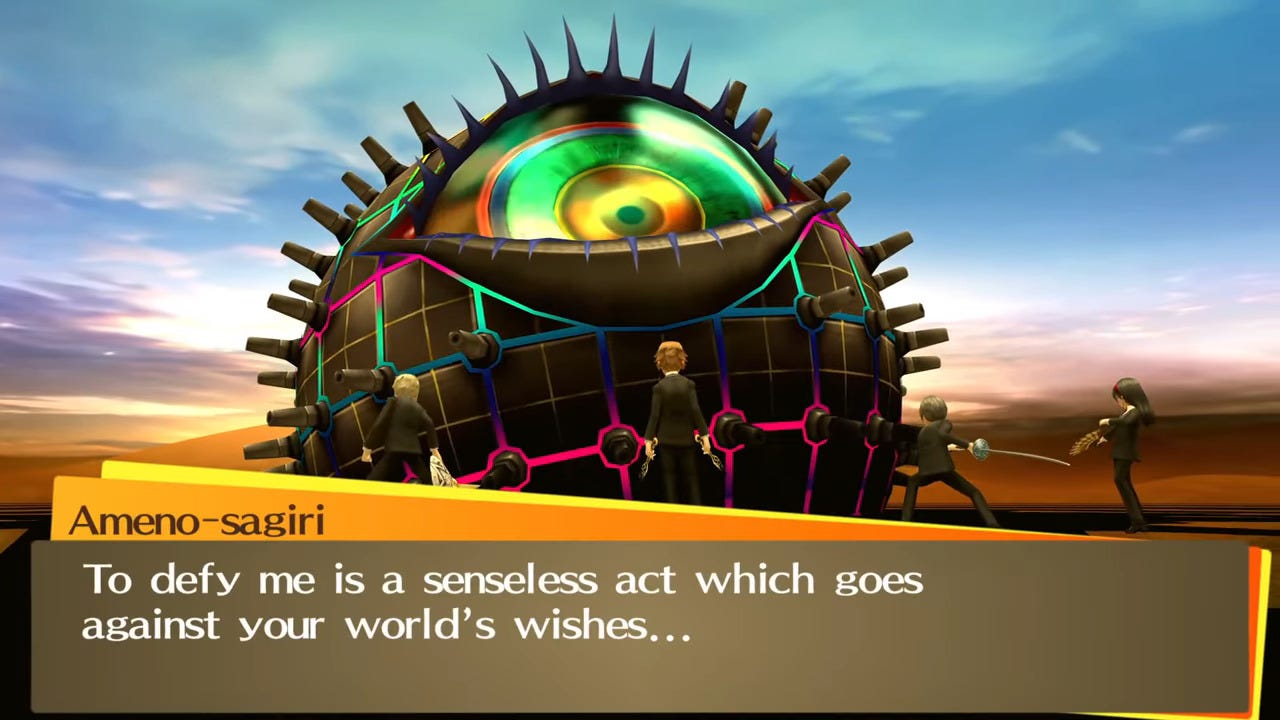
Upon its defeat, Ame-no-Sagiri reinstates the barrier between reality and the TV World, restoring peace once again to Inaba’s distressed community. The imposing god fades away, leaving behind Adachi as his original human self. The team celebrates their victory in Inaba’s refreshed, sunny streets, and time passes until the day that our hero Yu must return to the city.
In typical fashion for the modern Persona games, the player is given the opportunity to tour the town one last time and make their farewells to the characters they’ve formed bonds with over the long journey. Once all is said and done, it’s time to return home and finish preparing to catch the train tomorrow.
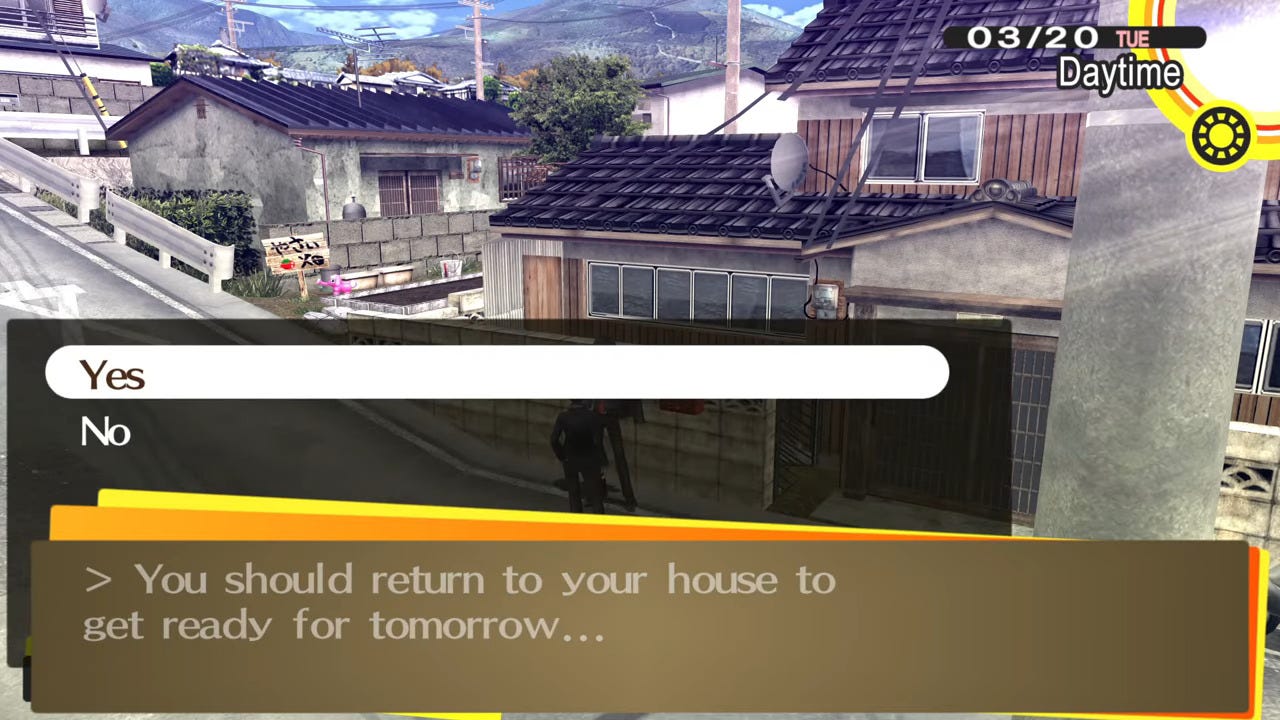
Adachi’s arrest has proceeded smoothly, false suspect Namatame’s name is cleared, and Ame-no-Sagiri no longer threatens the future of Inaba. It’s now time to take your well-deserved happy ending, take that train home and watch the credits roll.
…Did you really think Persona 4 was done tricking the player? No, of course it isn’t. The aforementioned prompt isn’t just a confirmation that you’re ready to proceed with the ending, it’s a quiet test of whether you’ve really taken the narrative’s lessons to heart.
If you’d have made a mistake any time prior to this, even those that result in a false ending, it’s somewhat obvious that you’ve made a significant error. Assuming that you didn’t overwrite your save data following the credits, it’s easy to return and make a different decision - but not this time. Selecting ‘Yes’ sends you to a completely inconspicuous ending that appears in no way out of place for a Persona game.
Now, all those questions that served as purely hypotheticals are flipped on you, the player, with real consequences this time. Was it the truth you really desired, or are you simply satisfied with the outcome now? Is it right to once again risk the serenity you finally secured for Inaba for the sole purpose of leaving absolutely no stones unturned?
If the answer to any of these questions leaves you in contemplation for any amount of time, you might just notice we’re still missing crucial information. Why did the TV world exist, anyway? Why were Yu, Namatame and Adachi the only ones able to access it? Who started the rumour of the Midnight Channel? Taking one last trip to the Junes foodcourt, the Investigation Team’s base of operations for the last year, we discover that the rest of the group had been independently pondering those same questions.
This cryptic method to achieving the true ending is one that’s been widely criticised over the seventeen years since Persona 4’s initial release, and for valid reasons - nobody wants to hear that they didn’t really beat the game that they had dedicated their last few weeks of free time to. However, given the purpose of its inclusion in the narrative, I personally believe it to be a brave design choice that demonstrates a rare faith in the player to understand what they truly wanted out of the story - after all, if you’re satisfied with the conclusion you reached, what’s so wrong with the journey ending prematurely?
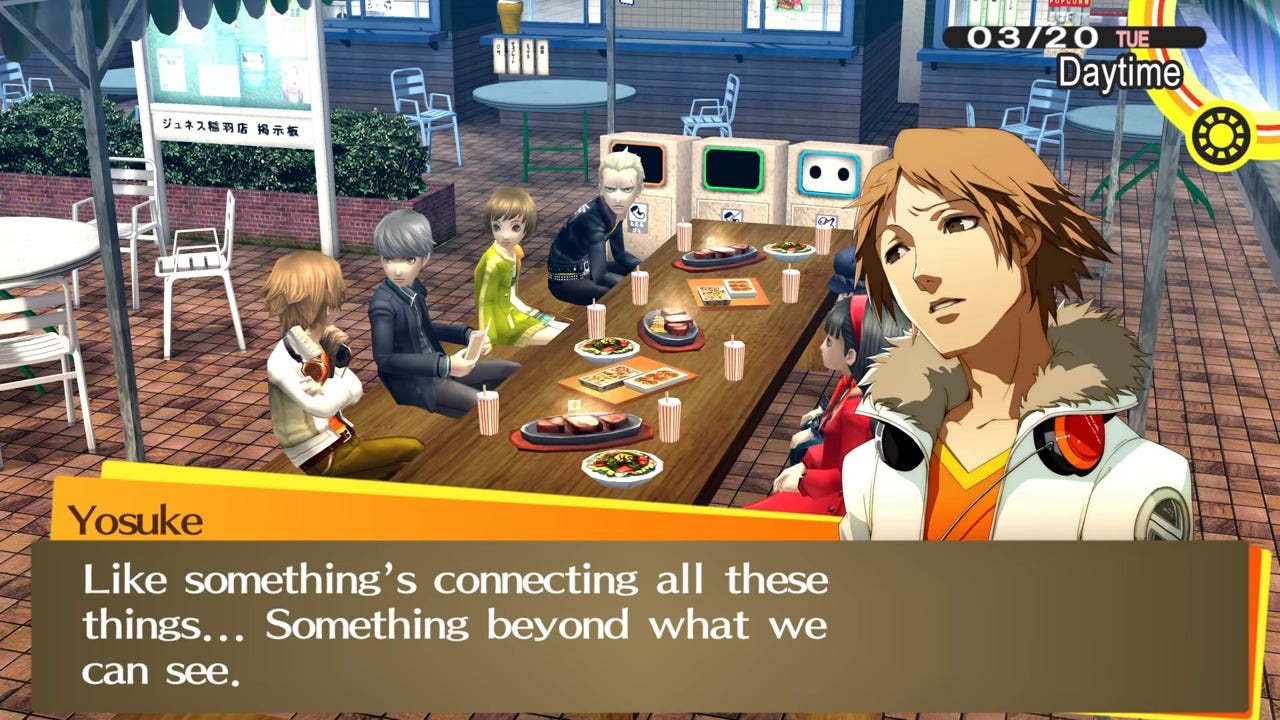
The conclusion reached by the team is that something must’ve occurred the day that Yu arrived in Inaba, as the lengthy murder case began suspiciously soon after. Shockingly, an investigation into the events of an unexceptional day over eleven months ago actually leads us to yet another otherwise inconspicuous figure - the town’s gas station attendant.
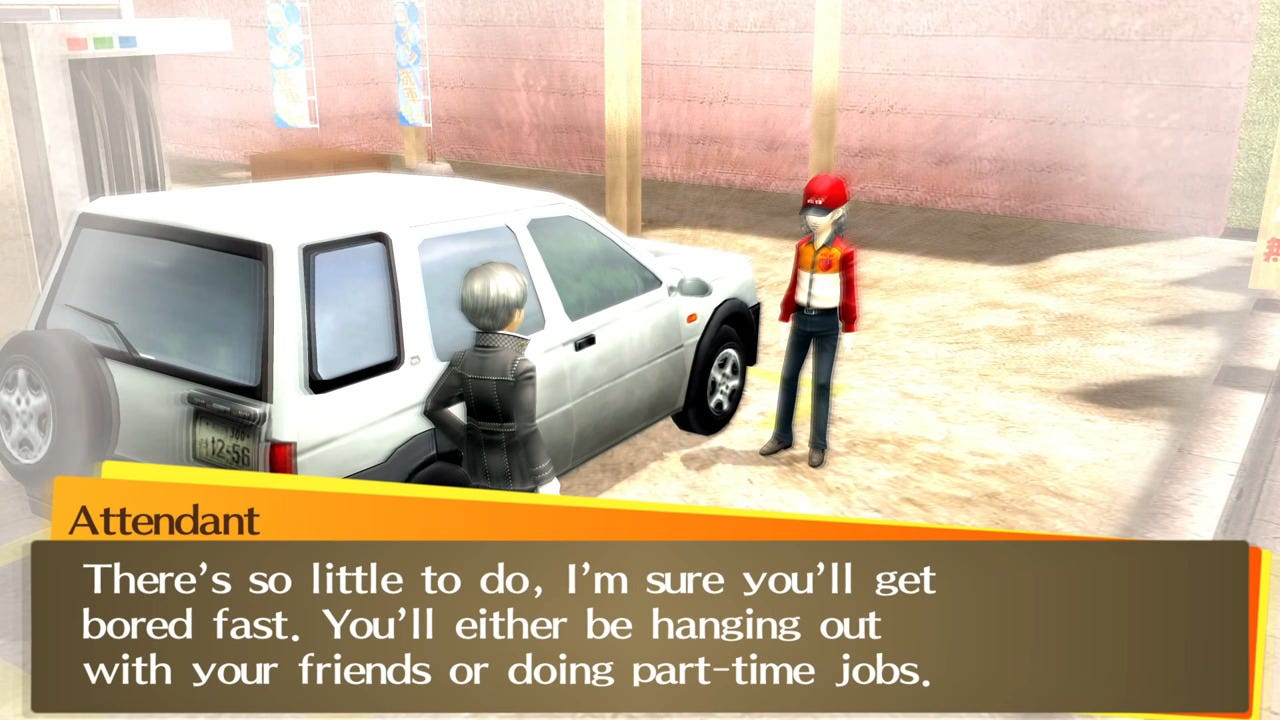
Upon confrontation, the attendant’s tone sharply changes, and she reveals her true form - another Japanese mythological god, Izanami.
The tale of Izanagi (represented in Persona 4 by the manifestation of Yu’s initial persona) and Izanami (represented by the attendant) is a major part of Japanese mythology, said to be the origin of Japan as a country. In short, the myth describes Izanami as having passed away due to complications in childbirth, and her grieving husband Izanagi pursuing her into the underworld to retrieve her. Izanami informs him that he cannot see her as she is already too deep into the process of her death, but her foolhardy husband is undeterred by her insistence. Following Izanami into the darkness, Izanagi sets his comb alight to reveal the shocking image of his wife’s corpse rotting away before his eyes.
Persona 4 twists this story to bookend its narrative, from Yu’s awakening to Izanami’s defeat, allowing it to closely parallel the player’s journey to the truth and the consequences faced by recklessly pushing further at each roadblock. Pursuing the game’s representation of Izanami abruptly plunges Inaba back into a deep fog as the team prepares for their final excursion - for real, this time.
Our final trial, Izanami, reveals the method by which she allowed the three subjects access to the TV World. Posing as the gas station attendant, she selected three people passing through based on three desired traits - Namatame representing despair, Adachi representing emptiness, and finally Yu representing hope. She created the TV World to facilitate her game, discreetly informed the three participants of the Midnight Channel, and spectated as they played their parts in a bid to discern the true extent of humanity’s desire for the truth.
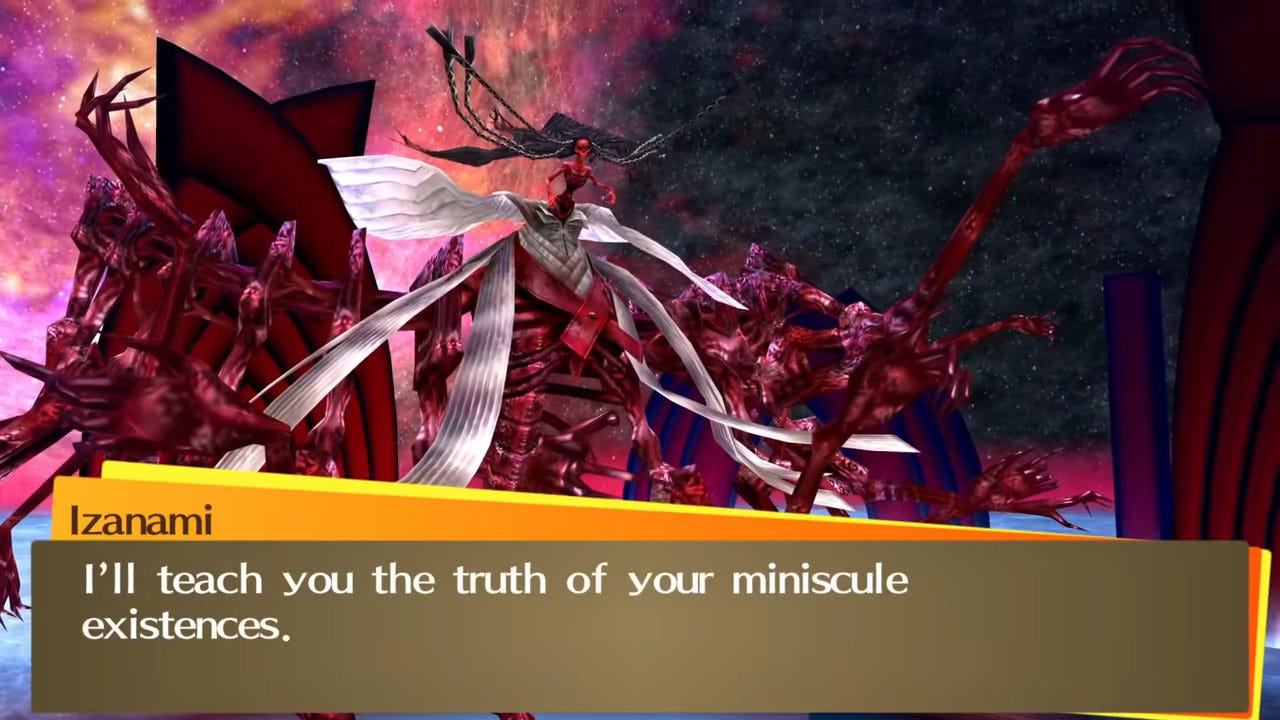
All three performed as anticipated, but in reaching Izanami, one shone distinctly more brilliantly than the others - the player’s avatar, having surpassed her expectations by flawlessly clearing every obstacle and evading every false conclusion along their journey. In defeating her, we learn the true consequences we would’ve faced if we hadn’t pushed this far. With Izanami still remaining, the world could’ve paid the ultimate price - her game could’ve transpired all over again, anytime, anywhere, with no guarantee of the outcome without the Investigation Team’s presence.
It’s the ultimate conclusion to Persona 4’s narrative, finally assuring the player that they made the right choices. All those decisions you made in pursuit of the ‘full’ truth, even those with immediate repercussions in the short term, were indisputably justified by the results achieved when observing them as a whole.
The game once again directly involves the player in proving the value of its message - not only in regard to its central theme of truth, but also in an abstract sense more widely applicable to our everyday lives. The correct paths in life, both on an individual and societal level, are rarely the easy, ‘convenient’ options often sold to us and making impactful, lasting changes often requires active consideration and temporary disruptions.
If you’re playing Persona 4 Golden, the 2012 expanded re-release of Persona 4, you’ll be additionally rewarded with a little treat here - an exclusive glimpse into Inaba’s future following the long-term effects of your unwavering efforts. Fans of the original release have voiced criticisms over this addition, stating that they preferred when the future was left ambiguous - but in the context of the narrative’s deep connection to societal issues in the real world, I personally appreciate it as a little insight as to ‘what could be’ if we all took its messages to heart.
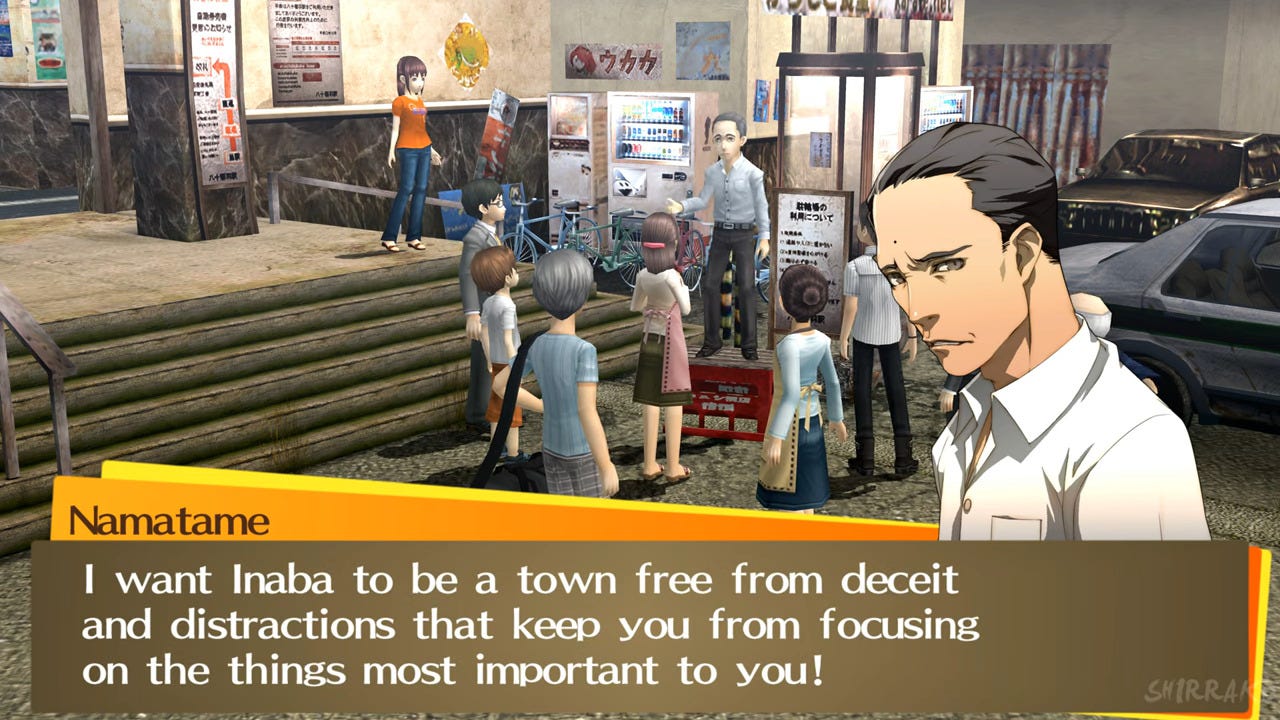
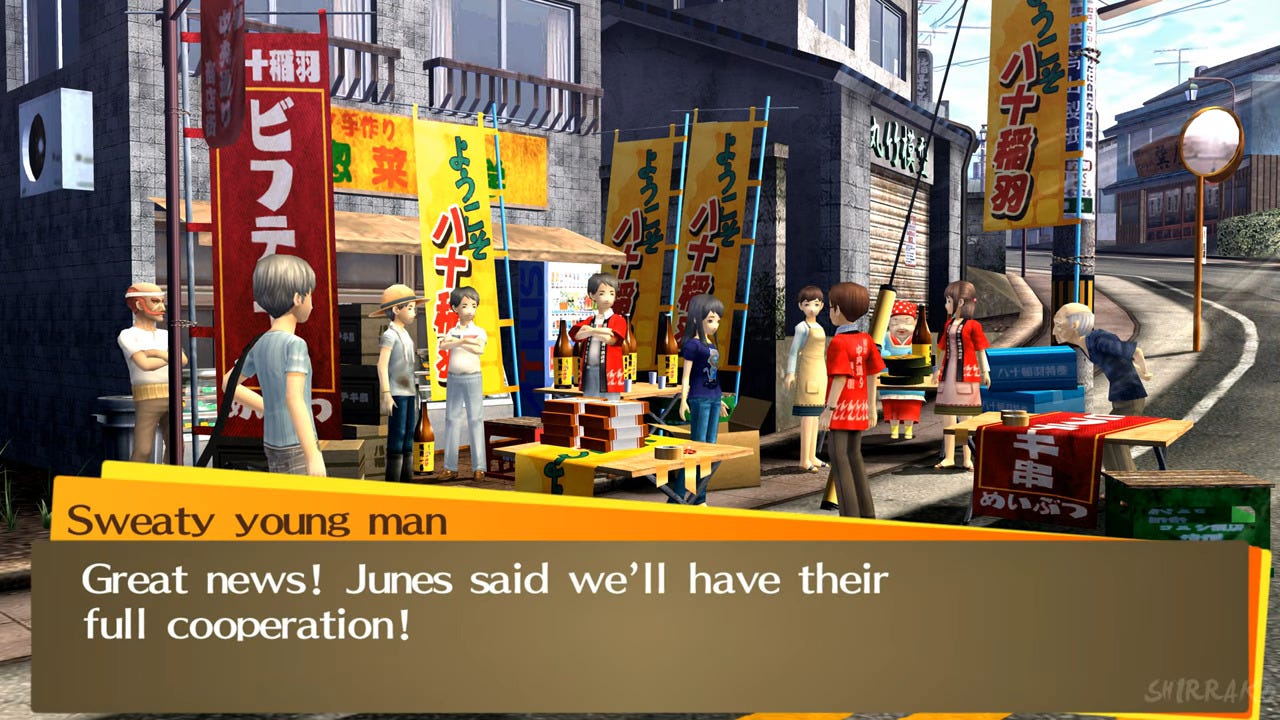
Wrapping up the story for good this time, the player is treated to an ending they can feel proud of, knowing that they’ve done everything in their power to secure a future for Inaba.
In hindsight, it’s remarkable just how well Persona 4 has aged. It clearly isn’t afraid to date itself, with aging technology such as CRT televisions and feature phones featured so prominently in its imagery, its distinctly 00’s pop-infused soundtrack, and the somewhat dated looking graphics - but I believe it’s the prevalence of these nostalgia-evoking elements that serve to effortlessly transport the player back to a time when TV news and online forums held more relevance to everyday society. This ‘time capsule’ effect allows us to walk away with something of a more abstract meaning from the realities of life back then.
It’s an under-appreciated aspect of the game that I hope developer Atlus understands the importance of as we grow closer to the release of Persona 4 Revival, the highly anticipated remake expected around 2027, to ensure that it retains a similar power to continue provoking conversation into its topics as the original releases have done for so many years now.
My first experience with Persona 4 didn’t come until mid-2022, but even in that short time this story and its characters have formed a special connection to me as a person - and I hope this article helped the game mean a little more to you too, whether you’ve played it before or not. I’m grateful for anyone reading this far, and I hope you’ll join me in anticipation of Persona 4 Revival giving this classic a renewed chance to shine once again.

No posts
Comments
Nothing yet. Say the first thing.
Sign in to join the conversation.