
I was folding laundry when Aileen Wuornos was executed and the story broke on ABC news. I wasn’t paying close attention really, until I heard Sterling Ivy’s voice, a spokesperson for the story, confirm Aileen’s time of death a little before 10:00 am. I always felt sorry for Aileen Wuornos. I remember sitting on the couch where I was folding towels and felt something unclench in my chest that I hadn’t even realized was clenched in the first place. Part of me was relieved she was gone, because let’s face it, she was a serial killer and earned her death sentence, but another part of me felt relief for her too. She lived a life of suffering. And now it was no more.
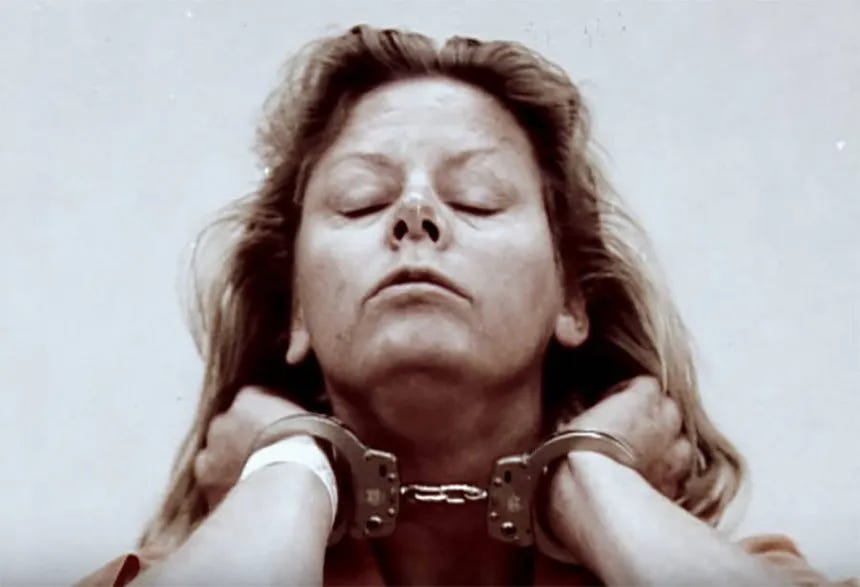
Aileen Wuornos was born in Michigan. Her father was a convicted child molester who later killed himself in prison. Her mother abandoned her and her brother, handing them over to her grandparents to raise them. Aileen suffered horrific childhood sexual abuse at the hands of her grandfather and by the time she was a teenager, she was homeless, doing whatever she had to do to survive. She was picked up over the years for petty theft and sex work. Until one day, she committed her first murder.
She ended up murdering seven men over the course of a year. She was arrested in 1991 on an outstanding warrant and held while prosecutors built the case against her. Within a couple of weeks, she’d confessed to the killings. Her trial began in 1992 and on October 9th, 2002, Aileen was executed by lethal injection. She declined a final meal and asked only for a good cup of coffee the day she died. She was cremated, and her childhood friend scattered her ashes somewhere in Michigan.
Such a tragic life from start to finish.
I think about that unclenching feeling a lot. Because the truth is, I wasn’t just relieved the killer was gone. I was relieved on her behalf as well. She was a woman who spent her entire life being abused by men and then punished for it when she used violence back. That’s a complicated thing to feel about a serial killer, and it’s not a feeling I’ve ever heard another woman say out loud, though I suspect a lot of us have felt it watching cases just like hers.
That contradiction, satisfaction and grief sitting in the our chest at the same time, is the whole reason true crime exists for women the way it does. It isn’t really about fear. It’s about the one genre where our rage, even rage as messy and unresolved as what I felt for Aileen, is unapologetically allowed to land somewhere.
Women Watch True Crime Twice As Often As Men
Pew research has found that women are almost twice as likely as men to regularly listen to true crime podcasts and documentaries. It is the single most popular genre among women in America. Walk into any bookstore’s true crime section, scroll through the top chart on any podcast app, and the pattern holds. This is, overwhelmingly, content made by women, for women, about violence, usually in response to the bad behavior of men.

On it’s face, that should be strange. Women are not the majority demographic committing these crimes. We are disproportionately, the victims in them. Every article that tries to explain the gender gap reaches for the same handful of theories. They say women listen out of fear, to armor themselves against men in their own lives. Which, is a reasonable theory… but it’s also incomplete.
If fear were the whole explanation, the appetite would be broader and blunter, any violence, any threat, would do. But, it isn’t. Women gravitate toward a very specific kind of story. The coercive husband, the controlling boyfriend, the predator who operated in plain sight for years before someone finally stopped him. These aren’t random-stranger narratives designed to teach vigilance. They’re stories about domestic control, about men known to their victims, about women who tried to leave and couldn’t, or did leave and paid for it.
The fear explanation treats these stories like self-defense manuals, but it’s bullshit. Self-defense manuals don’t need a satisfying ending. True crime does. And that need for resolution, for the moment the controlling man finally faces consequences, is doing more work in this genre that fear ever could.
Finding A Place For Rage To Go
I think what we’re actually starving for isn’t information. When one in every three women are being sexually assaulted, we live it. At this point, we need an ending where the man doesn’t get away with it. Because in real life, he usually fuckin’ does.

Women who report coercive control are told they’re overreacting. Women who leave are told they provoked it, or didn’t leave soon enough, or should’ve seen it coming and it’s their fault that they stayed as long as they did. Women who finally snap, who fight back, who stop absorbing it, are the ones who get called crazy. Not him. The ones who’ve had enough.
So we don’t get to be angry out loud. Not at the boss who corners us, not at the partner who isolates us and beats on us and rapes us, not at the man in the parking lot, not even at the institutions that fail to protect us when we beg them to. That anger gets managed, minimized, apologized for, because a woman’s rage is treated as an unfortunate but understandable outburst. We learn very early on which version of ourselves are allowed in public and which ones we’re forced to keep hidden behind closed doors.
True crime is the one place where the math flips. When the verdict comes down, when the arrest finally happens after years of him getting away with it, we get to feel something we’re rarely allowed to feel anywhere else — satisfaction that a man like that finally lost. I’m willing to bet most women are Team Lorena and not Team John. We all know the Bobbitt story. It’s not an accident that the true crime stories women return to again and again aren’t the ones about strangers in dark alleys. They’re the ones about husbands, boyfriends, fathers, men who had years to be stopped and weren’t, until finally they were. This is a woman’s rage with nowhere else to go, finding the one room in the house where it’s allowed to land.
The Men Still Get Center Stage
Even in the one room built to hold women’s rage, the man still gets the better story.
Think about how these narratives actually get told. The docuseries doesn’t open with the victim’s childhood, her ambitions, the people who loved her. It opens up with the killers. We learn about his father, his first arrest, the moment something in him broke. By the time the show reached the murder itself, we’ve spent three episodes inside his head, and the victim has become a name on a timeline, a photo held up by a grieving relative, a body found somewhere in a ditch off the highway. He gets psychology. She get’s a eulogy… if she’d even lucky enough to get that.
Even Aileen Wuornos followed that shape. Her documentary, her film, her endless cultural retellings all center her, which is rare for a perpetrator, but only because she occupies both roles at once — victim and killer. That makes her legible as a subject in a way her own victims never were. The men she killed barely registers. We don’t know their childhoods, but we know hers.
That’s the quiet betrayal sitting inside the genre. Women tune in for the one place our anger is allowed to land, and even here, it has to be routed through a man, his motives, his damage, his arc, before it’s even considered a story worth telling. Our caged fury gets runtime while our interiority still doesn’t.
The discomfort at the center of all this was never really that women watch true crime, but more so what the appetite says about every other room in the house where the same feelings aren’t welcome. We are not, in fact, calm. We are not, in fact, over it. We have simply learned where it’s safe to let it show, on a couch, in the dark, watching someone else’s rage get resolved because we’re rarely permitted to resolve it on our own.
Maybe that’s the real ending Aileen never got, and the one most women are still waiting on. Just a room where the fury doesn’t have to be someone else’s story first.
This Substack is reader-supported. Paid subscriptions help keep me at my desk. Right now, a yearly subscription is 30% off through July 2027! Consider subscribing today for only $56 for the entire year.
If a paid subscription isn’t in the cards right now, I completely get it — truly. But if you’ve ever read something here and thought “damn, she needs to keep doing this,” you can throw a few bucks in the tip jar over at Buy Me a Coffee.
No pressure. No guilt. Just me, asking nicely, with my hand out like a very earnest raccoon who writes controversial essays.
☕ buymeacoffee.com/eeviebateman
Thank you for being here. Seriously. You make this worth doing.
~Eevie
Please Restack! Sharing my content is the other best way to support my work 🤍
Comments
Nothing yet. Say the first thing.
Sign in to join the conversation.