
The music arrived before the coffee did. This Saturday morning of the fifteenth of August, twenty-five floors above Singapore, our windows were open to the usual low hum of the city when something older came through them: Vande Mataram, brass-forward, slightly weathered by the climb, rising from the lawns of the Indian High Commission on Grange Road. Our apartment overlooks the High Commission the way a balcony overlooks a stage. For 364 days a year, the stage is empty with a flag. On this one, it sings back.
Both my grandfathers served in the British Indian Army. The one I am thinking of this morning was born in Lahore, went to Scotland as a boy with the Scouts, and came home, only to return to ‘The Shop’ at Woolwich, then Cambridge and a commission in an army that would change flags beneath him. He stayed on, retired a general, and fought in the young republic’s wars, including the worst of them, against China in October 1962. He moved between Urdu, Punjabi, Hindi and English without noticing the borders. His wife, my grandmother, was a lawyer’s daughter from Peshawar who played tennis and held opinions. Neither of them was born in the country they died in. Neither of them ever moved.
He knew this city too, though his Singapore and mine never overlapped: his was the 1960s, mine began in 1999. When I told him I was moving here, he told me what the island had been before both of us: headquarters of the Indian National Army, where Subhas Chandra Bose stood in the Cathay Building, a fiftreen minute walk from this flat, and proclaimed a government of Free India on 21 October 1943. My grandfather had no quarrel with Bose the patriot. His quarrel was with the soldiering: the INA was raised from prisoners of war who had taken up arms against the army they were sworn into, an army in which two and a half million of their countrymen were then serving, the largest volunteer force in history. To a career officer, that was mutiny, whatever the cause. Bose could be brave and still be wrong. He was, in my grandfather’s estimation, both.
What I did not know, in all the years he told me this, is that the song now climbing to my window had been at that proclamation too. Vande Mataram was sung at the Cathay in October 1943, for the other India. The one that never happened.
This morning it is being sung for the one that did. Seventy-nine years in, I want to take stock of the difference, and then make three wishes.
Last week’s blog, Sirens, Ships and Sovereign Wealth, was about the ropes nations tie themselves with: Odysseus at the mast, and the funds built so a future finance minister cannot untie the knot. The political theorist Jon Elster once observed that the largest such knot ever drafted is not a fund. It is a constitution. So this week the ledger travels to the nation that raised me: India at seventy-nine, the twin it was cut from, and what I would ask of the eightieth year.
Two nations came out of the same labour ward within twenty-four hours: Pakistan on the fourteenth of August, India at midnight on the fifteenth, Mountbatten presiding at both deliveries, flying from Karachi to Delhi in between. They were not neighbours who happened to be born together. They were conjoined twins cut from one mother, and the surgeon had five weeks and had never seen the patient.
Cyril Radcliffe, a London barrister who had never been east of Paris, landed on 8 July 1947 to draw a line through Punjab and Bengal from a bungalow in Delhi. The line was published on 17 August, two days after the flags went up: millions celebrated independence without knowing in which country. Radcliffe destroyed his papers, declined his fee, and never returned. Estimates of the dead run to two million; some fourteen million crossed the line, the largest forced migration in history. Within ten weeks, the twins were at war over Kashmir. The men on either side of the line were, by bitter irony, the two most anglicised Indians of their generation, Jinnah of Lincoln’s Inn and Nehru of Harrow and Trinity, divided partly by proximity: Nehru was warm with the Mountbattens; Jinnah was not. Nations get made this way more often than the textbooks admit, by who dined with whom.
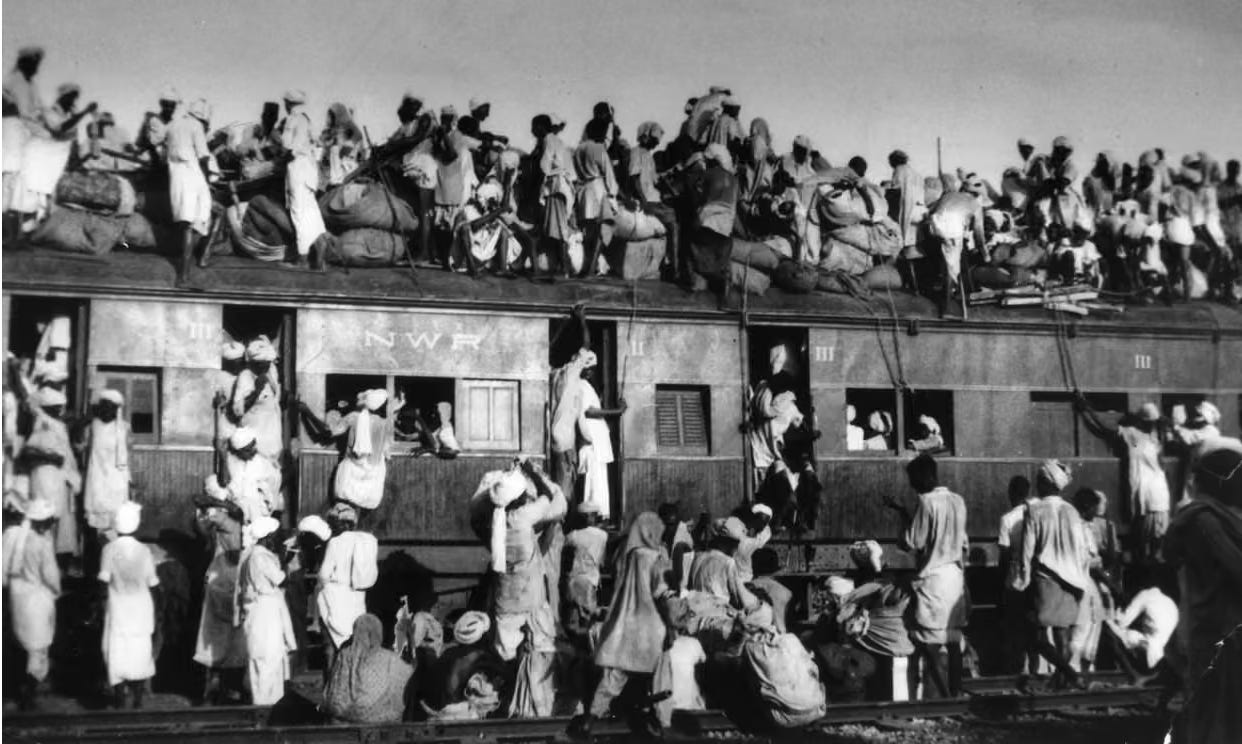
The line ran straight through my family’s map. Lahore, where my both my father and grandfather were born, fell to Pakistan; so did Peshawar, where my grandmother grew up. Every street they had known became, from one morning to the next, a foreign country. People like them, the club-going, impeccably tailored class filed today under brown sahibs, a term I unpacked in Life, Love & Liquidity at Fifty, were at their best the best of both worlds: from the English, not the accent but a stubborn faith in the rule of law; from India, the fact that they had never stopped being Indian. That mix produced a particular decency: the kind that could not forgive Bose the soldier, and that carried the same cadre to side with the freedom struggle and build a republic with people who were now, by a lawyer’s line, their only countrymen.
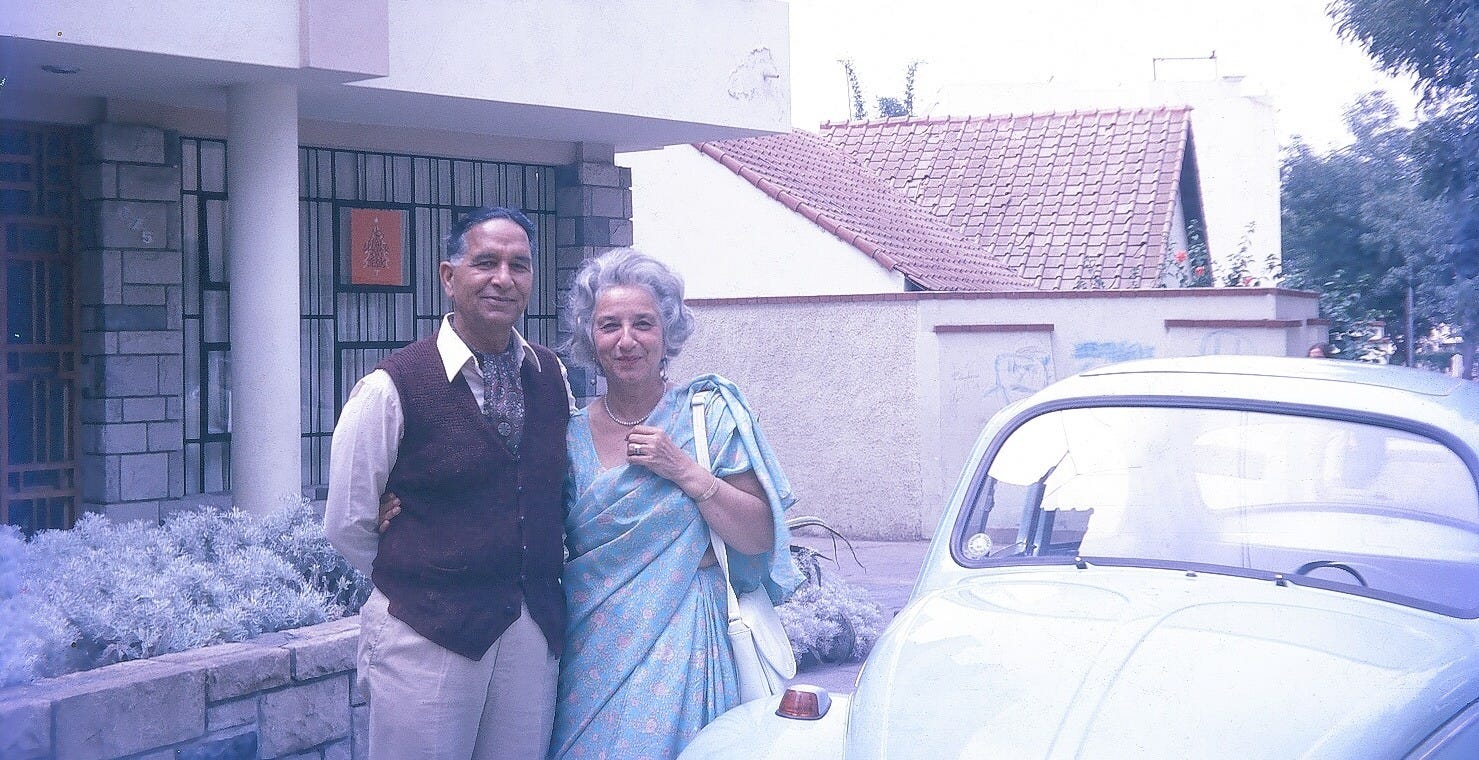
Partition drew a border across the land. It also drew one across people who had never needed to choose.
The twins pose a question that deserves a better answer than destiny. Same civil service, same railways, same regiments, same law books, though not the same luggage: Delhi kept the capital, the mint, the secretariat and most of the industry, while Karachi began in tents, its files pinned with thorns for want of paper clips. Even so, seventy-nine years later one twin is the world’s fourth-largest economy and its largest democracy; the other has spent thirty-three of those years under direct military rule and much of the rest in its shadow. The difference was not blood or faith or luck. It was three decisions, in this writers opion, taken on one side of the line and shirked on the other.
The first was about time, and nobody chose it. Jinnah was dying at midnight and had told almost no one; tuberculosis took him on 11 September 1948, thirteen months into his country. His lieutenant Liaquat Ali Khan was assassinated in 1951. Pakistan then took nine years to write a constitution and lost it to a coup before its third birthday. Its first national election on universal adult franchise came only in December 1970, and when the wrong side won, the army refused to seat the winners and the country split in two: Bangladesh. India got Nehru for seventeen years: long enough for the unglamorous habits to set, parliaments seated, budgets passed, generals reporting to ministers, defeats absorbed without tanks in the streets. The nearest India came to that road is a story my grandfather told about his contemporary, later Field Marshal, Sam Manekshaw. After the 1971 war, Delhi gossiped about the victorious general’s ambitions, and Indira Gandhi asked him directly.
As my grandfather told it, Manekshaw replied: “Madam, I am a soldier. You are a politician. Let us each stick to what we are good at.”
In India the soldiers stayed soldiers. In Pakistan they became the politicians. Most of what followed is footnote.
The second decision compounded the first, and it has a Turkish twin. Both republics were imagined secular by their founders: Atatürk abolished the caliphate in 1924 and built an army to guard the state against the mosque; Jinnah told Pakistan’s Constituent Assembly on 11 August 1947 that religion “has nothing to do with the business of the State.” Both founders were overturned by later strongmen. Erdoğan has spent two decades re-Islamising Kemal’s republic; General Zia-ul-Haq, who seized power in 1977 and sent the elected prime minister he had deposed to the gallows in 1979, went further: he blended the faith into the force, recasting the army’s creed around faith, piety and holy war. An army that had dominated the state now claimed a divine licence to define it. Elections could now be held without power really changing hands: democratic in name only, DINO. No Pakistani prime minister has ever completed a full term. The mirror at home: India suspended its own democracy for twenty-one months in the Emergency of 1975 to 1977; the difference is what happened next. The voters threw the government out, and the government went.
A democracy is not a country that never stumbles. It is a country where the stumble is survivable.
The third decision was about land: the least told and, I suspect, the most important. In India, Sardar Vallabhbhai Patel folded more than 560 princely states into the union in barely two years, and the new state legislatures then abolished the zamindari system, with Ambedkar’s constitutional machinery, the First Amendment of 1951 and its Ninth Schedule, shielding the reforms from the courts. Uneven, evaded, incomplete, the reforms still changed who India belonged to: the tiller got a title, and with it a stake, just as the electoral roll had given every adult a name. Pakistan’s founding party was, in its western wing, a landlords’ party, and behaved like one: the ceilings of 1959 and the 1970s were evaded through paper transfers to cousins and minors, and in 1990 a sharia bench ruled ceilings un-Islamic. The feudal families still seed the parliament, and the incentives lock: a landlord has no interest in schooling his tenants, a garrison none in growing private capital it cannot own. Between the chaudhry and the cantonment, the only people left carrying the country are the people.
None of this is written from a high horse: half my family’s map lies across that line, and Pakistan’s own historians have named these forks more unsparingly than any outsider could. The ledger holds a number that silences gloating anyway: by the Maddison Project’s long series, Pakistan’s income per head exceeded India’s for 44 of the 67 years to 2016; India regained the lead only around 2009 and has stretched it to 1.86 times (2023), the widest on record. Institutions are compounding instruments; their returns arrive decades after the decisions, which is why the decisions matter.
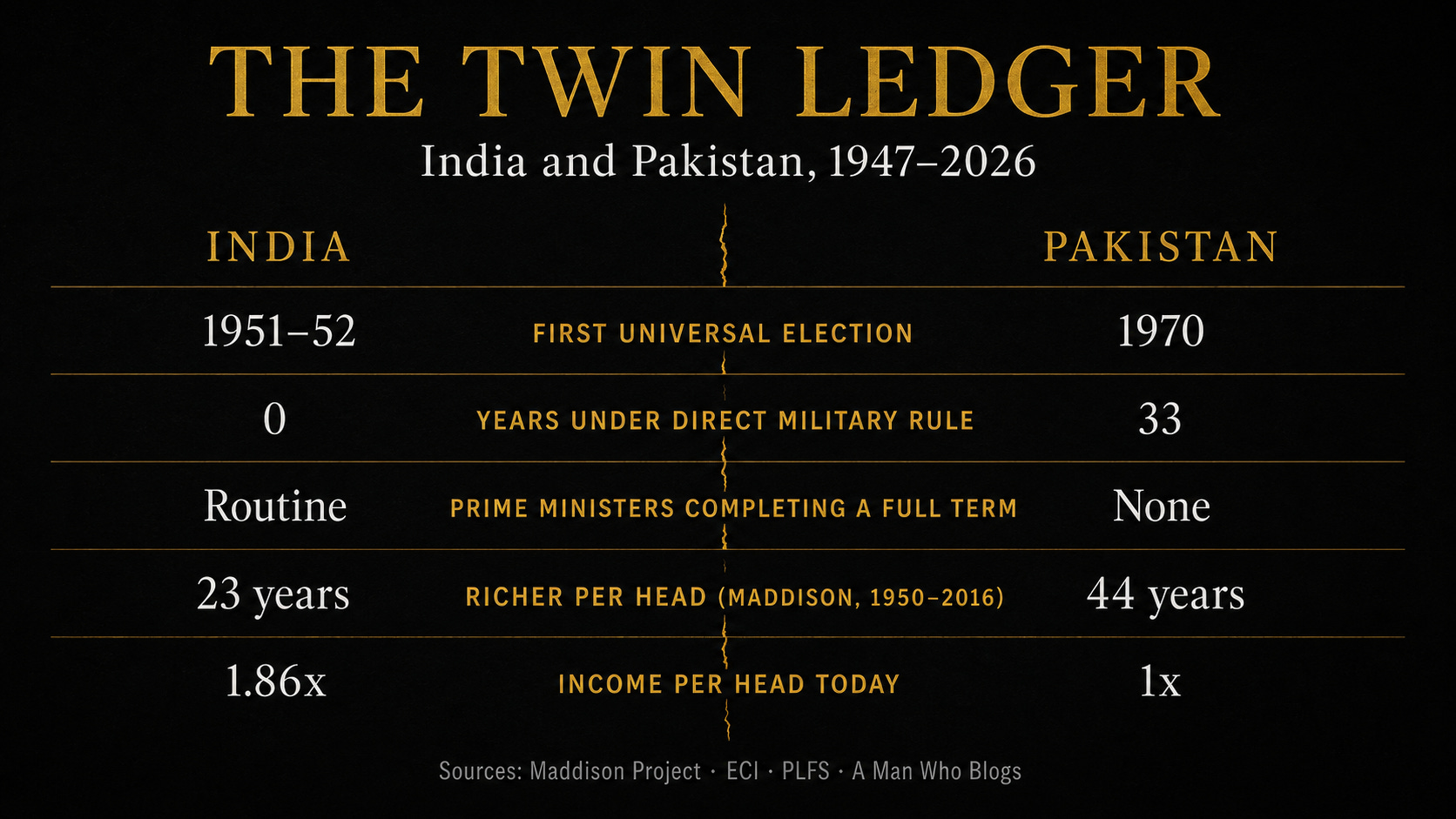
Nations are not born better or worse. They are decided, one fork at a time, and the interest compounds quietly.
At the republic’s first census, in February 1951, life expectancy stood at 32 years; 18.33 per cent of Indians could read, among women 8.86 per cent.
Churchill had delivered the imperial verdict in 1931: “India is a geographical term. It is no more a united nation than the Equator.”
Against that, the Constitution of 26 January 1950 granted universal adult franchise. Everyone, at once: no literacy test, no property bar, no phasing; Britain took ninety-six years over the same walk. No poor country had ever tried. Sukumar Sen, a mathematician turned civil servant, registered 173 million voters house by house, 85 per cent of whom could not read the roll, and answered illiteracy with design: symbols instead of names, 224,000 booths, ballot boxes by train, boat and elephant. Call the instinct Premature Universality: enrol everyone before it is prudent, and trust the country to grow into the machinery.
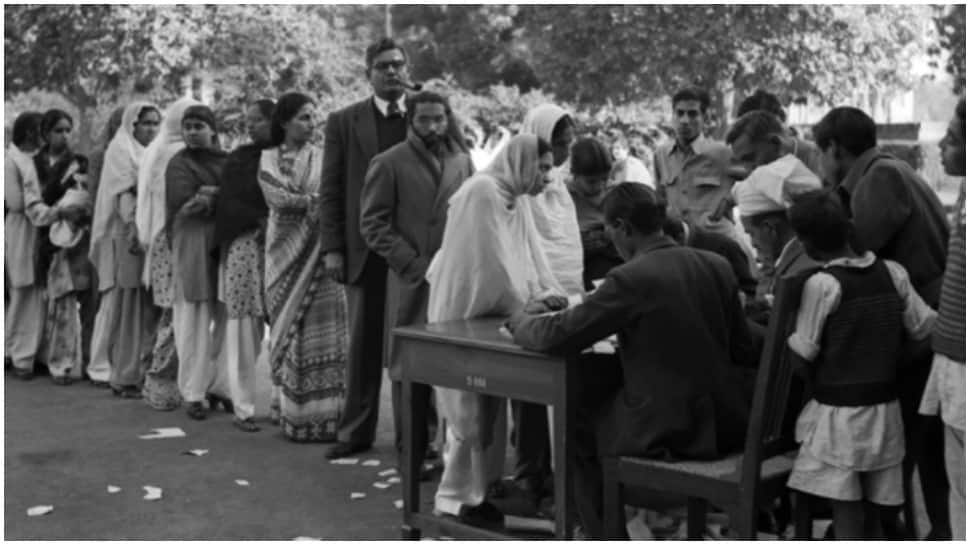
The country did. Life expectancy has climbed from 32 to just over 70 (UN estimates, 2023 to 2025). Literacy has gone from fewer than one in five to roughly eight in ten . The 173 million became 968 million registered voters in 2024; about 642 million voted. On the IMF’s April 2025 numbers, India’s output edged past Japan’s at $4.19 trillion, with Germany within reach. And UPI, piloted in April 2016 on Sen’s wager, assumes nothing about the user except personhood, now carries 49 per cent of the world’s real-time transactions (ACI Worldwide, 2024), the largest retail fast-payment system on earth (IMF, June 2025). The caveat travels with the credit: per head, India’s $2,694 (World Bank, 2024) sits beside Japan’s $32,487. The rank flatters; the queue is simply that long. But only China has travelled further, faster, from a harder start, carrying a billion people, and China never asked anyone’s permission at a ballot box.
The queue outside the polling booth in 1952 and the QR code on the vegetable cart in 2026 are the same idea, seventy years apart.
True progress, though, is measured by the courage to face the distance still to cover. So, three wishes, from a young old man to his young old country.
This morning, on the ramparts of the Red Fort, Narendra Modi delivered his thirteenth consecutive Independence Day address. Only Nehru, with seventeen, has stood there more often in a row; Modi passed Indira Gandhi’s eleven last year and is now the third longest-serving prime minister the republic has had, behind Nehru and Nehru’s daughter. I note this without a partisan flicker; the point is not the man. The point is that a country whose only three long tenures are a father, his daughter and the present incumbent has always depended on something other than its leaders to survive them.
That something is the roots; the twins’ story prices them. India is not the world’s oldest democracy but its largest and most audacious experiment: 22 scheduled languages, every major faith on earth, one shared ballot box. It endures by independent courts, a press that is a nuisance, an Election Commission built to be feared, and a Constitution that outranks every government, including the popular ones. Especially the popular ones. Manekshaw’s line was funny because it did not need saying, and it did not need saying because a generation of officers, my grandfather among them, had made the oath so ordinary that breaking it was unthinkable. Ordinariness of that kind is the most expensive thing a nation owns, and the cheapest thing to lose.
Institutions are not monuments. They are subscriptions, renewed or cancelled one generation at a time.
Growth that bypasses the village, the daily-wage earner and the daughter is arithmetic, not progress. The daughter is the entry that refuses to reconcile.
Start, again, in Singapore. The INA’s Rani of Jhansi Regiment put Indian women into combat uniform here in July 1943, ahead of most armies on earth. The Constitution made every Indian woman a full voter in 1950, twenty-one years before Switzerland got round to it. And in the very first election, roughly 2.8 million women were struck off the rolls because, asked their names, they would give only a husband’s or a father’s, and Sukumar Sen refused to enrol a citizen listed as somebody’s wife.
Read that again. The state was ready for her before the household was.
My grandmother, the tennis-playing lawyer’s daughter from Peshawar, would have had a view on that. Seven decades on, the ballot half has closed magnificently: in 2024, women’s turnout, at 65.8 per cent, edged past men’s. The earning half has not. Female labour force participation stands at 41.7 per cent (PLFS 2023-24, ages 15 and above), barely two in five, and even the sharp rise from 23.3 per cent in 2017-18 needs tongs: it is overwhelmingly rural, much of it agricultural or unpaid family work, and urban participation sits near 28 per cent. More Indian women are working. Far too few are being paid properly for it.
No nation reaches its potential with half its talent sidelined, and no payment rail fixes safety, childcare, transport and permission. Premature universality solved identity and money because those were problems of enrolment. This is a problem of the household, and the household does not run on rails.
The republic made her a voter in 1950. It has not yet made her an earner.
The third wish concerns the thing Indian families do better than any society I know, and the thing the Indian state does worse than almost any of its peers.
No polity on earth is more privately devoted to education. The sold bangles, the second job, the 5 am tuition run: every Indian parent knows the liturgy. Yet the nation that produces this devotion spends 0.84 per cent of GDP on research and development (FY2023-24, government reply to the Lok Sabha, July 2026), against 2.69 per cent for China (2024) and five to six per cent for South Korea and Israel. The gap is not talent: India is the third-largest producer of scholarly publications and 38th on the Global Innovation Index, up from 66th in 2019 (Economic Survey 2025-26). The gap is translation: a country strong at early-stage research that abandons its ideas in the valley between prototype and product.
This is the honest limit of jugaad, the genius of scarcity; improvisation is how a poor country survives. Frontier science is a different discipline: patient capital, tolerated failure, decade-long bets that mostly die. The wish is not to abandon jugaad but to graduate it, from survival jugaad to jugaad at scale and sophistication: foundational models, frontier science, original global IP. The devotion India has in oceans is private. Invention is institutional. The eightieth year’s work is to build the pipe between them, because the next universality, after identity and money, will be intelligence itself, and India should not have to rent it.
The superpower everyone keeps forecasting will be built in classrooms and laboratories first, or it will not be built at all.
The band on Grange Road has moved on to something with more drum in it, and I am left with the strangest entry in the account: the journey the music itself made.
When Bose’s provisional government needed an anthem in 1943, it chose Tagore. Jana Gana Mana was rewritten into Hindustani and set to a martial tune by Captain Ram Singh Thakuri at the INA’s station in the Cathay Building. On 16 August 1947, the morning after the tryst was kept, Thakuri’s orchestra played that tune at the Red Fort as Nehru addressed free India. Even the greeting closing every post you scrolled past this weekend, Jai Hind, was minted here by the army that never got to march on Delhi. Everything the other India made that was worth keeping, the anthem, the greeting, the women in uniform, the refusal to be ruled, was absorbed by the India that swore an oath and queued.
India walks its next stretch between two brothers. The elder is China, bhai to bhai in the slogans of the 1950s until it taught my grandfather’s generation, in the passes in 1962, what naivety costs: further down the road, never once asking its people’s permission, carrying unpaid bills of its own. The younger is Pakistan, the India left behind at a lawyer’s line, still governed by its first forks. Between them walks India, richer than the younger, freer than the elder, finished with neither of their journeys nor its own. When Nehru died in May 1964, a hand-copied stanza of Robert Frost sat on his desk, ending with the miles to go before he slept . The republic inherited the promise along with the debt.
I called this year’s letter to my daughters The Young Old Man: fifty is the age at which you know what to keep and are still young enough to build. Seventy-nine is the national version of the same age. India is old enough to know what is great about it, the roots, the queue, the oath, the audacity of trusting everyone at once, and young enough, with a quarter of its people between ten and twenty-six, to build its manifest destiny. This has not been nostalgia, or a lament for a twin. It is a to-do list, in three lines: guard the roots and the guards around them; pay the republic’s outstanding bill to its women, who have kept their half of the bargain since 1943; and turn the private devotion of a hundred million households into public institutions of invention.
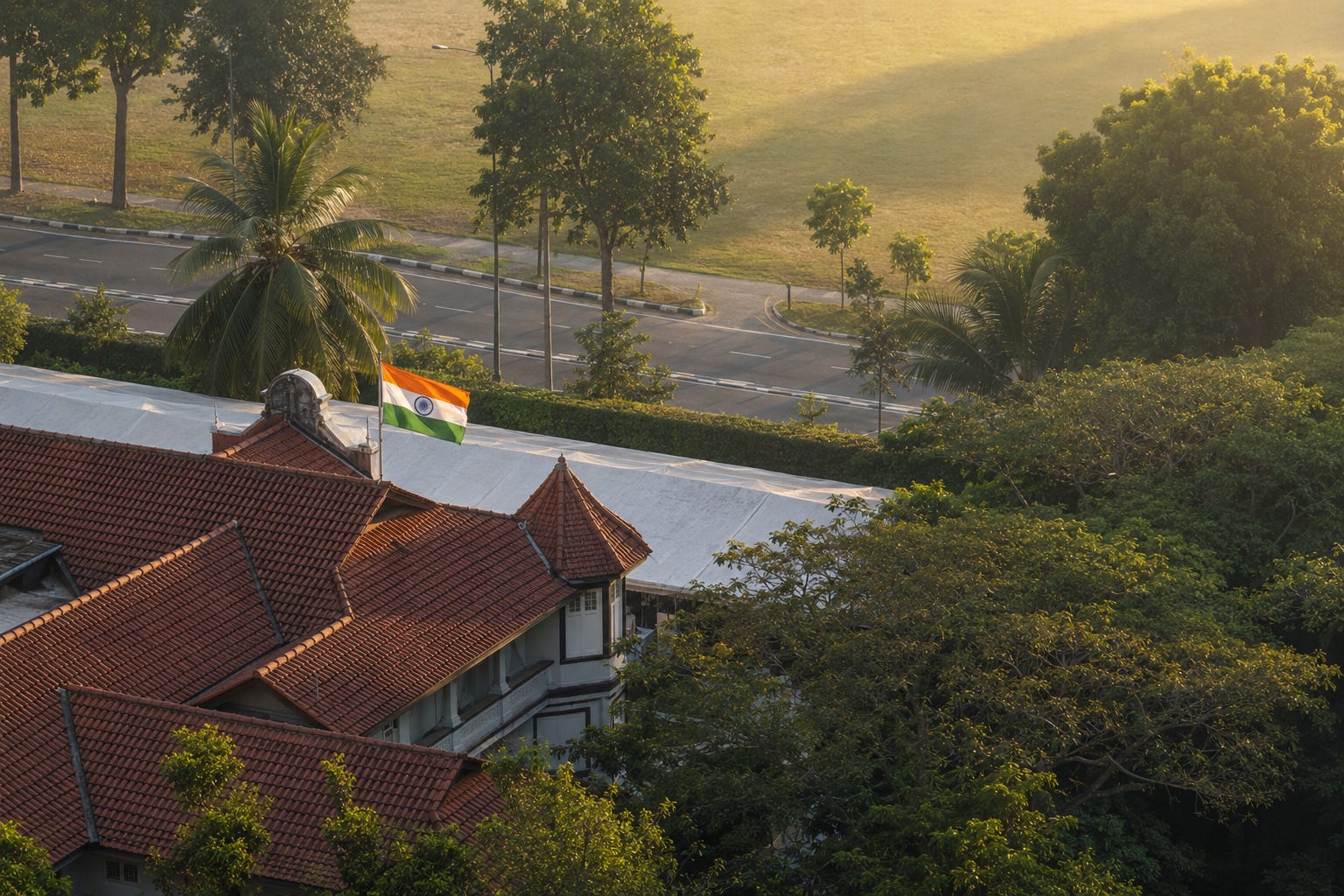
The song reached my window the long way round: through a war, past a lawyer’s line, up twenty-five floors.
It knows the way. It has made harder climbs.
Jai Hind.
Aman Narain is the founder and principal of A2Z Advisors, a boutique fintech and digital advisory firm, and co-hosts the A2Z Fintech podcast. Born in the UK, raised in India, educated in the US and France, resident in Singapore, where the Indian High Commission obligingly performs his heritage to him once a year, free of charge.
For adjacent AMWB territory: the generation that carried the Pukka Inheritance in Life, Love & Liquidity at Fifty, the letter that named the age in The Young Old Man, the elder brother’s arc in From Bhai Bhai to Buy-Buy, and India’s first financial dynasty in The Medici of the Monsoon.
No posts
Comments
Nothing yet. Say the first thing.
Sign in to join the conversation.