
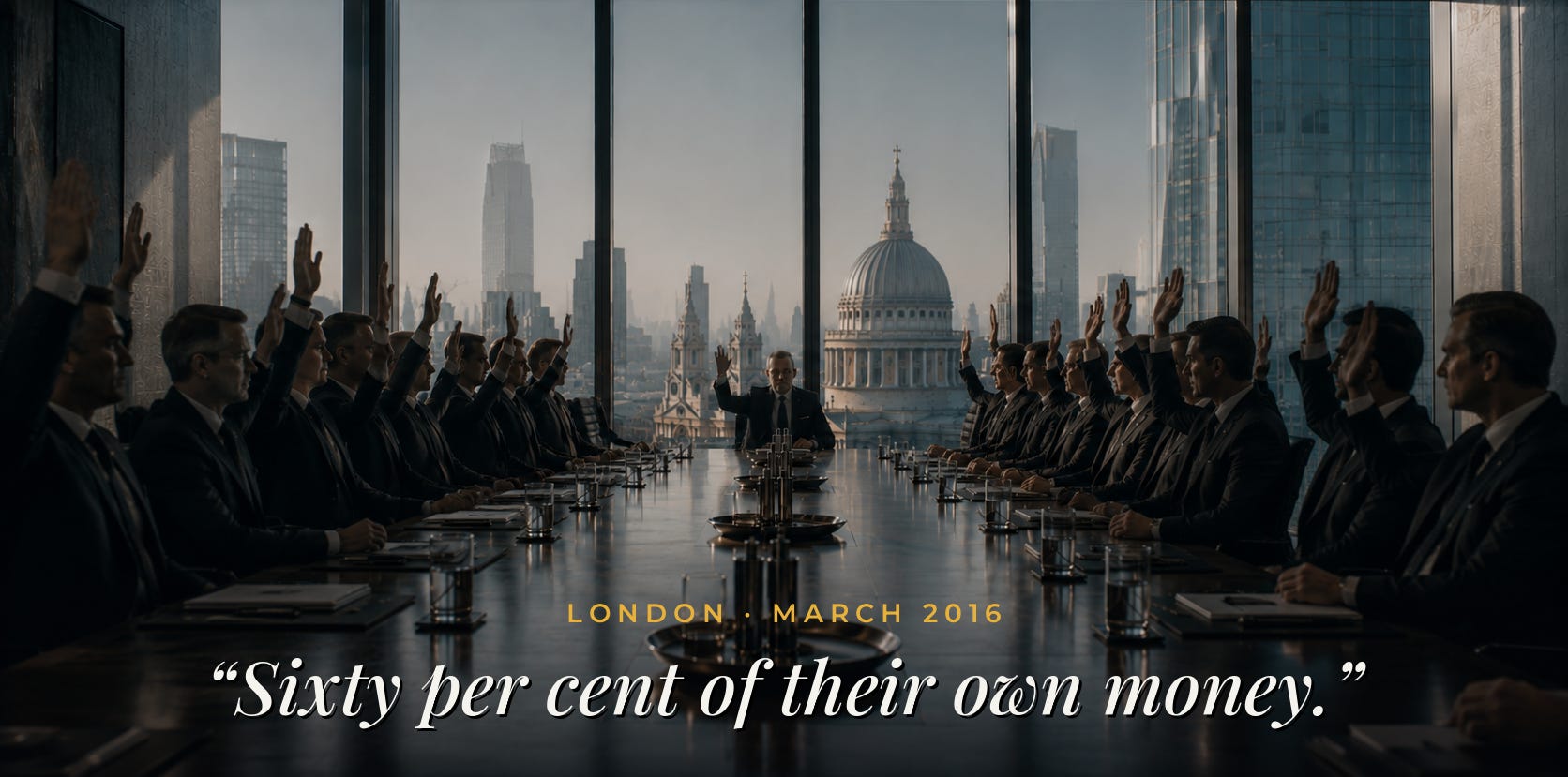
It is March 2016, and London has, for once, bothered to show up bright: one of those rare, hard, clear afternoons when the light comes straight off the glass. On the top floor of an office in the City, behind a wall of windows nobody is looking at, a little under a dozen men are taking their seats. Dark suits in every available shade of dark. The only diversity in the room is the ties, the hairlines, and two South Asian faces, which in that room, in that year, counted as radical.
This is the global distribution leadership of one of the most storied names in money management: the men who face off against the private banks, the retail banks, the insurers and the fund platforms. One of the two South Asian men is new. He has been handed the floor, and he is genuinely curious, so he asks a simple question. How many of you own ETF index trackers in your own personal portfolios?
Every hand in the room goes up. Every single one. So he pushes. Keep your hands up if it is more than twenty per cent of your money. The hands stay up. Forty per cent. Still up. Sixty per cent of your own money sitting in the cheap passive funds you do not sell to anyone. The hands are still up, and the room has gone very quiet. Across the table, the man who hired him is giving him a look that says, with perfect clarity: enough. You made your point.
That man was me. The firm was Schroders, 222 years old this year. Hired to drag it into the digital age, I lasted a year, then left for Google, possibly the first person in the firm’s history to make that move and almost certainly the last. For ten years I have wondered what that number really was. In June, I finally got to ask.
Last week's blog, Farewell, My Forties, stamped my papers at the border between decades and noted that birthdays keep a ledger whether you ask them to or not; that ledger was not denominated in money. This week I am staying with the one that is. What follows distils Episode 19 of A2Z Fintech, recorded on 17 June 2026 with two men who worked the same Schroders floor I did, then walked out of the same door in opposite directions. Tim Phillips, born to a British father and a Hong Kong mother, runs Chasing Boring and tells ordinary people to ignore men like my other guest. Zal Devitre, from a Parsi family of professional migrants, sits at Avestar, a multi-family office spanning New York, India and Singapore: the man you cannot ignore once your wealth grows large enough. All three of us washed up in Singapore. Keep that geography in mind. It is the whole point.
The room of hands was not an aberration. It was a preview, and to see of what, wind the tape back 158 years.
In 1868, in London, Philip Rose launched the Foreign and Colonial Government Trust, promising the investor of moderate means the same advantage as the large capitalists. In 1924, Boston’s Massachusetts Investors Trust made the pooled fund tradable daily. In the 1970s the pension quietly died; the risk of your old age slid off your employer’s balance sheet and onto yours. You did not get a vote. You got a portfolio. May Day 1975 abolished fixed commissions. In 1976, Jack Bogle launched the first index fund to near-universal ridicule. In 1993, State Street listed SPY, the first ETF, at a fifth of one per cent against active’s two: today the most traded security on Earth. And in 2024, the punchline: passive overtook active in America for the first time, a gap since stretched to roughly $21 trillion against $18 trillion, while over the preceding decade only about one in ten active US large-cap funds beat the machine built to embarrass them.
One in ten.
Zal, whose clients sit at the apex of the pyramid, did not flinch. “The passive wave has really been irresistible,” he said: passive products are cheaper, “and their performance has been just as good, if not better... the money goes where the performance is better.” There are exceptions, and we will come to them; the exceptions are where his industry now lives. The base case was conceded inside ten minutes, by the man from the family office.
Which reframes the room of hands. For ten years I read that silence as hypocrisy: men selling one thing while quietly buying another. I now think the best-informed distributors in the business examined their own product with no sales pitch in the room, and allocated accordingly, two decades before the flows caught up.
They were not hypocrites. They were the control group.
🎬 WATCH: Fund Managers Own Index Funds. They Just Don’t Sell Them.
I walked in carrying a taxonomy borrowed from an ex-Googler friend whose IPO wealth had headed south, one doing the rounds on the All In podcast. There is life-changing wealth, popularly known as FU money: fly business, book the Michelin table, answer to nobody. There is generational wealth: all that, plus your daughter can become a ballerina, or in my household a fashion designer, without the maths mattering. And there is society-changing wealth, the Gates and Thiel tier, where the debate stops being about the money and becomes about its use.
Zal declined the tidy thresholds for the working definition his clients actually use: “the ability to say, look, for the rest of my life, this is the lifestyle I’d like my family to live with, and I want to have enough financial resources to make sure that lifestyle is covered.” The number differs “if you’re in Singapore or Sierra Leone”, and with whether the American taxman follows you. The discipline is constant: “go in with your eyes wide open.”
Listening back, one symmetry struck me. At the bottom of the pyramid, the failure is over-caution: savings idling in low-yield cash, quietly losing to inflation, while the saver waits to feel safe enough to begin. Tim sees it in the Singapore benchmarks his audience obsesses over: $100,000 by 30, a million by retirement, even as CPF Life sits underused: funded to the enhanced retirement sum of around S$450,000, it pays roughly S$3,400 a month for life from 65.
And at the top? Zal named three mistakes; the first was the same disease in better tailoring. “I’ve made my money, I just wanna protect it, let’s be very conservative,” and the returns fail to keep up with inflation. The second is the opposite pole: “I made a lot of money. Let’s take risks. Let’s buy SpaceX. Let’s put a lot of money into this venture that my friend is doing in Papua New Guinea.” The third is neglecting tax and estate planning until it takes a massive chunk out.
Tim, from the other end of the market, quoted Morgan Housel: the one thing that ensures you build wealth is not having FOMO. Then came the line I would frame on the wall of every bank branch in Asia: “I’ve learnt through 20-odd years of investing, doing nothing typically leads to a lot better results. Staying put, staying invested, not churning.”
Two guests, opposite ends of the pyramid, one diagnosis. The retail investor churns out of fear of missing out; the ultra-wealthy concentrates, or freezes, out of fear of losing what defines them. The instruments differ by three orders of magnitude. The amygdala does not.
Fear does not scale with net worth. It only changes its tailoring.
So how do you actually get rich? Tim’s answer is deliberately, almost aggressively unglamorous. He refused the one-size-fits-all trap before I could set it: risk appetite and time horizon come first, and a fifty-something facing sequence-of-returns risk has no business lump-summing into equities the way a 25-year-old should.
For the young, the playbook is short. Global equities through a low-cost ETF, then leave it alone. Lump-sum investing beats dollar cost averaging roughly two-thirds of the time, because time in the market is the entire trade. There has never been a negative 20-year rolling return for the S&P 500, even across 2000 to 2009; timing your way around the dry spells, in Tim’s words, is a fool’s errand.
Where he took it next was quietly radical: not Singapore, with its CPF architecture and FIRE forums, but the kid in India or China whose country runs no retirement scheme worth the name: “go and try and put away $100 a month into a UCITS ETF... You don’t need to be worth 10 billion to do well.”
The machinery of compounding is not the industry’s secret. The secret is the opposite claim, sustained by the marketing budget. Tim put it without hedging: “There’s this perception, because the finance industry puts it out there, that you can only invest well if you have some inside knowledge or you have someone with access, and that’s the biggest lie out there.”
His prescription runs to four verbs: control your emotions, keep it simple, be consistent, be disciplined. Do that, he says, and you beat 95 to 99 per cent of people.
Boring is not the absence of a strategy. Boring is the strategy that survives its owner.
🎬 WATCH: What Does Rich Actually Mean?
Now for the most practically valuable ten minutes of our season, and a mistake much of this readership is making right now.
Most investing content on the internet is American: Roth IRAs, 401(k)s, and the beloved VOO, Vanguard’s S&P 500 tracker. Tim was unequivocal: “No, do not invest in VOO. If you’re not American, do not put your money into that.” Then the line that deserves a poster: “If it doesn’t have UCITS before it, no, it does not deserve to belong in your portfolio if you’re not American. If you’re American, go for it. Go out all out on VOO.”
The mechanics matter, so let us name them. A non-US investor in a US-domiciled ETF faces 30 per cent withholding on dividends and, less famously, US estate tax at up to 40 per cent above a threshold of roughly $60,000. Your heirs discover this at the worst possible moment. The same exposure through an Irish-domiciled UCITS ETF, a VWRA, a CSPX, a SPYL, cuts withholding to 15 per cent under the US-Ireland treaty, sits outside the US estate net, and in accumulating classes reinvests dividends automatically. Same index. Same companies. Over thirty years, a materially different destination.
Read that again if you hold VOO and carry anything other than a blue American passport.
There is a poetry here, given where this essay is heading. The fund itself has a domicile, a treaty, a legal nationality; the wrapper is a travel document. Most investors spend more effort choosing the index than its passport, and the passport is where the money leaks.
Money may have gone stateless. Tax authorities have not.
If the maths is this clear, why does almost nobody in Asia hear it from the person managing their money?
Tim’s answer was structural. Asia’s distribution runs through banks: a product-centric ecosystem of commissions and trailer fees, where the manufacturer pays the shelf. America leans more on registered advisers with a fiduciary duty. Unwinding it would demand political capital nobody has offered to spend: how do you move an entire salesforce from commissions to fees? The system persists behind the industry’s favourite defence: people in Asia don’t want to pay for advice. Which decodes, in practice, to: lie to me about the fees, but don’t tell me you’re charging them.
I have watched this economy from both ends. On the morning we recorded, my mother rang because a relationship manager was urging her to buy something on the grounds that somebody else had. And in a former life, moonlighting alongside private banking RMs, the conversation was never about fund domicile or fee drag. It was truffle oil and tickets to the F1.
Call it the truffle-oil economy: a distribution system in which the relationship is the anaesthetic and the fee is the operation. The client remembers the paddock pass. The spreadsheet remembers everything else.
So I asked both guests the gene-editing question: if you could switch off one product in the banking genome, which goes? Tim did not hesitate: structured notes. “I’ve seen a lot of people lose a lot of money in structured notes.” Then the Charlie Munger line that became the episode’s refrain: “Show me the incentive, and I will show you the outcome.” Zal, formerly of Singapore retail banking, chose the dual currency account: “I’ve watched clients invest in these sort of across the cycle, and invariably they lose or make very, very little money.” Tim’s summary deserves carving above the industry’s door: “complexity equals high fees in disguise.” And his cheapest advice was priceless: if you are an accredited investor in Singapore, do not announce it; the products pitched to you will get worse, not better.
In the truffle-oil economy, the tasting menu is free, because the diner is the margin.
So far, so index fund. Here the argument turns. If simplicity equalled optimal returns at every altitude, Avestar would not exist and nine-figure families would not queue to pay it.
The honest answer starts with an admission from the family office. For efficient asset classes, US large-cap above all, Zal’s firm buys the same market beta Tim preaches: “we actually use ETFs and market beta, because that’s the most optimal way for our clients to access that asset class.” The edge that survives lives in inefficient markets, an India, a China, distressed and esoteric strategies, where information travels badly and access is unequal. In my Schroders year I discovered many mutual funds were themselves largely assembled from ETFs: a mixologist charging cocktail prices for pouring the house spirit, and, as the hands confirmed, chugging it neat at home.
What the wealthy are actually buying above roughly $10 million, and emphatically across borders, is sequencing. In the Avestar method, the striking thing is how late investments arrive. First, horizon, risk tolerance, cash needs. Second, the tax and estate picture across every jurisdiction the family touches. Third, the structures: trusts, entities, architecture. Only then the instruments that go inside. For a family spread across three tax systems with heirs in a fourth, that ordering is not a luxury; done badly, the estate bill devours more than any fee ever could.
Then there is the service nobody puts in the brochure. Private banking, Zal acknowledged, is under pressure: margins squeezed, rarefied access democratised, cost to serve punishing. What endures is structuring, and, in his lovely phrase, clients’ “needs to just control their worst impulses and instincts”. The best private bankers operate as counsellors to the family; the Swiss houses have often been there longer than the children have. Tim sees the same from his end of the telescope: past 100 or 200 million, the game is preservation. “If you’re worth 100 million, you could put it into T-bills and live perfectly happily.”
It yields the cleanest definition of the industry I have heard in twenty-five years.
Below a certain number, an adviser’s job is to grow the money. Above it, the job is to stop the money’s owner.
Four days before we recorded, the perfect test case landed. SpaceX went public, went straight to $2 trillion, and minted in Elon Musk the world’s first trillionaire. The believers describe a $28 trillion opportunity; the accounts, around $5 billion in losses. Every FOMO circuit on Earth lit up at once.
The two answers were the episode in miniature. Zal declined to say whether Avestar was in the deal, then made the deflationary point: giants like SpaceX will enter the indices anyway, so “you don’t need to chase the individual name... you’ll get exposure to it as an investor.” Tim ran the arithmetic: on entry, SpaceX would be perhaps 0.05 to 0.06 per cent of a global tracker like VWRA, and S&P inclusion cannot come before June 2027. The FOMO trade is a bet on the eighteen months before your boring portfolio quietly acquires the same asset anyway.
Zal then reframed the access question: “What I love about public markets is you are on the same playing field, whether you’re Temasek or just a guy who earns $3,000 a month, because you are buying the exact same underlying.” Private assets are the opposite: preferential access, allocations you may or may not get, information you will not.
This is exactly what tokenisation promises to fix, and the collapse is real: private-market minimums that once started at $5 million now start at $20. Which is why my guests’ scepticism matters. Zal likes the democratisation “if it’s done properly”, but pointed at the private credit funds where investors “didn’t focus on the semi part” of semi-liquid and met the gates on the way out. Tim was blunter: “If you’re talking about a liquid vehicle backed by illiquid assets, I couldn’t think of a worse recipe in terms of an investment proposal for the average investor.” When institutions offer their most illiquid risk to the public through a wrapper that trades by the minute, ask who benefits from the exit ramp.
And AI? On air I confessed to handing my IBKR portfolio to Claude; back came an analysis perhaps 90 per cent right and, more usefully, sharp questions for a human adviser: the patient who arrives annoyingly well-read. The bad version is the one Tim sees daily, people who “just outsource their brains to it”. His verdict: a great tool for explanation and time, but on your allocation and goals, “there is still a value-add to a human element and a relationship there.”
Tokenisation has democratised the entrance. Nobody has yet democratised the exit.
🎬 WATCH: SpaceX, AI and the Get-Rich-Quick Trap
On this show we talk about the five primitives of financial services: banks help you see your money, move it, borrow it, protect it, and grow it. The first four are things you do to your money. Sit with the fifth; it is different in kind.
For 200 years, money had a home. A country, a currency, a name on the door, a vault in a city you could walk to. The industry the three of us grew up in, the storied houses, the marble lobbies, the room of hands itself, was built on the idea that your wealth lived somewhere, and you went to it.
That money is dead. We watched it die.
Now money moves the way the three of us have moved all our lives: born in one place, raised in another, loyal to nowhere, fluent everywhere, carrying a passport that is really just a login. Money has become a third culture kid. No fixed address, a UCITS wrapper for a travel document, an index for a neighbourhood. The wealth management industry is still selling geography, marble and belonging to an asset that emigrated years ago.
Which brings me back, one last time, to that bright March afternoon and the hands that would not go down. For a decade I filed the scene under hypocrisy. I no longer think that is what I saw. Those men were the best-informed money in the building, and their personal wealth had already emigrated: out of the storied house, out of the fee structures, out of the whole idea that returns were the product, years before the flows made it official in 2024. The hands were not a confession. They were a forecast.
The forecast came with a caveat none of them said aloud. See, move, borrow and protect are things you do to your money. Grow is the one thing money does to you. You do not reach the end of a life of growing wealth and find a number. You find out who you were willing to become to get it.
The index will not tell you that. Neither will the family office. That part you grow yourself.
🎧 A2Z Fintech Episode 19: Index Guy vs Family Office is live on YouTube, Apple Podcasts and Spotify. The clips are the trailer; the hour is the argument.
📬 A Man Who Blogs publishes twice a week: Sunday essays like this one, Wednesdays on the infrastructure of money. Subscribe and both arrive on time.
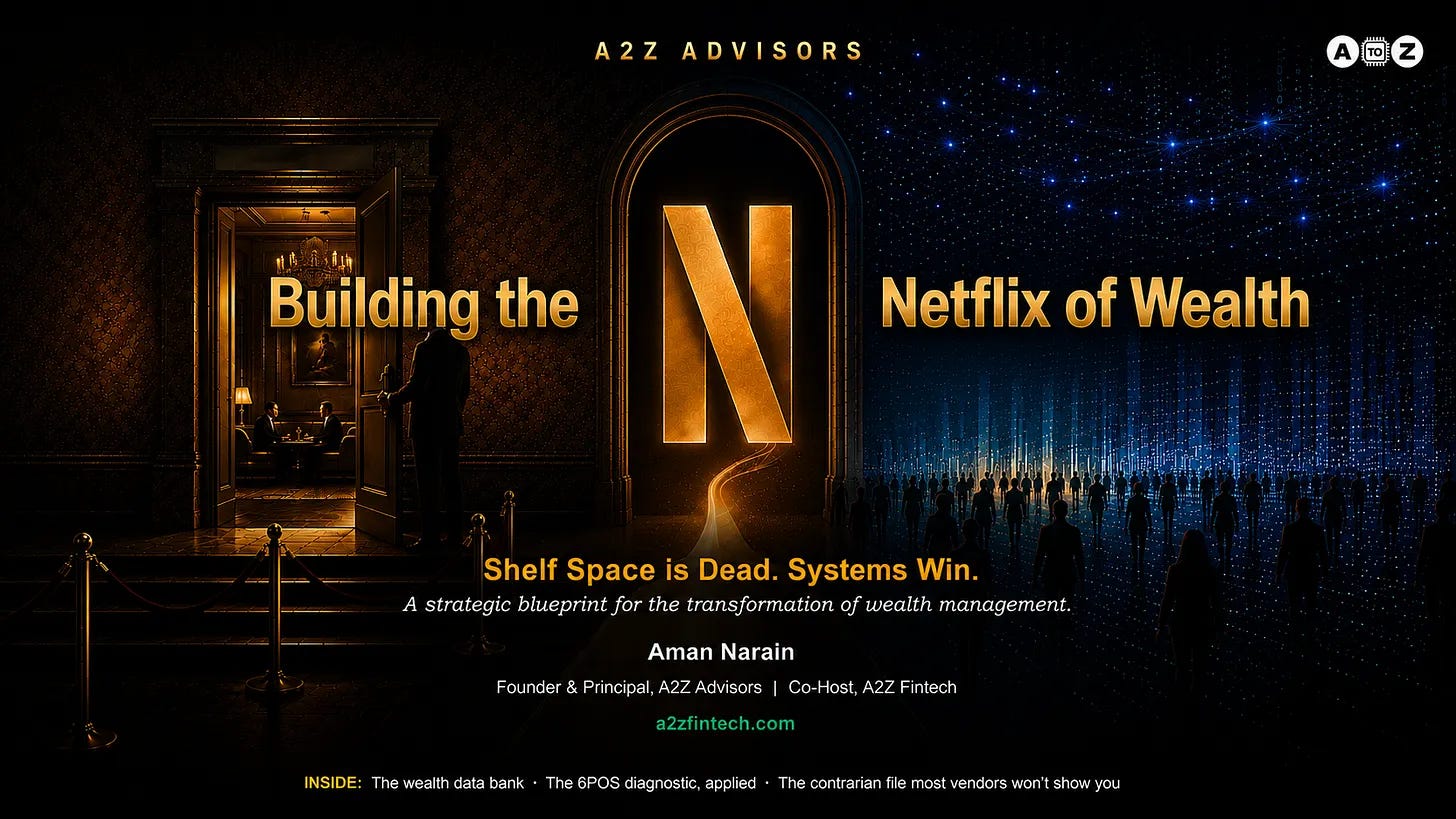
A note from the day job. An estimated $84 trillion changes hands over the next two decades, and more than seven in ten heirs replace their family’s adviser at the moment of inheritance. Wealth management is having its Blockbuster moment; this essay is the diagnosis, and the playbook is now a document. Building the Netflix of Wealth, the 16-slide A2Z Advisors blueprint, covers the Blockbuster parallel, the five forces, the economics side by side, and where the Netflix logic breaks.
Want it? Comment “Netflix of Wealth” below, or DM me below or on LinkedIn, and it lands in your inbox. And if it reads less like commentary and more like your board agenda, the next step is 30 minutes, no pitch: aman@a2zfintech.com. People-light. Outcome-heavy.
None of this is financial advice, and the tax treatment described varies by passport, residence and treaty; before acting on anything here, talk to someone licensed to know your situation. And if you turn three former Schroders men pontificating on a podcast into your actual portfolio, that is on you.
No posts
Comments
Nothing yet. Say the first thing.
Sign in to join the conversation.