
The Aegean in late June is a lesson in glare. Out on the water, the light does not fall so much as ricochet: off the sea, off the white hulls, off the pages of whatever you were pretending to read. On our boat there was a ritual before anyone was allowed near the bow. A bottle of factor 50 travelled hand to hand like a relay baton, and a father repeated the four words his daughters have heard from him more than any others in their lives. Wear your sunscreen. Girls. Sunscreen.
Somewhere off Alonissos, the boat’s speaker shuffled its way to a song older than both of them: a spoken-word oddity from the late nineties in which an unhurried voice dispenses a lifetime of advice over a gospel chorus, and confesses in its first breath that only one item on the list has any science behind it. My daughters looked up at the opening line, then at me, then at each other. The old man’s catchphrase, it turned out, had a backing track.
That was two weeks ago. It is now a Thursday night in Singapore that has quietly become a Friday morning, and I am awake for three reasons. The first is jet lag. The second is the World Cup, played this July in American time zones, which in Singapore is a tournament staged entirely in the small hours. The third took me longer to admit: this is the last weekend on which I can truthfully call myself a forty-something.
Victor Hugo, who knew a thing or two about long books, is said to have observed that forty is the old age of youth and fifty the youth of old age. Turning fifty, by that reading, is not an ending. It is a border crossing: the moment a man stops being an old young man and must learn, with whatever grace he can borrow, to be a young old man. What follows is my declaration at customs. It is addressed to two people in particular, and to anyone else standing in the queue.
Last week’s blog, The Republic of Invention, was written from that same boat, about a nation turning 250 and the conditions that let it invent the modern world. This week the anniversary is smaller by a factor of five and the subject much closer to home. Same water, shorter ledger: a man turning fifty, writing an open letter to his daughters. You are all welcome to read over their shoulders.
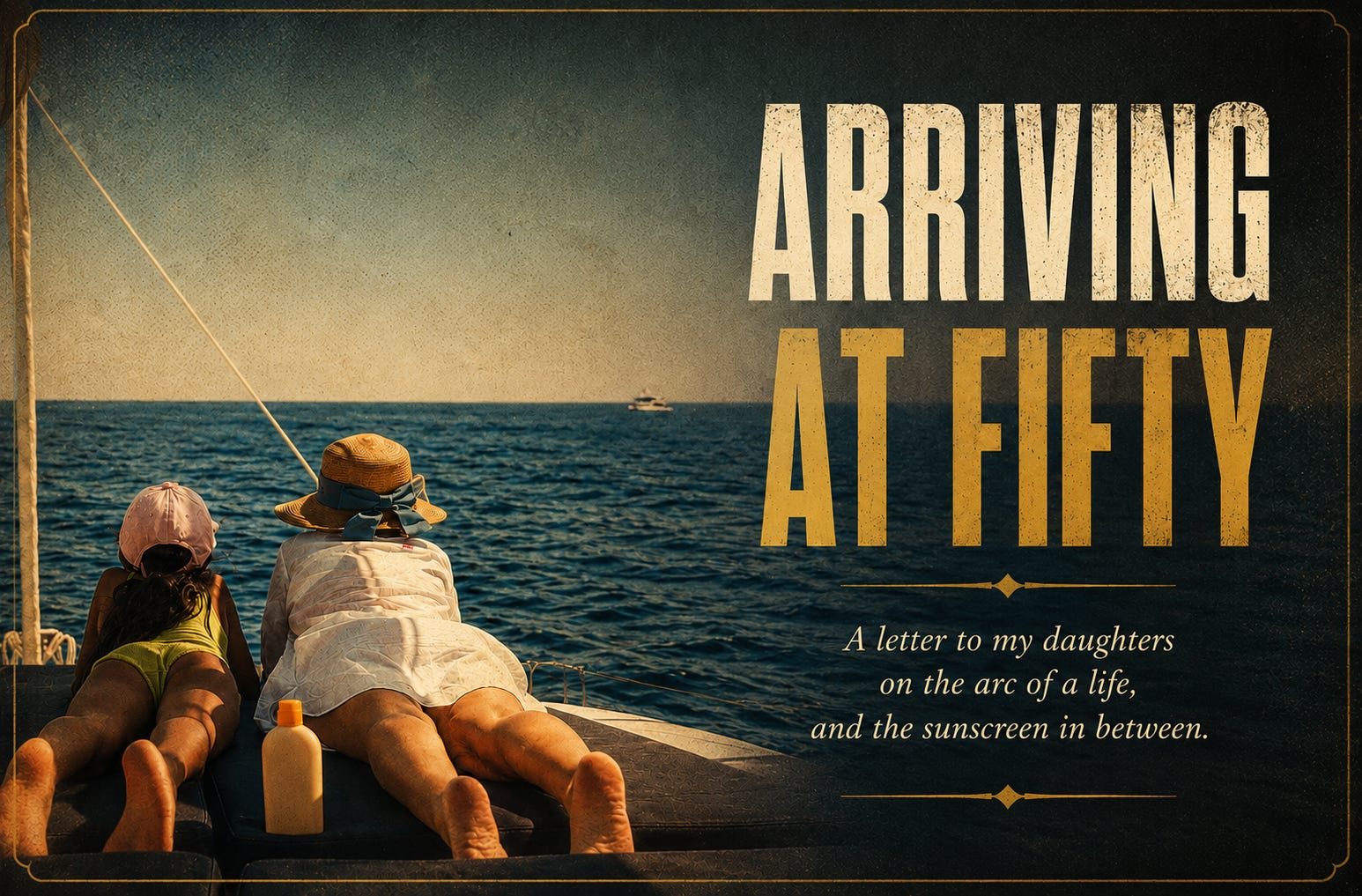
Singapore, July 2026: the last weekend of my forties. My Darling Girls,
Growing up in India, my birthdays arrived with three fixed features, as dependable as the monsoon that delivered the first of them. It always rained. I always ate too much of my own cake and spent the next day paying for it. And at some point in the proceedings, without warning and to my lasting embarrassment, I would cry.
I am pleased to report progress, though the ledger is uneven. Leaving India solved the rain by geography rather than by character, which is the kind of victory consultants are paid to dress up as strategy. The cake I have learned to respect from a polite distance. As for the crying, I have graduated into the quieter guild of people who simply go pensive as their birthday approaches. You two belong to the other tribe entirely, the one that plans the day months in advance and counts down the sleeps, and I want it on the record that I prefer your club, having been dragged into it annually by your enthusiasm.
Last July I broke my own weather rule on purpose. For my 49th we went back to the rain: my first birthday in India in twenty-five years, spent with your grandparents and with you, the monsoon drumming its old percussion on the roof as if no time had passed at all. A few months later we returned for your Dada’s 79th. The two trips were designed as a matched pair, the penultimate celebrations before this year’s capstone, when we would all mark his eightieth and my fiftieth in the same season and call it a jubilee.
We got the penultimate. We never got the capstone.
I wrote about him last month in Rules for an (Extra)Ordinary Man, so I will not linger here, because he would not have wanted lingering and because this letter faces forward, the way he did. I will say only this. I spent this past year assuming the milestone had been cancelled. Sitting here at fifty’s doorstep, I realise I had the architecture wrong. A capstone is not the last stone laid. It is the one that holds all the others in place.
Now I am going to do something no one who wants you to keep reading should ever do, which is hand you the exit before the argument.
In June 1997, a Chicago Tribune columnist named Mary Schmich wrote the commencement speech she would give if anyone were foolish enough to ask her. It opened with the only advice she could offer that scientists had actually proven: wear sunscreen. Everything else, she admitted, rested on nothing firmer than her own wandering experience. The internet promptly stripped her name off it and sent it round the world as a speech Kurt Vonnegut had supposedly given at MIT. He hadn’t. Two years later Baz Luhrmann set the column to a gospel chorus, and “Everybody’s Free (To Wear Sunscreen)” went to number one.
That is the song that found us off Alonissos. It does in five minutes what I am about to attempt in twenty: sing, floss, be gentle with your knees, be careful whose advice you buy. If you would rather press play than read on, I release you with a father’s blessing. It is a genuinely superior product, and unlike this letter, it rhymes.
But if you stay, here is why I wrote it anyway. Schmich’s whole joke, the one hiding under the gospel chorus, is that advice can never be proof. It is one generation’s experience decanted for the next, useful precisely because it is unverified, offered anyway, and free. Which makes advice and sunscreen the same technology.
Advice does not stop the sun. It buys you longer in it.
So consider what follows the factor 50 I could not fit in the beach bag: protection, in advance, for a journey whose weather I will not always be there to check.
You two are still inside the first phase of a life, the one I think of as the diving years: the plunge in, the full-body immersion, the two decades before anyone hands you a map. A diving child does not steer. She is carried by the water, learning its temperature, swallowing the odd mouthful, thrilled and terrified in the same breath. That is childhood, and it is meant to be exactly that immersive.
The second half of it, where you are now, feels less like swimming and more like learning to drive. Everything accelerates at once. The body, the emotions, the opinions, the appetite for independence. You are behind the wheel for the first time, the roads are unfamiliar, you oversteer constantly, and you are convinced the entire car park is watching you reverse. It is propulsion before direction. The engine works years before the judgement does.
Nyla, you are deep in that stretch, which is why every sentence in this letter has been road-tested against your eye-rolls. Naina, you are not far behind.
Do not rush the diving. Its whole purpose is immersion, not arrival. But know what waits on the far bank, because I have written about it before, in TWTW #8: Decisions, Diamonds & Destiny: the roughly ten grand decisions that shape a life, most of them clustered in what I called the architect years, from about eighteen to forty, when your agency peaks and your choices quietly become blueprints. Education, craft, partner, city, children. We fret over the thousand small choices and sleepwalk through the ten large ones. The three decades that follow the diving years are where nearly all ten get made.
You cannot steer while you are still learning to float. Direction is a privilege the water grants you later.
Your twenties are the striving decade, and their governing law is the one your father spent a career watching people apply to money and almost never to themselves. Compounding. Habits, skills and friendships compound exactly the way capital does, and the twenties are the only period when the compounding is cheap. A small deposit at twenty-two, in learning a tool, in eating decently, in saving a sliver of every payslip, becomes effortless momentum by forty-two. Start late, and you will pay double for half the return. Youth is the only market where everything is a bargain, and the discount expires quietly.
Do not draw yourselves a ten-year career map; the world redraws the roads too fast for that.
Run a portfolio instead. Treat each role as a position with a risk and return profile, and in this decade optimise ruthlessly for the rate of learning over the rate of pay. Trade income security for steep curves and equity in yourselves while your burn rate is low and your obligations are few. Aggressive risk is cheapest now and gets dearer every single year.
And be suspicious of the commencement-speech commandment to follow your passion.
Passions at twenty-one are volatile, plural, and entirely about you. Follow your contribution instead: the intersection of what you are unusually good at and what the world genuinely values. Passion tends to arrive at that address on its own, a lodger who moves in once the house is built. Better still, become a double or triple threat. You do not need to be the best in the world at one savagely contested skill; top quartile in two or three distinct ones, a quantitative footing plus the ability to write or to sell, makes you rare at the intersection.
Two last provisions for the decade.
Choose the right pond: the most ambitious, fastest-moving water you can find, ideally one where the founders are still swimming in it.
Because that is where you learn how things are built rather than how bureaucracies are maintained. And absorb early what psychologists call the spotlight effect: almost nobody is thinking about you, because they are all far too busy worrying about themselves.
Nobody is thinking about you, and that is the good news. It is also total creative freedom, issued free of charge.
Your thirties are the thriving decade, when momentum finally arrives, and with it the most elegant danger of adult life: drifting on it. The striving years are for accumulation. The thriving years are for direction, and direction is chosen, never inherited.
Start with fear, because it is the most reliable compass you will own.
The research on end-of-life regret is strikingly one-sided: the regrets that endure are the regrets of omission, the risks untaken, the words unsaid, the ventures unfounded. Failures fade because failure comes with closure. If a move, a pivot or a conversation makes your stomach flip with equal parts terror and excitement, that is usually the signpost to growth, not away from it. The thirties will tempt you to protect what you have gathered. Keep jumping while the falling is still cheap.
Regret keeps better records of the things we never did.
Then choose your people with the same seriousness.
Your great-grandfather, the General, gave me the line I keep returning to, most recently in I Was Richer Than I Thought: you are the company you keep. It is permissible, and sometimes necessary, to outgrow people. Seek the friends who challenge you and celebrate your wins without a shadow behind the smile. A handful of deep ties outperforms a stadium of acquaintances, and the dividend, I can now report from experience, compounds for thirty years and counting.
Guard your attention the way you would guard capital, because in this decade everyone starts asking for it.
A cluttered calendar is a portfolio of other people’s priorities. Apply what I think of as the head-and-heart veto to anything new: take it on only if both your logic and your genuine excitement say yes, and if either hesitates, pass. Spend the surplus on experiences rather than objects. Psychologists have a name for it: hedonic adaptation. The possession thrills, then fades into furniture, while the road trip, the festival, the shared table become load-bearing parts of who you are. Nobody on a deathbed has ever asked to see the television again.
And service the vehicle. Lift something heavy, protect your hearing, mind your teeth, stretch: sunscreen for the whole machine, not just the skin. It is crushingly boring counsel, and I am giving it anyway, because vitality at fifty is a luxury purchased in monthly instalments at thirty. Pay the premiums early. The claim always comes.
Your forties, I can now confirm from the far bank, are the surviving decade. Demands peak on every front at once, energy dips, and the first real losses arrive. If striving was accumulation and thriving was direction, surviving is subtraction: stripping away the noise to protect the few things that genuinely matter.
The first subtraction is the job from the self. A career is a vehicle for income, skill and impact; it is not a soul.
I have watched brilliant people weld their identity to a title and then watched the industry shift, the reorganisation land, the logo change to someone else’s name, and the person go down with the letterhead. Build an identity the payroll cannot touch, because this is the decade that stress-tests it.
The second is the apology from the refusal.
A remarkable share of midlife exhaustion is simply the compound interest on a decade of undeserved yeses. Saying no to what does not fit your values is not selfishness. It is the entry fee for excellence, and it requires no footnote.
The third subtraction is the hardest and the most freeing: the halo from the people who raised and taught you.
Somewhere in this decade you discover that your parents and your mentors were improvising all along, carrying their own unresolved baggage, doing their best under pressure you never saw. The discovery is not a demotion. It is an upgrade, from worship to friendship, and it lets you forgive old mistakes and build something more honest with them. The operative clause, which I did not fully hear until this past year, is: while they are still here. Make the calls. Ask the questions. The archive closes without notice.
You will also, if you have pushed into rooms that matter, get things properly wrong in this decade, with consequences attached. The setbacks hurt more at forty-five and the recovery runs slower; that is physiology, not failure. What separates people is not the absence of the hit but how fast they get back up. Resilience stops being a trait you have and becomes a practice you keep.
One instruction remains, and it is the one I most wish someone had shouted at me at forty. The good parts of this decade hide inside the exhausting ones: the chaos of young children, the tight-knit fatigue of building something, a particular summer with particular friends. Pause, and taste the good times while they are happening, because saying it out loud is the only trick that works: this is one of the good parts. I did it on the boat two weeks ago, somewhere between the sunscreen and the song.
The good times rarely announce themselves. They wait to be noticed, and they do not wait long.
Have you made it this far? If you have, and you are under forty, genuine congratulations: you are ahead of your old man, who only woke up to most of this on the approach to fifty, deep in what Taylor Swift would presumably file as my surviving era. If you pressed play instead and wandered back later, more power to you. The song was always the better teacher.
Here, then, is the biggest thing I have learned on the eve of fifty, and it is the opposite of what I expected to write.
Nobody has it figured out. At your age I was certain that fifty came with the answers pre-installed.
The unfathomable, brilliant reality is that the book of life is infinite and the questions only multiply as you read. Whether that fact delights or defeats you is the single most consequential setting in your character. To a curious mind it is a cold drink on a hot day in the midday sun. To an incurious one, the sunset it sees coming becomes a self-fulfilling prophecy.
So here is my prayer for you both, the only inheritance that pays out immediately.
May your dreams always outweigh your fears. May your actions double and your excuses halve. May you drive through your lives looking through the windscreen, and glance at the rear-view mirror only long enough to smile at what you have passed.
I am back on that boat now, in memory at least, watching the bottle of factor 50 travel hand to hand while an Australian voice on the speaker gives you, over a gospel chorus, everything I have just tried to give you in prose. I finally understand why those four words became my catchphrase. Of all the advice a father dispenses, sunscreen is the only line with proof behind it. Everything else here rests on nothing sturdier than one father’s fifty years of educated guessing. I offer it anyway, the way Schmich did, the way every parent does: unverified, unsolicited, and underneath it all, just another way of saying I want you out in the sun for a very long time.
On the sunscreen, trust me. On everything else, trust yourselves.
All my love, always,
Dad
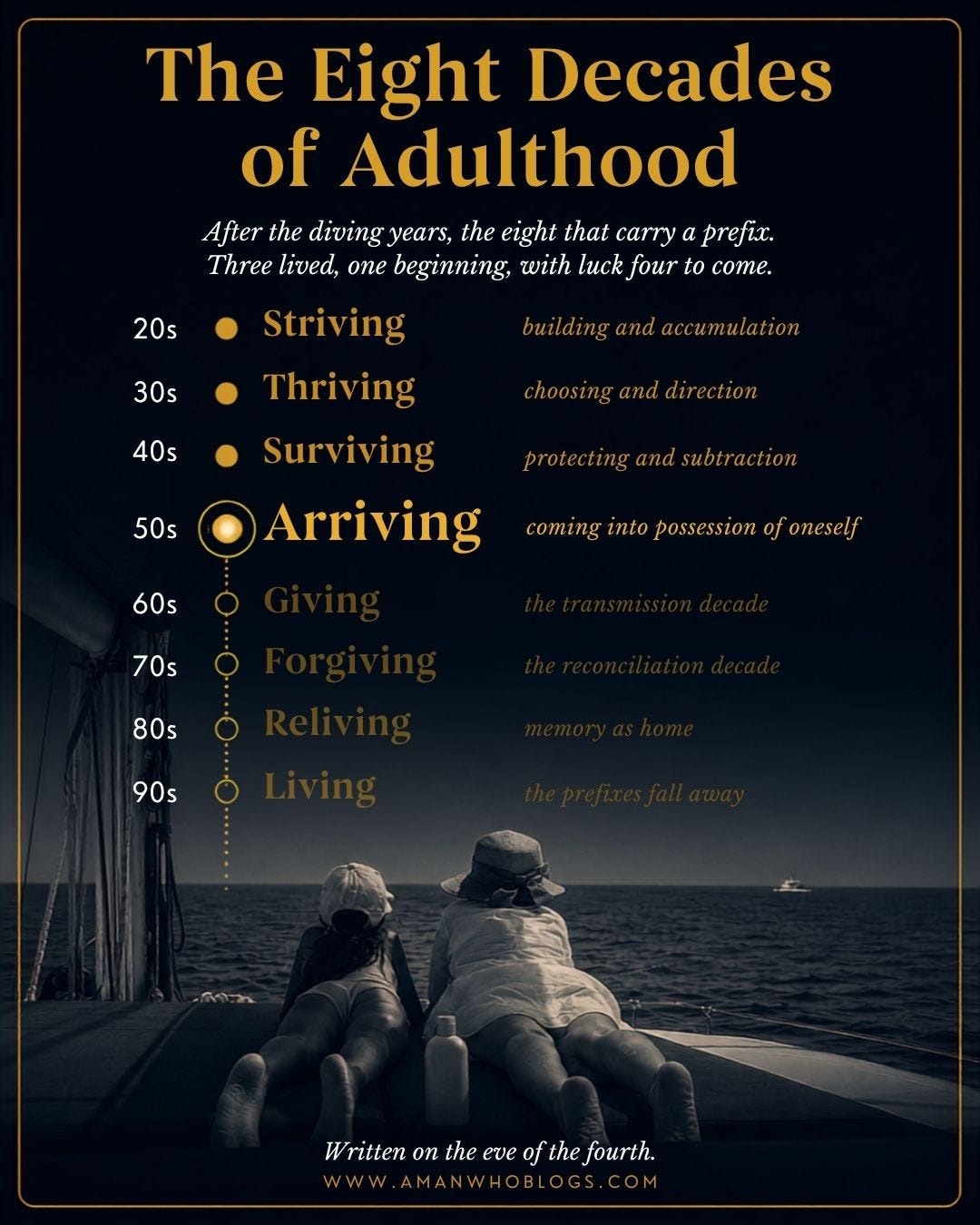
P.S. Knowing you two, you finished the last line and immediately asked over my shoulder: fine, old man, but what about your next three decades? A fair challenge. Everything above I have lived and can vouch for. What follows is hypothesis, a forecast filed before the weather arrives, and you are both licensed to mark it against reality as we go.
My fifties, beginning this weekend, I am calling the arriving decade: the years of coming into possession of oneself, when the striving portfolio finally concentrates into the two or three positions, in work and in life, that I would never sell.
My sixties, if the forecast holds, will be the giving decade: the vanaprastha turn our tradition mapped out long before management theory rediscovered it, when everything accumulated flows outward in mentorship, teaching, and time given to the people and causes that earned it. Arthur Brooks calls this the shift from fluid to crystallised intelligence, the wisdom of pattern and synthesis that stays high long after raw speed fades. Your worth comes to lie less in what you can still do than in what you can help others become. Grandparenthood, should you two ever grant it, is simply that principle wearing its warmest clothes.
The seventies I expect to be the forgiving decade. Of others, for slights that no longer deserve carriage. Of circumstance, for the doors that never opened. And hardest of all, of oneself, for the years spent striving at the wrong things and the words left unsaid to people no longer here. The research suggests these are among life’s most contented years, and I suspect forgiveness is most of the mechanism. The load lightens because you finally put it down.
And the eighties, the reliving decade, when memory becomes the main residence, which is not a diminishment but a homecoming. You walk back through the earlier decades at leisure: the diving child, the striving graduate, the glorious forties that felt unbearable at the time and turn out, on replay, to have been the good parts. This is where “pause and taste the good times” pays its final dividend. The moments you banked in your thirties are exactly the currency you get to spend.
Which completes an arc I only noticed while writing this letter. First the diving years of childhood, the plunge in. Then the eight decades of adulthood, each carrying its prefix: striving, thriving, surviving, arriving, giving, forgiving, reliving, and at the last, living. A life begins by diving into the water and ends by simply living in it, and everything between is a prefix that falls away as you go, until what remains at both ends is the same unadorned verb.
So hold this letter somewhere safe, girls, because it has a sequel scheduled. My hope, filed in writing, is that fifty years from now the three of us read it together while I plot the note on becoming a centenarian. Not one of those centaurs the Greeks put on Mount Pelion, half man and half horse. Something far better: a man with a hundred years behind him, still facing the windscreen, whose dreams still have wings.

Aman Narain is the Founder and Principal of A2Z Advisors, a boutique fintech and digital advisory firm based in Singapore. Born in the UK, raised in India, educated in the US and France, he spent twenty-five years inside global banking and payments at Standard Chartered, HSBC, Schroders and Google Pay. He co-hosts the A2Z Fintech podcast with Zubin Vandrevala and writes A Man Who Blogs twice a week. He turns fifty next week, is at peace at last with rain on his birthday, and still applies factor 50 with the zeal of a man taking his own advice.
Go Deeper: Mary Schmich’s original column, “Advice, like youth, probably just wasted on the young,” Chicago Tribune, 1 June 1997 · Baz Luhrmann, “Everybody’s Free (To Wear Sunscreen)” (1999) · Arthur C. Brooks, From Strength to Strength (2022) · Robert Waldinger and Marc Schulz, The Good Life (2023), on the Harvard Study of Adult Development · TWTW #8: Decisions, Diamonds & Destiny
No posts
Comments
Nothing yet. Say the first thing.
Sign in to join the conversation.