
A discreet slip road just before you reach Terminal 3 at Changi leads to an entrance that looks and feels more like the lobby of a Four Seasons than the front of an airport. You have to know it is there. The car turns off the main artery and arrives at a single set of glass doors which open before you have signalled them to. There is no queue. There has never been a queue. Two porters move quickly to take the bags from the boot. They do not know my name. One of them recognises me, which tonight is everything.
This is the fifth year I have walked through that door as a Solitaire PPS member. It is my last. The flight to London leaves at two-forty in the morning, an ignominious hour and an unintended rite of passage; by the time I return to Singapore, the relegation will have been quietly processed in the system. I have known this day was coming for eighteen months, since the morning I traded the corporate role for the entrepreneurial life and walked away. However, I had not entirely admitted it to myself, from the spend account that paid for the membership. Tonight is the closing entry.
A Solitaire PPS membership is a strange object. It is not a discount. It is not, properly, even a privilege. It is the airline equivalent of a Loro Piana cardigan: a quiet, portable signal of belonging, addressed to a particular kind of room and invisible outside it. Each time the porter recognised me. Each time the queue dissolved before I reached it. Each time a flight attendant, on a flight where I had ended up in economy, smuggled me a camomile tea across the curtain from business class with the conspiratorial air of a courier running a small piece of contraband. None of these are extravagances. They are the cabin equivalent of a cashmere scarf nobody can identify by brand at three paces. Tonight, the signal goes quiet. Shona, who carries the supplementary card, will keep the family in the language for another twelve months.
Singapore Airlines did not build a frequent flyer programme. It built the most psychologically sophisticated caste system in the modern world. But unlike most caste systems, the cruelty of it is not the exclusion. It is the demotion.
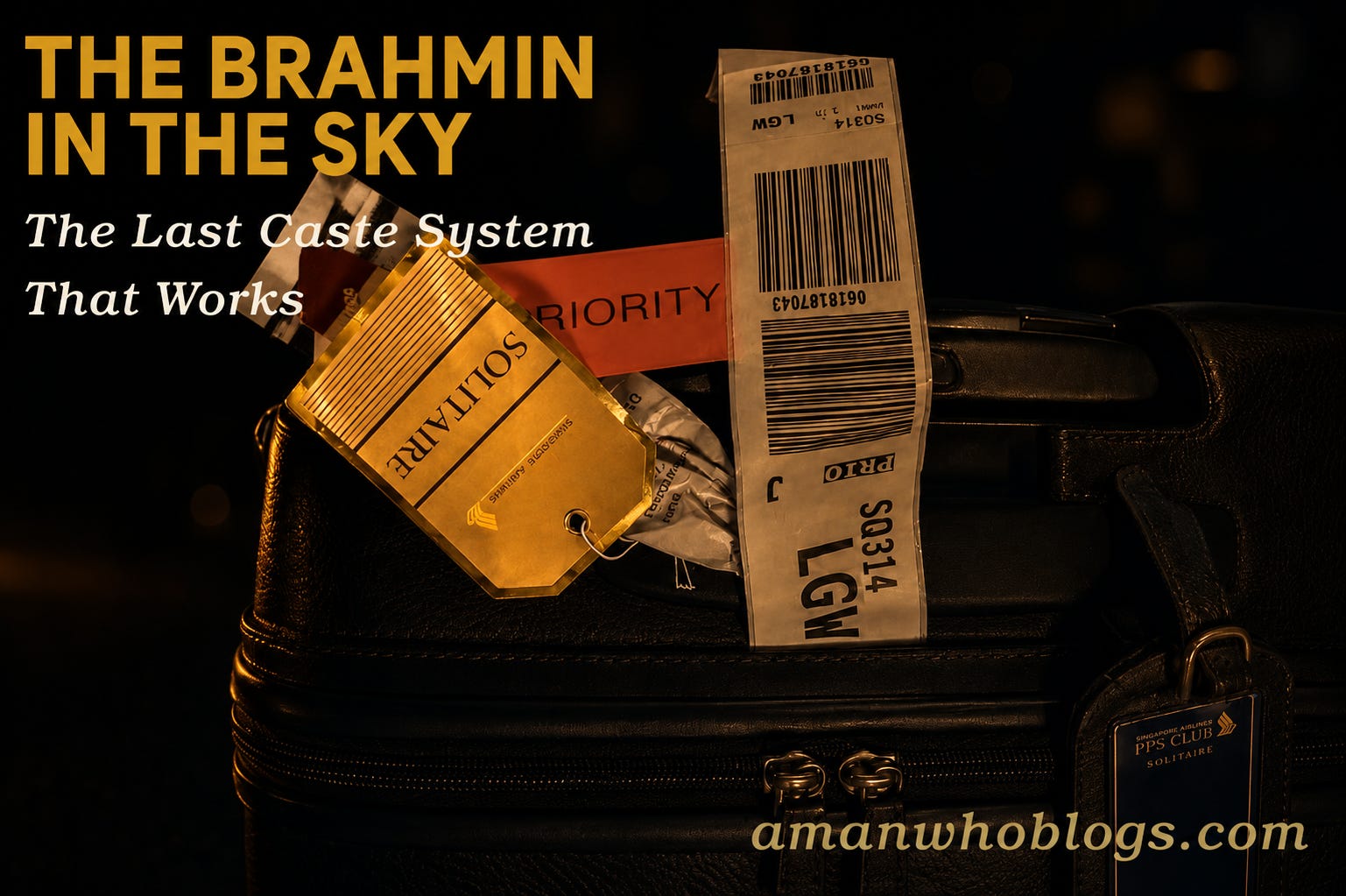
Last week’s blog, on Life, Love & Liquidity at Fifty, audited what a person actually owns at the halfway mark: the assets that have earned quietly, the ones that turn out to be habits, and the ones that look like wealth until you read the small print. The Brahmin in the sky is about one of those: the airline as a caste system, and the precise mechanism by which it persuades a household to live, for most of a working life, inside a code of belonging the household never quite chose.
🚪 The Sacred Gate
Airports are, as the academic literature unhelpfully calls them, non-places. The term belongs to the French anthropologist Marc Augé, and it describes a site of pure transience: a depersonalised corridor through which the body must move and at the end of which it is mechanically certified for travel. For most travellers, that is exactly what an airport is. A queue, a check, another queue, a scan, a wait, a gate.
For the elite tier of any sophisticated airline, the airport is something else entirely. It is a sequence of bypasses and inner sanctums, organised so that the passenger never has to occupy the same space as the depersonalised mass. Private check-in. A separate immigration counter. A fast-track security lane staffed by an officer who already has your details on the screen. A lounge whose architectural language is borrowed wholesale from royal palaces, with the same enfilade logic of one chamber leading deeper into the next, and access to each chamber tightening as you proceed.
Changi’s First Class terminal is the gold standard of the form. It is, mechanically, a separate building, accessed by the unmarked slip road that the Grab driver knows because the booking told him and that the first-time visitor would never find unaided. The check-in counter is staffed by four people, not twenty. The immigration officer is a single human being, not a row of glass cabinets and automated kiosks. The walk to The Private Room takes ninety seconds. The Private Room itself is closer in feel to the foyer of a Rosewood Hotel than to anything an airline traditionally does. Italian leather. À la carte dining. A long, cool, lit corridor at the back, which leads, at the appointed hour, to the aircraft (or, in the case of Singapore’s fierce competitor Emirates at its Dubai hub, directly onto the plane itself).
What is being purchased here is not a faster journey. The flight, after all, takes the same number of hours regardless of which door you walked through. What is being purchased is the small protected space in which the passenger’s identity is reflected back at them at every turn. The porter recognises you. The agent at the desk knows your name. The bottle of water in the lounge is the brand the file says you prefer. By the time you sit down on the leather, you have been recognised by face or name eleven times, and the day has been arranged so that no part of it requires you to wait alongside anyone whose ticket cost less than yours.
I should say, before the analytical voice runs away with me, that I have been one of the people sitting on that leather for five years. The temple is not new, and I am not a recent visitor to it. What is new is that anyone with a corporate spend account can walk into one, and what is recent, in my own life, is the realisation that walking into one for long enough quietly changes the way you read every other room.
The Aisle Seat
My cameo appearance in First Class life began more than twenty years ago, on a balmy evening in Mumbai. I was twenty-five. I had just finished a tour of duty with Standard Chartered in the maximum city, and I was flying back to London on British Airways, deeply pleased with myself in the unspecific way that men of twenty-five can be deeply pleased with themselves. I had a Business Class ticket. I had earned that, in the relative sense in which one earns one’s first Business Class ticket, by giving every waking hour for three years to the work that paid for it.
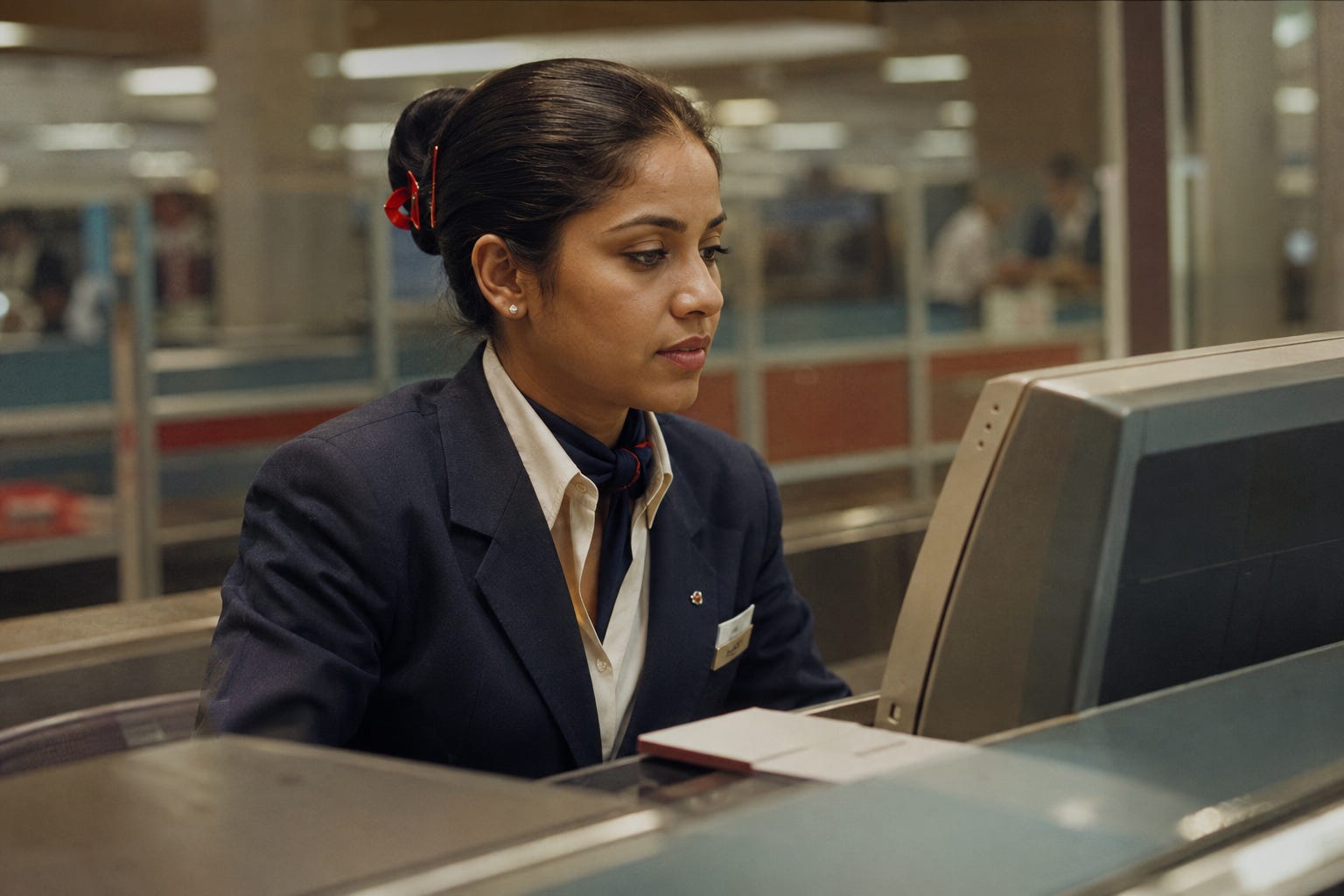
At the British Airways counter, the agent was a petite, immaculate Indian woman with a distinctly British sense of humour and the bearing of a person who had long since stopped being surprised by anything Bombay could put across her counter. She processed my passport. She studied her screen. Then she said, in the politely apologetic tone of an agent delivering bad news, that she was very sorry but they were unfortunately full up in Business this evening, and they had upgraded me to First for the flight back to London.
I wanted to dance a jig. I wanted to pump my fists in the air. I pleaded with myself, in the half-second I had before responding, to restrain this sporadic exuberance and to mask my joy in the dignified manner of a man who had been upgraded before. I composed my face. I summoned, from a part of myself I had not previously needed, an air of polite ambivalence. I said, with the studied indifference of a senior partner being told his usual table was free,
“Thanks. But do I have an aisle seat?”
She did not turn her head. She lifted her eyes over her glasses and held the look for the length of time it takes a sentence of unspoken commentary to be silently composed. She fiddled, briefly, with the dark bun and the red BA clips that held it in place. Then, in a tone that was polite but bordered on indignant, with deliberate emphasis on the Sir that was simultaneously a courtesy and a reminder I was twenty-five and did not entirely deserve the title, she replied:
“Sir. They are all aisle seats in First Class.”
The mercy was Indian. The line was British. The combined effect was the most efficient act of class education ever performed on me, in seven words, free of charge, in twenty seconds.
I think about that woman often. What she gave me that evening was not the aisle seat. It was the entire syllabus of the system into which I had just, accidentally, been admitted. A system in which the seats arrange themselves around the passenger rather than the other way around. A system in which the questions you ask are themselves a tell. A system in which my own naïveté was, briefly and forgivingly, made visible to me.
I walked onto that aircraft illiterate. I stepped off it twelve hours later having decided, at some level I could not yet articulate, that I would spend the rest of my working life buying my way back into the building.
The Theology of the Solitaire
Every airline runs a loyalty programme. Most of them are, in essence, the same product: a tiered system in which the customer is rewarded for repetition, and the rewards take the form of incremental privileges that compound as the customer climbs. The architecture is, on paper, identical across the industry. In practice, the cultures are wildly different, and the differences sort themselves into something that looks much less like marketing and much more like comparative religion.
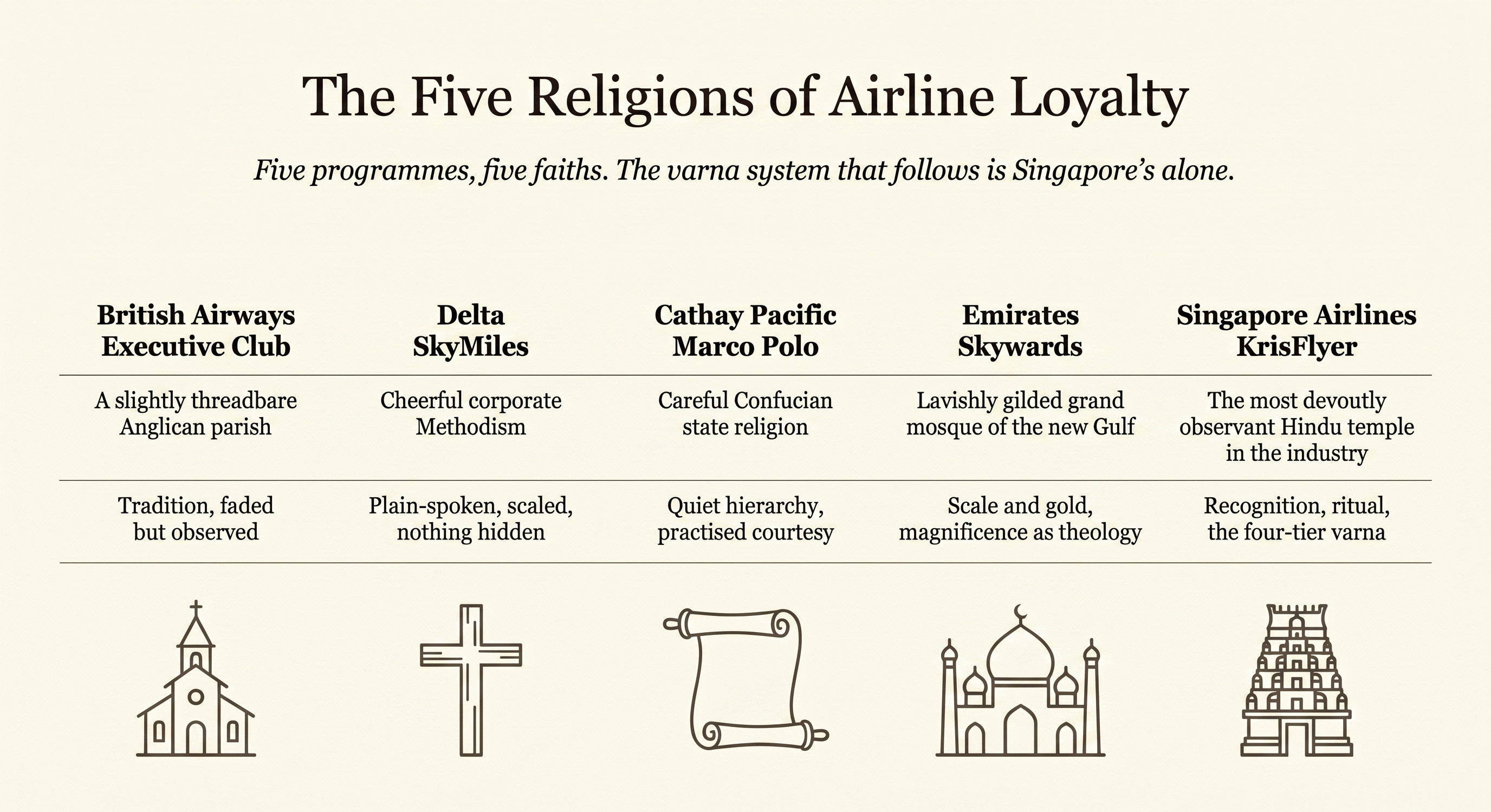
British Airways’ Executive Club is a slightly threadbare Anglican parish. Delta SkyMiles is the cheerful corporate Methodism of the American highway. Cathay Pacific Marco Polo is the careful Confucian state religion of a city in transition. Emirates Skywards is the lavishly gilded grand mosque of the new Gulf, where scale and gold leaf do the work that ritual and recognition do in older faiths. And then there is Singapore Airlines, the most devoutly observant Hindu temple in the entire industry. It runs a four-tier varna system with absolute internal coherence. KrisFlyer is the laity. Elite Gold is the merchant class, the working flyer who shows up for prayers but does not understand the priest’s Sanskrit. PPS Club is the priestly class proper, the Kshatriya who has earned position through repeated visible sacrifice. And Solitaire PPS is the Brahmin: the small, near-permanent inner circle whose status is signalled less by what they receive and more by the recognition they are given everywhere they go.
I have spent two decades working my way up that varna system, often willingly, and have internalised its codes the way one internalises codes that flatter one. The Cull, when it comes, is the temple’s quiet reminder that the codes are on lease.
Every Brahmin caste has its founding schism, and the SIA system has its own. In 2007, the airline conducted what is now politely described in industry forums as the Great PPS Cull. The qualification logic was changed from one based on distance flown to one based on amount spent. At a stroke, thousands of long-tenured members who had built their status on years of long-haul flying were de-recognised. People who had imagined themselves as members of the priestly class woke up to discover they had been quietly reassigned to the merchant tier. The reaction was not annoyance. The reaction was grief.
That tells you almost everything you need to know about what these programmes actually are. A change in marketing terms could not have produced grief. The loss of a discount could not have produced grief. What produced grief was the loss of a category of selfhood the airline had spent fifteen years installing in the customer’s house, and the realisation that the airline reserved the right, at any time, to remove it.
The Brahmin in the sky is a Brahmin only as long as the temple says he is.
A Language of Rooms
I had assumed, until quite recently, that what a Solitaire member was buying was service. Better seats. Faster lanes. The small mercies that compound on a long career of long flights. I have come to think I was wrong about that. What a Solitaire member is buying is something quieter and stranger.
What a Solitaire member is buying is the Loro Piana of flying.
The vocabulary of quiet luxury has made its way back into the language of consumption. The signal is no longer the loud monogram; it is the cashmere scarf that announces itself only to people who can read it. Solitaire is the airline expression of the same grammar. It is not really about the lounge, or the food, or the seat, although those are lovely. It is about the priority tag on the bag the porter has noticed three seconds before you have. It is about the agent at check-in who does not look up your record because she does not need to. It is about the small white card in the wallet that the person across the immigration counter sees and recognises without comment. It is, when you sum it all up, a code of belonging, addressed to the exact, narrow, professional class of person who has spent enough time in airports to read the code.
The point of Solitaire is not that you are above other passengers. The point is that you are legible to a particular community of strangers, who never see one another but recognise one another by airport, by lounge, by the way they stand at the gate. It does not yell. It does not announce arrival. It tells the people who can read it where you have been.
I should be careful, while I write this, not to sound as if I think this is a fine and noble thing. It is, in some lights, a small and slightly silly thing. The class of person who has spent twenty years being legible at airports is not a class that has earned anyone’s admiration; we are simply a class that has flown a great deal, often for reasons that, in the cold light of fifty, look less heroic than they did at the time. I have been part of it. Tonight, I am being eased out of it, and I am noticing, perhaps for the first time, what exactly I had been paying for.
What I had been paying for, I now think, is fluency. Five years of Solitaire is not five years of being treated well. It is five years of being treated as if I were already known, in a language only the room speaks. The fluency is portable. It travels with you to the Concorde Room at Heathrow, to The Wing in Hong Kong, to the lounge in Frankfurt where the woman at the desk smiles before she has asked your name. The whole of the global premium-travel network is, in essence, a single conversation in the same language, and Solitaire is one of the cleanest accents in it.
Shona has been quietly fluent in this language for the same five years. The children, when they fly with us, are picking up the accent without being taught it. They have not earned this. They have inherited it, in the small everyday way that children inherit the language of the household. On Monday, the language begins to leave us. Not in a single moment, because Shona keeps the supplementary for another year. But in the longer arc, the household will start to lose its accent, the way a family that moves country slowly loses the fluency of the country it left.
Lose the fluency, and the rooms do not become hostile. They simply revert to silence.
The Working Affluent and the Arrived
Spend long enough in airline lounges and you start to see two populations sharing the same furniture with very different relationships to the room. The first is what I will call the Working Affluent. They have arrived in business class on a corporate ticket. They are dressed for the meeting at the other end. They are conscious of the cabin in the way of those who have reached a tier of society and are still measuring themselves against it. The luggage is hard-shell, branded, occasionally embarrassed by a small but loud monogram. There is, and the word fits, a certain infamy to the modern business-class loud logo: it is doing more work than the wearer perhaps intends, announcing him to a room he did not realise was listening.
I should say, before I am tempted to condescend, that I have worn those logos. The room I now describe as quiet luxury was, for years, a room I worked hard to enter, often loudly. The move from the Working Affluent to the Arrived is less a graduation than a recalibration of what one is willing to be seen needing, and one I am about to make in reverse.
You can spot the solitary champagne traveller in business class at almost any hour. He is in his fifties, his suit is good but worn. The flute arrives within ninety seconds of him sitting down. He is not celebrating anything. He is, in some private accounting only he knows, marking a moment. The champagne is not the indulgence. The not-having-to-explain-it is the indulgence.
The First Class lounge runs a different sociology entirely. The clothing is, in the current vernacular, quietly luxurious. Lululemon. Loro Piana. A cashmere scarf in winter that has not been styled to be photographed. The luggage is older, leather, scuffed in places, carrying the patina that only appears after thirty thousand miles of being handled by porters who knew it was leather and treated it accordingly. Nobody is photographing the menu. The phones are face down on the table.
The single most counter-intuitive piece of First Class sociology is who turns up. The cabin is not, contrary to popular imagination, full of solitary executives. That cabin is the upper edge of business class, where the man with the watch is decompressing on a profligate corporate ticket. The actual First Class cabin in 2026 is full of families. Quiet ones. Three children, two parents, sometimes an older relative. They are not celebrating anything in particular. They are getting from one home to another. They are in First because the alternative (three children and two parents in business) would have been more uncomfortable for everyone, and they have already crossed the threshold beyond which the marginal cost of upgrading the family is no longer the operative question.
Veblen would have recognised that the grammar of consumption has inverted along the income curve. The Working Affluent display, because they are still climbing. The Arrived recede, because they are not. The loud logo is the signal of recent money, or insufficient money, or the slightly anxious adjacency to it. The signal of actual money is the small priority tag on a leather bag, which the porter has already noticed before the family has reached him.
The Porter and the App
A former colleague of mine at Google used to ask, half-rhetorically, which of these consumer industries has actually solved the offline-online problem? He meant the problem of running, end to end, a single recognition system across a physical encounter and a digital one, in a way the customer experiences as continuous rather than as two clumsy systems. Most of the room would answer Apple. Or Amazon. Or one of the luxury hotel chains. He would shake his head. The right answer, he insisted, was airlines. Specifically, the better Asian airlines.
He was right, and the longer I have spent in fintech the more obvious he turns out to have been. Banks have spectacular data on the customer and almost no physical theatre. Hotels have spectacular physical theatre and almost no data continuity across stays. Tech companies have spectacular scale and no physical encounter at all. The airline alone runs the full circuit. The system knows your face, your seat preference, your wife’s name, your child’s allergies, and the fact that you take camomile rather than English breakfast on a long night flight. The porter at the gate knows because the system told him. The agent at check-in knows because the system told her. None of them are reading from a screen at the moment of recognition; the screen has done its work hours earlier, and the human being is now performing what the screen prepared.
This is what I have started calling, when explaining it to bank clients, the Business Alpha of the modern airline: the rare combination of high frequency, high physical theatre, and high data continuity, running through the same brand, on the same customer, across both surfaces of their life. Frequency without theatre is the mobile network. Theatre without continuity is the hotel. Data without theatre is the bank. Frequency plus theatre plus continuity, on the same customer, is the airline alone.
What a retail bank should notice about Singapore Airlines is not the lounge or the suite or the porter. It is the recognition engine that connects the porter to the app. It is the seamless inheritance of fluency from primary to spouse. It is the way the customer’s emotional balance sheet is updated in real time across both surfaces of their life. The airline has built the household relationship that every retail bank still talks about as if it were a future ambition.
You can run an airline as a transport business and lose money. You can run it as a recognition engine, with a transport business as the surface, and lose far less.
The Soft Landing
This essay has been written, in part, in The Private Room, where I have quaffed the complimentary champagne in the manner of a man at his last meal. The porter outside has recognised three more people the way he recognised me, none of them by name. The corridor to the aircraft beckons. It has, on this particular evening, the courteous weight of a condemned man’s last walk to the gallows: well-lit, impeccably staffed, the destination not in any way negotiable.
I am not, on reflection, mourning the room. It is a well-appointed room and it has been kind to me, holding a table’s worth of family memories: flights with the children, dim sum and wagyu sliders washed down with fresh coconut water, the small everyday rituals of a household that had grown used to flying together. But rooms are rooms; one ages out of them, or into others, and the ones that genuinely matter in a life are not the ones at airports. What I am noticing tonight is something smaller. A fluency I had acquired without knowing I was acquiring it is going to begin to fade. The porter will not recognise me. The agent will not have my preferences. The flight attendant in business may not, on a future flight, ask about the camomile. The file that told them is being archived.
Soft landing, the manuals call it. The mechanic is deliberate: a Solitaire falls one tier rather than many, and the household’s fluency thins at the edges rather than vanishing in a single move. It is a courtesy I now read for what it is, which is not generosity. It is the system’s small, careful refusal to break the family’s language all at once. Languages, even commercial ones, are best lost slowly.
Somewhere over the Indian Ocean, the file will be quietly archived. I will land in London on the morning of the relegation. I will not, in any practical sense, have lost anything that matters. I will simply have stopped speaking a language I did not know I was speaking, in rooms I did not know were listening.
The British Airways agent in Mumbai, more than twenty years ago, told me in seven words and twenty seconds that all the seats in First Class are aisle seats. She was right. What she did not say, because there was no need to and she was not in the business of saying things that did not need to be said, is that the seats are aisle seats only as long as you are in the room.
A Man Who Blogs drops twice every week. Aman Narain is the Founder and Principal of A2Z Advisors, a boutique fintech and digital transformation consultancy based in Singapore. His professional background spans Google, HSBC, Standard Chartered, and Schroders, and he co-hosts the A2Z Fintech podcast with Zubin Vandrevala. He writes from Singapore or a plane, is currently negotiating with himself about the cost of one more qualifying flight, and accepts that the porter at Changi has read his passenger record more carefully than any analyst he has ever hired.
Comments
Nothing yet. Say the first thing.
Sign in to join the conversation.