
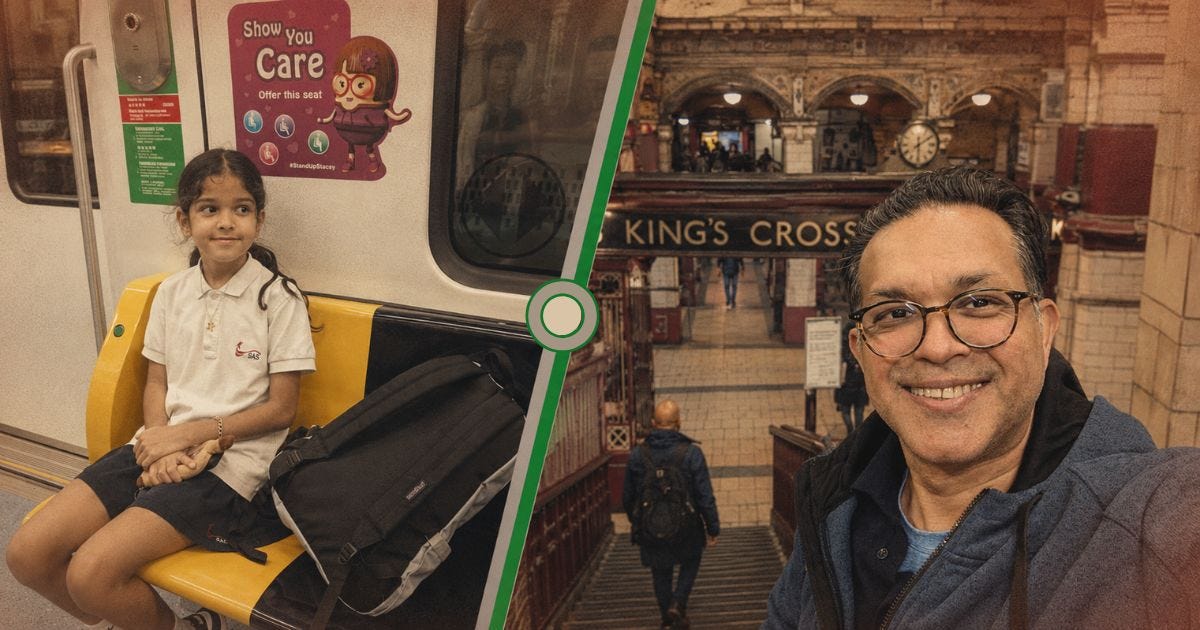
The photo arrives on WhatsApp at five in the morning, New York time. Jet lag has me awake to read it. My ten-year-old daughter, in school uniform, perched on a bright yellow priority seat in an MRT carriage, schoolbag wedged beside her, her current small-toy obsession cupped in both hands. She is travelling home from school with our helper, who has sent the photograph, because I am half a world away and not there to do the Thursday extracurricular run that is usually mine. The cartoon Stand Up Stacey on the priority-seat sticker behind her frames her smile better than I could have arranged. Singapore parents put their children on the MRT the way Singapore parents do most things: matter-of-factly, with quiet faith in the infrastructure. The trains arrive on time. The platform screen doors keep her two feet from a 750-volt rail. The announcements arrive in four languages. She knows when to get off, and she does.
I have been doing some version of this myself for ten days, in cities I do not live in. St John’s Wood in the morning, dropping down a long escalator into the silvery Jubilee-line dark, surfacing at Canary Wharf for coffee with a former colleague who has just left a global bank and a longer lunch with a possible collaborator who has not yet decided whether he is one. The Piccadilly line at six in the evening to King’s Cross for a beer with an old friend now at Google. Then the flight to New York. Three mornings later, the 5 train pulls in at Grand Central and I am on it, hemmed in by a banker, a busker, a girl with a violin case, and an old man asleep against the window. The doors open. I step off onto a hot platform of rust-stained tile, under the soft yellow light of a station kept alive for over a hundred years, and the idea arrives and refuses to leave. I have been getting the subway wrong. I have always thought of it as a commuter line. A practical thing. A means.
The thought follows me up the stairs. By the time I surface into the great concourse, beneath its astronomical ceiling, Orion in gilt, the constellations painted backwards, it has set hard. The tunnel posed the question. Under the painted constellations of the concourse, I decided to answer it in writing.
It is none of those things. My daughter on her yellow seat in Singapore is on the same network of ideas as the old man on the 5 train. They are both riding the answer to a question London first asked in January 1863, when a small steam locomotive ran beneath its streets. The subway is one of the most fascinating arteries of humanity the modern, post-industrial, urbanised age has produced, and it is only getting more important: in Delhi, draining the densest gridlock on earth, in Lagos, Lima, and Jakarta, where the first tunnels are still being bored, in Singapore where my daughter rides home alone.
A hundred and sixty-three years ago, almost no one alive understood what they were looking at.
We are still working it out.
Last week’s blog, on The Brahmin in the Sky, was about airline loyalty as a caste system: about the velvet ropes the modern frequent-flyer programme has built to make a few of us feel separate from the many. This week, the focus inverts. The subway is the opposite of that programme. It is the only place in the modern city where you cannot pay to be alone. This week, my mind is on the underground: how it began, who dug it, what it costs, what it has come to mean, and where it goes next.
The subway was not born of ambition. It was born of disgust.
By the 1850s, London was choking on the biological waste of its own mobility. Tens of thousands of working horses moved goods, omnibuses, and people through a medieval street grid never designed to carry them. Each animal produced between fifteen and twenty pounds of manure a day. On dry days, the waste dried into fine, lung-irritating dust. On wet days, it dissolved into a gelatinous sludge that coated wheels, hems, and shopfronts. The city was, in the most literal sense, drowning in itself.
Widening roads was politically impossible. Central London land was prohibitively expensive. Structural steel had not yet matured enough to build vertically. The only remaining dimension was downward.
Almost nobody thought this was a good idea. The popular press declared that passengers would be suffocated by volcanic fumes, crushed by collapsing buildings, or driven mad by the darkness. Geologists warned of disturbed springs and reopened plague pits.
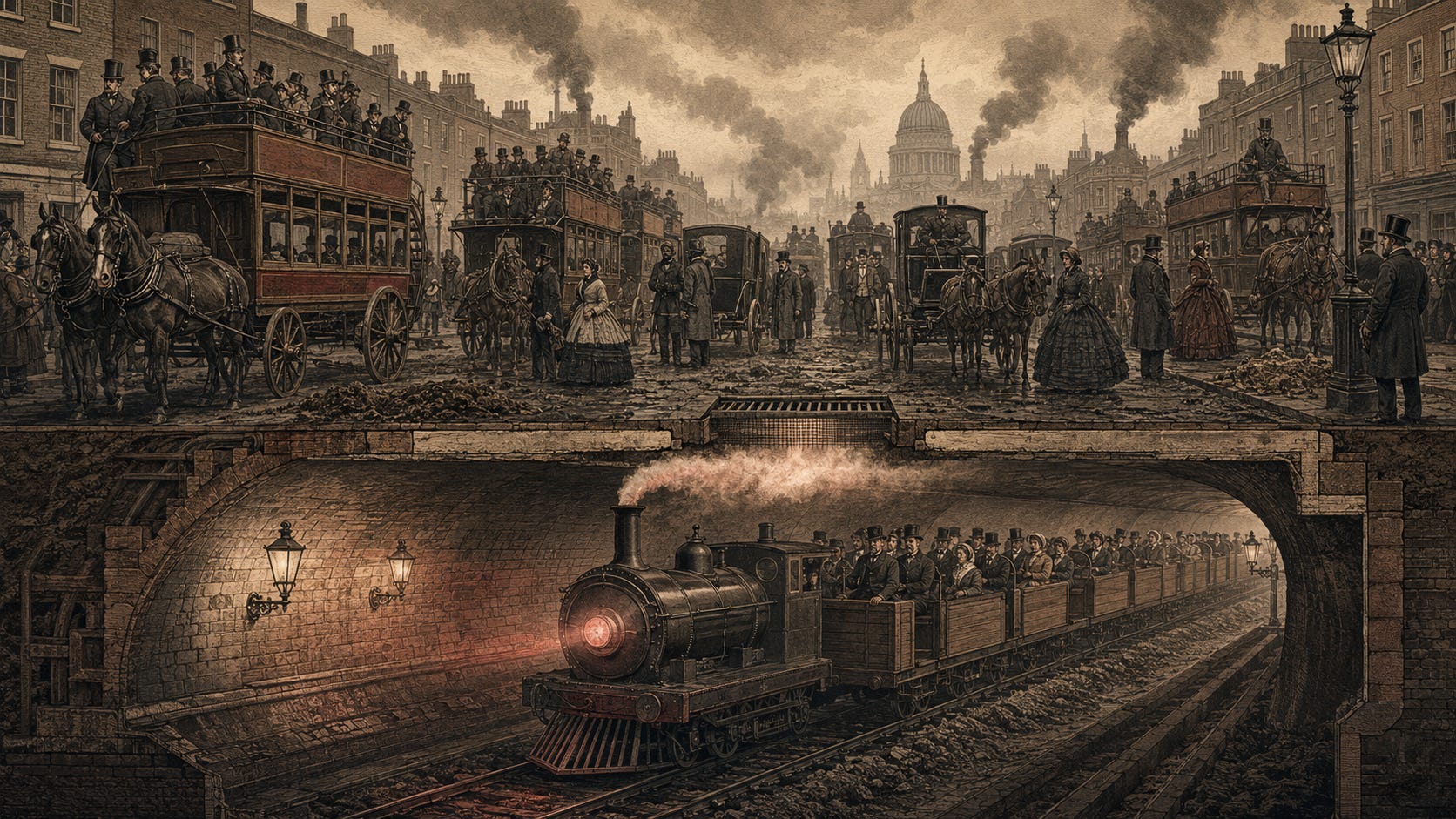
The man who refused to be embarrassed out of the idea was not, strictly, an engineer. Charles Pearson, Solicitor to the City of London, was a social reformer with a structural understanding of what cheap transit could do for the working poor. He argued that if the labouring classes could be moved efficiently outward, the slums of the centre would empty and the health of the city would rise. He won. In January 1863, the Metropolitan Railway opened the world’s first urban underground line between Paddington and Farringdon.
It was, by modern standards, almost laughable. Steam locomotives ran in a shallow brick-vaulted trench, fireless engines rolled in for the worst stretches, fumes vented through cuttings at intervals. Passengers emerged at the other end coughing, soot-flecked, late, and entirely happy with the new arrangement.
What Pearson had built was not just a railway. It was the first practical answer to a question nobody had quite known how to ask. How does a city stop being eaten by its own success.
The same question, eighty years later, would be asked in Moscow, Tokyo, and São Paulo. In a different vocabulary, it is being asked today in Bengaluru and Lagos. The answer has always been the same shape, even if the soils have differed. Go down.
London did not build the Underground because it could. It built it because the alternative was to stop being a city.
Once the principle was proven, the engineering arms race began. And like most engineering arms races, its protagonists were a stranger and more varied crew than the textbooks credit.
The deeper physics of urban tunnelling were demonstrated decades before the Metropolitan opened by Marc Isambard Brunel. Between 1825 and 1843, Brunel drove the first Thames Tunnel between Wapping and Rotherhithe using a rectangular cast-iron shield divided into thirty-six cells. The project was repeatedly flooded, gas-exploded, and bankrupted. It also proved that tunnels could be driven through soft, waterlogged ground beneath a major river. Every sub-aqueous transit line built since rests, intellectually, on Brunel’s shield.
Forty years later, James Henry Greathead turned the rectangular cellular shield into a circular hydraulic one, jacked through the earth on its own steel skin, with compressed air inside to balance hydrostatic pressure. In 1890, his methods produced the City and South London Railway, the world’s first deep-level electric tube. The Tube was no longer a trench in the street. It was a clean, dry, dark cylinder a hundred feet beneath London Clay.
Across the Channel, Fulgence Bienvenüe approached the same problem with a different temperament. Charged with delivering the Paris Métro for the 1900 Exposition Universelle, he made every decision a clinician would make: shallow tunnels hugging the geometry of the streets above, standard station templates, minimal expropriation. Line 1 opened on schedule in July 1900. The Métro became, structurally, an extension of the Paris street grid rather than an escape from it. The personality of a city’s subway, it turns out, tells you almost everything about the personality of the city itself.
Moscow’s personality was theatre. Lazar Kaganovich, Stalin’s administrator of the Moscow Metro, dismissed British engineering advice on the city’s waterlogged soils and deployed tens of thousands of Komsomol volunteers and Red Army soldiers at round-the-clock excavation. He demanded the stations be designed as Palaces for the People: marble walls, bronze statues, crystal chandeliers. The first line opened in May 1935. Eighty years on, Mayakovskaya and Komsomolskaya still draw tourists who have come not to ride but to look.
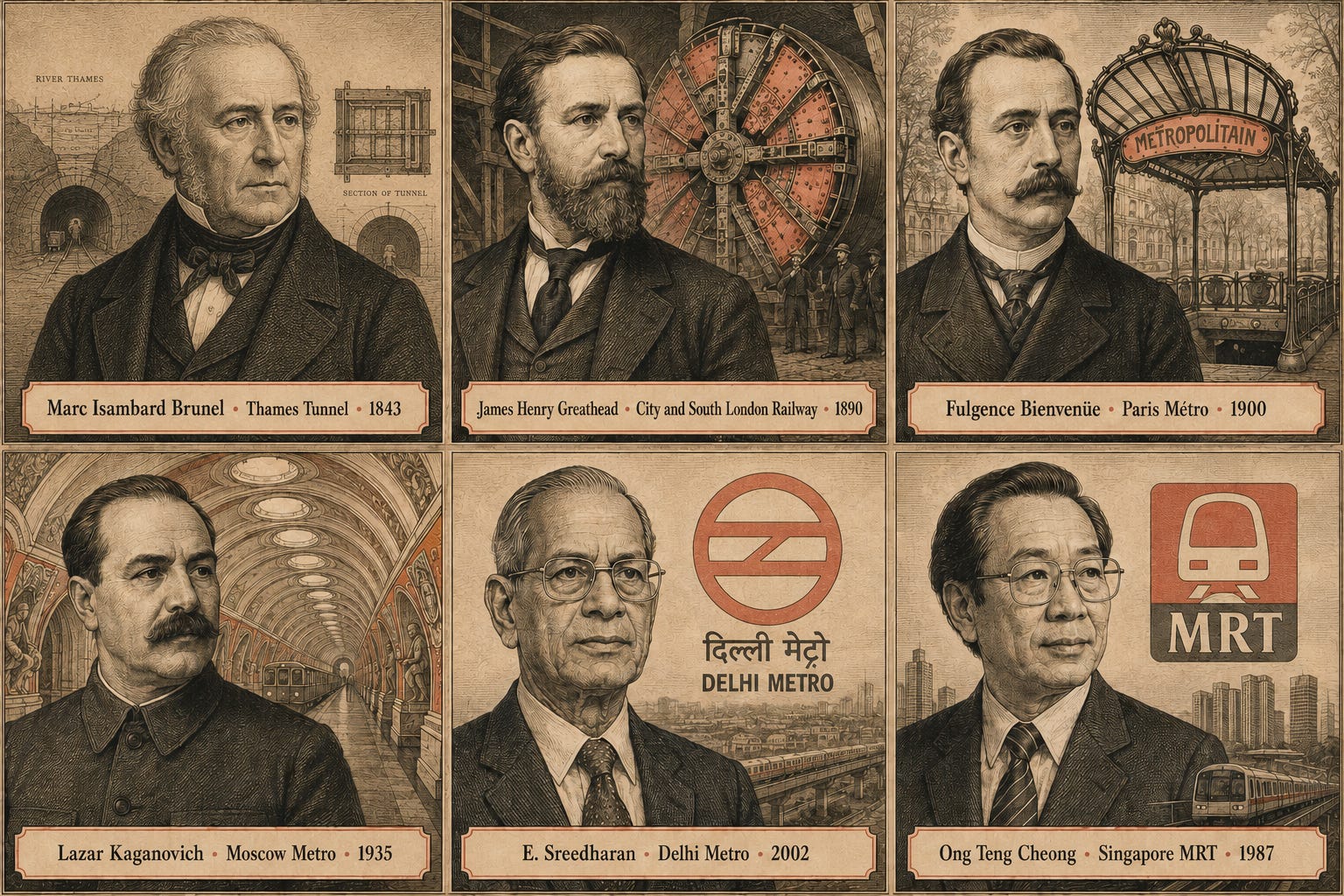
Six lines, and the year each one opened. The people who willed the underground into being were rarely the people who dug it.
Six lines, and the year each one opened. The people who willed the underground into being were rarely the people who dug it.
Half a century later, Elattuvalapil Sreedharan, India’s Metro Man, inherited the Delhi Metro project in 1995 with every reason for it to fail. His genius was institutional rather than mechanical. He insisted on absolute autonomy from political interference, installed digital countdown clocks at every site, and delivered Phase I ahead of schedule and under budget, setting the procurement template for everything India has built underground since.
The fifth name in this lineage is Singapore’s. In May 1982, after a decade-long fight in which Goh Keng Swee argued the city-state should make do with an all-bus network, Lee Kuan Yew and Ong Teng Cheong authorised the Mass Rapid Transit: a S$5 billion gamble that Singapore would need rail-shaped density it did not yet have. They were right. The MRT did not just keep pace with the city. It pulled the city into the shape the planners wanted it to take.
The greatest tunnels of the modern world were dug, in the end, by people who were not, in any strict sense, tunnellers. They were lawyers and reformers and administrators and politicians who understood that the hardest part of building underground is not the geology. It is the institution.
The Metropolitan Railway’s first passengers stepped off the train coughing. Within a generation, that small biological fact had reshaped the technology of urban movement.
The atmosphere inside the early tunnels was unspeakable: sulphurous smoke, carbon monoxide, soot thick enough to coat lungs. As long as steam was the power source, tunnels could not go deep. The deeper line and the cleaner air arrived together, from the United States. High-voltage direct-current motors, distributed through a third rail laid alongside the tracks, delivered maximum torque at zero speed: exactly what a subway needed to accelerate clear of a station every ninety seconds. By 1890, the City and South London tube was running on electricity. By the turn of the century, the Tube as we know it was practically defined: deep, dry, electric, dark, and quiet.
Then came Frank Sprague, who solved the next bottleneck. Sprague’s Multiple-Unit control ran a low-voltage control bus through every carriage so the motorman in the front cab could actuate the motors on every car at once. Trains could now be arbitrarily long without losing acceleration. Sprague’s MU bus is, in modified form, in every subway train in the world today.
For a hundred years after Sprague, the operational ceiling of a subway line was set not by power but by safety. Fixed-block signalling divided the track into discrete sectors; only one train was permitted in a block, and the blocks were long enough that a heavy train at maximum speed could brake before hitting the next occupied one. The unavoidable consequence was empty track.
The escape came late in the twentieth century, with Communications-Based Train Control (CBTC). CBTC dispenses with fixed blocks entirely. Each train continuously reports its position, velocity, and braking profile; the safety buffer becomes a dynamic, moving zone. Headways below sixty seconds become physically possible. The same Victorian tunnel can carry fifty percent more capacity without a single shovel.
The signalling revolution made another revolution possible. The International Association of Public Transport classifies metro automation from GoA0 (driver controlling by sight) to GoA4, in which the train operates entirely without staff on board. The world’s first GoA4 metro opened in Kobe in 1981. Two years later, Lille’s VAL did the same for a real city. In 2003, Singapore opened the North East Line and quietly became, until China’s recent surge, the longest fully driverless urban railway in the world.
You can stand at the front of a Singapore MRT carriage now, on the Downtown Line or the new Thomson-East Coast Line, and watch the tunnel coming at you through the window where, on every older system, a driver’s cab would be. The train is making forty-eight decisions a second. Nobody is making any of them.
The deeper the automation, the lighter the train, the quieter the tunnel, the more the city above forgets it is there at all. Which is exactly what good infrastructure was always supposed to do.
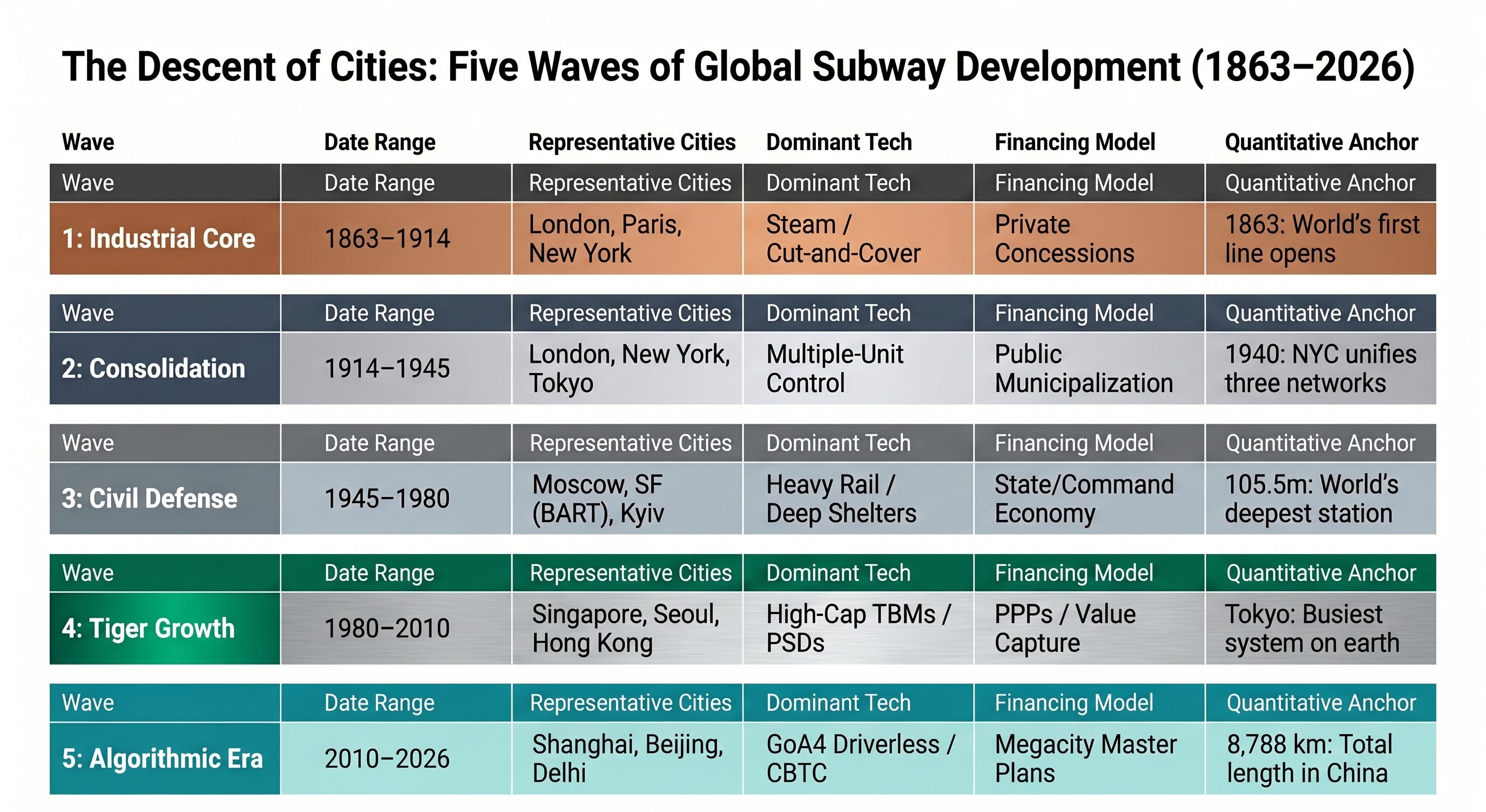
Draw the history of the world’s subways on a single timeline and five waves come into focus.
The first, between 1863 and 1914, was the Anglo-European industrial core: London, Budapest, Paris, Glasgow, Berlin, Boston, New York. The second, between the world wars, was a wave of consolidation, with private monopolies absorbed into public ownership. The third, between 1945 and 1980, ran in two directions at once: Western suburbs were strung with new commuter networks like BART and the Washington Metro, while behind the Iron Curtain the great Soviet-era deep stations were driven into bedrock as dual-purpose civil-defence shelters.
The fourth, between 1980 and 2010, shifted the centre of gravity east. Seoul, Singapore, Hong Kong, Taipei, Cairo, São Paulo: cities not historically known for underground railways added them in a single generation, with high-capacity tunnel boring machines, platform screen doors as standard, and public-private financing models that built more, faster, for less. Tokyo, quietly, became the busiest metro system on earth by ridership, moving more daily passengers than London, New York, and Paris combined.
The fifth, the one we are living inside now, belongs almost entirely to mainland China. Between 2010 and 2026, China alone has built more subway kilometres than the rest of the world combined. By the end of 2023, the global metro footprint passed twenty thousand kilometres, and 8,788 of them sat in mainland China. Shanghai has the longest single-city network in the world, at over 830 kilometres. Beijing is not far behind. Chengdu, Shenzhen, Guangzhou, Wuhan, Hangzhou: cities whose names would not have appeared on a global transit map in 1995 now run twenty-line networks of GoA4 driverless trains on moving-block CBTC.
India is the closest thing to a parallel story. The Delhi Metro, which barely existed in 2002, has grown past 390 kilometres by 2026 across nearly three hundred stations, with Phase IV adding another hundred kilometres in the years just ahead. Bengaluru’s Namma Metro is approaching seventy. Mumbai, Chennai, Hyderabad, Kochi, Lucknow, Ahmedabad, Pune, Nagpur: each carries its own project at varying stages. The Government of India has approved metro systems for around thirty cities. Some will, by the early 2030s, be larger than London’s.
The most under-noted fact about all of this is cartographic. The map of the world’s subways was, for most of its history, drawn in English. Harry Beck’s 1933 London tube map set the global standard: lines abstracted into vertical, horizontal, and forty-five-degree geometries, distances regularised, geography subordinated to system. When New York’s MTA tried in 1972 to apply a stricter Beck logic, with Massimo Vignelli’s modernist masterpiece, the city rejected it. Central Park rendered as a grey square. The rivers beige. Manhattan distorted. New Yorkers refused, with characteristic violence, to recognise their own city. The map was scrapped within seven years.
That argument feels almost quaint now. The new metro maps are being drawn in Mandarin, Hindi, Tamil, Korean, and Bahasa. Singapore’s MRT map has been redrawn three times in the last decade. Delhi’s, five. Shanghai’s is now so densely meshed that the printed version requires an inset for the central business district.
There are now more underground kilometres in mainland China than in the rest of the world combined. The map of the metro is no longer drawn in English.
Underground rail is a capital sink. Every transit network has had to invent a financial architecture to keep its lights on, and these architectures turn out to be more interesting than the engineering itself.
The cleanest case study sits in Madrid. Between 1995 and 2007, the Madrid Metro built more than 120 miles of new line and 150 new stations at a cost-per-mile so low it became, for a period, the embarrassing example the World Bank quoted at every other transit authority on earth. The 1995-99 programme alone added 35 miles for around $2.8 billion in inflation-adjusted dollars: roughly $65 million a mile. Madrid achieved this not because its geology was kind but because its institutions were sane. The regional authority designed simple repeating station templates, bought its own fleet of identical tunnel boring machines, ran tunnelling teams round the clock, and held geomechanical risk inside the public agency rather than pricing it into contractor bids through legal contingency.
Compare this to New York. Phase 1 of the Second Avenue Subway cost $4.45 billion for two miles and three stations, completed in 2017. Phase 2, budgeted between $6.9 and $7.69 billion for 1.5 miles, takes the unit cost past $4 billion a mile. The reason is not the rock of Manhattan. The MTA has hollowed out its own internal engineering capacity over decades. Design, risk, and supervision are outsourced to third-party consultancies that price every uncertainty upward. Procurement is fragmented. Environmental review is interminable. Mezzanines are over-specified. Each layer of friction adds a margin, and the margins compound.
Hong Kong has gone in the opposite direction. The MTR Corporation is among the only major urban transit operators in the world that consistently turns a profit without operating subsidy, through its Rail-plus-Property model: the government grants the MTR development rights to airspace and land around new stations at pre-rail values; the MTR partners with developers on the towers, malls, and offices that emerge above. The uplift in land value flows back to the railway operator, not the original landowner. The subway becomes the anchor asset of a real estate portfolio that funds the transport utility.
Singapore has tried to take the best of both. Since January 2022, the MRT has operated under the New Rail Financing Framework Version Two. The Land Transport Authority owns all heavy assets and bears the long-cycle capital risk. Private operators run daily service under short, performance-linked licences. The profit-and-risk-sharing is symmetric: if ridership undershoots, LTA shares the shortfall; if it overshoots, an escalating licence charge channels the excess into a dedicated Railway Sinking Fund for the next round of asset renewal. The system is structurally insulated from both private over-promising and political starvation.
The newer chapter is green. Braking trains, packed bodies, and millions of wheel-on-rail interactions generate enormous quantities of low-grade waste heat. London Underground’s central section now runs persistently hotter than the surrounding city. London and Madrid are experimenting with water-source heat pumps that extract this geothermal load and feed it into district heating networks above. The subway, which once filled lungs with soot, may yet end up heating the houses above it through Northern European winters.
The difference between a city that gets the subway right and a city that does not is not, in the end, its geology. It is its capacity to act as its own client. Madrid’s mile cost what New York’s eighth of a mile costs. The difference is not the rock. It is the room where the decisions are made.
Whatever else the subway is, it is the only space in the modern city where you cannot pay to be alone.
The first-class carriage was abolished from most underground networks a century ago and never revived. There is no Solitaire PPS on the tube. The Jubilee line carriage that runs from Canary Wharf to Bond Street at half past eight on a Tuesday morning will contain, in any given car, a junior banker, an Algerian Uber driver, a Polish electrician, a Nigerian-born consultant paediatrician, three LSE students, and a tourist who has misunderstood the direction of travel. They pay roughly the same fare, touch the same handrail, step over the same gap. For ninety seconds between Westminster and Waterloo, in a city otherwise organised with surgical precision into postcodes by net worth, they are equal. It is the closest thing the modern metropolis still has to a commons.
During the Blitz, tens of thousands of Londoners bought tickets nightly simply to sleep on tube platforms, refusing every government attempt to stop them. Blitz trains were eventually run to distribute food. The Ministry of Home Security commissioned eight bespoke deep-level shelters beneath existing stations, each holding around eight thousand citizens behind massive overhead caps of reinforced concrete. The Underground had become, by popular insistence rather than government plan, a civic last refuge.
The Soviet Union made the lesson architectural policy. Arsenalna station in Kyiv descends 105.5 metres into bedrock, partly to outlast nuclear overpressure. Pyongyang’s metro, deeper still at over a hundred metres, was designed as the operational command bunker for the regime. After the Sino-Soviet split, Mao Zedong issued his instruction to “dig deep holes, store grain everywhere”, and Beijing complied, building a network of civilian tunnels called the Underground City, linked into the new subway to evacuate the central population to the Western Hills in the event of attack. The deepest stations in the world were not designed primarily to serve commuters. They were designed to save them.
The subway has been a stage for biology. The London Underground mosquito, Culex pipiens form molestus, lives in the warm year-round tunnels and bites humans without a prior blood meal. Moscow’s commuting stray dogs learned, in the post-Soviet years, to ride specific trains to specific stations to beg for scraps and return home at night. The MTA’s rule that pets must be enclosed in a container has produced the celebrated New York genre of the duffel-bag Husky, head protruding, eyes closed in resignation.
It has been a stage for protest. In February and May 1913, the Women’s Social and Political Union planted improvised explosive devices on the London Underground, including a shrapnel-packed nitroglycerine bomb at Piccadilly Circus. It has been a venue for art: Beck’s 1933 map remains the most reproduced piece of British graphic design in history; Paris and London run formal auditioned busking schemes with designated floor markers and acoustic profiles; Stockholm runs the most museum-like network in the world, with stations carved like raw caves.
And it has been a stage for tragedy. The Couronnes fire in Paris in 1903 killed 84 people, almost all of whom refused to leave the burning train without their fare refunds. The King’s Cross fire of November 1987 killed 31 and revealed the Trench Effect, in which superheated gases in an inclined escalator shaft flash over into a high-velocity jet of flame at the booking hall above. Daegu in February 2003 killed 192. The 1995 sarin attack on the Tokyo Metro, the 2005 London bombings, the 2010 Moscow attacks: each laid bare what the subway is. A long, sealed, densely populated tube whose vulnerabilities are exactly its strengths.
The subway is the city’s most honest space because everything the city is, and everything the city is afraid of, ends up underground. The shelter. The mosquito. The dog. The busker. The suffragette’s bomb. The terrorist’s bomb. The fire. The map. The crowd. The lonely commuter at three in the morning. There is no other room in the modern city where all of this is held in the same air.
The case against the subway is not weak. It is just not strong enough.
A subway tunnel is a hundred-and-fifty-year proposition. Concrete degrades, tiles crack, steel rails wear, and signalling code written in the 1970s becomes unmaintainable as its last engineers retire. Climate change has changed the nature of the threat: the danger to an old system now is not fire but water. Hurricane Ida turned several New York subway entrances into vertical waterfalls in September 2021. Zhengzhou’s Line 5 flooded during the Henan rains of July 2021, killing fourteen passengers trapped as the water rose to chest height. London, Paris, Boston and Mexico City each carry decades of deferred capital maintenance the next twenty years will have to fund. Add the targeted attacks of the last thirty years, Tokyo 1995, Madrid 2004, London 2005, Moscow 2004 and 2010, and the long, sealed, densely populated tube starts to read less like an asset and more like an attack surface.
These are real. They are also lessons the systems have already begun to absorb. Daegu produced a generation of low-smoke, zero-halogen rolling stock and mandatory platform screen doors. King’s Cross ended wooden escalators across the network. The years after 2001 rounded structural pillars to reduce fragmentation, replaced bins with blast-absorbing polymer, and put AI behind the concourse cameras. Subway systems learn slowly. They do learn.
Then there are the challengers, and this is where the more interesting story sits. For a decade the fashionable bet was that some sleeker mode, hyperloop above all, would render the steel-on-steel subway obsolete. Virgin Hyperloop wound down its operations in December 2023. The post-mortems blamed the engineering: the impossibility of holding a near-total vacuum across hundreds of kilometres of steel, the geometry of near-supersonic turns through a dense city. All true. But the engineering was the symptom, not the disease.
The hyperloop did not lose a technology race. It answered a question cities were not asking.
A city does not need to move twenty-eight people between two points at the speed of sound. It needs to move a crowd, the same crowd, every ninety seconds, through a dense grid, reliably, for a hundred years, cheaply, and unseen. That is a throughput-and-permanence problem, and it has a hundred-year-old solution. The hyperloop, and the Boring Company’s Las Vegas Loop beside it, kept optimising for speed and novelty because speed and novelty make the better pitch deck. China’s CASIC ran a maglev pod at 387 mph through a low-vacuum tube in Shanxi in February 2024; it is a magnificent piece of state research, and it still carries no one to work. The crowd was never the unit any of them were built for. The crowd is the only unit that matters.
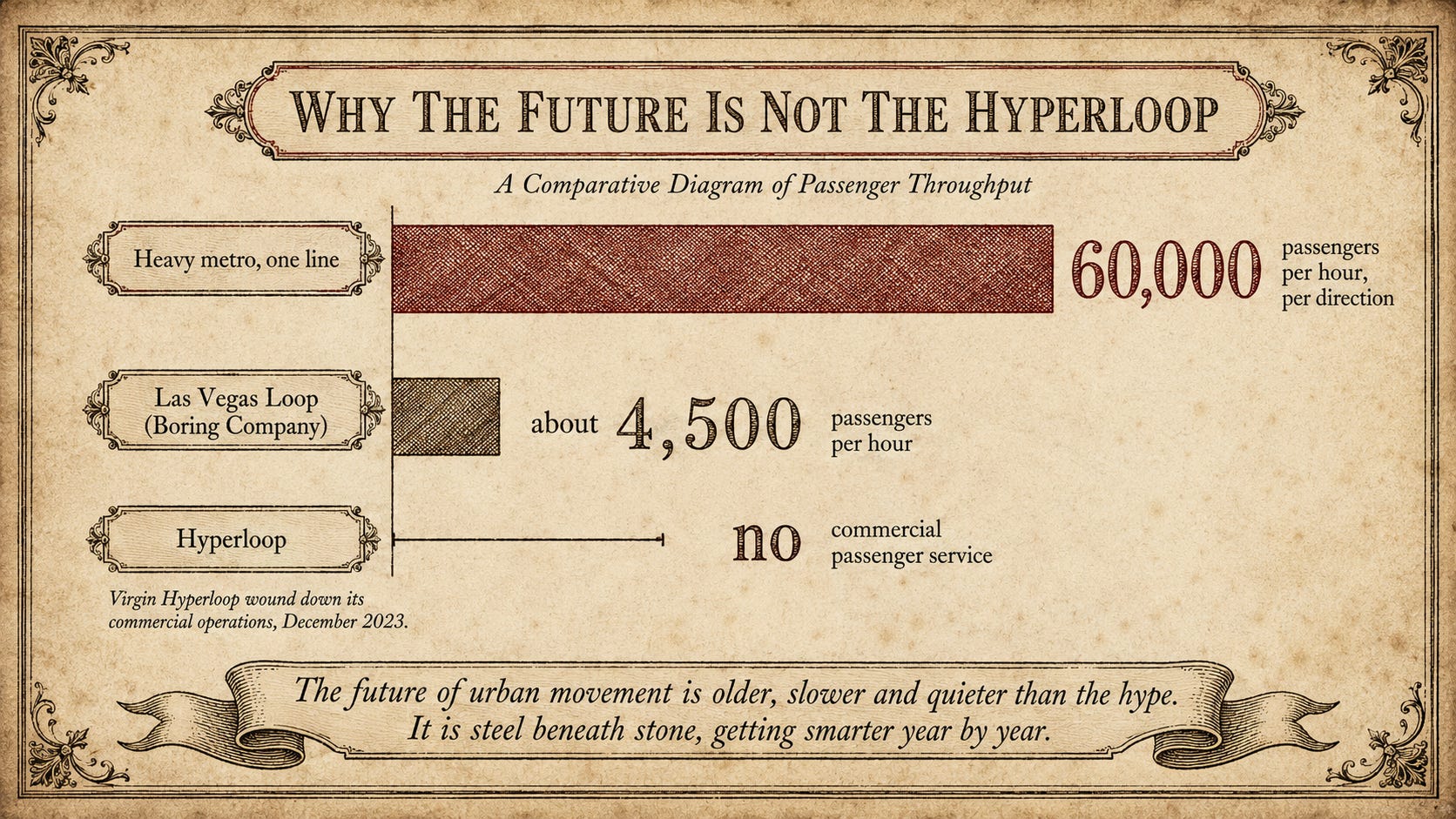
Which is why the real future looks so unremarkable. GoA4 driverless operation is now the default for new lines outside the legacy networks of Europe and North America. Tunnel-boring machines have made deep work routine. Singapore’s Cross Island Line was driven seventy metres down through hard granite, beneath the Central Catchment rainforest, specifically so that almost no one walking the forest above will ever know it is there. That is not a compromise. It is the highest form the craft takes. The masterpiece of civic infrastructure is the one you never notice.
The subway that once saved London from its own manure is now starting to save Delhi from its traffic, Mumbai from its monsoons, and Singapore from itself. None of it is glamorous. All of it is necessary. The hyperloop tried to make infrastructure thrilling. That the subway never had to was never its weakness. It was, all along, the point.
The Stations That Connect Us
The 5 train pulls in at Grand Central. The doors open. I step off with the banker and the busker and the girl with the violin case. The old man hasn’t moved, still asleep against the window, still being carried. The rest of us climb up out of the dark together, off tracks laid by a railway company that no longer exists, out from under a city that almost did not survive the manure of its own success, having ridden, for a few minutes, the most honest civic thing the modern city has ever built.
Somewhere beneath Singapore, a tunnel-boring machine is grinding through granite at seventy metres below a rainforest. Somewhere beneath London, a Jubilee line train is leaving St John’s Wood, silver and silent and a little late. And somewhere on the East-West Line at City Hall, a ten-year-old is stepping off at her stop, schoolbag over one shoulder, bear in her arms, looking left and then right before she walks home.
For ten days the photographs have travelled both ways. Hers arrive from a bright yellow priority seat. Mine go the other way, and almost none are of the skyline. They are of the culture below it: a saxophonist filling a Jubilee tunnel with Coltrane, the graffiti art of a New York platform, a man reading Proust on the Piccadilly line in a hi-vis jacket. I have been sending my children the crowd, not the skyline. They send the same network back, from the far side of the world.
I think about what they will carry into these carriages. My grandparents rode with hats on their heads and non-verbal pleasentries exchanged across the aisle for company. My parents rode behind a newspaper, origami-folded for the crush. We ride with the whole web in a pocket, heads bowed to it. My children will ride with something in the ear or across the eyes that knows their stop before they do. The device that accompanys the rider changes every generation. None of it changes the carriage. The bench, the gap, the dark, the crowd, the arrival: all of it will be exactly what it was when a steam locomotive first ran beneath London in 1863.
That is the quiet astonishment of the subway. It was the artery of the industrial age. It will be the artery of the intelligence age. It will barely look different doing it. The technology we carry underground keeps reinventing itself. The reason we go down there does not. My daughter will get off at her stop and look left and then right, the way she does now, the way I do, the way her own children will, in a tunnel that is still the most civilising thing the city ever thought to build.
A hundred and sixty-three years ago, almost no one alive understood what they were looking at.
We are starting to.
Happy Sunday, wherever and whenever this finds you.
If this resonated, share it with someone who has spent more time this week on a platform than at their own front door, and send them, as I keep sending mine, something from the culture below.
Aman Narain is the Founder and Principal of A2Z Advisors, a boutique fintech and digital transformation consultancy based in Singapore. He spent twenty-five years inside global banking and payments at Standard Chartered, HSBC, Schroders, BankBazaar and Google Pay. He co-hosts the A2Z Fintech podcast with Zubin Vandrevala and writes A Man Who Blogs twice a week. He has spent the last ten days riding the Tube and the New York Subway, and is still, somehow, faintly surprised that the doors close at the same time at both ends of the carriage.
No posts
Comments
Nothing yet. Say the first thing.
Sign in to join the conversation.