
This post is not recommended for sensitive women.
Many people believe that diseases are simply a matter of chance, something that statistically happens to a certain percentage of the population. They think someone is just unlucky due to genetic or other factors, and it just happens that they got sick. This, of course, is far from true. Every disease has its cause, even though it’s often not obvious.
Unfortunately, understanding the true causes of diseases isn’t profitable, which is why such research is often poorly funded. The money is in treating diseases. Unless you can reduce illness with pharmaceutical drugs, it’s more profitable to treat than prevent.
Even when the scientific community has already identified the real causes of diseases, they don’t like to talk about it. For instance, no one disagrees that the severe course of measles is most often linked to malnutrition and a vitamin A deficiency. But how much do we hear about this in the media or from health authorities when measles outbreaks occur?
The main cause of complications from chickenpox in healthy children is the use of ibuprofen. No scientist disagrees with this, yet most doctors don’t know about it. This knowledge isn’t profitable because it undermines the construction of a new narrative "chickenpox being a very dangerous disease." Also, antipyretic medications seem to be one of the main causes of bacterial meningitis and invasive bacterial infections.
Preventive measures for diseases are introduced into general medical practice based on their cost. It took 50 years from James Lind’s experiment, which proved that citrus fruits prevent scurvy, for them to be used in the military navy, and 100 years before they were used on civilian ships. It took 50 years after Ignaz Semmelweis discovered that washing hands after handling corpses reduced maternal mortality by tens of times, before this practice became common in medicine. It was 60 years after it was first proven that vitamin A reduces mortality from measles, before it was used in treatment.
However, vaccines are a different story. The smallpox vaccine was widely used less than 10 years after its invention. The polio vaccine was used worldwide 3 years after it was developed. And the COVID-19 vaccine was developed and implemented in less than a year.
1. HIV
Last week, we discussed that the meningococcal epidemic in Sub-Saharan Africa was not caused so much by the meningococcus itself, but by sand. What is less well-known is that the HIV epidemic in Sub-Saharan Africa is also largely linked to sand. And, by the way, sand also played a role in the cervical cancer epidemic in Africa.
Thanks to the media, many people who grew up in the 80s and 90s believe they are at high risk of contracting HIV. But that's far from true. According to a systematic analysis from 2018, the risk of contracting HIV through unprotected heterosexual contact with an HIV carrier is 0.04% for men and 0.08% for women. [1] Considering that the percentage of HIV carriers in developed countries is about 0.3%, it can be calculated that the chance of contracting HIV through a single unprotected encounter is about 1 in 400,000 for women and 1 in 800,000 for men. To contract HIV with at least a 1% probability, one would need over 4,000 random unprotected heterosexual contacts for women and over 8,000 for men. In reality, these numbers are even higher because the percentage of infected individuals among heterosexuals is much lower than 0.3%.
Thus, contracting HIV through heterosexual intercourse is quite difficult. In the case of homosexual intercourse, the risk is significantly higher: firstly, because the chance of transmission is 30 times higher with anal sex (1.3%), and secondly, because there are more HIV carriers among homosexuals. The risk is also much higher with blood transfusions (92.5%) and the use of HIV-infected needles (0.63%).
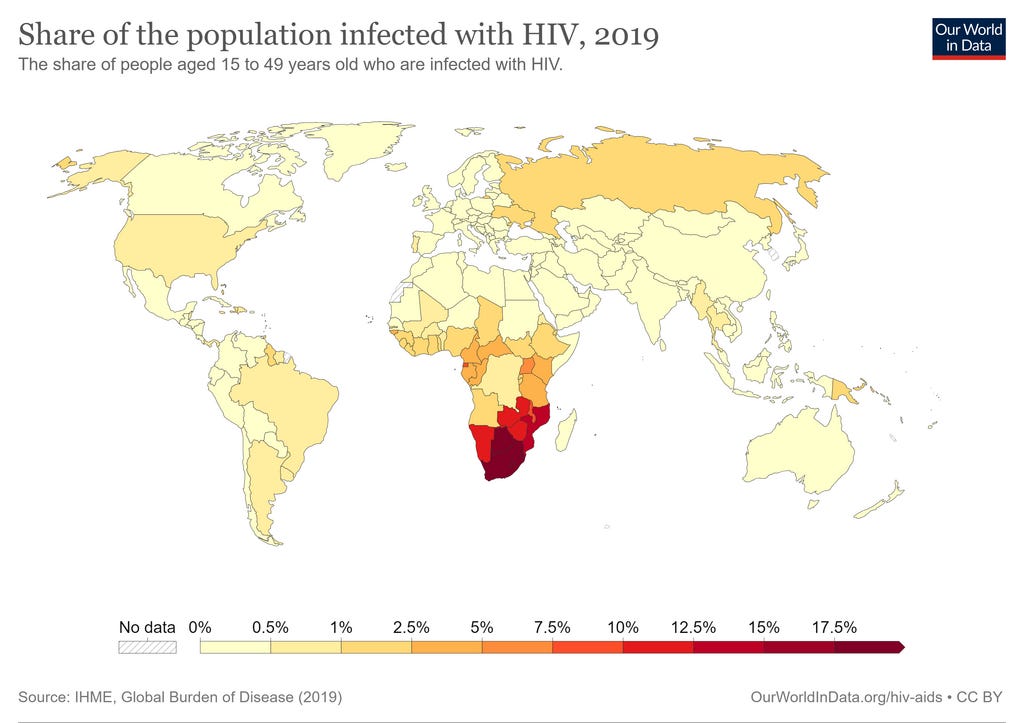
Looking at the global HIV prevalence map, there is only one region that stands out: the countries of Southern Africa (South Africa, Namibia, Botswana, etc.), where the infection rate is extremely high—ranging from 10% to 30% of the population. Moreover, the majority of new infections in Southern Africa occur among young women. [2] This raises a logical question: if contracting HIV through heterosexual intercourse is so difficult, and homosexuality is not widespread in these countries, then why is the HIV rate so high?
2. Dry Sex
The primary reason for the high prevalence of HIV in these countries is the practice of dry sex—sexual intercourse without vaginal lubrication. How widespread is this practice? Very widespread: 86% of women in Zambia and 93% of women in Zimbabwe practice dry sex; in South Africa, 87% of young people with low education, 50% with higher education, and 80% of prostitutes engage in it. [3-5]
Why do they do it? According to research, men in South Africa consider vaginal lubrication during intercourse to be a sign of a woman’s infidelity or a sign that she may have a sexually transmitted infection. In Zaire, a moist vagina is perceived as the result of a curse or misfortune. In Senegal, it is believed that the vagina is not just a natural part of the body but should bear signs of artistic "work." Both men and women prefer vaginal dryness during intercourse. In Zaire, as in Zimbabwe, it is believed that this increases sexual satisfaction for both partners. As such, lubrication is not considered a significant element of a pleasurable sexual experience. In Zimbabwe, both educated and uneducated women believe that by using vaginal drying agents, they become "like virgins," enhancing their partner's sexual pleasure.
To achieve vaginal dryness, women use various substances: crushed stones, chalk, talcum powder, leaves, herbs, fruits, animal feces, toothpaste, sugar, salt, alum, aluminum hydroxide, dry cloth, toilet paper, cotton, newspapers, cold water, ice cubes, Coca-Cola and Sprite, lemon juice, bleach, laundry detergents, Tiger Balm, boric acid, caustic soda, potassium permanganate, silica gel, chili pepper, aspirin, Knorr soup cubes, antiseptics, bactericides, antiperspirants, and baboon urine powder. [6-9]
Less gentle practices also exist, such as burning the vagina with hot objects, or "anatomical modification." Anatomical modification is done by having a person lie on their side on a hard surface, and then an obese person compresses her pelvic bones by jumping on her hips. This practice is often used to return the vagina to its original size, particularly after vaginal childbirth. Some women report difficulty walking afterward. [10]
3. Umuti and Genital Cuts
Baboon urine powder is also rubbed into cuts on the thighs and other body parts. It’s believed that "just as baboons urinate in the same spot every night, if a man is under the influence of this substance, he will return to the same woman." Another substance is called delunina, meaning "forget mother" in the Ndebele language. "If you use it, the man will forget his relatives and think only about the woman he is with."
In addition to dry sex, this is also linked to another practice that has spread across Southern Africa in recent decades. Women make cuts with razors on the vagina, labia, clitoris, around the belly button, on their breasts, joints, eyebrows, and other body parts, and rub various traditional remedies—umuti, usually consisting of roots, bark, leaves, ground minerals, various chemicals, and animal parts—into these cuts.
It’s believed that when a man contacts these parts during intercourse, he "takes" the umuti, which "binds" him to the woman. Women also report that genital cuts increase sexual pleasure. Vaginal cuts are thought to enhance intimacy and harmony in sexual relationships and reduce conflicts. It is said that this makes couples "like bread and butter."
Since polygamy is very common in Southern Africa, many women believe that umuti is a way to "reduce the number of a man’s girlfriends." Genital cuts are more commonly made by those who believe their partner has other sexual partners.
Almost all women reported that they do not tell their partners about their genital cuts. When asked what their partner would do if they found out, 38% said he would get angry, and 32% said it would lead to violence or abandonment. Men also said they would likely resort to violence if they found out their partner was using umuti, but also paradoxically, if their girlfriend decided to stop using it at some point. "If she stops using it [after long-term use], you will want to beat her and ask who she slept with."
4. Cervical Cancer
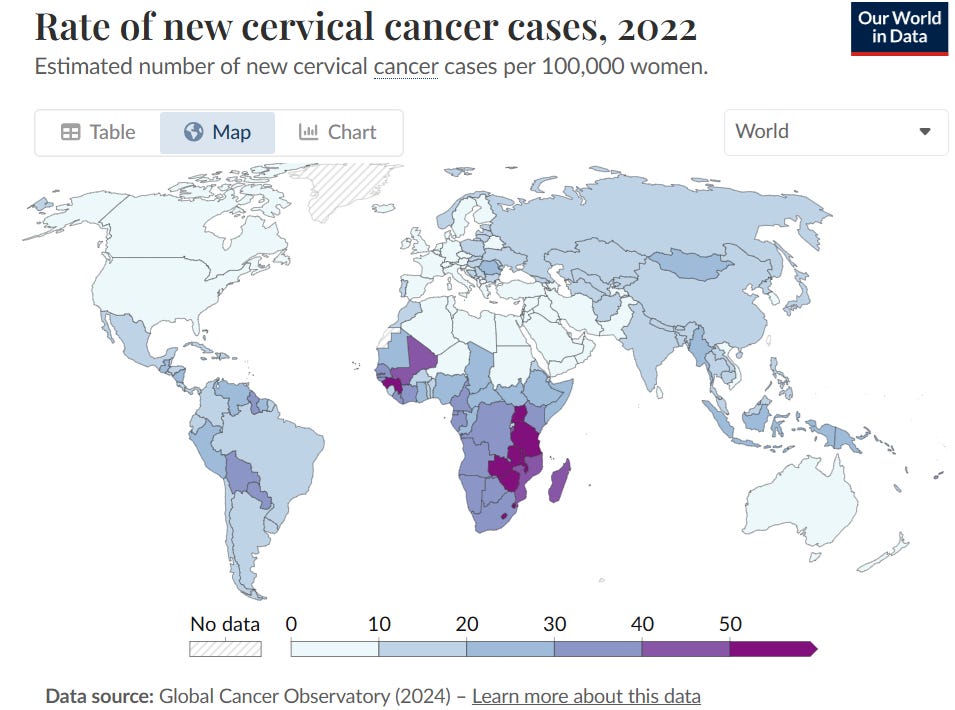
Women believe that substances used to dry out the vagina can cause cancer. The most frequently mentioned is cervical cancer. Indeed, the countries of Southern Africa are global leaders not only in the prevalence of HIV but also in cervical cancer rates. This type of cancer is the most common in these countries.
Women in Southern Africa often practice vaginal douching with solutions of vinegar, ginger, lemon, sugar, or salt. This practice is associated with a sevenfold increase in the risk of abnormal cervical lesions. [11-12] Douching is also linked to pelvic inflammatory diseases, vaginosis, candidiasis, cervical cancer, an increased risk of HIV, and other diseases. [13]
Women using drying agents often complain of lower abdominal pain and internal infections. Other side effects include sores on the genitalia, vaginal swelling, cuts, and abrasions. Women can identify the substances causing these problems. For instance, study participants reported that Kariba stone causes cuts in the vagina and sores on the penis. The plants isidikili and ingotsha cause inflammation of the genital organs in both men and women.
In a study in Zaire, among seven women who used leaves as drying agents, only one had an intact vaginal mucosa. All others experienced vaginal inflammation resembling a localized chemical burn or allergic reaction. Another study in Zaire, among 377 prostitutes, found that women who inserted substances into the vagina were significantly more likely to be HIV-positive than those who did not.
Conclusion
The increased friction caused by the practice of "dry sex" and the use of abrasive substances to dry out the vagina can lead to numerous health problems. These practices damage the vaginal epithelium, creating genital abrasions, cuts, tears, and chemical burns. Additionally, the pH in the vagina rises, which promotes inflammation and makes tissues more vulnerable to infections. Chronic inflammation and tissue damage increase the risk of HIV transmission and may contribute to the high rate of cervical cancer.
Researchers believe that the preference for "dry sex" should be considered when developing new HIV prevention strategies. However, despite the obvious risks, this issue remains under-researched. Over the past few decades, only about two dozen studies have been conducted, most of which date back to the 90s. Since then, interest in the topic has significantly waned.
Meanwhile, while large budgets continue to be poured into unsuccessful attempts to develop HIV vaccines and spread antiretroviral therapy, HIV and cervical cancer prevention through changes in everyday practices among women remains in the background. Scientists and politicians tend to support complex and expensive projects, while simple and effective measures remain in the shadows.
By understanding the true causes of epidemics, they can be easily stopped. To end a cholera epidemic, there’s no need to fight the cholera bacteria. Simply stop drinking from contaminated water. Sanitation, clean water, and hygiene have practically eliminated not only cholera but many other once-endemic diseases such as typhoid, plague, hepatitis A, dysentery, leptospirosis, Guinea worm disease, yaws, and others. It’s much harder to fight the disease-causing agents than it is to create conditions where they don’t lead to disease. But it's far more profitable.
Sources:
1. Estimating per-act HIV transmission risk: a systematic review. (Patel, 2018, AIDS)
2. Sustained high HIV incidence in young women in southern Africa: social, behavioral, and structural factors and emerging intervention approaches. (Harrison, 2015, Curr HIV/AIDS Rep)
3. The practice and prevalence of dry sex among men and women in South Africa: a risk factor for sexually transmitted infections? (Beksinska, 1999, Sex Transm Infect)
4. Anal and dry sex in commercial sex work, and relation to risk for sexually transmitted infections and HIV in Meru, Kenya. (Schwandt, 2006, Sex Transm Infect)
5. Concern voiced over "dry sex" practices in South Africa. (Baleta, 1998, Lancet)
6. Vaginal Drying Agents and HIV Transmission. (Kun, 1998, Int Perspect Sex Reprod Health)
7. Wet and dry sex—the impact of cultural influence in modifying vaginal function. (Levin, 2005, Sex Relat Ther)
8. A cross cultural study of vaginal practices and sexuality: implications for sexual health. (Hilber, 2010, Soc Sci Med)
9. Dry and tight: sexual practices and potential AIDS risk in Zaire. (Brown, 1993, Soc Sci Med)
10. Effects of dry sex practices on reproductive health among women in Asego Division, Homa-Bay County. (Ochieng, 2012, University of Nairobi)
11. Vaginal douching in Zambia: a risk or benefit to women in the fight against cervical cancer: a retrospective cohort study. (Hamoonga, 2019, BMC Womens Health)
12. Vaginal douching and adverse health effects: a meta-analysis. (Zhang, 1997, Am J Public Health)
13. Vaginal douching: evidence for risks or benefits to women's health. (Martino, 2002, Epidemiol Rev)
No posts
Comments
Nothing yet. Say the first thing.
Sign in to join the conversation.