
Previous parts:
Part 1: Introduction
Part 2: DTP
Part 3: Encephalopathy
Part 4: Dravet syndrome
Part 5. SIDS
Part 6. West syndrome
The obedient always think of themselves as virtuous, rather than cowardly
Robert Anton Wilson
Chapter 5. Make the Angels Weep
After wrapping up his discussion on the film "DPT: Vaccine Roulette," Paul Offit dedicates the fifth chapter of his book to Barbara Loe Fisher, a prominent anti-vaccine advocate. Fisher co-authored the 1985 book "A Shot in the Dark: Why the P in the DPT Vaccine May Be Hazardous to Your Child's Health" Offit begins by praising her:
She had spurred an enormous effort by academic researchers, pharmaceutical companies, and public health officials to make a purer pertussis vaccine. She had helped craft legislation that included a monitoring system for licensed vaccines—a system that would, ten years later, detect a rare but serious side effect. And although the reason for Fisher’s activism—her belief that pertussis vaccine had caused her son’s learning disabilities—wasn’t supported by the science, she had been a catalyst to changes that clearly benefited children. She was, in short, America’s premier vaccine safety activist. The media believed her, politicians relied on her, and parents turned to her. Barbara Loe Fisher was poised to do a tremendous amount of good...
When Barbara Loe Fisher burst onto the scene, several vaccines had serious side effects, every year causing allergic reactions, paralysis, or death. Public health officials and doctors didn’t hide these problems. But they didn’t do anything to correct them, either. And most parents had no idea they existed.
Regarding the claim that "public health officials and doctors didn’t hide these problems"—that’s obviously not true. Otherwise, there would be no need to say that "most parents had no idea they existed." These two consecutive sentences completely contradict each other.
Offit then writes that Barbara Loe Fisher could have targeted her vaccine safety campaign at the live polio vaccine, but she didn’t.
Years later, one advocate would force the government to acknowledge the rare but invariant paralysis that came with Sabin’s polio vaccine and to change public policy. It could have been Barbara Loe Fisher. But it wasn’t.
She could have fought to remove egg protein from vaccines, which can cause severe allergies. Today, the flu vaccine is still made the same way it was decades ago—grown in chicken eggs. Unfortunately, he writes, "some people can’t get it because they’re severely allergic to eggs. (In the United States about a million are.) Reactions can be frightening, and can include hives, low blood pressure, difficulty breathing, and shock—all of which could be avoided; companies could grow influenza viruses in mammalian cells rather than avian ones. Although this procedure wouldn’t be easy, it’s doable. But, absent a public outcry, pharmaceutical companies have had little incentive to make the change and public health agencies haven’t insisted they do it. Again, it’s a perfect situation for an advocate." But she didn’t do that either, Offit laments.
He then writes that not only egg protein but also gelatin in some vaccines can cause severe allergies. Additionally, some religious groups are hesitant to accept vaccines containing gelatin because it’s made from pigs. To Offit’s disappointment, Barbara Loe Fisher didn’t support this worthy cause either
As for Paul Offit himself, who is the same age as Barbara Loe Fisher and could have been such a hero, fighting to remove dangerous components from vaccines, and whose voice would have carried much more weight as a recognized expert in vaccination, he somehow doesn’t mention.
Haemophilus influenzae disease
Instead, Barbara Loe Fisher directed her efforts against new vaccines in the schedule. The first such vaccine, licensed under her watch, was the Hib vaccine.
Hib, Offit writes, is a horrible disease that used to be the leading cause of meningitis and also caused epiglottitis (inflammation of the epiglottis). In 1987, the FDA licensed the first Hib (Haemophilus influenzae type b) vaccine, and for doctors across the country, it was a godsend. But Barbara Loe Fisher didn’t share their enthusiasm. She believed that several more independent trials were needed to determine whether it caused chronic diseases like diabetes. According to Fisher, vaccines simply replaced infectious diseases with chronic ones. For every new vaccine, Fisher found at least one doctor who supported her view. In the case of Hib, it was Bart Classen, who showed that children in Finland who had received three doses of vaccine in infancy were more likely to have diabetes than those who had received only one dose in the second year of life.
Classen published a series of studies on the potential link between vaccination and the development of juvenile diabetes. In a 1997 article cited by Offit, he shows that the incidence of type 1 diabetes correlates with the vaccination schedule across Western Europe. Specifically, the addition of the Hib vaccine correlated with an increase in incidence, while vaccination against tuberculosis correlated with a decrease.
Classen is not an anti-vaccine advocate. He conducted laboratory studies on mice and found that some vaccines, like the anthrax vaccine, could reduce the risk of developing diabetes, while others, like the DPT vaccine, could increase it.
Thanks to his research, Classen began collaborating on clinical trials of the Hib vaccine. He found that the vaccine increased the risk of juvenile diabetes by 26%. The disease began to manifest 38 months after vaccination. He confirmed this in an experiment on mice predisposed to diabetes. Vaccinated mice developed the disease significantly more often than the control group. [1]
In an attempt to refute Classen’s conclusions, Offit cites three sources.
The first is a CDC study with a case-control design. However, such a study design ranks significantly lower in the hierarchy of evidence-based medicine compared to the randomized clinical trial on which Classen’s conclusions were based. A case-control study, regardless of its results, cannot prove or disprove causation—that’s only possible in a randomized clinical trial. Therefore, it cannot serve as a refutation of Classen’s results. Moreover, this study was extremely small in scope—only eight children in the entire sample were not vaccinated against Hib (but were vaccinated with other vaccines).
The second source is not a scientific study at all but merely a five-page report from the Institute of Vaccine Safety. More on that later.
The third study, published in 2002, found no increased risk of diabetes. It’s a very short article—just two pages—and it was clearly hastily written in response to Classen’s study. Analyzing this article is impossible because the authors not only fail to describe their methods but don’t even indicate how many children developed diabetes in the studied groups. Unlike other similar studies, the article doesn’t even contain a cumulative incidence graph.
In essence, we’re left to take the authors at their word, which is quite problematic, considering this study was also conducted by the CDC, and among its authors is Frank DeStefano, whom we’ll discuss separately in the next part. Incidentally, Frank DeStefano is also an author of the aforementioned case-control study.
But most importantly, this study was conducted in the U.S. with a different vaccine (ProHIBiT), while the Finnish study used the HibTITER vaccine. These are two different vaccines, with different amounts of antigen, different adjuvants, and produced by different companies. Can we conclude that if one vaccine doesn’t lead to diabetes, another one won’t either? No one would claim that if the AstraZeneca COVID vaccine doesn’t cause myocarditis, then the Pfizer vaccine won’t either. But in studies on children’s vaccines, this is done all the time. They prove the safety of one vaccine with studies on another.
This is especially common in meta-analyses. They mix all studies of different vaccines together and make generalized conclusions, completely ignoring the differences between vaccines [1] [2]. Or remember when we discussed that the Institute of Medicine established the safety of the DPT vaccine based on a Danish study that used not the DPT vaccine but a monovalent pertussis vaccine without aluminum? This happens all the time.
Offit:
The inability of researchers to reproduce Classen’s findings caused them to take a closer look at his original study. They found severe flaws in his analytical methods, further substantiated when, ten years after vaccination, Finnish children who had received Hib vaccine in infancy weren’t more likely to have diabetes—exactly the opposite of what Classen had said on World News Tonight.
Regarding the claim that "severe flaws were found in Classen’s analytical methods," it apparently refers to the aforementioned report by the Institute of Vaccine Safety, published in 1999. It does state that "the panel concluded that the analytical methods were incorrect," but no explanations or breakdowns of what those errors were are provided.
Moreover, Classen’s main article was published only in 2002, so it’s unclear how a 1999 publication could refute data that hadn’t yet been published. In 1999, Classen had only published short report. His full study appeared later, and in it, he uses an extremely transparent and straightforward approach—providing cumulative diabetes incidence graphs in three groups: children vaccinated earlier, vaccinated later, and unvaccinated. There’s not much room for "severe analytical flaws" in this approach, and after the 2002 publication, no one claimed his methods were flawed. Unlike the complex statistical methods often used in vaccine safety studies, which we’ll discuss in more detail in the following parts, Classen’s analytical methods are as simple as can be. He simply compares incidence rates in two randomized and identical groups.
As for the claim that "ten years after vaccination, Finnish children who had received Hib vaccine in infancy weren’t more likely to have diabetes," such an article does exist. Let’s take a closer look at it.
It’s a study conducted by the National Institute of Public Health in Finland. The authors analyzed data from the very Finnish clinical trial and concluded that Hib vaccination is not associated with the risk of developing type 1 diabetes.
The article presents the following graph. The blue line reflects the cumulative incidence of type 1 diabetes among children vaccinated at three months of age, and the red line among those vaccinated at two years of age.
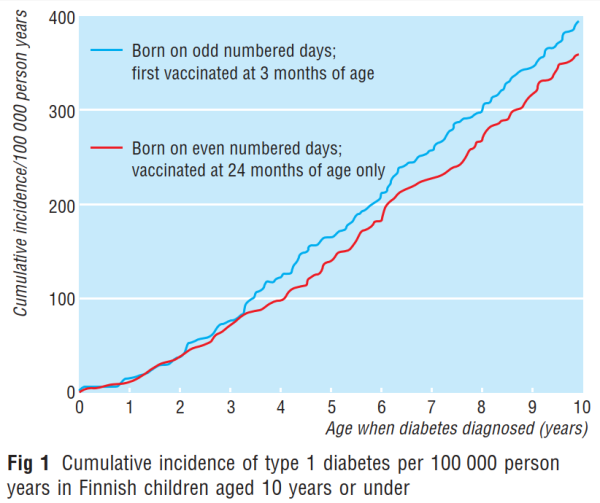
If it seems to you that on this graph, children vaccinated at three months of age have a higher incidence of diabetes than those vaccinated at two years of age, it’s only because you choose to believe your lying eyes rather than the correct statistical methods, which find no difference between the blue and red lines.
Nonetheless, this very graph, which the study’s authors claim should refute Classen’s conclusions, actually only confirms them. The graph clearly shows that around 3.5 years, the lines begin to diverge, which precisely matches Classen’s results, who wrote about the onset of a diabetes cluster 38 months after Hib vaccination.
Moreover, Classen showed that in those vaccinated at three months, the diabetes cluster begins around age 3, while in those vaccinated at two years, a similar increase begins two years later, around age 5.
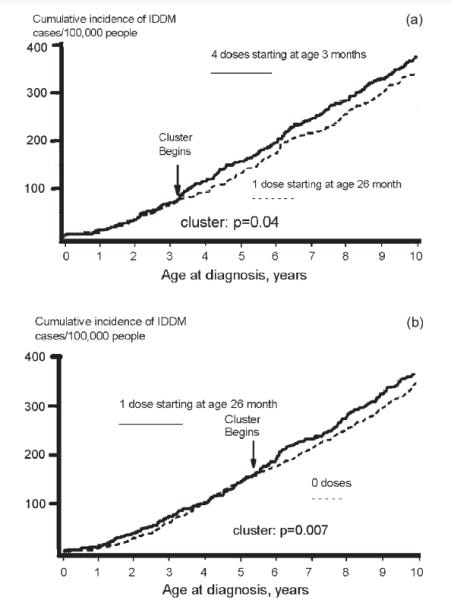
Graph from Classen's study
There is also biological evidence that the Hib vaccine may contribute to the development of diabetes. According to a 2003 Swedish study, infant vaccination against Hib increases the risk of developing antibodies to GAD and threefold to IA-2 nearly sixfold. Both types of antibodies are considered autoimmune markers preceding the development of type 1 diabetes.
*****
Let’s examine the topic of diabetes a bit further, since we’ve touched on it. Type 1 diabetes is an autoimmune disease where the immune system attacks and destroys the insulin-producing beta cells of the pancreas. We’ll discuss the potential link between aluminum and autoimmune diseases in the next part. For now, let’s focus on the prevalence of diabetes.
Like West syndrome or Dravet syndrome, type 1 diabetes is a disease that, although known since ancient times, was quite rare. However, in the mid-20th century, the incidence suddenly began to rise, coincidentally aligning with the start of mass vaccination. In the 1980s, the incidence in the U.S. plateaued, but in the 1990s, it began to rise again, coincidentally aligning with a significant expansion of the vaccination schedule.
A 2002 article reviewed all available studies on the prevalence of type 1 diabetes at the time. The author concludes that the increase in incidence indeed began simultaneously in many developed countries in the mid-20th century. He notes that over the past 30 years, numerous attempts have been made to explain this increase. A common starting point was the assumption that some new factor, likely related to diet or infections, had entered children’s lives.
The leading hypotheses were:
- The influence of cow’s milk (due to decreased breastfeeding rates).
- The impact of enterovirus infection.
- The hygiene hypothesis (suggesting that reduced parasitic infections might increase the risk of autoimmune diseases).
But none of these hypotheses were confirmed. The decline and subsequent rise in breastfeeding in the U.S. didn’t correlate with type 1 diabetes rates. The enterovirus infection hypothesis also didn’t hold up, as the incidence of enteroviruses in both children and pregnant women decreased over time, not increased. Epidemiological data also didn’t support the hygiene hypothesis.
In the 1980s, it was believed that the causes of type 1 diabetes were primarily genetic, as the disease was significantly rarer in less developed countries. But later, a sharp increase in incidence began in these countries as well, coincidentally aligning with the expansion of national vaccination programs.
In the end, despite decades of research, science still doesn’t know what caused the rise in type 1 diabetes incidence and can’t identify what new factor entered children’s lives in the mid-20th century that wasn’t there before. This mystery will likely continue to intrigue doctors and researchers for a long time.
***
The discussion on Haemophilus influenzae infection concludes with the following statement:
American children have used Hib vaccine for more than twenty years. During that time the number with Hib meningitis, bloodstream infections, pneumonia, and epiglottitis has decreased from twenty thousand every year to fewer than fifty.
Firstly, the mentioned 20,000 annual cases of Hib infection are an estimate by the CDC, and it’s unknown how accurate it is. The CDC only began collecting Hib infection statistics three years after mass vaccination started.
Secondly, vaccination did indeed sharply reduce Hib infection rates. But a few years later, they began to rise again. The Haemophilus influenzae type b (Hib) began to be gradually replaced by other serotypes.
For example, according to a 2006 Canadian study, Hib incidence in Manitoba initially decreased but then began to rise again, reaching pre-vaccination levels. Moreover, the authors compared their data with official statistics and found that of 17 confirmed cases of the disease in 2000–2004, only 3 were officially recorded. They conclude that Hib incidence statistics are significantly underestimated, and likely the same applies to other Haemophilus influenzae serotypes.
According to кanother 2017 Canadian study, the incidence of serotype A (Hia) in Ontario already exceeded Hib incidence in the pre-vaccination era by 76%. And in Alaska, the use of a combination vaccine led to the emergence of a more virulent Hib strain.
Such strain replacement is observed in many countries. Researchers emphasize the need to develop new vaccines that will cover other Haemophilus influenzae serotypes [1] [2].
In the context of Hib vaccination, the so-called "negative phase effect" should also be mentioned. Since Haemophilus influenzae is part of the normal nasopharyngeal flora, in some cases, vaccination against it can lead to meningitis or invasive Hib infection. This phenomenon was also observed in clinical trials of Hib vaccines. In participants who already had antibodies to Hib, their levels decreased after vaccination rather than increased as expected. In particular, in a study conducted in Minnesota, the risk of invasive Hib infection was six times higher in the first week after vaccination.
The clinical trials on the safety of modern Hib vaccines are, to put it mildly, perplexing. For the PedvaxHIB vaccine (by Merck), participants were observed for only 3 days. And for the Hiberix vaccine (by GSK), it was 4 days. Any side effects manifesting after this period simply couldn’t be recorded within the clinical trial framework.
A more detailed post on Haemophilus influenzae infection.
The fifth chapter is the longest in the book, and its analysis spans four posts. In the next part, we’ll move on to discussing the hepatitis B vaccine.
No posts
Comments
Nothing yet. Say the first thing.
Sign in to join the conversation.