
Fanaticism is always a compensation for hidden doubt.
—Carl Jung
Chapter 10 (continued)
Formaldehyde
After devoting only a couple of pages to aluminum, Offit moves on to formaldehyde. He cites five studies that, according to him, refute the claim that “formaldehyde in vaccines can cause cancer.” None of these studies is related to vaccination. However, one of those studies found that formaldehyde is a mutagen. The second and third studies, published in 1988 and 1989 respectively, did not find formaldehyde to be a carcinogen. Nevertheless, other studies have reached that conclusion. Moreover, the classification of formaldehyde as a carcinogen is the official position of the WHO, the EPA (Environmental Protection Agency), the NTP (National Toxicology Program), and other organizations.
The fourth paper Offit cites is a 1959 study that has nothing to do with formaldehyde. The fifth study merely measures formaldehyde concentrations in humans and rats after inhalation exposure, which is also unrelated to the issue.
In other words, Offit does not cite a single study demonstrating the safety of formaldehyde in vaccines. At the same time, to my knowledge, there is no evidence that the concentrations of formaldehyde used in vaccines are harmful. Unlike aluminum or mercury, which are very difficult to eliminate from the body, formaldehyde is an organic compound that the body can metabolize. For that reason, I do not consider this topic worth further attention.
Vaccine Adverse Event Reporting Systems
In the United States, there are two main systems for monitoring vaccine adverse events: VAERS and VSD.
VAERS is an open system to which anyone can report a suspected adverse event. Because of this, it is often claimed that VAERS is unreliable. However, that conclusion is incorrect, since knowingly submitting false information to VAERS is a federal crime.
VSD is a closed system accessible only to the CDC and a limited group of researchers who have received CDC authorization.
Offit:
The problem with VAERS is that two groups of people never report to it: people who get a vaccine and don’t suffer any side effects and people who suffer the same illness as is reported to VAERS but never got the vaccine. This information is critical to determining whether the risk of a possible side effect is greater in the vaccinated group. Sears also fails to address another problem with VAERS: biased reporting. For example, 80 percent of people who reported to VAERS that vaccines caused autism weren’t doctors or nurses or nurse practitioners or parents; they were personal-injury lawyers.
First, Offit is either deliberately misrepresenting the data or did not read the study carefully. According to the study he cites, only 20% of the reports claiming that vaccines caused autism were submitted by lawyers. The 80% figure refers to a different category of reports—cases of “overdose,” meaning situations in which a child accidentally received extra doses of a vaccine or a vaccine not appropriate for their age.
Second, the phenomenon described was limited to a short period—2001 to 2003—when there was indeed a surge in lawsuits, primarily related to thimerosal, which was being phased out of U.S. vaccines during those years. Before 2000, lawyers hardly submitted reports to VAERS at all.
Third, as noted above, knowingly submitting false information to VAERS is a federal crime.
Offit implies that VAERS inflates the number of adverse events. However, VAERS is a passive surveillance system that captures only a small fraction of actual reactions. As a result, the true number of cases is underestimated, a point that will be demonstrated in more detail below.
VAERS
In 2006, the CDC commissioned and funded a study costing more than one million dollars to develop a new electronic system for monitoring vaccine adverse events based on the Harvard Pilgrim database. The study lasted three years and found that the existing VAERS system captures fewer than 1% of all adverse events. The results were so unwelcome to the CDC that it declined to implement the fully developed system and terminated cooperation with the researchers.
The authors collected data from June 2006 through October 2009. During that period, 376,452 individuals received 1.4 million doses of 45 different vaccines. A total of 35,570 potential adverse reactions were identified. The system’s developers asked the CDC to take the final step—linking VAERS with the Harvard Pilgrim system so that reports could be transmitted automatically to VAERS. However, as the authors noted, “the CDC consultants responsible for receiving data were no longer responsive to our multiple requests to proceed with testing and evaluation.”
The fact that passive systems capture only a very small fraction of adverse events has been confirmed by other studies [1] [2]. In 1993, the FDA Commissioner wrote that only about 1% of serious adverse events are reported to the FDA, leading to delayed detection of drug-related problems. As an example, he noted that although silicone implants had been on the market for 30 years, only recently had they been linked to autoimmune diseases.
VSD и PRISM
Unlike VAERS, the VSD (Vaccine Safety Datalink) is an active surveillance system. Until 2001, it was directly administered by the CDC. However, after some researchers began obtaining access through the Freedom of Information Act (FOIA) and using the data for studies that identified potential vaccine harms, the CDC transferred administration of the VSD to private organizations. As a result, the data were no longer subject to FOIA. Access to the system is granted only to scientists and organizations that produce “acceptable” results. A similar model applies to PRISM (Post-licensure Rapid Immunization Safety Monitoring).
Recall the CDC study (Verstraaten, 2003) that initially found a sevenfold increase in autism risk associated with thimerosal, but after multiple iterations, data adjustments, and exclusion of various groups, the final publication reported the association as statistically insignificant. That study was conducted using VSD data. Independent researchers have attempted for years to obtain the original data from the CDC in order to analyze them without extensive statistical manipulation, but without success.
Offit:
The reason that Sears fails to distinguish whether a side effect following a vaccine is actually caused by the vaccine is that, like anti-vaccine activists before him, he simply doesn’t believe in coincidence.
No comments.
Offit:
In fact, vaccines are tested in larger numbers of people for longer periods of time than any drug. HPV vaccine was tested in thirty thousand women, the conjugate pneumococcal vaccine in forty thousand children, and the current rotavirus vaccines in one hundred and thirty thousand children before licensure; all were tested for more than twenty years. No drug receives this level of scrutiny.
As already discussed, the central deception in vaccinology is that inert placebos are not used in the clinical trials of any vaccines included in the immunization schedule.
In clinical trials of the pneumococcal vaccine, an experimental meningococcal vaccine was used as the placebo.
In clinical trials of the HPV vaccine, aluminum was used as the placebo.
In clinical trials of both rotavirus vaccines, the placebo consisted of the same vaccine formulation without the viral component [1], [2].
Comparing a vaccine to another vaccine or to a biologically active placebo cannot establish its safety, regardless of the size or rigor of the study.
Offit:
Every year many children suffer pneumococcal pneumonia, bloodstream infections, and meningitis. And those who don’t die from meningitis are often left blind, deaf, or mentally disabled. For example, in 2001 Shannon Peterson of Minnesota decided not to give her two children the pneumococcal vaccine. Both suffered severe pneumococcal infections. Her five-year-old son survived; her six-year-old daughter didn’t. “I can’t tell parents enough the importance of vaccines,” said Peterson. “I hope that no one else has to hold their child when they die.” Sears could have told a story like this one.
In describing this case, Offit omits a highly significant detail. Shannon Peterson’s children first came down with chickenpox. The daughter was the first to fall ill. She developed a headache and a high fever. Shannon assumed it was the flu and immediately gave her ibuprofen, which is contraindicated in chickenpox precisely because it can trigger bacterial complications. A rash appeared later.
The girl’s condition continued to deteriorate, and Shannon called the hospital, where she was advised to continue treatment by alternating ibuprofen and acetaminophen. Shortly afterward, the girl developed extensive skin lesions — a typical presentation of necrotizing fasciitis, a known complication of chickenpox associated with ibuprofen use. She was rushed to the hospital but died on the way.
In other words, Offit presents what is essentially a classic case of death associated with ibuprofen use as a death caused by lack of vaccination.
Offit:
In truth, tetanus is not an infant disease,” he writes [Sears]. “Also, diphtheria is virtually non-existent in the United States. So you could create a logical argument that a baby could skip the tetanus and diphtheria shots for a few years and be just fine.”
These statements are inaccurate. First: tetanus is a disease of infants. A cursory look at any textbook of infectious diseases provides grim pictures of newborns suffering severe muscle spasms and breathing difficulties from tetanus; that’s why it’s called the “disease of the seventh day.”
In this case, Offit is deliberately misleading. In the past, newborns developed neonatal tetanus almost exclusively because the umbilical cord was cut with non-sterile instruments. Cases of neonatal tetanus in developed countries are exceedingly rare simply because people stopped cutting umbilical cords with rusty scissors.
Second: the casual advice that one can simply wait to get a diphtheria vaccine ignores history. Between 1990 and 1993, when public health programs were disrupted in the Russian Federation (states newly independent from the Soviet Union), a hundred and fifty thousand people suffered diphtheria and five thousand died, mostly children. In the absence of vaccination, such an outbreak could happen in the United States just as easily.
Diphtheria, like tuberculosis, is a disease of poverty. The diphtheria epidemic of the 1990s was caused by the sharp decline in living standards in the countries of the former Soviet Union—just as the diphtheria outbreak in Venezuela in 2016 followed a dramatic economic collapse. The United States does not vaccinate against tuberculosis and has never done so systematically, yet Offit does not appear concerned about a tuberculosis epidemic.
Moreover, the CDC article Offit cites in that paragraph explicitly states that the diphtheria outbreak in Russia occurred “despite high levels of vaccination coverage against diphtheria.”
Offit:
“Hib is a bad bug,” writes Sears. “Fortunately, it’s also a rare bug, so rare that I haven’t seen a single case in ten years. Since the disease is so rare, Hib isn’t the most critical vaccine.” As Sears knows, Hib is rare because of the Hib vaccine. And if we stop using the vaccine, Hib will be back. Which is exactly what has happened. Sears’s book was published in October 2007. The following year, outbreaks of Hib meningitis occurred in Minnesota and Pennsylvania. All these outbreaks centered on children whose parents had chosen not to vaccinate them; four died from their infections.
Referring to the outbreak in Pennsylvania, Offit cites a newspaper article that is not publicly accessible. In the case of the Minnesota outbreak, he links to a CDC article stating that two of the five children were vaccinated. The CDC also reports that no epidemiological link was identified among the five cases and, consequently, there was no identifiable epicenter. In strict epidemiological terms, this was not an outbreak.
As with meningococcus, Hib is an opportunistic infection and does not produce outbreaks in the epidemiological sense. Haemophilus influenzae is a normal component of the nasopharyngeal microbiota, and the development of invasive disease is generally associated with immune deficiency.
Offit:
One final irony. For a new vaccine to be added to the schedule, the FDA requires concomitant-use studies. Pharmaceutical companies must show that a new vaccine doesn’t interfere with the immunity or safety of existing vaccines and that existing vaccines don’t interfere with the new vaccine. Only then can a vaccine become part of the schedule. Dr. Bob’s schedule, on the other hand, is completely untested—never reviewed by the FDA, CDC, or AAP to make sure it’s as safe and effective as the existing schedule.
Here, Offit prudently provides no references. This is, of course, a false claim. The safety of the childhood immunization schedule has never been studied as a whole, and Offit is well aware of that. Many vaccines were added to the schedule with minimal supporting research, such as the hepatitis B vaccine for newborns.
Moreover, in 2012 the Institute of Medicine explicitly recommended conducting studies on the safety of the immunization schedule. The committee proposed:
- comparing the health outcomes of fully vaccinated, partially vaccinated, and unvaccinated children;
- comparing children vaccinated according to the recommended schedule with those vaccinated on a delayed schedule;
- investigating the existence of subgroups of children at increased risk of adverse reactions to vaccines.
None of these studies has been carried out to date.
Offit then turns to criticizing the book You: Having a Baby by Mehmet Oz and Michael Roizen.
Regarding the rotavirus vaccine, they wrote, “A prior version of this vaccine was withdrawn from the market in 1999 because it was linked to a severe condition known as intussusception, a blockage or twisting of the intestine. A new vaccine, released in 2006, has been associated with even more cases of intussusception ... than the first version, prompting an FDA notification in 2007. We recommend that you opt out of this one until more data are available.” Oz and Roizen should have read the FDA notification a little more carefully. If they had, they would have seen that the FDA stated that all cases of intussusception following rotavirus vaccine may have occurred by chance alone. Further, one year before YOU: Having a Baby was published, the CDC found the risk of intussusception was the same in children who did or didn’t receive the rotavirus vaccine; parents no longer have to wait for data.
Offit cites a CDC study which is based on the VAERS system. The authors calculated the number of post-vaccination intussusception cases reported to VAERS and compared it with the “expected” number of such cases.
How was the expected number calculated? The authors took the actual number of intussusception cases recorded in the Vaccine Safety Datalink (VSD) and multiplied it by 37. Why 37? Because the previous rotavirus vaccine, Rotashield, had been associated with a 37-fold increase in the risk of intussusception.
The resulting “expected” number was then compared with the number of cases reported to VAERS. The authors assumed that VAERS captured 75% of all intussusception cases. Since the number of reported cases was lower than the calculated “expected” figure, they concluded that RotaTeq was not associated with intussusception.
The CDC authors did not take into account that, according to a CDC-commissioned study, VAERS likely captures fewer than 1% of adverse events. It was more convenient to assume 75% reporting. Even with these assumptions, at most the study suggests that RotaTeq does not increase the risk of intussusception 37-fold. Whether the vaccine increases the risk tenfold was not established by this analysis.
However, we know from other studies that RotaTeq increases the risk of intussusception approximately ninefold.
It should also be noted that numerous studies based on VAERS data have concluded that certain vaccines are unsafe. Such studies are sharply criticized by vaccination proponents. Yet when VAERS-based analyses are used to argue for vaccine safety, the same methodological limitations are, for some reason, no longer treated as disqualifying.
****
Chapter Ten includes a total of 26 footnotes which include 17 studies:
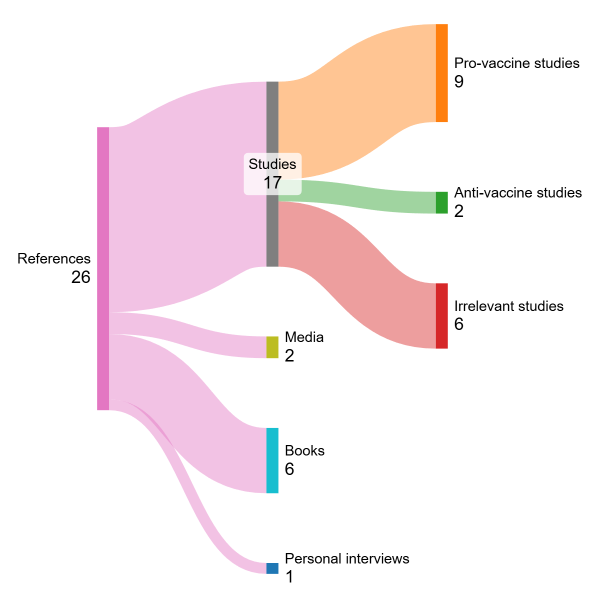
Out of those:
Studies unrelated to vaccination (6 footnotes)
Anti-vaccine studies (2 footnotes)
9 studies are presented as evidence of vaccine effectiveness or safety and were discussed in this and previous entries.
No posts
Comments
Nothing yet. Say the first thing.
Sign in to join the conversation.