
In this newsletter you’ll find:
Studio Views
Spain!
Look & Listen
Your work
Studio Views
Not much to see in the studio this past month. I was struck down by a very nasty flu and am only now catching up on half-finished projects and it looks as though the studio has exploded — there is a couch in here somewhere...
I’m sorry if you came by Knit City to say hello — I was in bed!
Any creative practice, therefore, has been at low ebb between illness, the crush of the end of term, and a few other surprises. I didn’t even take any pictures at Landmade last month, nor have I done any drawing or sampling, though I do have a project for Gist Yarn on the loom for release later this year.
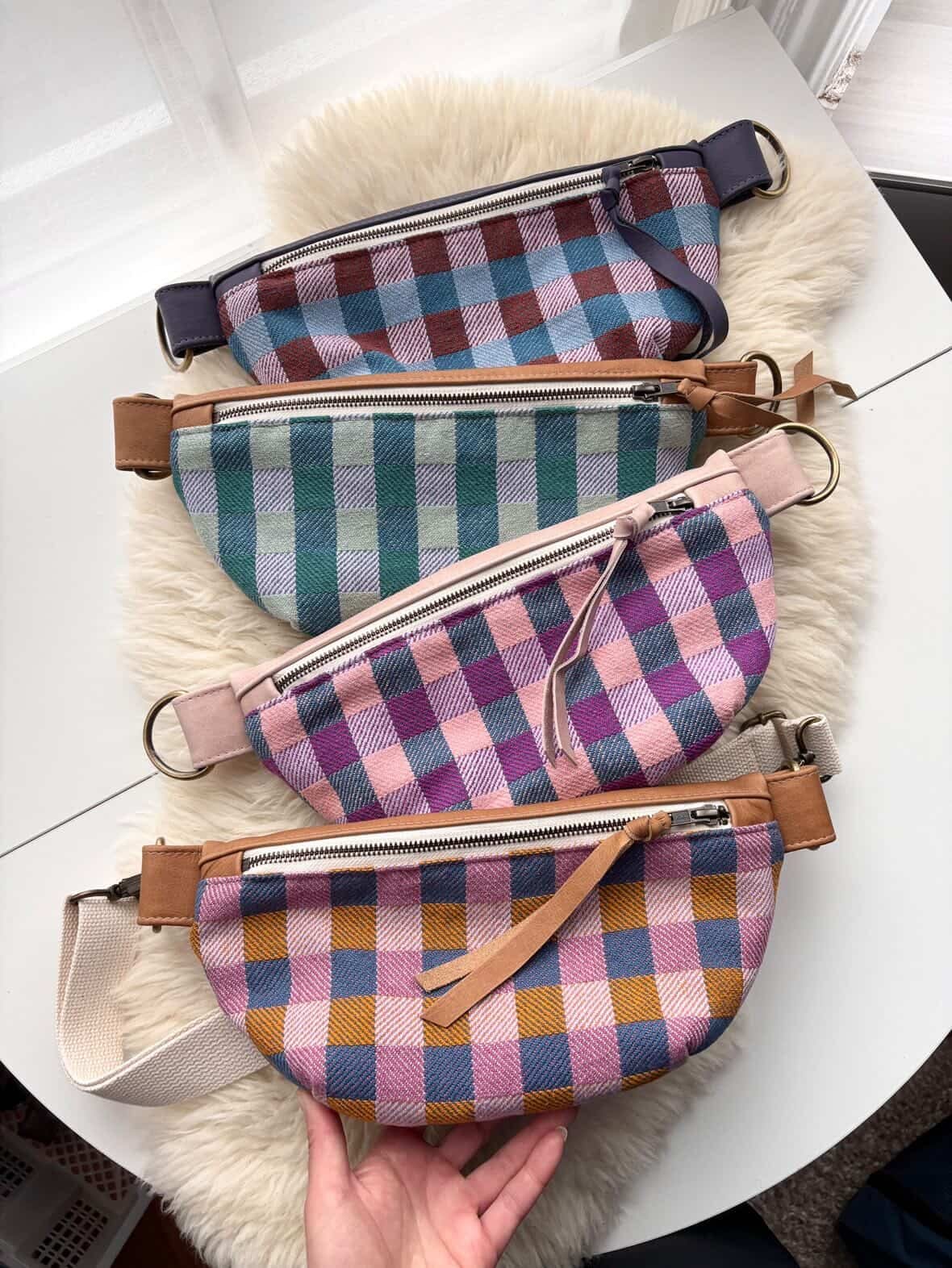
What I can share are some images of the finished collaboration with Roncy Packs! They debuted at the OOAK Show in Toronto and I was very humbled to hear people were hustling to get there to buy one. Post-show, there are three of twelve packs remaining — they will go on sale through the Roncy Packs website on Sunday, April 19th.
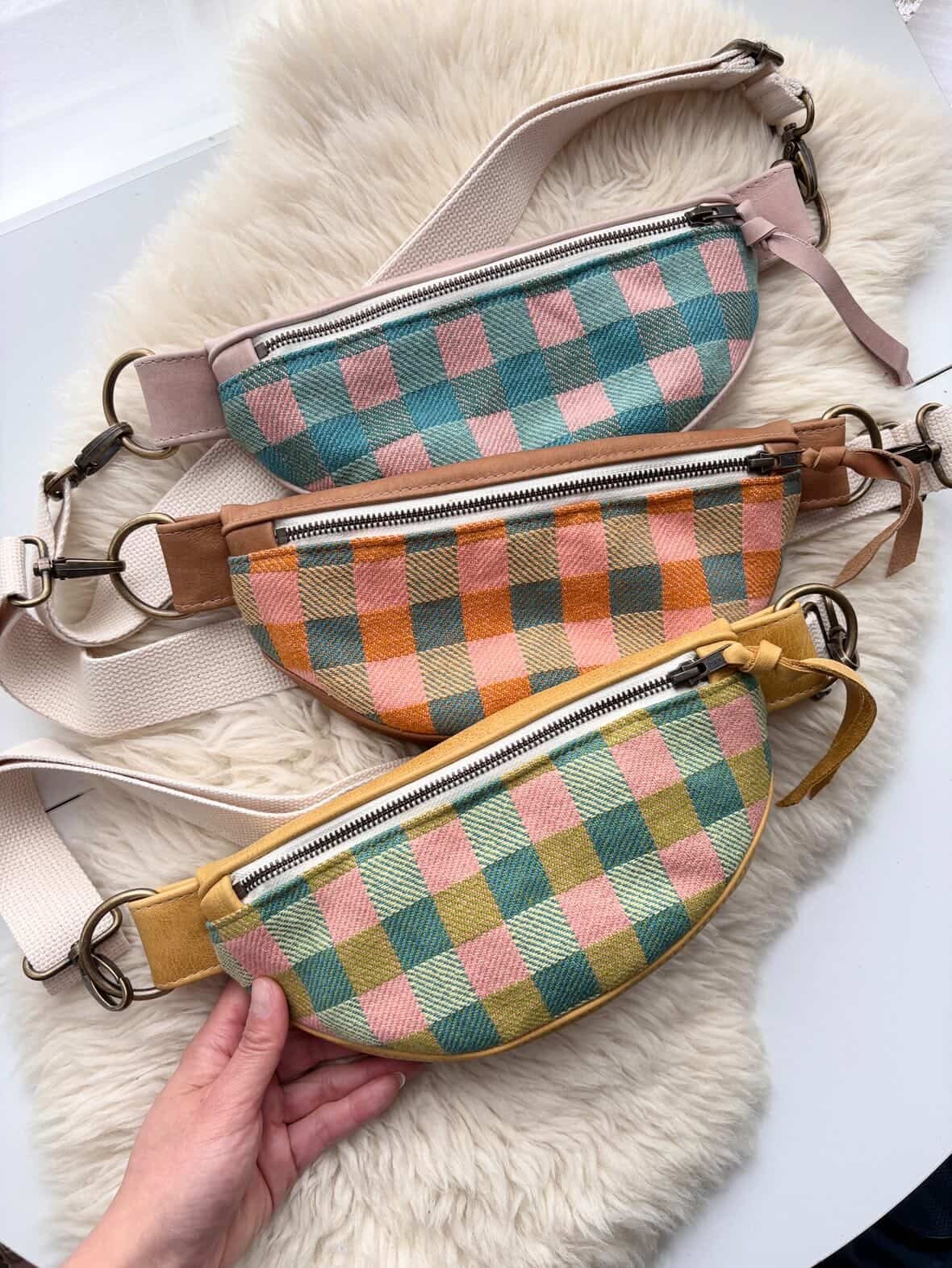
Le Ching gave me a ticket to visit the show and we got to meet for the first time, which was so nice after so many messages back and forth. I had such a wonderful time working with them again and we’ve already talked about another collaboration in the future…
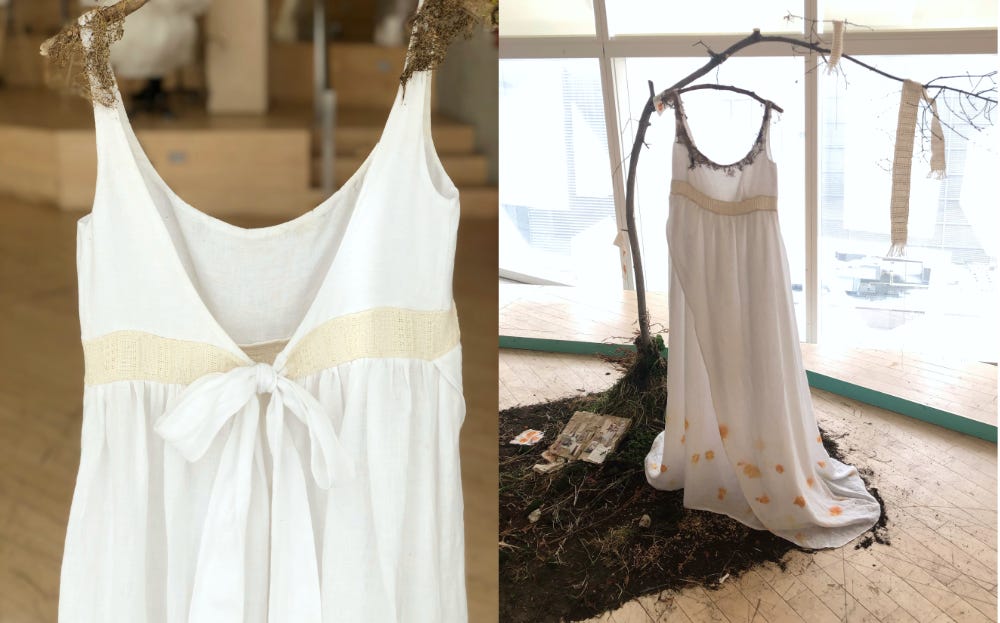
It’s also the end of term, which means student fashion shows and exhibitions. I was thrilled to offer two past students, Emma Piercy and Kate Fitzpatrick, some technical advice on including hand weaving into their graduating projects. Emma created a beautiful exhibition titled In Her Nature, exploring the intersection of humanity and nature through rooted, growing garments that incorporated natural dyes and handwoven lace. Emma had explored hand manipulated lace weaving in my class, and for her capstone collection I advised her on loom controlled lace weaves, which you can see integrated in the garment below.
Kate’s runway collection is called For Fluidity and is a “fall/winter gender-fluid collection that reimagines androgyny through avant-garde silhouettes and handcrafted textiles.” Kate’s experimental process explored hand spinning samoyed dog fur (!), hand woven trims, and an open, very loosely woven fabric, much of it inspired by work she did while on exchange in the UK last year.
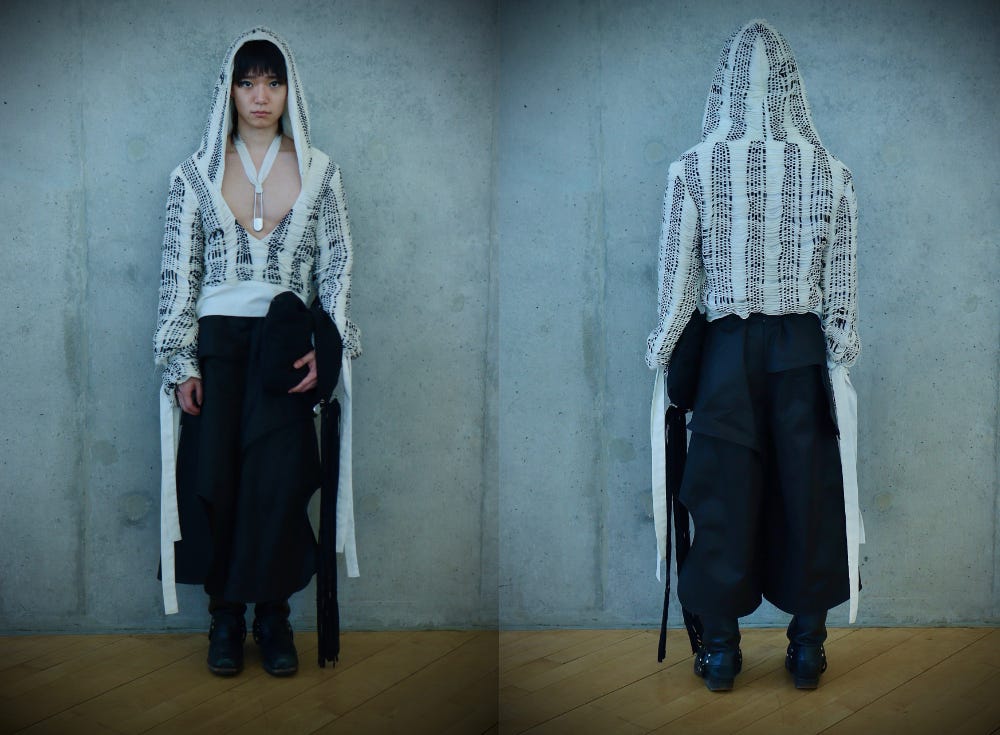
Her final collection featured several of these elements, including a hooded top made with hand woven yardage (seen above). Making yardage is a huge undertaking and it was a thrill to watch her looks go down the runway. You can see her collection in the broadcast of the show below (it’s cued to begin with her collection).
Thank you Emma and Kate for letting me feature your capstone projects in my newsletter!
Spain
I will be in the Asturias next month. Do you have any recommendations or favourite things to do in Madrid or near Oviedo? As always, I’d love to connect with weavers and I’m particularly interested in local textiles and wool!
Look & Listen
In February, Gather Textiles launched a wonderful series of short videos on the weavers of Edmonton, Canada, called Weaving Stories. I love personal, local projects like this; I often find myself stuck feeling like the most interesting things are happening elsewhere, and this is a great reminder that there are amazing people and fascinating stories everywhere.
This series of video interviews brings to light some of the individuals and groups that make up the weaving community in Alberta. I enjoyed learning about the dancing costumes, Métis sashes, and the connections to history, self, and heritage that weaving has brought into people’s lives. Craft and small-scale making adds so much to the fabric (pun intended) of our communities, and it is wonderful to see it foregrounded and supported so sensitively.
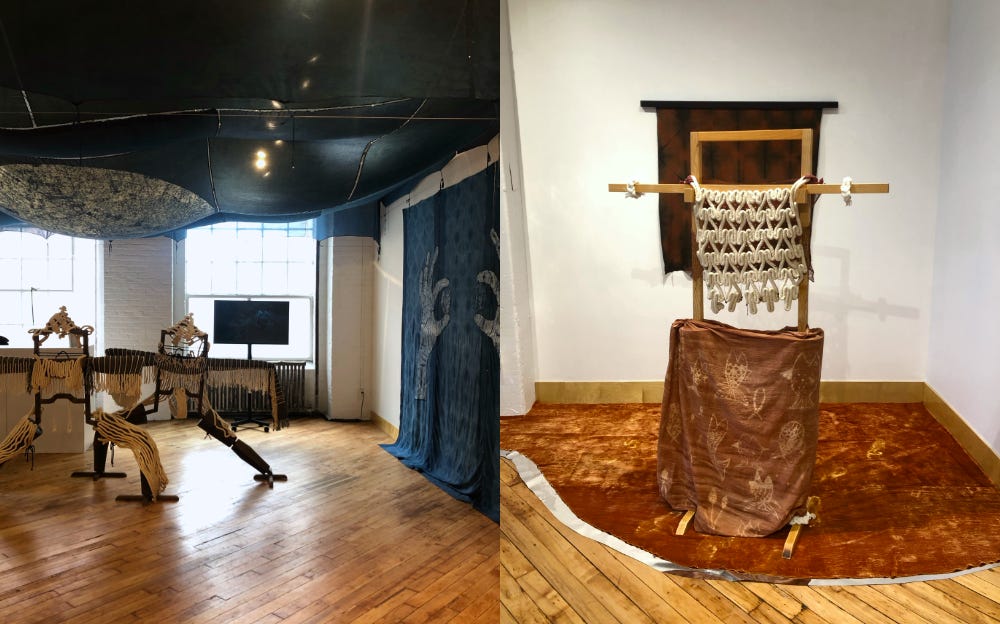
The Weaving Stories project is free to watch on YouTube and can be found on the Gather Textiles website here.I had a chance to pop into Craft Ontario to see Akash Inbakumar’s exhibition When I Ebb and Wax. Bringing together costume, textiles, and performance, this exhibition was a delight; rippling indigo textiles draped from the ceiling, and playful, costumed figures of wood and rope created a feeling of narrative and implied movement. The costumes were indeed meant to move; you could watch a video performance or attend a live, in-person performance where performers brought them to life. When I Ebb and Wax is only on for a few more days, until April 18, 2026, and the exhibition page can be viewed here .
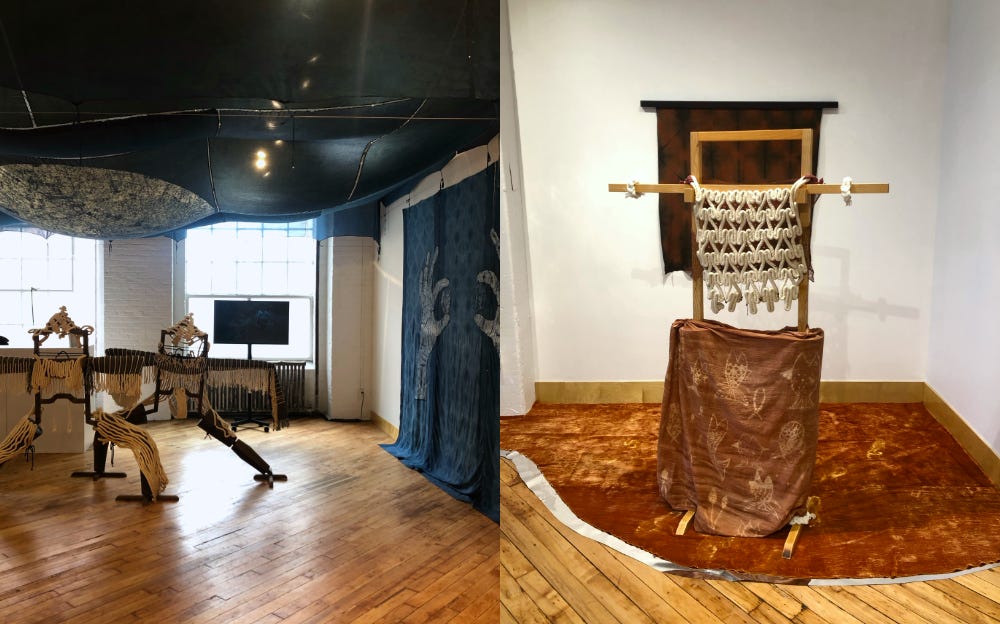
Akash Inbakumar at Craft Ontario. My friend Ikumi Otaki has recently been added to the Homo Faber Guide, an online platform dedicated to raising the profile of craft artists around the world. Ikumi trained as an artist and weaver in Japan and Sweden, and lives and works in Yamagata, Japan. Her woven work is very beautiful (she has a lovely sense of colour and pattern!) and I think very fondly of our time together in Japan visiting silkworms, rummaging at the ReBuilding Center, and delicious meals with her and her family. Her Homo Faber profile can be viewed here.
Two current Danish textile exhibitions were recently profiled on the HANDVÆRK website. Gobelins – The Frederiksborg Tapestries is a newly opened exhibition celebrating the tapestries that ring the Great Hall of Frederiksborg Castle in Hillerød. From about 1900-1928, a group of women weavers lead by Kristiane Konstantin-Hansen planned and organized the reweaving of tapestries depicting historic narratives. A close up of dandelions and clovers on the Frederiksborg website shows the care and complexity of the work, and I’m sure the exhibition’s accompanying publication, Strands of Time, expands on the process, work, and stories included in the tapestries.
The article on HANDVÆRK also mentions another exhibition titled NATURE TO NATURE at Munkeruphus in Dronningmølle.
“NATURE TO NATURE is a large thematic exhibition exploring what happens when art and design rediscover the richness and narratives embedded in our Nordic material heritage.
The exhibition is rooted in the fact that the Nordic landscape possesses remarkable biodiversity, once clearly reflected in art, design and craft. In the past, we made things from a wide range of local natural materials, drawing on a wealth of skills, disciplines, traditions, rituals and ingenuity. We made them waterproof, tanned them, dyed them, glued them and processed them – all without the synthetic, often plastic-based materials we widely accept today.
This exhibition invites us into a world where a connection has been re-established between what we create and the nature that surrounds us, and where every artwork can once again be returned to nature producing the finest soil.”
This group exhibition features several contemporary makers, but I am particularly intrigued in the kombu seaweed sculptures of Julia Lohmann, the bark and mud sculptures of Jette Mellgren, and work by Claudy Jongstra (you may like to listen to a Material Matters interview with Jongstra that I’ve mentioned before).
A free article (in English and Danish) is available to read on the HANDVÆRK website with images and impressions of both exhibitions.The artist Nakahira Misako is one of this year’s finalists for the Loewe Craft Prize. She’s posted a short video to her Instagram about her work and process that you can watch below:
The Loewe Craft Prize is an annual competition that celebrates outstanding skill in contemporary craft from artists around the world. There are thirty finalists in the ninth edition of the prize; the exhibition of their work is being held at the National Gallery Singapore from May 13 - June 14, 2026, and features Nakahiro Misako as well as artists like Adelene Koh (bookbinder), Fadekemi Ogunsanya (textile artist, see below!), and Jongjin Park (ceramics). In 2019 I was in Tokyo at the same time as that year’s prize and I still think about it — it was one of the most incredible exhibitions I’ve ever seen (not least because it was presented in Isamu Noguchi’s piece Stone Heaven, which you can see here).
Another far-off exhibition I’d love to visit is Thread at Sarah Myerscough Gallery in London, England. Running from March 28 - May 16, 2026, Thread “explores the notion that weaving is both a thought or idea, as well as a process of making that speaks to the fundamental interconnectedness of human experience.” This group exhibition surveys contemporary woven work by global artists like Patrick Bongoy (who explores environmental pollution), Wanbing Huang’s ramie and xiabu (Chinese grass cloth) sculptures, and Kate McGuire’s uncanny, feathered pieces. This exhibition is not to be missed if you are able to go! I should have decided to fly to Spain through London…
Textiles, Politics and Creative Resistance is an online book club happening on April 23, 2026, to celebrate the publication of a new book from Common Threads Press titled We Will Find Them: Arpilleras and the Political Art of Chile Under Pinochet. This book explores and celebrates the work of the arpilleristas, groups of working-class women who created resistance textiles during Augusto Pinochet’s military dictatorship in Chile (you can read more about the textiles and see images here.)
I’ve had the pleasure of seeing these colourful, pointed, and beautifully stitched narrative works, and I imagine author Jess White and artist Francisca Aninat’s conversation will offer many interesting insights into textiles-as-resistance and Latin American textiles. Tickets for this meeting are free for Crafts Council members and £8 for non-members. See more on their Instagram page here or on the Crafts Council website.
Your Work
Lastly, I really love when people send me images of projects they’ve woven from my weaving patterns, and I periodically like to share them here in my newsletter. I think of writing patterns much like I do recipes: I provide the ingredients and you choose what to substitute, which is where the fun happens!
Thanks to Jeannette and Veronica for kindly letting me share these interpretations of their Rosa Wash Cloths and Seed Pod Towels projects.
Thank you, as always, for reading this newsletter. I’m looking forward to finishing school and having a bit of rest — and then a summer of fun in the studio!
Amanda
Comments
Nothing yet. Say the first thing.
Sign in to join the conversation.