
In a recent episode of Dire Straights, Tracy and I discussed how porn today has become a somewhat bipartisan scapegoat for patriarchy. Porn has been blamed for everything from the male loneliness epidemic to women’s heteropessimism. Within the manosphere and in conservative circles, porn is also increasingly cast as a tool of not just women’s but men’s oppression.
As we discussed in that episode, the truth is that our bodies, relationships, lives, and desires are shaped by the aesthetics of sex in far more complicated ways that we allow into public discourse. We all have complex stories about encounters with porn, and they tend to emerge not only from firsthand consumption, but from our sexual and romantic relationships—such as how others (say, straight men) metabolize the genres they consume, and what they expect of their partners in return.
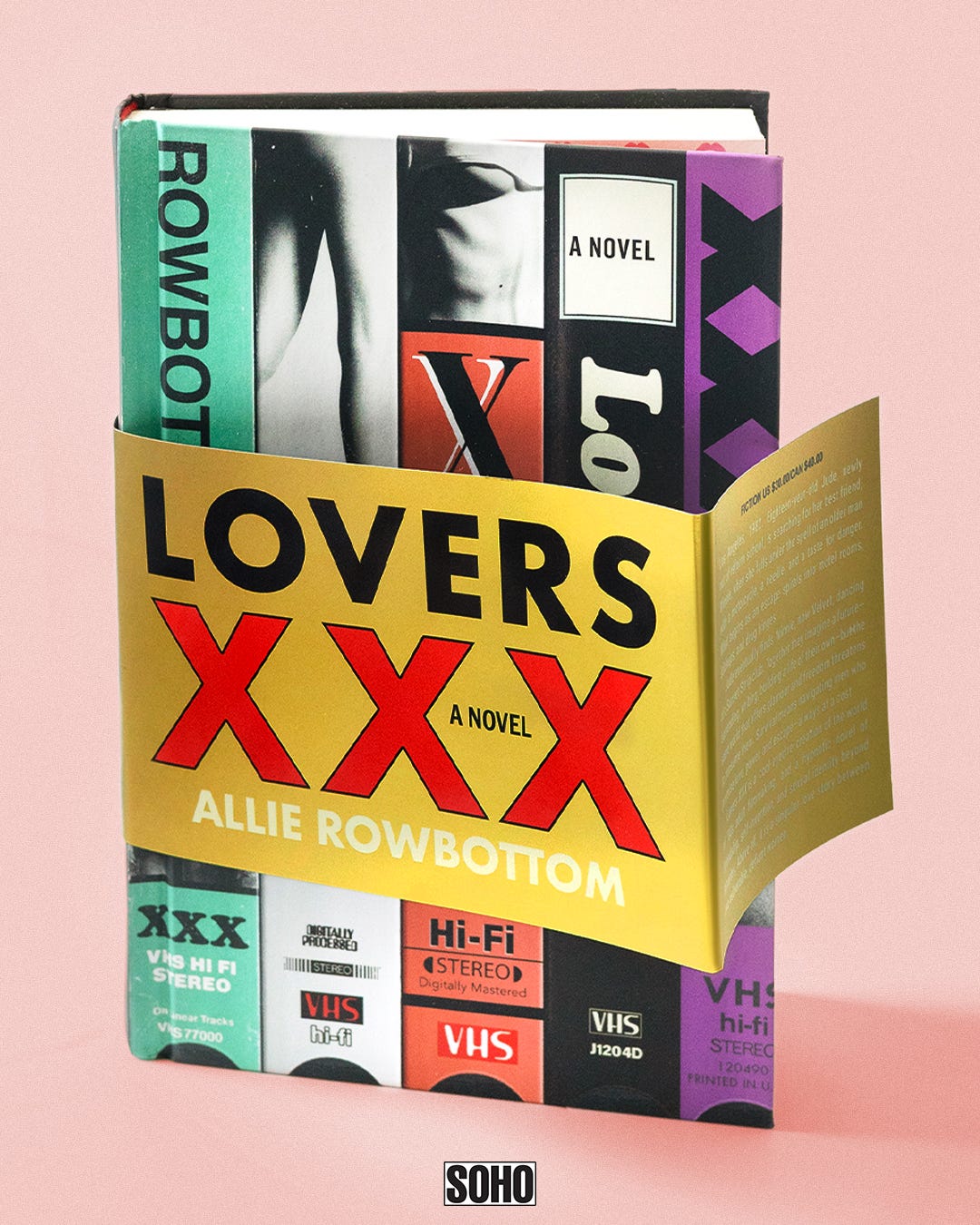
In her new novel LOVERS XXX, Allie Rowbottom explores porn and power from an entirely different angle. That is, through the lives of two women inside the industry in the 1980s—an era of VHS tapes, drugs, neon, and high tension between sexual liberation and exploitation. The book leads not with judgement or superiority, but with relentless attention to the psychology of desire, pleasure, performance, and femininity.
I met Allie over a decade ago, while we were both working on our MFAs at an experimental arts school just outside Los Angeles. She has always been a sharp, poetic writer with relentless tenderness for women’s experiences—and for stories otherwise untold by the literary canon. LOVERS XXX is libidinal and luscious on the sentence-level in its depiction of Los Angeles, the San Fernando Valley, and Southern California. It took me home to LA in a romping, epic, thriller kind of way. But the book is also profoundly invested in exploring the nature of girlhood, womanhood, friendship, agency, and the plausibility of escaping the male gaze.
Perhaps what I love most about the book is its unapologetic literary ambition— it’s a book that announces itself, within the story and the characters’ own ambitions, as a retort to the prudishness of literary fiction, while paying homage to so many of Los Angeles’ best artists and writers. It’s the kind of book that makes you want to write, while also making you want to want, to explore one’s own desires and every momentary exchange of power. That is, to love and to live.
What is something you are mad about right now?
What “feelings rules” did you learn growing up? What did those lessons teach you about gender, relationships, and the world?
From my mother I learned to embrace my own predisposition for deep feeling. From my father I learned to do the opposite. For a time, his version of reality, his way of moving through the world, was the one I emulated. I believed it would keep me safe. Of course it did the opposite. An essential element of my maturation and healing was realizing that the feelings I thought would kill me were actually essential for my survival. And with that realization, I stepped fully into womanhood.
What is your relationship now to feeling/emotion? What feelings scare you most? Which emotions do you find most powerful? Do you like feeling things?
One privilege that’s come for me with age and experience (of grief, most specifically) has been learning I can survive my own emotional range. That what might feel permanent is in fact fluid. That my heart can break and I won’t die; in time it will grow back stronger.
Do you think of your creative process as related to a state of madness? Some other way?
When I write I go out of my body a bit. If the work is any good, I enter a sort of trance state wherein time disappears and my bladder expands, camel-esque. The project transmutes into a puzzle and my relationship to it becomes compulsive; even if I’m not rushing, I’m obsessed with finishing, because once finished, the puzzle will be solved and I will be able to rest. When the project is a long one, like a novel, this can be quite inconvenient.
What is your relationship to diagnosis?
Well, judging by my previous answer, it may seem like I should have a more consistent relationship to it. But by and large, my experience with diagnosis has been like my experience with any label: I usually find them useful at first, and reductive in the long run.
If you had to diagnose yourself with something, what would it be?
Chronic occipital and vagal nerve compression from hunching over my legal pad/computer and obsessively solving the puzzles of my writing projects. This is an area where diagnosis has been useful to me recently (thank you Instagram).
Have you ever felt normal, healthy, or healed? What is your relationship to these concepts?
I have never felt normal. I don’t think normality really exists, though for some it may feel reassuring to believe in, in which case I say go for it. I have felt healthy and healed. Like anything, the sensation of health and healing is transient. But when I feel that way, it’s a gift and one that goes hand in hand with gratitude and presence.
How do art and culture make you feel? What are your favorite feelings to have when engaging with books or culture? What do you hope people feel when they engage with your work?
At the risk of sounding trite, I want people to feel swept away and utterly immersed in my work. I want them to find pleasure in the world, at the same time they’re challenged by it. I want them to come away emotionally altered in a lasting sense, like the book will live inside them for years to come. This feeling of permanent alteration is what I value most about my favorite novels, films, albums, TV shows; and it’s what I value most about the experience of writing my books; each one has fundamentally changed how I see the world and will remain forever a part of who I am.
I can only hope that others have a similar experience with my work. But it’s not really my business.
In a broader sense, when it comes to art and culture, I find myself troubled by the marked absence of work that delivers to me that feeling of utter immersion and personal change. I start a lot of hyped up books I don’t finish, more so now than ever. There’s a lot of garbage on TV; popular music is dopamine baiting slop.
I know I sound like a curmudgeon—there’s always been mid-art. So maybe it’s just that culture seems more permissive to midness. We too readily accept that popular novel/album/show that feels like it was rushed out full of plot holes and emotional patness. I guess the one upside to this trend is that when great art finally comes along it shines all the brighter? I hope that’s not just wishful thinking.
What is the relationship between politics and art for you, and in your work?
Rarely do I set out to write with a political agenda. But my work is almost always inextricable from politics because my work is almost always about women, and usually women I feel have been somehow overlooked—even (especially?) if that means they have been looked at more than many of us.
With Aesthetica, I wanted to explore the psychology of self objectification; with LOVERS XXX I wanted to explore porn of course, but more specifically the relationship between sexual performance and sexual agency—where is the line, often invisible, often (always?) elusive, where the two become one? And what is the relationship between that line and the patriarchal systems in which porn is made, the gaze to which it most often (but certainly not always) caters?
With both novels, I wanted to ask readers to take a closer look at women too often passed off as superficial, silly, weak, unfeminist, the butt of some unspoken cultural joke. But I didn’t want to judge my characters or ask readers to do so. That was actually the last thing I wanted to do.
One of my biggest pet peeves is when I pick up a novel in which I can sense the writer’s politics or moral leanings. A preconceived notion of right and wrong, an eau of moral certainty, might work for some readers but to me feels boring, infantilizing, and besides the point. I’d rather enter a fictional world, dwell in uncertainty, and have to think for myself about what that uncertainty might mean. I’d rather be afforded the opportunity to understand and empathize with characters who are different from myself, and in the process, expand my mind and world view. Such is the job of literary fiction: to help readers empathize and think, but not tell them how to do so, or what conclusions they’re supposed to come to in the process.
Is there a question you are often asked in interviews that makes you angry or uncomfortable? What do you wish people would ask you instead?
Sometimes I feel a little awkward when asked what my parents think of my work, simply because the answer tends to make others uncomfortable, which then makes me feel bad for having made them uncomfortable. My dad doesn’t read my writing (it’s for the best) and my mother isn’t alive. Though if she were I imagine she would mostly love it and maybe simultaneously be slightly competitive.
My favorite questions are craft questions. Recently Chelsea Bieker asked me about my relationship to outlining. I had so much fun answering, but it’s too long to really get into here.
For now I’ll just say: when I start a new longform project, I outline chapter by chapter, making sure each one has both an emotional arc in which characters move from high to low emotional states and sometimes back again. I do the same for each act of the book itself and then for the book as a whole. Once I start to write and the plot inevitably changes, I go in and edit the outline in tandem with the book.
I also love craft books, love the ego-killing reality of writing: that one can always improve, that returning to the basics is always fruitful, that just when you think you’re really good, you’re probably about to be humbled, which is actually exciting, because it means you get to sit down and read and outline and try to get better.
What is something keeping you sane right now?
I feel like I’ve just arrived at a stage of womanhood where I’m returning to my girlhood self. The crap I picked up between let’s say twelve and twenty-something is just…falling away. This feels especially pronounced when I’m playing with my dog Jammy, or riding my horse Budgie, or giving them baths, or attending to various elements of their wellbeing, as I did with other animals (angels) in my girlhood, often feeling utterly enmeshed with them, soul to soul. It’s a peaceful place to be. Aforementioned crap sometimes blocked that place in my adolescence and young adulthood. But no longer.
No posts
Comments
Nothing yet. Say the first thing.
Sign in to join the conversation.