
I get stuck in the day-to-day a lot — the stupid online fights, the intra-factional bullshit, the back and forth that make me want to throw my phone into the sea — but every so often, I think it’s useful to zoom out and see where we are as a party in our years in the wilderness.
My current assessment: We might win this November (and I really hope we do, for the sake of democracy), but it won’t be because of anything we do — and if/when we do win, that won’t solve our bigger problems as a party.
Per at least one new poll, Trump’s approval rating is at a record low — barely cracking 32%. (That’s the same as what George W. Bush’s was when he left office…)
Meanwhile: Per a NYT poll back in May: 89% of likely Democratic voters are almost certain or very likely to vote, another 9% are somewhat likely.
Emerson College says that Democrats have an 11 point advantage over Republicans on the generic ballot.
CNN’s new poll out yesterday says that Democrats are +8 with registered voters — with a 20 point advantage among voters who say they’re extremely motivated to vote.
Basically: Our people will crawl over broken glass to cast their ballots. And Republicans are less than thrilled about candidates that aren’t Trump.
People don’t like the war in Iran. They definitely don’t like the economy (because holy shit things have gotten expensive, and they’re only getting more expensive). They don’t like the president, who got us into the aforementioned war and made the prices go up.
They also don’t particularly like the Democratic Party! (Or the Republican Party, for that matter.)
But! Voters generally like the Democratic candidates enough. One spring poll showed that even among people who dislike or sort of dislike the party, 57% say they’ll still vote for Democrats anyway. (Hell, I’m probably one of those people: I’m pretty meh on the party as a whole and I will absolutely always vote for Democrats!)
Again, I certainly fall into this bucket. 96% of Democratic voters say the party needs to be changed — 39% said minor changes, 47% said major changes, and 10% said completely reformed.
From yesterday’s CNN poll:
80% say it’d significantly improve the Democratic Party to replace the current leadership
83% say it’d be better for us to take a stronger stand against Trump
85% (!!) say it’d be ideal for us to nominate younger people for major offices
Part of the reason people are demanding change: They simply don’t believe we’ll do what we say.
Only 15% of all voters say they trust the Democratic Party and feel like it represents their interests — and 58% of likely voters say they won’t vote for a candidate they don’t trust, regardless of issue positions.
Per that new CNN polls, 52% of Americans say Democrats aren't spending enough time on cost-of-living issues — and even among those who hear the message, a majority (59%) say Dem policies would hurt or make no difference on costs vs. 41% who say they'd help.
That means they hear us but don’t believe us.
And beyond that: They don’t believe we can do anything about anything. (But again, they’re also not that optimistic about the GOP.)
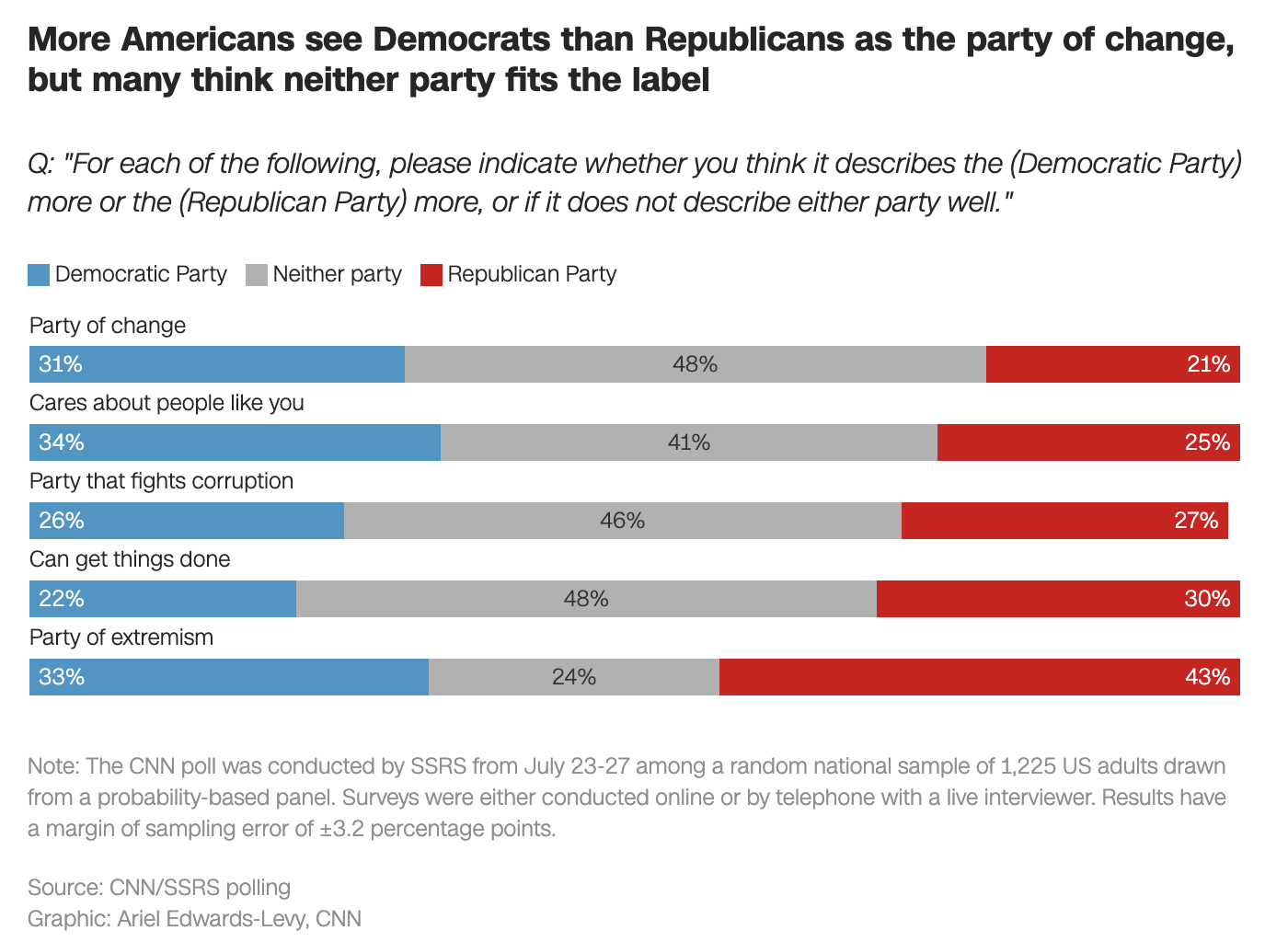
The distrust started in 2016, with the feeling that the party rigged the primary,1 and then really ramped up in 2022/2023…
Voters really did not want Biden to run for re-election.
In JULY 2022 (!!), only 26% of Democratic primary voters wanted Biden to the nominee in 2024; one third of the people who wanted a different nominee because of his age. 94% of Democrats under the age of 30 wanted someone new.
He did so anyway, seemingly with the support of the entire party apparatus — even as he was obviously decaying (sadly) before our eyes. (Putting aside for a moment: As I’ve talked about at length elsewhere, no one is incentivized to tell an older leader to step down, and that conversation is really really hard — and no one but Biden himself could’ve made the call.)
They feel like the party establishment concealed his decline. A June 2025 poll showed that 68% of voters — including 52% of Democrats — believe the administration was dishonest about Biden’s condition. (I’d also add people felt prettttty gaslit by an administration saying “the economy is good, actually!” when they didn’t feel that in their day-to-day lives.)
Then voters didn’t get a say in his replacement.
There isn’t a ton of data on this, but it’s worth noting: Before Biden dropped out, some polling (from Welcome PAC, who had some self-interest in this finding, so take it with a grain of salt) showed that 64% of Democratic Primary voters would have wanted an open convention.
And while people rallied behind her fast, I suspect there’s a broader sentiment that Harris was made the nominee without the voters’ explicit consent or approval. (I understand why that happened - there really was no way to hold a super-fast primary, and she almost certainly would’ve won any convention or primary anyway, but still: Buy-in matters!)
Then congressional Democrats absolutely ate shit against Trump through most of 2025, mistakenly believing that just because he won the popular vote, what he was doing was popular. Quinnipiac shows Dems went from 21% approval in February 2025 to 18% approval in December. Not great!
On top of all that: Ken Martin undermining trust in the DNC doesn’t help with our own party!
Now, I hear the counter-argument, which is that Biden did keep his promises on many things. Sure! Maybe! But if he couldn’t sell it, and people couldn’t feel it (for example: the infrastructure bill that just recently started kicking off construction projects…), then it may have been good policy but it doesn’t actually matter for political purposes.
Again, from this week’s newest CNN poll:
54% say it would be better if the party moved left. 45% say it wouldn’t.
54% say it would be better if the party moved center. 46% say it wouldn’t.
Real clarity on the path forward there, huh.
But tbh, this makes sense to me.
As I’ve said many times before — including on Pod Save America just a few weeks ago: People don’t have ideologies. They have problems; they want solutions, and mostly they want to not think about politics that much.
The left is offering solutions, while the center is offering…hippie-punching, mostly.
And if the argument is around electability, or “well, trust us, we know what wins” — well, most of the last decade proves that wrong.
As Astead Herndon put it: it’s not that the left is rising so much as the “center” is falling. It’s worth reading his newsletter in full — I absolutely agree with this:
This is why I think it matters to read the Democratic Party’s post-2024 convulsion as a story of establishment collapse rather than left-wing ascension. Stevens, Clyburn, and the party’s leadership would prefer to make this a referendum on the left — on the acceptability of its candidates and its media figures. But the base is communicating something else: a lack of confidence in the center, and in a version of establishment politics that prizes seniority and loyalty over voters’ values. …
The center’s other problem is that its core general-election pitch — we may not thrill you, but we’re not Trump — is losing relevance the weaker that Trump looks politically. … When the opposition’s own coalition is cracking, branding yourself up as an inoffensive vessel who can gather up the most anti-Trump voters looks less compelling. The establishment needs an affirmative reason to be chosen — and it hasn’t found one.
People don’t trust our establishment, they don’t trust our party, they want change, and they want things to get better. They want to believe that leaders can make things better!
If you’re selling small nibbles around the edges — even if that’s realistically what might happen if we take power — you’re not speaking to the way voters are feeling, and politics is about feelings even more than it’s about facts.
And/but, there’s a real tension in all this: Most of our candidates who are promising big solutions aren’t going to be able to deliver them — especially those running for Congress, which will not be able to meaningfully govern until Trump’s out of office and we hopefully have a Democratic president.
And if they can’t keep their promises, the trust deficit grows.
This is why centering leaders at the state and local level is fundamental to restoring the party brand.2
In 2021, Mayor Brandon Scott proposed a violence reduction strategy that Baltimore had already tried and failed at twice — once in the ‘90s, once in 2014. He was asking a city that had been let down on this exact promise, twice, to believe him anyway. Baltimore ended 2025 with 133 homicides — down 60% from 2020, substantially outpacing the national decline.
Governor Mikie Sherrill declared a state of emergency on utility costs on day one in New Jersey and told the BPU to get credits onto people’s bills by summer. More than $70 million in credits have landed.
Mayor Zohran Mamdani is mid-promise-keeping: 2,000 free 2-K seats this fall, universality in four years. (And in the meantime, he’s filling potholes and having fun.)
And/but, the ceiling here is real: none of this fixes what a Democratic Congress can’t do until 2029.
Mayors and governors may be able to do a ton on affordable housing, child care, and public safety (among other things), but they cannot deliver a functional federal government. They can’t get us out of wars. They can’t bring about universal health care or solve the immigration crisis or keep Trump’s picks off the Supreme Court.
Pretending otherwise is exactly the overpromising that got us into the trust hole.
What they can deliver is proof that when someone in our party says a thing, the thing happens. You can’t message test trust and you certainly can’t buy it with TV ads.
All you can do is do.
Do the work, sell the work, rinse, repeat. Do it enough, in enough places, and we’ll stop having to ask people to trust us. They’ll see and live the proof.
A few other things I’ve written about the Democratic Party:
When We’re in Charge is my leadership book for millennials and gen Z trying to do things differently. Pick up a copy in any format you’d like — hardcover, e-book, or audio book (narrated by yours truly) anywhere you get books, including Amazon or Bookshop.org or literally anywhere else. If you have Spotify Premium, you can listen to for free right this very minute. It’ll be out in paperback in September.
I do like to flag though: As a Hillary Clinton staffer, if we were going to rig it, do you think that’s how it would’ve gone???
Free idea for a billionaire: Embed high-quality content teams with every Democratic governor and a whole bunch of charismatic mayors — Scott, Michelle Wu in Boston, Justin Bibb in Cleveland, Frank Scott in Little Rock, Phillip Jones in Newport News, etc — and let ‘em cook.
Comments
Nothing yet. Say the first thing.
Sign in to join the conversation.