
A note here: This is just my opinion, not my organization’s. True always, true now.
I really was going to write about something else this week — something non-politics, perhaps the new Claudia Goldin paper.
But then yesterday morning a story came out in the NYT that Third Way, a moderate think tank, is preparing for “war” against DSA.1
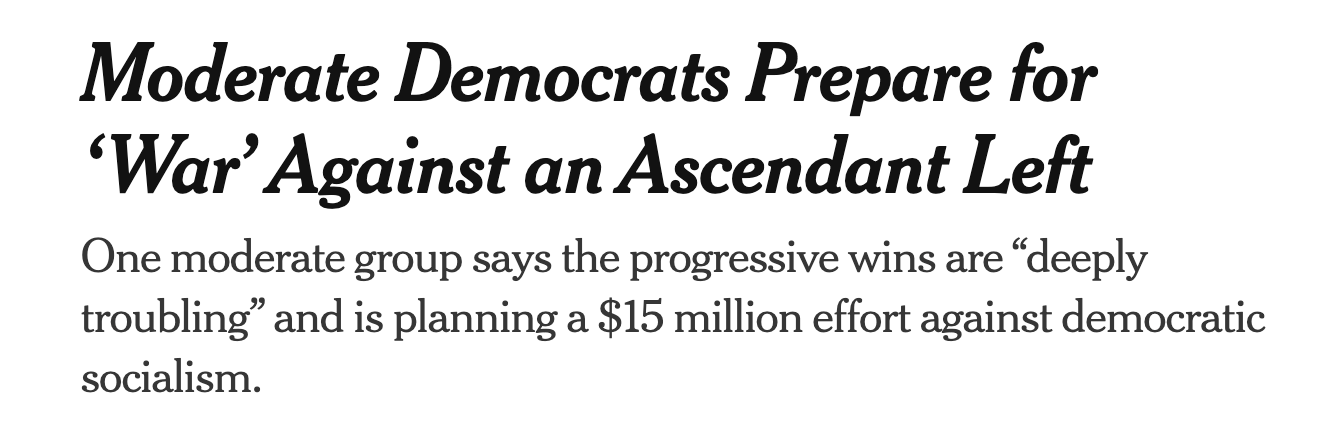
Reporter Shane Goldmacher explains:
Mr. Cowan [the president of Third Way] said the $15 million his group would spend through 2028 was not directed at individual candidates. Instead, the group plans to target the Democratic Socialists of America movement, which he believes poses a “mortal danger” for Democrats.
He said the effort would include opposition research into D.S.A., polling, social media programs and educating Democratic activists and leaders. It would target both proud democratic socialists and those such as Dr. El-Sayed, whom he derided as performing the “D.S.A. dodge” — flirting with democratic socialists enough to get their organizing manpower and support while remaining distant enough to avoid the explicit label …
Centrist Democrats say their purpose is to make progressives understand the risks of some of the more radical planks of the official D.S.A. platform: defunding the “Department of War,” taking “steps toward fully abolishing the police and prison system,” enacting “reparations” and establishing a 32-hour workweek.
This got me so fucking irritated.
For starters, why would you do the GOP’s work for them? They’re already going to demonize socialism — remember how they called Joe Biden a socialist?? — and we don’t need to help them do it.
Second: It’s remarkable how much money is being given to ostensibly Democratic groups explicitly to shit-talk other (popular!) Democrats (especially when so many organizing and infrastructure groups are struggling to raise right now.)2
I seem to recall a number of centrist pundits and organizations making this point about some of the lefty organizations over the years — weird how it doesn’t apply to them! (And not for nothing but I did a video on my fury about this yesterday and the amount of comments of people being like “I thought they put their HQ up for collateral!! where is the money!??!” — misunderstanding that Third Way is not the DNC — tells me that efforts like this are bad for the brand too!)
Beyond that, I wish these people would define their terms. When they say “Democrats” — do they mean party electeds, or donors, or gatekeepers, or pundits? Do they mean random people on the internet? (Usually, yes — either randos or other operatives online who are willing to spar.)
Or do they mean Democrats as in our voters indicating how they feel by literally casting votes in Democratic primaries?
DSA-affiliated or far-left candidates are winning — often against the odds and ungodly amounts of money, like in Michigan earlier this week, when Abdul El-Sayed won despite being outspent 11:1, state Rep. Donavan McKinney beat a sitting Congressman, and a progressive won a competitive primary for a flippable House seat.
And if one is going to define the Democratic Party as OUR VOTERS — as I think we should — then the kinds of candidates who won those elections shape who we are as a party.
Or at the very least, it’s who we’re on track to becoming.
Now, of course the left isn’t winning every time. There are plenty of examples just in the last week of the establishment holding its own, like in Missouri when Wesley Bell beat Cori Bush.
But it’s happening enough and in enough places that the old guard is freaking out; this isn’t the first shot in their war against the DSA.
There are a few arguments Third Way et al. are making that are worth taking step by step. (I’m paraphrasing these here but I see them enough to respond to them…)
This is what happened to the GOP — the Tea Party takeover gave way to the Trump hostile takeover — and we don’t want that happen to us.
Totally. Yes. That was bad for democracy and bad for the American people. But also: After that transformation (which, again, on the whole, bad!), the GOP won the White House twice, basically cemented control of the Supreme Court for a generation, and at various points has controlled one or both chambers of Congress.
Figuring out how to leverage anti-establishment anger in service of long-term power is worth the effort. But that’s not what the center is doing right now…
The DSA harms the broader party brand, and battleground candidates get maligned even if they’re not DSA-affiliated.
The party brand is already in the toilet.
And if a candidate can’t clearly say: “I disagree with my colleague on X Y and Z but I look forward to working together to lower costs and get money out of politics” with their full chest, then they’re not a good candidate to begin with.
Democrats shouldn’t elect people who can’t win the general.
It is true: Being able to win the primary alone is not proof someone can win the general. (The GOP has proven that wrong many times over the years.)
But the inverse is also true. If you cannot win the primary, you absolutely cannot win the general, because you cannot inspire the party’s most active members to show up and vote. (This is why we shouldn’t have super PACs messing around in primaries — candidates should have a mostly independent chance to make their case.)
And the argument of “Vote for me because I’m the most electable” is not particularly compelling when the Democratic establishment/old guard has lost the voters’ trust.
Without an argument on electability — which they have no ground to stand on after Trump won twice3 — they’re coming up empty.
Because if you think the DSA or left candidate is bad, then who is your alternative? Where are the non-DSA or non-”scary” candidates you think Democrats should be electing instead?
In the same way that it is not sufficient to just be “not-Trump,” it’s not enough to just be “not the hippies” either.
Instead of decrying what you are not, I wish they’d make the affirmative case.
Make an argument for why you would be better for the American people. Rally people behind a vision.
Present clear solutions for the housing crisis, the childcare crisis, the trust crisis — tell voters that you’re angry, you understand why they’re angry, and you’re going to do the work together.
Find and support charismatic community-driven leaders who can communicate in a way that meets the moment.4
It would be better if there was a cohort of vibrant, interesting values-aligned center-ish candidates — our democracy would benefit from a rigorous conversation about policy and prioritization (because alas, we’re definitely not getting one from working with the GOP.)
And there are some orgs trying to build this! I hope they succeed, because the more political homes we can create, the better!
But that’s not what this particular initiative is.
This plan is not coming up with proposals to speak to the challenges people are experiencing, or finding ways to channel people’s anger into action.
It’s not organizing, or movement building, or restoring the civic ties and creating a bigger sense of community.
It’s explicitly tearing down the people who annoy them online — because the intra-factional war is generally 99% a social media construct (that I sometimes engage in, sorry!!), 1% a thing that some voters are in the splash-zone on.
Listen, I sort of get the impulse to want to spend millions of dollars shit-talking my trolls.
I get yelled at a decent amount by all sides (much to the entertainment of my husband, who thinks it’s all very silly when I show him my mentions where I’m somehow a neo-liberal shill, a dirtbag leftist commie, and an anti-Semitic slur, all at the same time.)
Alas, I am not a moderate. I’m also not a DSA member!5 But I appreciate how they’ve built a political home for people seeking community and connection. They do the organizing work, even when it’s messy and conflict-heavy.
They are accountable to each other — which raises the question: Who are these center-left and moderate orgs accountable to? Who are their stakeholders? Since they don’t have a membership-based model and don’t serve a clear constituency, I assume it’s the people who give them money. Who’s that? Well, they don’t release their donors — wonder why!
I’m also not a working class voter in Michigan or Texas or anywhere else. I’m a Brooklyn mom in the back half of my 30s; I don’t presume or assume to know what those voters want to hear. That’s why I’m not the one shaping communication with them.
Instead, I’ve spent the last decade building an organization that recruits and supports thousands of people rooted in community across the pro-democracy side of the spectrum, from (yes) DSA-affiliated candidates to former Republicans winning in Trump+40 districts.
My job is not to recruit candidates that reflect my politics; it’s to recruit candidates that understand what their neighbors care about and can speak to them.
And from that, I’ve learned one big rule that holds true across the country:
Candidates need to be able to answer the question of “why should voters want me to win” — and right now, the left are the only ones who are telling a story at the emotional tenor voters want to hear.
To be fair, I don’t think the left always does this perfectly.
Progressive policies might benefit working class people but that doesn’t always correlate to progressive candidates winning working class voters, for any number of reasons that I hope the left is both honest and curious about — there is more work to do here.
And while I know the temptation to be all ~Vote Blue No Matter Who applies to you guys too!!~ to the more center-leaning Democrats, being shitty doesn’t serve the end goal of winning power.
Fight like hell in the primary, unite in the general. (To their credit, Rep. Haley Stevens and Sen. Mallory McMorrow are modeling this incredibly well in Michigan!)
Ultimately my questions about this program and nearly everything else are simple:
Have you chosen the fight you need to win? Or are you choosing the fight that satisfies your ego?
I regret to say, this is not my first time engaging in the intra-factional debate. (My self-loathing about this participation is deep and vast — but also, I cannot help myself.) Read my last essay on this:
When We’re in Charge is my leadership book for millennials and gen Z trying to do things differently. Pick up a copy in any format you’d like — hardcover, e-book, or audio book (narrated by yours truly) anywhere you get books, including Amazon or Bookshop.org or literally anywhere else. If you have Spotify Premium, you can listen to it for free right this very minute. It’ll be out in paperback in September.
This is not about me, but: $15 million would fund my org for nearly 2 years.
I also hear their argument that AOC/Sanders-aligned groups haven’t flipped any House seats. That’s true! We’ll see what happens this year. I am curious: When moderate candidates lose flippable races, which they do all the time, do we blame their ideology? Were they too far to the center?
Easier said than done, trust me.
I agree with many of their policy positions (including the 32-hour work week, which lol, the only people against that are CEOs who hate their families) — but tbh, the cool-kids-club vibes are off for me, and some of the stuff is too radical. But I have voted for DSA candidates before and almost certainly will again if they speak to the issues I care about!
Comments
Nothing yet. Say the first thing.
Sign in to join the conversation.