
Welcome to week THREE! What a triumph! This week is all about finding our flow. For me, this means enjoying the process so much that you happily lose track of time. I most frequently feel this sensation when painting, but it happens on boats, in the woods, and while skiing as well. Sometimes it happens when I am dreaming up a new creative idea, like this 28-day challenge. So let’s allow our ideas and imaginations to flow this week, and turn our attention outward to the world we observe and imagine.
As always, take what you like, do as much or as little as possible, and be gentle with yourself. For a bit more context, consider checking out this post or this video. You are receiving this because you subscribed to my Substack. For this month, I’ll be delivering daily writing and art prompts in a weekly guide.
Lepidoptera — Monday (day 15 of 28)
Meditation: Butterflies and moths hold a special place in human imaginations and our ecosystem as a planet. In Ancient Greek, the word for butterfly is “psyche,” which translates to “soul”. The goddess “Psyche” (goddess of the soul) is often depicted with butterfly wings, and Roman sarcophagi often depicted butterflies escaping the cocoon as the soul departing the physical body. The return of Monarch butterflies around the Day of the Dead in Mexico was viewed by the Aztecs and Mixtecs as the returning souls of ancestors. In Japan, butterflies were often used as family crests by samurai to represent elegance and spiritual rebirth.
Writing: Think about moths and butterflies in your life. Is there a story of the appearance of such a creature in an interesting moment? As if an ancestor was coming to say hello? Alternatively, you can reflect on your experience of rebirth. Are you in a caterpillar stage now? Or do you feel your wings breaking out of the cocoon? Write about any of this for 10 minutes.
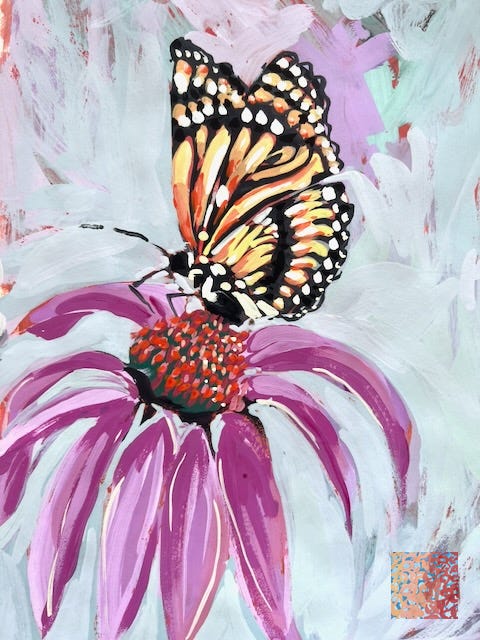
Art: Google Lepidoptera, and pick a butterfly or moth, or a collection of both, and draw/paint or collage them into your notebook. Think of yourself as creating a Victorian-style collection of shape and pattern. As always, messy is welcome, encouraged, even. Don’t overthink it, unless you are having fun!
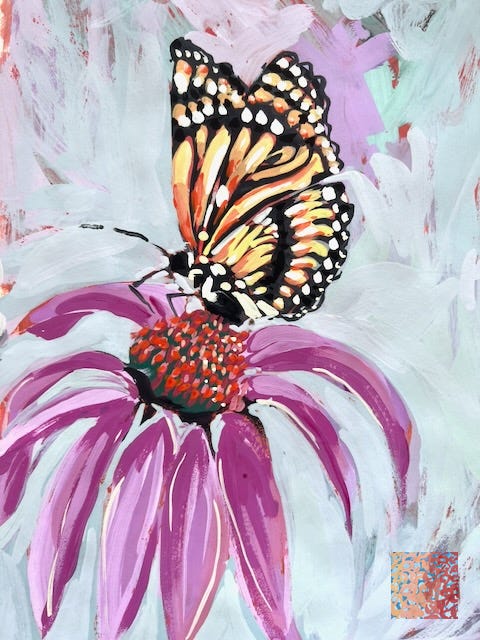
Gouache in my art journal 2025.
Botanical — Tuesday (day 16 of 28)
Meditation: So much of our world is shaped by botanical inspiration. For today, let’s slow down and really observe some botanical specimens in your environment. It could be a houseplant or a garden weed. If you are feeling the need to be exact, spend some time with John Muir Laws and his remarkable guidance on botanical illustration.
Writing: Take a few moments to think about botanical specimens in your life. Pick one and describe it — look for patterns and coloration, relative sizing, and the shape of its leaves or flowers. Determine if there is a larger symbolic meaning with a quick Google search, or note what personal meanings the plant might hold, for example, a flower from your wedding bouquet or the invasive bittersweet that plagues your garden today. Explore it.
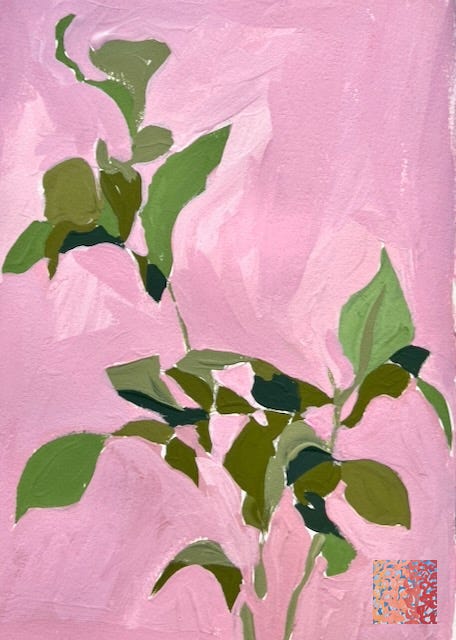
Art: Create a drawing or painting of the specimen you have been observing or remembering. Treat it either like a field book study, with dimensions, descriptive notes, and color notes, cross sections, and diagrams; or just draw it with abandon. You decide!
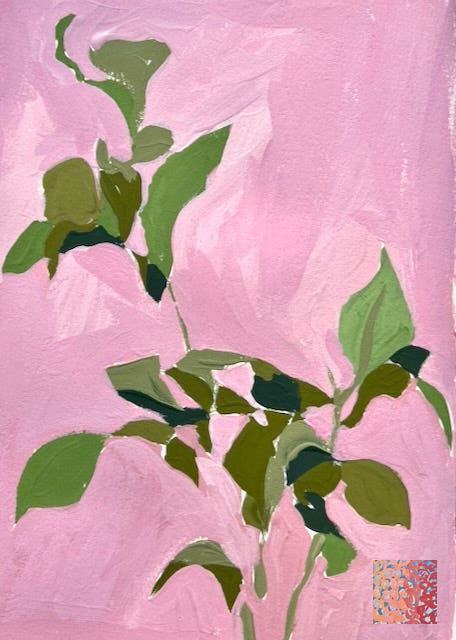
Gouache in my art journal 2023.
Landscape — Wednesday (day 17 of 28)
Meditation: My father left behind thousands of slides from a lifetime as a photography enthusiast. Many are landscape images that he captured during trips or workshops. Some are out the back window of our house, or from the side of the road. I have been working my way through the slides, scanning them so I can see them better — the slide projector, sadly, long broken. There is something wonderful about seeing the world through his eyes. My father didn’t leave journals behind, as my mother and grandmother did, but I feel lucky to have this visual record of what he experienced throughout his lifetime.
Writing: If you had a slide collection from your own life, what would it include? What would you document the most? What would it say about your curiosity and priorities? Write about the landscapes of your mind.
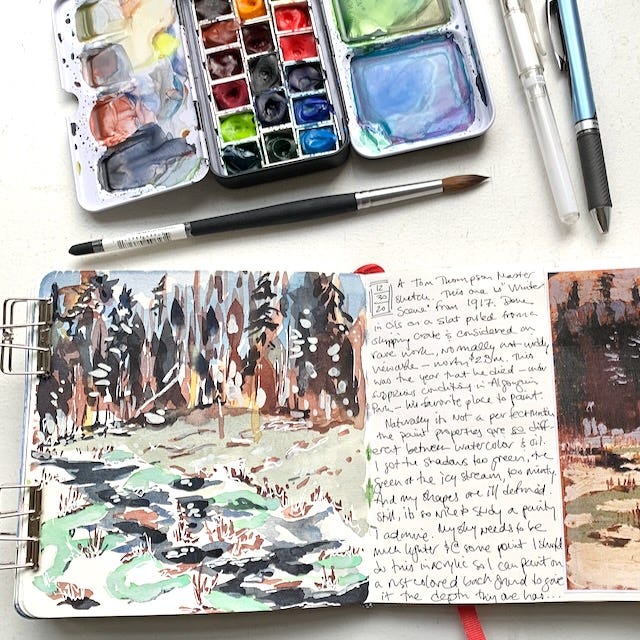
Art: Draw a simple landscape of some place you treasure - perhaps the view from a beach you enjoy, or a nearby cityscape.
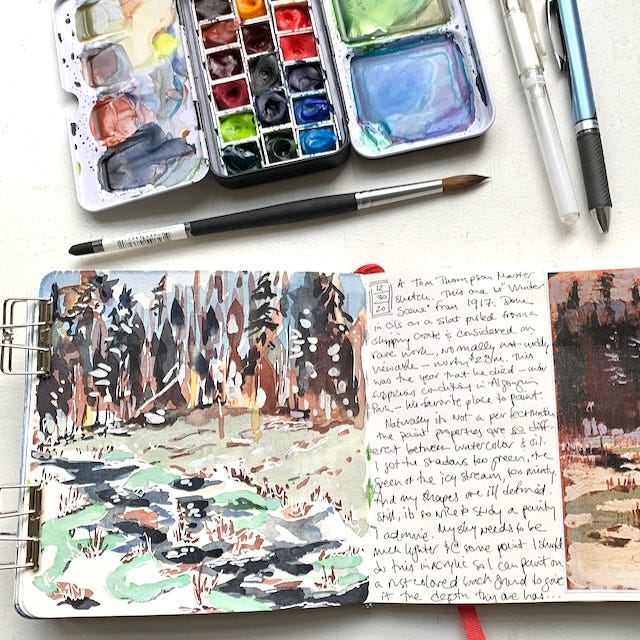
Studying Tom Thompson landscapes in my journal, 2020.
Animal — Thursday (day 18 of 28)
Meditation: Studying a creature for an afternoon, or even a few minutes, can give us the ability to step out of our regular day-to-day human rhythms and understand a more primal existence. Our pets don’t worry about productivity or their legacy. They live! Watching a dog curl up in front of a door, or give chase to a tennis ball, is to observe the purest form of joy.
Writing: Write about what you are observing. Is it a bird out your back window, or a pigeon on the street? A beloved pet? A young kitten or an old dog? How do they move through space, and how does their presence change the feeling of the area surrounding them?
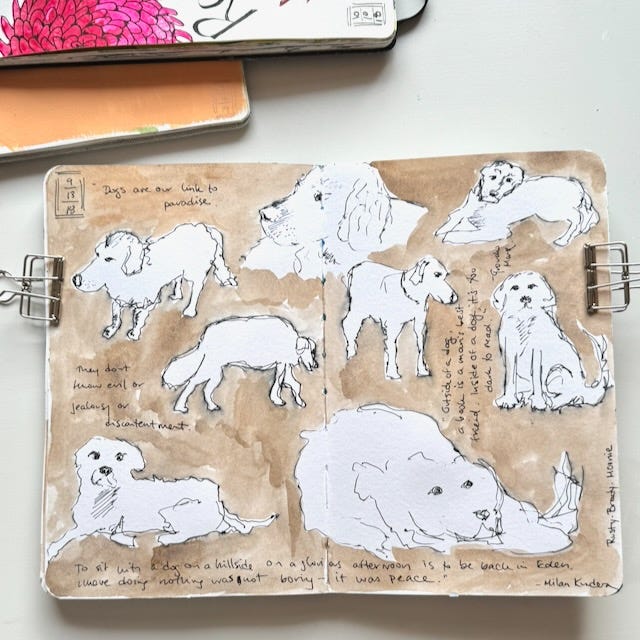
Art: Capture what you are observing — animals move a lot, so a collection of brief sketches may be more descriptive than a more measured traditional portrait. Gesture, pattern, shape, detail. Add a name if there is one, and any additional notes.
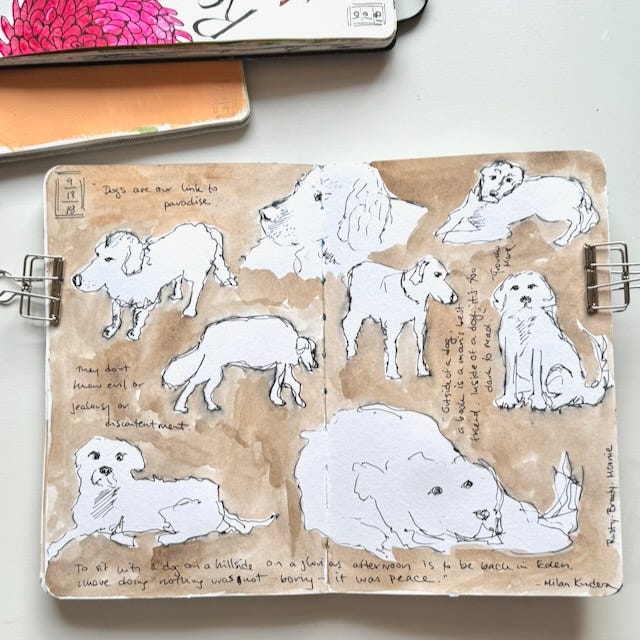
Dogs, 2019.
Abstract — Friday (day 19 of 28)
Meditation: Let’s think about Matisse’s cutouts in his illustrated book Jazz, which was originally about the circus. This endeavor was famously the result of an illness that left him unable to paint standing up; thus was born: “painting with scissors”. In addition to the remarkable abstract work that he created in that book and beyond with this methodology, he demonstrated astonishing personal resilience.
Writing: Where have you demonstrated resilience in your life? Or who have you watched come back from discouraging odds? What drove that tenacity for change? What have you learned from that experience or observation?
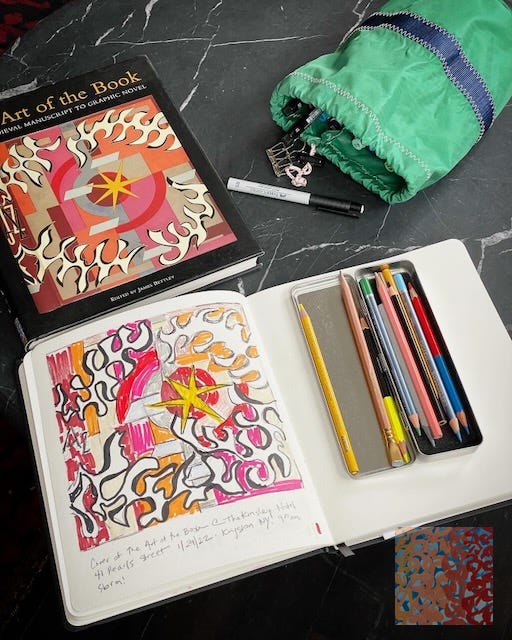
Art: To honor Matisse and his memory, grab some collage papers (magazines, recycling, etc., will do great if you don’t have any) and let’s paint with scissors. Take a look at this link to the Metropolitan Museum’s information about Le Cirque and create a collection of organic shapes that tell a sort of story. Try not to get too detailed in your collage work. Try to keep it to 5-6 main shapes to fill your page.
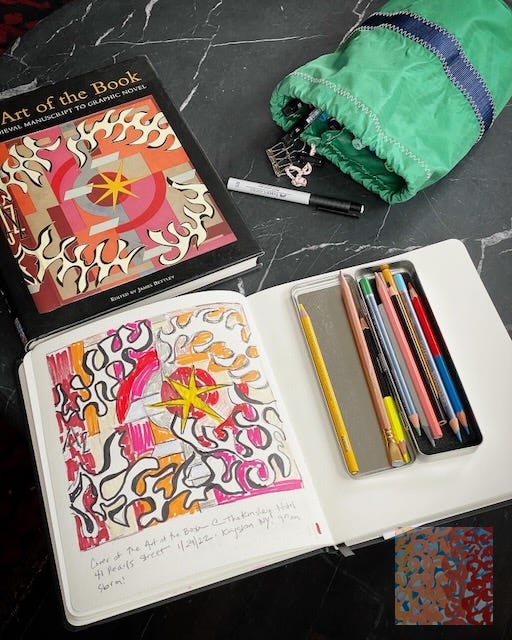
Finding abstracts in interesting places, 2022.
Pattern — Saturday (day 20 of 28)
Meditation: Some have argued that one of humanity’s defining characteristics is the ability to create and recognize patterns. Through pattern recognition, we observe sounds, behaviors, and ideas in our environment and make sense of them in ways that drive language, culture, and survival. Pattern manifests itself in virtually every aspect of our lives: texture, food, nature, music, and much more. Pattern has a particularly robust presence in art through the ages — whether part of a larger whole (see Tudor portraits) or a language all its own (Alma Thomas).
Writing: What patterns have you observed in your own life? Or in the generations of your family? Patterns can be positive and destructive— are there patterns you would like to double down on? Or break? Pick a pattern and explore it for 10 minutes.
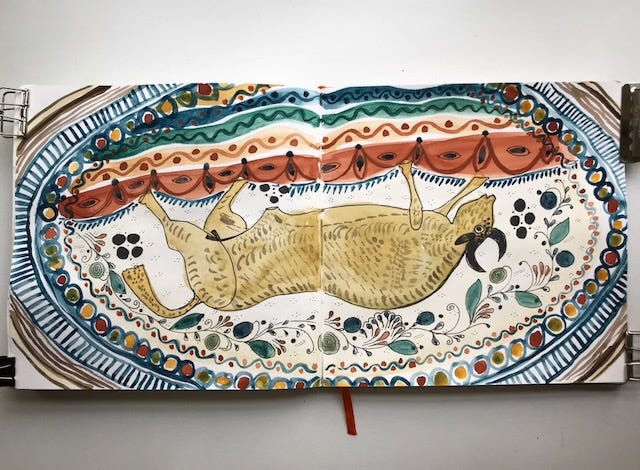
Art: Let’s think about surface pattern design. Find a quilt, ceramic dish, or rug that you love. Bout points if it has historical significance to you. Perhaps it is a piece of pottery from a grandparent. Replicate the pattern in a messy way—either draw the entire vessel or just depict the pattern. If none of these appeal: create an entirely new pattern. Use a variety of repeating marks, brush strokes, and colors of your choosing. Fill the page.
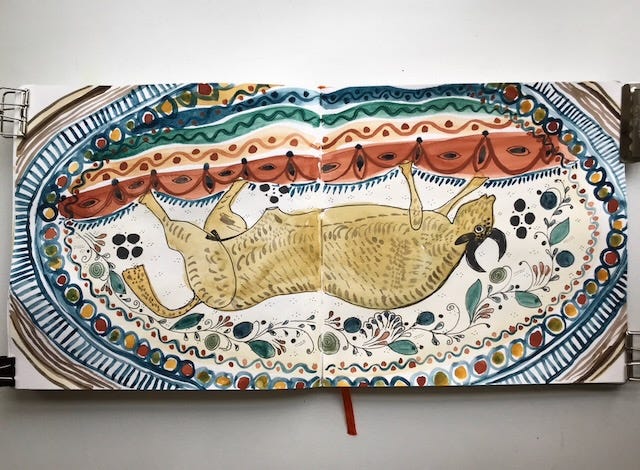
Mexican ceramic patterns, from a platter my grandparents brought home from their honeymoon, sketch from 2017.
Hope — Sunday (day 21 of 28)
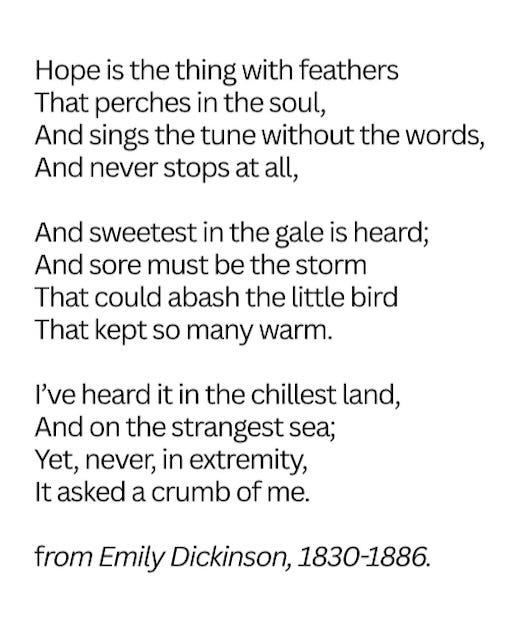
Meditation: Emily Dickinson is one of my favorite poets. She has a simplicity to her work that I find elegant. Amazing to me that these words, written nearly 130 years ago, can still resonate today. Poetry can drive so much inspiration — I especially love it when a poem or a piece of music inspires an artist, and vice versa. Several visual artists have developed a series of works based on major literary or musical masterpieces, such as Moby Dick or Death & the Maiden. Sometimes when I feel stuck, I like to look for inspiration from other fields. So, for now, let’s consider: Hope is the Thing with Feathers by Emily Dickinson, 1830-1886.
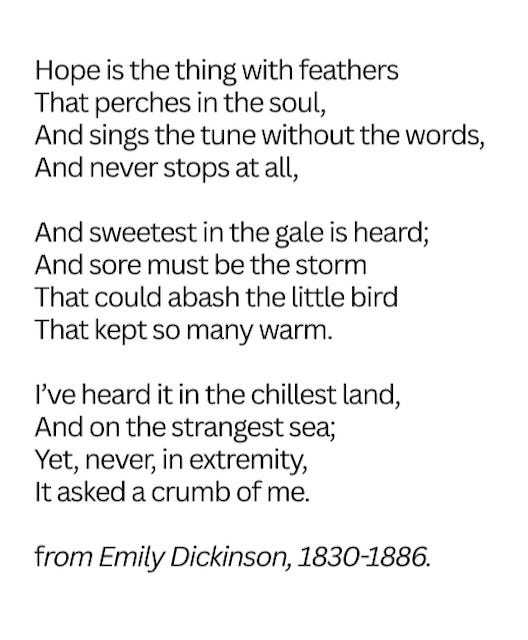
Writing: Consider the poem and think about how it relates to your life. Write about it for a time.
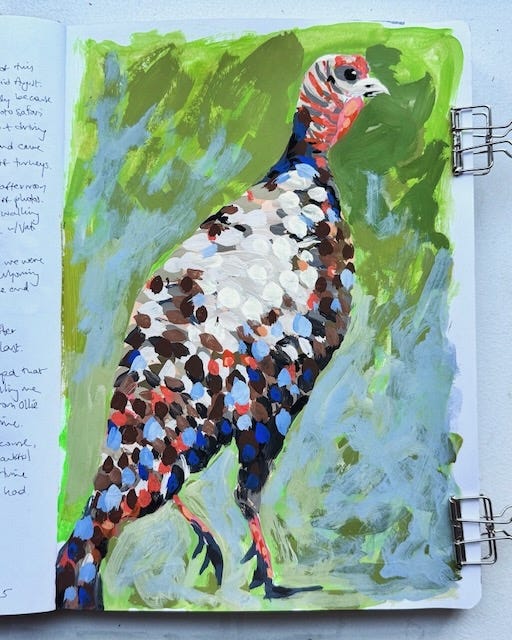
Art: Draw or paint a bird in a way that feels right to you right now. A pencil sketch will do just fine, or a more complete marker study. If there's another symbol you’d prefer for hope, please, by all means, use that!
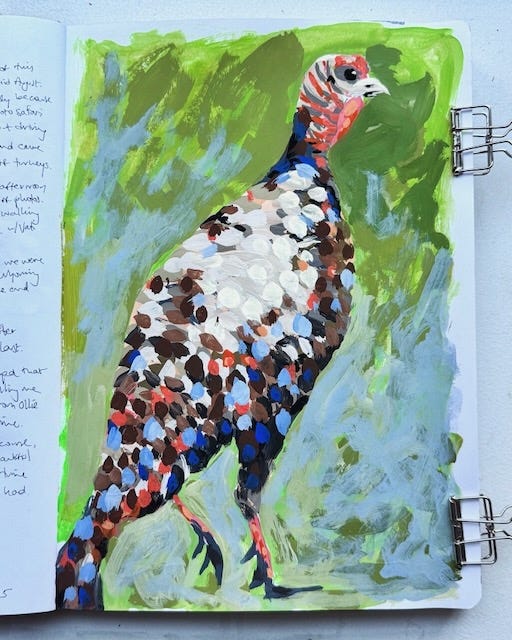
Turkey with patterning in gouache, 2024.
Wowza! By the time you get to this paragraph, we’ve completed week three! I hope that you are getting something wonderful out of this process and filling your notebook with words and sketches. As always, please reach out with any questions. I’m looking forward to our livestream tomorrow!
And if you are enjoying this reset, consider sharing it with a friend? It’s really fun to do these activities with people we love!
Thanks all—and have a wonderful week!
Amanda
Comments
Nothing yet. Say the first thing.
Sign in to join the conversation.