
Every time I try to write about my childhood, it’s like a room full of voices arguing in my head-
“You’ll be exposed.”
“It’s not your story to tell.”
“You’ll only be exposed to the truth that all of it will amount to nothing, and it happened for no reason other than to make you miserable—maybe because you deserve it.”
Or just:
“fuck it.”
.
And then I end up writing more than I’m willing to share.
But before I share anything personal about me, I have to let it sit and marinate in my presence for a little bit before I’m comfortable showing others.
I’ve always been that way, even before I was allowed to do that.
It’s a way that keeps me safe—
my thoughts and feelings, and clarity on what happened.
It gives me some sense of control over the narrative, the story, that is my life.
Because for a moment if this poem, this story, this art piece is only known to exist by me,
then it has to be mine.
There’s a sort of special sanctuary in sharing space with art you haven’t shared with anyone.
The way a piece looks back with the eyes you’ve drawn yourself,
the way your own words wrap around you,
knowing and hearing your pain before anyone else does.
Sometimes, I don’t want to let that feeling go.
I let it sit and rot in my old journals,
every new chapter of my life brings me to go back and look at it.
Think about the different versions of me that come back to this same hug.
The person I had to be to survive, and the person I’ve become despite.
When I make art, the inner child in me takes over.
She takes the wheel, giggling as she makes donuts around a parking lot
and then drives to her favorite art stores after getting her favorite sandwich.
I watch her from the backseat,
holding on for dear life as she tries to veer onto a highway,
but smiling as she rolls down the windows and sticks an arm out while blasting ABBA.
She knows how to have fun, how to make people smile,
regardless of who they are and what they mean to her.
And yet,
she always showed me–my older self–more love than she ever gave herself.
And sometimes I catch her falling back into that same pattern
of believing that everyone deserves to mirror back her vibrant, dimpled smile,
but she wasn’t allowed to feel the joy that was behind those eyes.
She didn’t believe she deserved it.
And even when she did, she felt guilty,
and would pass the feeling over to a loved one with extended arms.
Even to this day, I have to remind her
that she’s allowed to feel as happy as she always looked.
She’s allowed to make herself smile doing the things she loves,
even if it doesn’t benefit someone else.
She’s allowed to tell her story of how she was hurt,
even if it isn’t convenient for the person who hurt her.
She’s allowed to not be quiet,
and tell her truth,
even if every bone in her body is screaming that she must’ve done something to deserve it—
because “everything happens for a reason,” right?
So I let my work marinate.
Sometimes a night, a day, a week,
before I post, or simply share with a friend.
And before I had the courage to share at all, it was with my therapist—
and that wasn’t until I was 17.
When my work sits with me, I sit with it—every version of me.
I bring the art piece in as a guest,
having them say hi to everyone
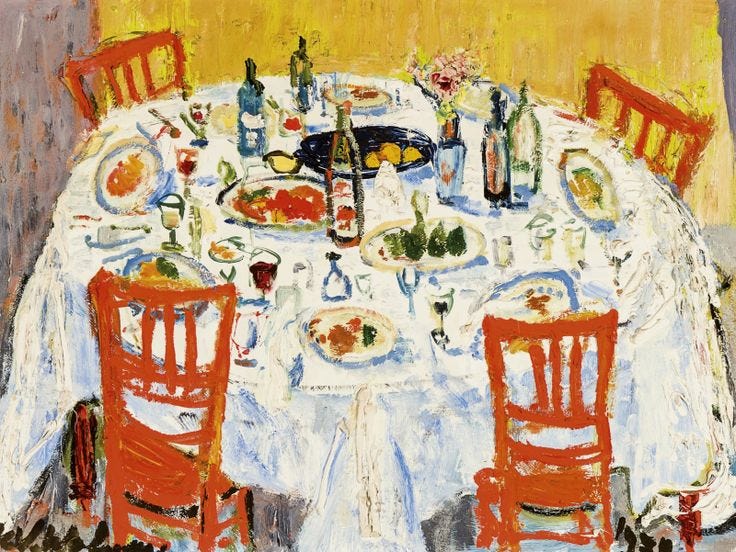
before sitting at the table holding every phase and year of me.
They all talk, breaking bread with those close to them—
one being loud and rude to another at the other side of the table,
one sitting there eating in silence as she dissociates,
and another frozen in fear.
On the other side, the mood shifts.
Anger, desperation, and hopelessness crowd the weary, tired eyes of the girls.
It’s only gotten worse since the other side,
and they certainly don’t see any way out other than to flip the table altogether.
You can see them debating it after each bite,
zoning out to parts of carved wood in which their nails have dug in,
writing secret messages to my true self, wherever she was,
in the indent of the wood table
as they listened to the other side drone on and on about the bible and purpose.
I sit at that table with every side piece I bring in,
seeing them greet them all joyfully and the same,
before going to their seats and sitting all differently,
their faces returning to the state that revealed what was beneath that smile.
My art whispers to me as we start eating,
“You all seem so kind and nice, none of them seem unhappy! Are you sure I’m a reflection of them?”
I lean back and whisper,
“Yes, you are. Look closer.”
I subtly point at the preteen across from me as she chats happily about her day.
“She’s been picking at her food since we sat down, and she won’t take a single bite.
She’s barely hanging onto the idea of existing.”
Art’s eyes widen.
“Look at her,” I murmur, pointing to a girl around 10 years old.
“She genuinely believes that her root, true nature, is evil. That’s what she was taught.
Everything she knows about herself was told to her.
She’s terrified of the world, her parents, and herself.
This is when her medical issues start—
which she also thinks is punishment of her being evil, somehow.”
Art whispers back,
“Who told her that was true?”
“My parents, the church,” I swallow.
“And me.”
I point to a young girl with clunky glasses and her long blonde hair tied up in a tight ponytail.
“She just started showing very chronic medical issues,
and her parents tell her it’s all in her head
because they believe she’s lying about being in pain.
They do this for every issue of hers,
and she doesn’t know why no one takes her seriously.”
“Well, is she lying?” Art asks.
“Of course not—she learned that even when she was begging, crying from pain,
they still wouldn’t take her seriously.
They’d say she’s dramatic no matter how bad pain she was in,
even if she didn’t show it and simply said that it hurt.”
“Damn…”
“Right?” I shake my head in angry disbelief.
“The older ones over here,” I wave my hand to the other side of the table,
“are the most different from each other.
Even just a year apart, one has changed almost completely from the other—
only a few base similarities between the two.
No matter the version, she still remained kind,
and she still cared deeply for those she loved.
However, a new person came into view of who she loved—”
“Who?”
“Me.” I grin.
I stand up, my art with me, and we say our thanks and goodbyes,
only the second half of the table acknowledging our leaving.
The oldest comes and hugs me, then shakes the hand of Art,
in awe of the power and the strength illuminating from her face.
She turns to me-
“I don’t know how you’re doing it—
I would be so scared if you came into my life during my time!
Tell me–what will you do when others see you? People you know and don’t know?”
“I’m beginning to not care what they think.
I believe what I put out there is for a reason,
and I will be led to the people who need to hear it,
just like I have done with other pieces of art and stories shared similar to mine.”
“But, you’ll be seen! Aren’t you terrified?”
“I realized that the people I’m afraid most of being seen by are those at the table,”
I nod to the many versions of me,
some eating, some pretending to.
“What, them?” The oldest version, just a year younger than me, scoffs.
“They don’t know anything. They barely even know themselves!”
“Exactly—
they are reacting exactly as they’ve been taught—
they don’t know themselves because they’re not being their true selves.
They are their surroundings, their current support system.
They’re not able to be their truth at that time.
That’s why I bring my art pieces to y’all,
breaking bread and acknowledging the presence of all together,
hearing the internal thoughts of every version
as they look at what I’ve brought to the table,
and pitch the idea of sharing it with the world.
There, I am given the most hate.
There, I am supported the most.
There, I am seen, heard, neglected, spat on, and loved in awe.
I’m afraid of seeing them in other people—
the versions that hate the current me the most—
and I’ll believe what they have to say.
So when I bring my Art to y’all,
it’s a test,
a dip into the pool of judgement,
that’ll ease me into feeling comfortable with doing what I feel my purpose is to do.
I let my gut guide me into the waters
as my body tenses to the cold and warm liquid,
my toes frozen and my torso hot,
my hands paddling cautiously as I prepare for whatever temperature comes my way.
With lots of practice, I’ve found my way to be able to swim no matter the temperature,
and to let my gut lead me out of the pool if it all becomes too much.
So yes—the outside world, the whole range of emotions that can come from me making my voice known
is already dwelling within me,
all having their own seat at the table.
They’re all that matter,
and the smiles and hugs that my Art goes and gives another girl at her own table.”
I look at art, who’s standing beside me, listening in silence while stroking my clenched hand.
I continue, looking back into the eyes of myself a year ago, hanging onto every word I say with bated breath.
“We all have our own tables—
I just draw on mine.
And I choose to show up and face them,
because when I do I can face anything,
even my deepest fear–
of being seen.”
.
And maybe that’s all art really is- all that can be reflected in a meal shared with every version of me who’s made it this far.
Thank you for reading my notes app rant. I started it out with the intention of writing about my childhood-rather just cptsd or crohns, and this came out instead. Just sort of easing myself into the waters with each post ig–i appreciate y’all sm ❤️
No posts
Comments
Nothing yet. Say the first thing.
Sign in to join the conversation.