
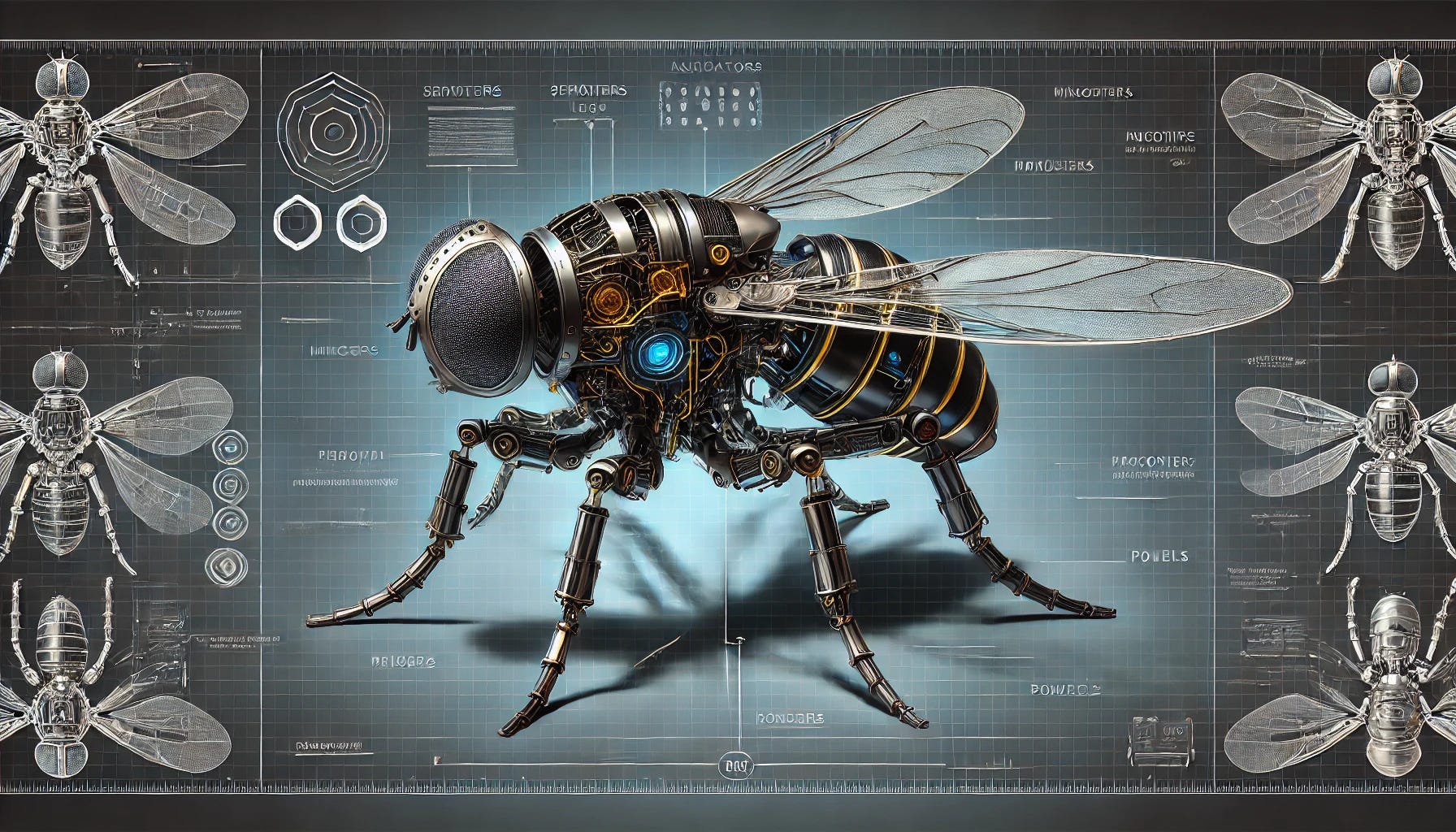
I could describe this book maybe as “Dystopian Fiction with a Happy Ending”
Flybot is a book by Dennis E. Taylor. In terms of writing, Dennis Taylor has done an excellent job with the Bob series over the last half-decade. Great books that make for light, dumb fun science fiction1. Flybot is Dennis Taylor's first delve into near-future science fiction. Even more accurately, science fiction attempts to address directly questions and social issues present in our societies today.
I respect your time as a reader by not using AI to write these articles. I would request that you respect my time as a writer by considering a $6 subscription. I appreciate every one of my paid subscribers willing to keep these publications happening.
Flybot is a book that addresses the specific issue of Artificial Intelligence, how our societies can control it, and what happens when an Artificial General Intelligence actually gets loose. The book centers around a physicist named Philip Moray working on asteroid resource extraction. Philip Moray is Dennis Taylor’s standard character archetype, a brilliant and often misunderstood introvert who just wants to be left alone to do his work in peace. If you’ve read any of Dennis Taylor’s other books, they all have basically the same lead character.
One afternoon, a fly is swatted while buzzing around the physics lab, and it lands with an uncharacteristic thud. A noise that flies aren’t supposed to make, and which kicks off the events of the book. Further inspections prove it to be an unbelievably complicated little device with an implanted AI chip that no one has ever seen before. One of his colleagues, Ceclia Hunt, a biologist, decides to play detective and attempt to investigate the bot’s origin herself.
In the near future, AI technology is tightly controlled by an international regulatory organization that has broad legal powers bordering on totalitarian: ATLAS. With the legal ability to tap phone records, expunge data, seize traffic logs, and apparently press-gang random police officers when the need arises. ATLAS is sufficiently powerful that even the scientists have second thoughts about reporting the flybot on the basis that their entire lab might be closed down.
What starts as a wild goose chase by some scientists through the city quickly escalates and brings in a reasonably large cast of characters. The research company that Ceclia and Philip work for gets bought out by a management company that presses them ahead on asteroid resource extraction. The local PD starts to find bodies that show up having been mummified by some new toxin that can force the water out of a human body in only a couple of minutes. A group of environmentalist radicals seems to have gotten their hands on advanced technology that they’re using to make biological weapons to attack various CEOs, sporting events, and infrastructure projects. A rogue hacker goes missing, dies, and then his body goes missing again.
At the center of all this is the question of a new generation of Artificial General Intelligence that, instead of requiring an entire data center to operate, can do so from within a briefcase. “Maybe we’ve finally reached that point, the point at which it is no longer possible to regulate because it’s simply gotten too small and too efficient.”
Fundamentally, the story is about the authorities who do seek to regulate such things, but straying away from that, it’s also about the tools employed to do so. The city is dominated by the “Traxi” system: automated electric vehicles that travel autonomously, and are called by using an app on one’s phone. Driverless vehicles are illegal in cities due to the risks they pose. Surveillance cameras are everywhere managed by a city’s Artificial Specific Intelligence (SPI) system.
People’s homes are smart homes that will autonomously record and optimize everyone’s lives for them. Most people that characters meet are communicated with digitally, and surveilled when they do so. People wear glasses or contact lenses that provide a HUD and can record encounters. Police can have the layout of a room uploaded into their HUD before kicking in a door.
A great deal of personal interaction occurs via digital augmented-reality devices. Some of the key characters are rare, if ever physically present. Existing only as digital images of someone in a distant office. The climax of the book takes place with most of the named lead characters in one room while guiding a team hundreds of miles away.
At one time, when any of these surveillance tracking systems are turned off, is when the police use a jammer to shut down all digital communications over a couple of apartments during a raid to prevent information from getting out.
Flybot is written from the perspective of the “good” guys. A couple of high-flying scientists working for a prestigious R+D company. A few well-meaning, if sometimes beligerant police officers. The ATLAS agents, whose goal is tracking down a rogue AGI that may or may not be poised to cause an extinction-level event. In the book, all of the surveillance tools are required to track down a dangerous group of environmental terrorists (a good safe bet from Dennis Taylor, as no one likes the modern Environmental terror-groups like Extinction Rebellion here in 2026).
At the same time, one is left to wonder what it’s like for everyday people. Those who aren’t high-flying scientists with a PhD, and those who aren’t police officers. The only people shown to be “safe” in the criminal underworld are forced through great pains to conceal or even fully erase their digital footprints. For that reason, while the book is fun, I think that it needs to be paired with a couple of other media that observe the social effects of centralized-automated control.
Return from the Stars by Stanislav Lem asks if we are even still human when we remove the capacity for rebellion, violence, or destruction. In Return from the Stars, cities are mostly automated, and a medical procedure was found that can make humans incapable of violence. A team of astronauts returns home to find Earth and Human culture fundamentally changed, with the fire having been bred out of the human population.
[Book Review] Return from the Stars
·
June 28, 2024
![[Book Review] Return from the Stars](https://substackcdn.com/image/fetch/$s_!pGGE!,w_280,h_280,c_fill,f_auto,q_auto:good,fl_progressive:steep,g_auto/https%3A%2F%2Fbucketeer-e05bbc84-baa3-437e-9518-adb32be77984.s3.amazonaws.com%2Fpublic%2Fimages%2F51e04ae5-bb48-4072-80ed-8a6a65015036_336x500.jpeg)
Stanislaw Lem wrote the book “Return from the Stars” in 1967 and it was translated into English in 1980. Return from the Stars is one of the most honest philosophical examinations of neoliberalism ever put to page by a classical science fiction author. In the current era, this book is one of the most topical pieces of science fiction and social commenta…
Psycho-Pass is a 2013 Anime that does much the same thing. A centralized artificial system runs people’s lives for them, and liquidates those who don’t fit. In the anime, the system decides what your job will be, who you should date, and schedules most of your life. People like it that way because nine times out of ten, the system does know best, and it’s a lot easier to let it decide than take on the responsibility of deciding for yourself. Even enforcer’s weapons won’t work unless the system determines that a target’s rating is low enough in it’s all seeing eyes.

Sure, universal surveillance, SPI autonomous governance, and overreaching government powers look like a good thing when the good guys have them. However, I would very much appreciate seeing what dystopian totalitarian governments like the United Kingdom, China, or Iran are doing with powers like that. How much human can you take out of human civilization before society devolves into nothing but good little consumers being piloted and optimized by their own personal SPIs?
Flybot may speak to a broader change in the societies we’re living in. Not the appearance surveillance or central control or reliance on highly functional just-in-time infrastructure. We’ve had all of those for a while. Flybot instead treats it differently from other books, not as the premis of a story, but as background noise.
It’s worrisome that these type of urban hyper-surveiled but ostensibly “free” environments are now something that we in the West seem to be getting used to. It’s simply a fact of life that an AI will probably be asked review everything you’ve ever said at some point; our forefathers would probably thought of it differently.
The book is written almost to say “this is normal” or even “this is inevitable,” in a way that many of are unwilling to accept. Especially after the attempts at vaccine passports and totalitarian lockdowns only a few years ago.
I recommend the Flybot. If for no other reason than to balance out some of the more dystopian, depressive aspects of modernity. Dennis Taylor does a pretty good job imagining how an Artificial Super Intelligence might think and function, along with all the little nooks and crannies it could get into in a world where most of human interaction exists solely in the digital no-space. There’s a point at which one questions whether the people they’re talking to are real or representations.
I also recommend it for not falling victim to most AI-tropes in science fiction. Taylor has a good understanding of how AI functions, and is well aware that it’s as contained to hardware as any other complex system. AI cannot escape into the internet, they’re bound to static data centers as its substrates. Likewise, would it be interested in cooperating with us, eliminating us as a potential threat, or decide that the easiest option is to try to escape the reach of civilization entirely? Unpredictable monkeys that we are, we can’t simply choose to ignore humanity.
The book asks interesting questions about AI. Could an Artificial Superintelligence effectively predict our thoughts and actions in a mutually hostile game of whack-a-mole? What does our civilization look like from the outside, looking in?
Important questions to ask should such an artificial intelligence ever get loose in the wild.
I’m still hoping that AI development runs into a wall soon, but the longer it doesn’t run into a wall, the more nervous I get about what government and bad actors are going to use it for.
[Book Review]: We Are Legion, We Are Bob
·
December 24, 2024
![[Book Review]: We Are Legion, We Are Bob](https://substackcdn.com/image/fetch/$s_!BHDS!,w_280,h_280,c_fill,f_auto,q_auto:good,fl_progressive:steep,g_auto/https%3A%2F%2Fsubstack-post-media.s3.amazonaws.com%2Fpublic%2Fimages%2F2f270710-989d-41ce-ac7e-c8bf648d704e_687x346.png)
We Are Legion (We Are Bob) is a book by Dennis E. Taylor. Light science fiction for those who enjoy that type of thing. It’s the first book of what is now a 5 book series. While the series itself is best described as dumb fun science fiction. One could also make the argument that it is the conceited power fantasy of an ignoble author. Dennis Taylor wrot…
Comments
Nothing yet. Say the first thing.
Sign in to join the conversation.