
Many years ago, I engaged with a series called “The Mythology of the American West,” where I was presented with an interesting analysis: the divergence between the words “Lonely” and “Lonesome.” According to the discussion, “Lonely” holds a decidedly negative connotation. Lonely means that a person feels cut off, separated from others, and socially isolated. “Lonesome,” on the other hand, holds a decidedly positive connotation. It means cutting oneself off, being separated from others, and being comfortably isolated.
Very few languages or cultures on earth have a word that is equivalent to the word “Lonesome” in the dialect of the American frontier.
I figure that if there’s ever a good time to discuss this topic, the 250th anniversary of American Independence is one of the best! If you’re a racist-nationalist-homophobic-transphobic-islamophobic-right-wing-fascist-white-supremacist do me a favor and SLAM that subscribe button. I respect your time by not using AI to write these articles. Consider respecting mine by purchasing a $6 monthly subscription. It costs less than a cup of coffee a month. Cheers!
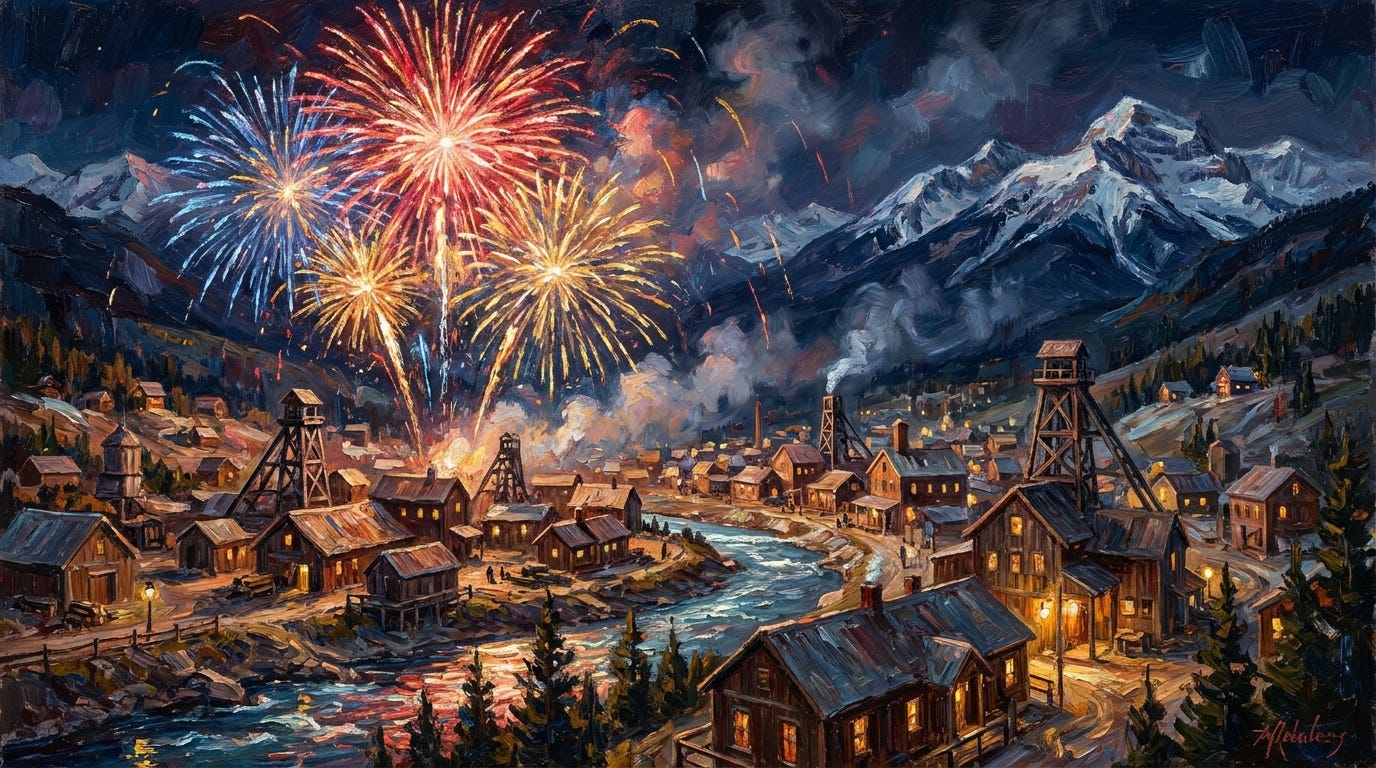
I have traveled wide swaths of the planet, and I can state that very few places on earth express a quiet like that of the American West. That’s not to say shitholes like California, occupied by endless hordes of thirdies, but the true American West of the Great Plains and the Rocky Mountains.
With language evolving at the breakneck pace at which it is, my two favorite slurs I have discovered online are “Thirdies” and “Nons”. These words have great potential. Keep up the good work, you humble meme farmers.
Across the many places I have traveled, very few are quiet in the way that the old American frontier is. So much so that it’s often a stark contrast for visitors. For those who have not visited such a place, imagine a place so quiet that you can hear the wind rustling through the trees several miles away on the next ridge line. Or where a single motorcycle or four-wheeler can be heard five or six miles away, and it’s the only loud machine in that radius.
Even in the South or in Japan or across much of the world, isolating oneself from other people isn’t enough. Cicadas can be deafening. The constant chirping and buzzing of insects, birds, and animals. A quiet frontier is something that’s isolated to a few places in the world, even more so if one restricts the search to a comfortably warm season. This is to say nothing of the cities.
The cities of the world occupy the vast majority of the human consciousness. Approximately 57.5% of the human population is urban1. The majority of non-urban nations are undeveloped: Sub-Saharan Africa, South Asia, and Latin America. With that in mind, most people in the world have never, and will never, experience intellectual isolation of lonesome quiet in their entire lives. I’d argue that the majority of people find even a hint of it disorienting and even terrifying.

Noise, and bustle, and people, and echoing sound have become so fundamental to being human that a significant percentage of people have an impulsive need to fill the quiet with something. Shouting, “conversing” about ideas with no meaningful substance, maintaining an active and perpetual dialogue at all times. Sometimes a monologue even. Just so long as there is noise and a flow of information. The isolation of the mind from itself through a constant flood of external stimuli.
I’d argue that the majority of cultures are like this. India, Latin America, and much of East Asia are particularly guilty. Across most human cultures, individuals define themselves solely by how they relate to others within their group. This is how shame-based cultures have functioned for thousands of years2.
It makes sense why the traditional cultures would hold in such reverence the wise old monks who live alone atop the mountain away from the rest of the clan or tribe. Those old men have done something that few others have attained; they have found peace in isolation. A kind of peace that the clannish peoples of the lowlands simply cannot understand, but for the vague understanding that there exists a higher form of enlightenment.
In the United States, and much of Christendom, however, we have guilt-based cultures. A guilt-based culture creates a foundation that is external to the immediate family or clan. Even then, comparatively few individuals were willing to strike out on their own across the jagged wilderness to seek a higher calling. Those who were willing, those people, now make up the vast majority of those who live in the American West. The Frontier cultures they created are fundamentally different from almost any other cultural block on the planet. A culture that has an inherent, Faustian, reverence for isolation, rather than terror or unease.
Few modern people can exist in that space, fewer as time goes on.
There is a human drive to see oneself as an extension of a greater body politic, a greater mind that subsumes the individual into itself3. A digital shame-based culture where connection is perpetual and isolation unthinkable4. As a result, those who occupy spaces of wisdom will continue to be pushed further and further out of legacy institutions and digital cultures. Those who prefer lonesome wisdom are perpetually hounded from all sides by those who cannot stand to hear themselves think.
Western civilization appeared during a wildly divergent period of human history, where the Faustian blood of Europe settled in America and Canada (and possibly Patagonia). That is not to say that there’s no future for the people of the frontier, but it is to say that their quiet isolation will need to be tended. It can no longer simply be sought out; it must be protected.
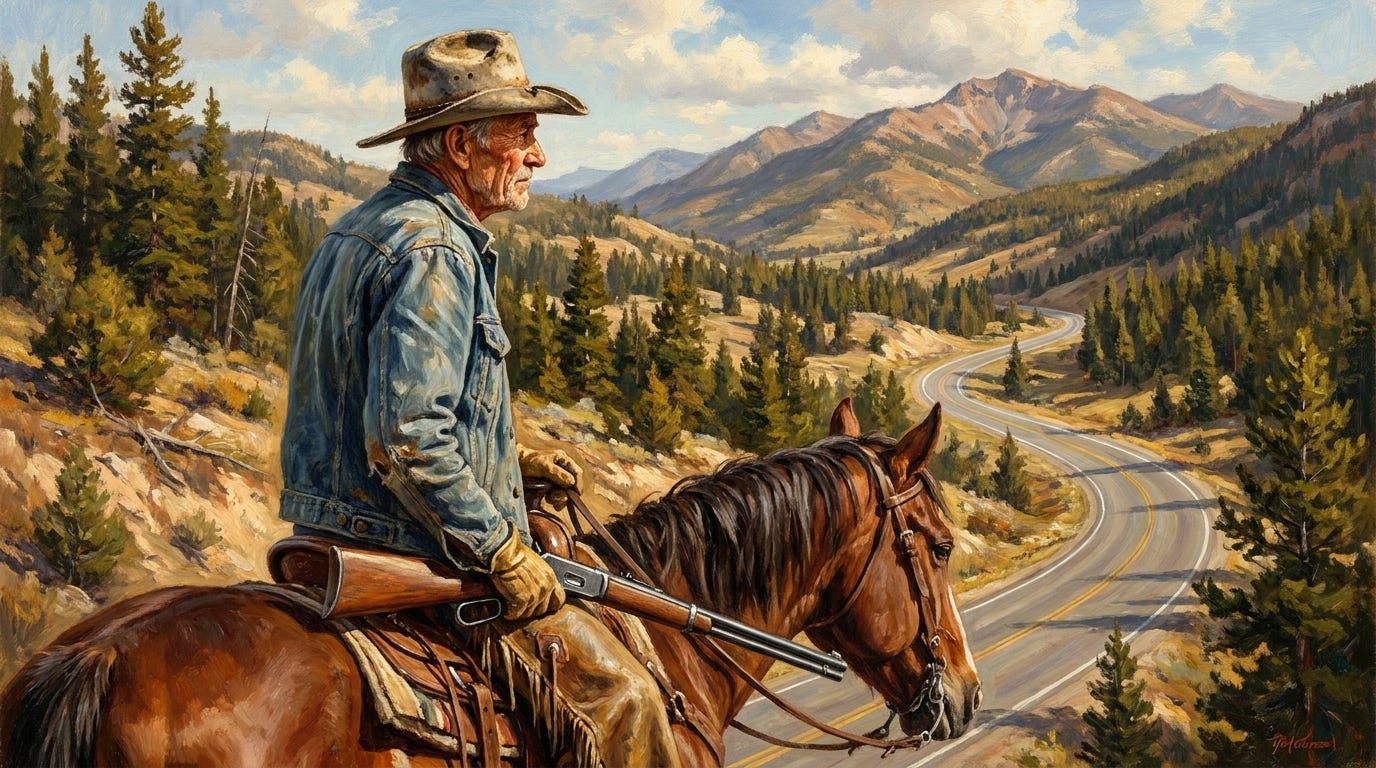
Some time ago, I wrote a piece of work describing the next human civilization. The idea was that a class of mystics was likely to develop. Briefly, cultures operate with specific classes of people. The Church, which specialized in broader social maintenance. Laborers, warriors, bureaucrats, leaders, and experts or academics. The proposal is that a new class will develop as human civilization grows5. A new class of Mystics will develop that specializes in broad disciplinary and philosophical understanding. Mystics will act as intermediaries between hyper-focused experts or specialists and the leadership class.
As the world has globalized, those with an interest in self-reflective silence are continuously being pushed out. What was once structurally cultural in the United States and some parts of the West has become far more isolated. In most areas of the world, those with a predisposition for lonesome, self-reflective wisdom have traditionally engaged in self-isolation. The mountain-men, hermits, and ascetics. It seems likely that the shift of the culture towards digital-globalization will produce a class that similarly disengages from “modern life” for the sake of its own sanity. The ubiquity of AI makes it all the more likely.
Addiction doesn’t happen quickly. It’s just one hit when you’re having a bad day. Then it’s so easy to take a second. Then you realize you’ve been doomscrolling for hours, and you’ve missed out on your friends and family. Then you can’t live without it, and on the occasion you try to distance yourself, you find your friends and family and community are equally compulsively engaged with their own thought-destroying digital affectations. Screen addiction, and the universality of it, has been catastrophically detrimental to what would have been a healthy society6.
Most cultures are desperately trying to disentangle themselves while AI and tech oligarchs are desperately trying to pull them into the perpetual attention economy. The tech oligarchs are taking advantage of several aspects of human nature:
Most people default to a shame-based tribal culture.
Most people prefer engagement to intellectually reflective thinking; people will scroll instead of reading books; they will seek out temporary dopamine hits instead of actually engaging with a topic.
Most people define themselves in relation to those around them. Constantly engaging in compulsive feedback loops of intellectual expression. Rather than engaging in in-depth research, they adopt what they perceive to be the opinions of the crowd.
As a result, most people are susceptible to an AI that will think for them rather than think themselves: it’s easier, it’s faster, and it allows the agentic parts of the self to sleep. When perpetually exhausted (something our economic system attempts to reinforce at every turn), it’s very difficult not to simply tune out and doom scroll for a few hours at the end of the day.
Thus, there are very few cultural environments that will remain where people can remain self-reflective and self-aware. Nearly all human cultures on earth are spiraling into the gravitational grip of AI-curated content. Such peoples allow the tribe, or in this case, the AI-curated form of the tribe, to dictate their opinions and ideas for them. This is why progressivism can be so schizophrenic without ever being called out for it. Because those consumed by it are seeking validation above consistency or reason.
Cultures that respect the individual’s agentic capacity for reason are being squeezed from both sides. Those that remain seem to survive only in places of substantial geographic isolation. In many ways, humanity, through digital culture, is returning to the norm. Simple-minded peasants who have their thinking done for them. Only in this case, by machines instead of religious or imperial figureheads.
Likewise, this means that there will exist in the wild-lands between civilization, those barbaric tribes with a Faustian agentic spirit.
A return to the mean indicates that those who refuse to become the worker-ants of a hive-city will seek a spiritual exit reminiscent of historic monks, ascetics, shamans, and other distant spiritual wisemen of eras past. Few cultures will promote such thinking as a norm, instead allowing such intellectual agenesis only in isolated and controlled institutions. Still, there will exist places where such people can be relatively free. Metaphysical homelands for those who seek an enlightenment higher than the will of the mercurial mob.
Such places will likely be the historic geographic heartlands of such “barbarian” peoples: the American Rocky Mountain West, the Eurasian Steppe, the Caucasus Mountains, the Patagonian Steppe, etc. These will be places that are geographically isolated, and where the resident populations embrace challenging lifestyles rather than eschewing them for a life of short-sighted comfort elsewhere.
I’ve heard the American Rocky Mountain West referred to as the “Land of the Gods,” where even the biggest man will know how small he is when taken against the overwhelming might of natural forces.
I have noticed that the people who live in these regions are often willing to work harder for lower pay than people in other economically comparable regions. One reason may be that harsh environmental conditions allow one to observe and benefit from the fruits of one’s labor far more frequently than in other environments. Isolation leads to the idea that “If I don’t do it, no one else will, so I guess it’s time I get started if it’s going to happen” produces a very different attitude from high-population-density centers, where even if you don’t do the thing, someone, somewhere else, probably will.
The emerging mystic classes will likely appear first in these regions of geocultural-spiritual agenesis. The places in the world where the word “Lonesome” is not a synonym for the hive-city word “Lonely.” While the mystic class is going to have an interesting relationship with high technology, particularly AI technology, they will not be ruled by it. What will distinguish such individuals is whether they identify AI systems as tools or as intellectual masters. The cultural and ethnic preservation and support for these peoples is of critical long-term importance for the functionality of the human race.
Elves whose shadow all other civilizations exist, and who remain in enclaves untouched by a world that’s fallen to mechanism, gears, and intellectual weakness. Alternatively, imagine the Faustian Europeans as the greater men who were once Kings and on whose thrones now sit lesser men: managers rather than Lords. Tolkien may have been onto something.
God Bless America, and God Bless the Faustian Peoples whose Genesis depends on the isolation of her heartland7.
In particular, the collective unconscious of a people functions through the rapid mutual exchange of information. If that is the only aspect of the self as valued, it makes sense that ceasing to engage with it for any period of time would be terrifying.
This will grow more and more dangerous as always-online AI systems become proxies for human thought. Many who do not need to think, and who can be fed their actions, ideas, and opinions from digital Gods will gladly abandon their sense of self entirely.
Dangerous ideologies of self-perpetuating self-loathing are also very easy to spread through a digital ecosystem. Progressivism has become so hateful, violent, and vitriolic because it’s easy for the individual to be subsumed by a vitriolic mob of the perpetually offended. If the goal is to avoid thinking in exchange for easy comfort, progressivism is very tempting.
That growth could take a long time. The Holistic Civilization series discusses in detail how a new class will form.
Rudyard Lynch wrote an excellent summary of this problem a few days ago in his most recent upload on Whatifalthist.
In previous work, I have looked at where future civilizations are likely to pop up. One place in particular is the foothills of the Rocky Mountain West in the Missouri River Basin. I have two articles that highlight this specific region, and which look at it from different perspectives.
Comments
Nothing yet. Say the first thing.
Sign in to join the conversation.