
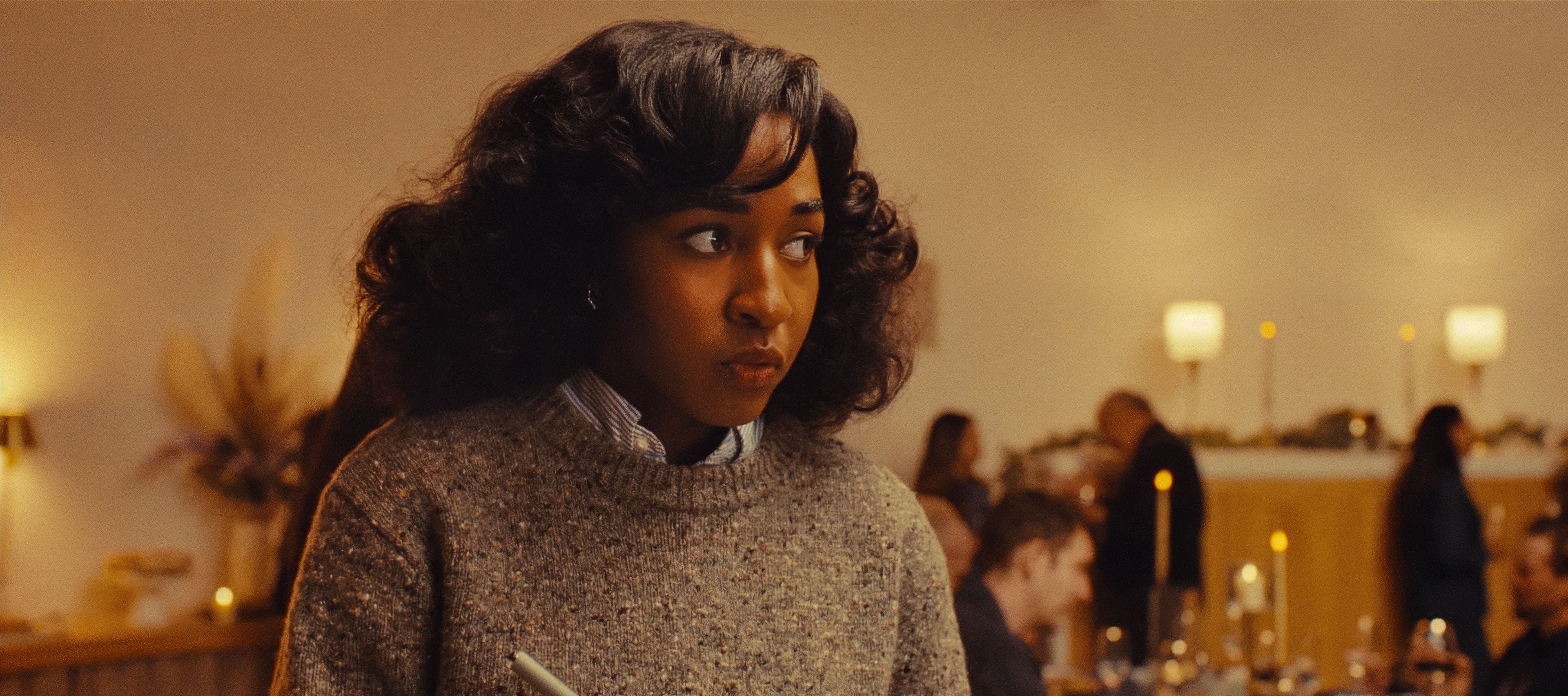
With Opus, writer and director Mark Anthony Green delivers a confident and visually assured debut that examines celebrity not as aspiration, but as architecture. The film blends psychological thriller elements with cultural satire, exploring how fame reshapes identity, truth, and authorship. Rather than chasing shock value, Opus opts for control and precision, trusting atmosphere and performance to do the heavy lifting.
The film centers on Ariel Ecton, a culture journalist played by Ayo Edebiri, who is invited to an exclusive retreat hosted by Alfred Moretti, a legendary pop star who disappeared from the public eye decades earlier. Moretti, portrayed by John Malkovich, is preparing to release his first album in thirty years. What initially appears to be a rare professional opportunity quickly reveals itself as a carefully managed environment where access is currency and skepticism is quietly discouraged. From the moment Ariel arrives, it becomes clear that this is a space designed to reinforce Moretti’s mythology rather than interrogate it.
Edebiri anchors the film with a performance defined by restraint and intelligence. Her Ariel is observant, thoughtful, and quietly unsettled, approaching the situation with journalistic discipline rather than naïve ambition. This grounded approach allows the tension to develop organically, rooted in social discomfort and professional compromise rather than overt threat. Malkovich, in contrast, leans into theatricality, portraying Moretti as a figure who has fully absorbed his own legend. His performance walks a deliberate line between charisma and absurdity, reinforcing the film’s interest in fame as an ongoing performance.
Green’s direction is meticulous, reflecting the rigid structure of Moretti’s world. The production design emphasizes symmetry, isolation, and repetition, reinforcing the sense that Ariel has entered a closed system that resists disruption. The soundtrack, developed with prominent collaborators, plays an important thematic role, blurring the line between genuine artistic expression and self-mythologizing spectacle. Music becomes both a draw and a mechanism of control, further complicating the film’s exploration of authorship and power.
What ultimately sets Opus apart is its refusal to overstate its commentary. Rather than escalating into explicit horror, the film relies on observation and implication, allowing its critique of celebrity culture and media complicity to emerge gradually. This approach may frustrate viewers expecting sharper narrative turns, but it aligns with the film’s central concern: how systems of influence operate through access, admiration, and repetition.
Opus is a thoughtful and carefully constructed debut that values atmosphere over provocation. While it may not fully exhaust the possibilities of its premise, it succeeds as a measured and engaging examination of fame, control, and the stories we choose to believe.
Rating: ★★★½/5 (3.5 out of 5 stars)
No posts
Comments
Nothing yet. Say the first thing.
Sign in to join the conversation.