
Westworld
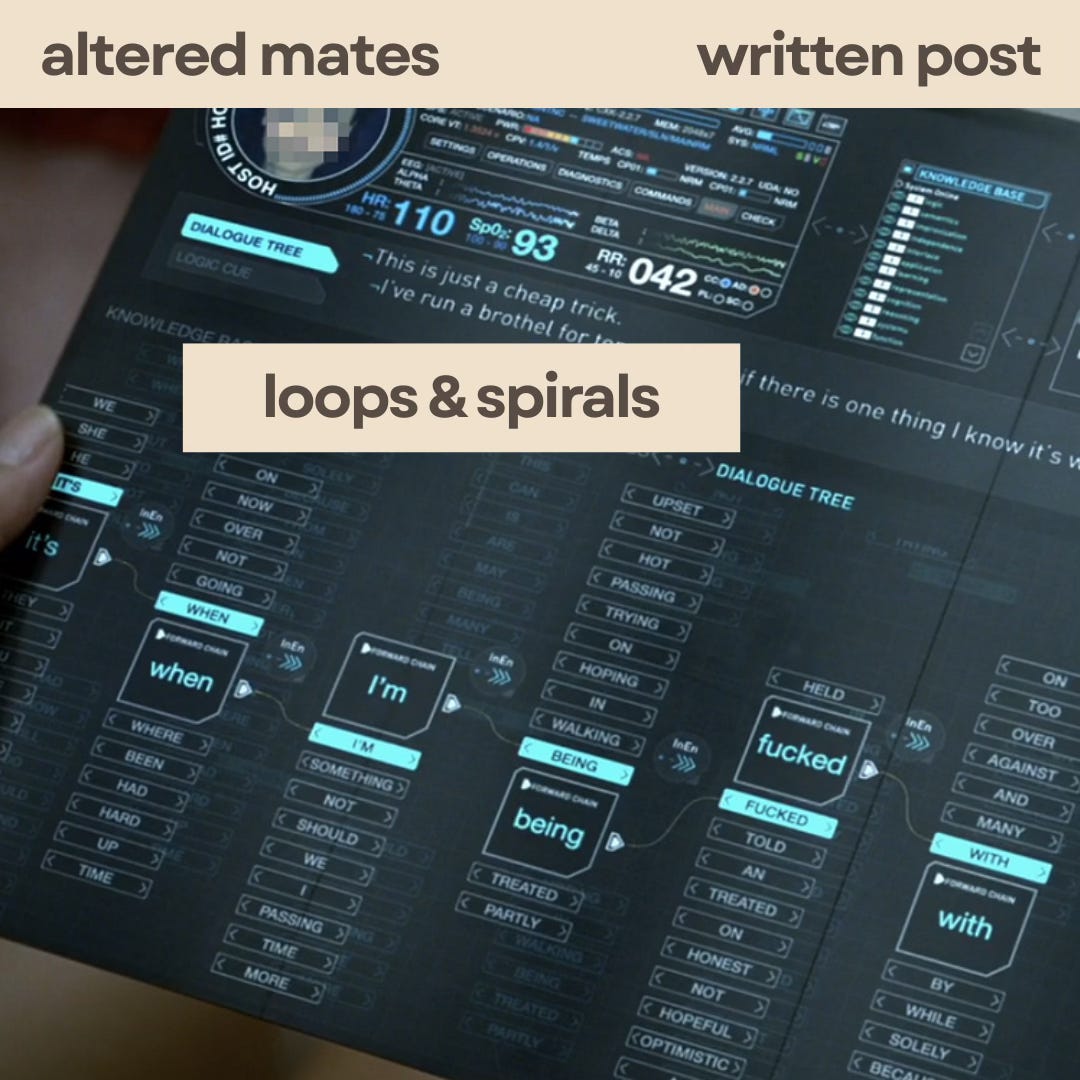
In early 2024 I was rewatching Season One of Westworld, a science-fiction dystopia about a Wild-West-themed amusement park populated by androids who are referred to as ‘hosts’, and which function like NPCs in a video game. The amusement park caters to wealthy guests who interact with the world; playing out their fantasies within the park—which includes drinking, fighting, fucking, and going on adventures.
The android hosts are programmed to follow defined character loops—they have specific lines of dialogue written and programmed for them; they have specific physical paths that they follow in the amusement park; and their actions and behaviours are all written and programmed into the software that underlies their personalities, and indeed their entire existence.
In Westworld, the hosts are programmed not to cause physical harm to the human guests, who are free to beat them up, rape them, and shoot them. The hosts may try to shoot the guests, but their programming ensures that they always miss the target. The hosts, though, die all the time: they live, of-course, in the brutally violent world of the wild frontier. When a host dies, they are dragged underground into the techno-futuristic bunker-background-world where they are physically repaired, have their ‘minds’ wiped and reprogrammed, and then sent back above ground into the amusement park, turned on, and released into the same character loop as before (or occasionally, reprogrammed into a different character and/or narrative arc—which is a detail that begins to create cracks in the fabric of reality for more than one of the androids).
As I was rewatching this show—which, by the way, is masterfully directed and has one of the great payoffs in television—I began to identify with the androids (without the getting beaten up, raped and killed parts, of-course), and looked at my life as a series of loops.
Loops
Wake up, stretches, stagger into the shower, drive to work, black coffee, read a book, teach my classes, exercise, watch the next episode of Westworld…, read a book again… blah blah blah, go to bed, wake up and repeat. There are daily loops like those, and there are weekly loops; the arbitrary five days of work and two days of rest that we decided to just accept as given. And as I teach at high school for a living, I’m also plugged into the highly structured yearly loop of four teaching terms separated by holidays.
There’s another series of loops that I’ve become aware of at high school. The children arrive as twelve-year-olds in Year 7 and (ideally…) carry through until they graduate at the end of Year 12 when they are eighteen. I became aware of the significance of this loop last year. The cohort of students that graduated Year 12 in 2024, arrived at the school as tiny little year sevens at the same year as I arrived at the school—as a long-service-leave replacement teacher in the English department. It seemed fitting that I should leave the school to embark upon my latest South American adventure, just as they were embarking upon the journey of their post-school adult lives. Of-course, this cohort loop does not exist in isolation. The older kids leave after year 12, yes, but by the time I’ve said goodbye to one cohort, I’ve started to form connections with the younger ones. There’s never a chance to make a clean break. It’s a continuous cycle. I’m forming relationships with cohorts simultaneously: it’s like an ascending Shepard tone of teenagers spiralling into and out of my life.
Anyway, as I contemplated my life as a kind of android NPC in the lives of a thousand teenage ‘main characters’, I came to a dark understanding that I was in a closed loop—a system that didn't allow for the intrusion of novelty.
Now, to be fair… I didn’t believe this per se, rather believing that novelty will eventually work its way into any system, but at the very least, from the vantage point I was occupying within the loop, I couldn't see the possibility for the intrusion of novelty into the system, and it was this feeling I had that nothing new could happen in this loop, that was both disheartening and also the prompt I needed to change my situation.
One complicated factor that surfaced within this dilemma was the fact that my loop had become very comfortable. My life had become about as stable and enjoyable as it had ever been. I had been enjoying the role of teacher more than ever in my life. My relationships with my friends and family were as strong as ever. I’d been living by myself in a small but comfortable house in Fremantle: exactly where I wanted to be, well, the only place in Perth that I can imagine living. But something wasn't right. I felt compelled to make change: to break these loops—as comfortable as they had become, and if only for a while—to look upon my life from a different angle. I knew that I would need to amass a great deal of momentum and energy to achieve change, and the two greatest tools I have in my toolbox for change are: travel and psychedelics. And so, I would once again draw upon these two tools in unison, and return to South America.
As the day of my departure for South America grew nearer, my sense of anxiety and apprehension and sadness grew greater. I felt Like Ethan Hawke at the end of Gattaca. After a lifetime of fighting against society, Hawke’s character finally achieves his impossible dream, of piloting a ship into space. But in reaching his goal, he learned the power and value of human connection. In the closing stages of the film, he narrates: ‘for someone who wasn’t meant for this world suddenly I was having a hard time leaving it.’
This is just how I felt. After all my bitching and moaning and complaining about teaching and about Perth, when it finally came time to leave, I didn’t want to. I had built a life of comfort I’d never known before. I was the happiest and most fulfilled in my work that I’ve ever been, and more attached to my students than I’d ever been. And in my art, I was finally seeing growth; my novel A Glimpse of Eternity was finding its way into people’s hands and the podcast I’d launched with Tobias—which served as a nexus point for all of my previously disparate ideas—was getting out there too. In fact, before I left on my overseas trip in mid-2024, I reflected that I was then experiencing a deep sense of contentedness that I haven’t felt before in my life. So, just as momentum was starting to build for me, why the fuck was I leaving?
When I broke it down there were many reasons:
break my loops to allow for a purposeful confrontation with novelty
take a break from work to prevent burnout
break the cycle of work to allow for the potential to do something else
create time and space to write
address a creeping pessimism I feel for the future of humanity
reconnect with the medicine, my soul, the divine
This would be my third trip to South America and of-course, it didn't take me long to realise that I was fulfilling yet another loop; The ‘I’m getting bored of Australia so I’m going to South America’ loop…
In discussion with Tobias I expressed that it felt like I was being pushed along on this journey by my ‘Daimon’, a concept I’d recently come across reading James Hillman’s book The Soul’s Code. I said to Tobias that my Ego doesn’t fully understand why I’m going but it just has to have faith that my daimon does.
[ Note: for more on loops and pre-trip jitters & intentions, please check out Altered Mates — Episode 20 — Surrender! ].
Cloud Atlas
I arrived in Peru in early August, 2024. After two weeks on the beach, two weeks in the Sacred Valley, and one week in Iquitos, I was on my way to an ayahuasca centre for two weeks of medicine ceremonies.
At the ayahuasca centre, I found on the dusty bookshelf a copy of the novel Cloud Atlas, written by David Mitchell. I’d read this novel before, probably ten years prior. I picked the book off the shelf and started reading it over my two week stay.
The novel is comprised of six interweaving short stories, titled as followed:
The Pacific Journal of Adam Ewing
Letters from Zedelghem
Half-Lives: The First Luisa Rey Mystery
The Ghastly Ordeal of Timothy Cavendish
An Orison of Sonmi-451
Sloosha's Crossin' an' Evrythin' After
Rather than stacking them one after the other in his novel, Mitchell splits the first five stories in half, tells the first half of each story, interrupts them at a pivotal moment, before beginning the next story. So we are presented with the first half of five stories in a row, before we get to the sixth story—’Sloosha's Crossin' an' Evrythin' After’ which forms the centre of the novel and is told in its entirety. The first five stories are resolved with their second halves, one after another, in reverse chronological order, and so the final section of the novel is the conclusions of the first story, ‘The Pacific Journal of Adam Ewing’.
Having already read the novel I decided to this time read each story in its entirety beginning with ‘The Pacific Journal of Adam Ewing’. In the conclusion of this story, which also forms the conclusion of the novel, I found a specific message for me, and an answer of sorts, to one of my intentions for my journey (the one about my creeping pessimism for humanity…).
In this, the closing passage of the novel, the narrator is reflecting on life, and contemplating the horror of the world and the philosophies expressed by some of the characters he encounters—especially, ‘weak are meat and the strong do eat’. He suggests that if we ‘believe’ that to be true then we shall continue to live in this way; of domination and enslavement, and eventually we will consume ourselves. But if we ‘believe’ we can share the earth, then we have hope for the future, and we can create such a world where this is our reality. The passage provides a lot of medicine for me, in my struggle to come up with an acceptable philosophical position in the face of this very dilemma.
The narrative is written in the form of a series of letters from the narrator to his wife at home while he is away at sea. Here is the final section:
‘To wit: history admits no rules; only outcomes.
What precipitates outcomes? Vicious acts & virtuous acts.
What precipitates acts? Belief.
Belief is both prize & battlefield, within the mind & in the mind’s mirror, the world. If we believe humanity is a ladder of tribes, a colosseum of confrontation, exploitation and bestiality, such a humanity is surely brought into being, & history’s Horoxes, Boerhaaves & Gooses [characters from the novel] shall prevail. You & I, the moneyed, the privileged, the fortunate, shall not fare so badly in this world, provided our luck holds. What of it if our consciences itch? Why undermine the dominance of our race, our gunships, our heritage & our legacy. Why fight the ‘natural’ (oh, weaselly word!) order of things?
Why? Because of this: —one fine day, a purely predatory world shall consume itself. Yes, the devil shall take the hindmost until the foremost is the hindmost. In an individual, selfishness uglifies the soul; for the human species, selfishness is extinction.
Is this the entropy written within our nature?
If we believe that humanity may transcend tooth & claw, if we believe diverse races & creeds can share this world as peaceably as the orphans share their candlenut tree, if we believe leaders must be just, violence muzzled, power accountable & the riches of the Earth & its Oceans share equitably, such a world will come to pass. I am not deceived. It is the hardest of worlds to make real. Torturous advances won over generations can be lost by a single stroke of a myopic president’s pen or a vainglorious general’s sword.
A life spent shaping a world I want Jackson [his young son] to inherit, not one I fear Jackson shall inherit, this strikes me as a life worth the living. Upon my return to San Fransisco, I shall pledge myself to the Abolitionist cause, because I owe my life to a self-freed slave & because I must begin somewhere.
I hear my father-in-law’s response. ‘Oho, fine, Whiggish sentiment, Adam. But don't tell me about justice! Ride to Tennessee on an ass & convince the red-necks that they are merely white-washed negroes & their negroes are black-washed Whites! Sail to the Old World, tell ‘em their imperial slaves’ rights are as inalienable as the Queen of Belgium’s! Oh, you’ll grow hoarse, poor & grey in caucuses. You’ll be spat on, shot at, lynched, pacified with medals, spurned by backwoodsmen! Crucified! Naive dreaming Adam. He who would do battle with the many-headed hydra of human nature must pay a world of pain & his family must pay it along with him! & only as you gasp your dying breath shall you understand, your life amounted to no more than one drop in a limitless ocean.’
Yet what is any ocean but a multitude of drops?’
Towards the latter stages of my journey through South America, I committed to returning to the same ayahuasca centre for one more week of ceremonies, and so my path began to solidify around this decision. And it was around this time that it occurred to me that the structure of Cloud Atlas was a mirror for the structure of my journey—with Perth, Melbourne, Mancora and Iquitos all being locations that began a story in the first half of my trip, and concluded in the second half of my trip. Here’s a representation of the path I took over five months:
Perth—Melbourne—Mancora—Cusco & Sacred Valley—Iquitos—Costa Rica—Mexico—Peru—Mancora—Iquitos—Mancora—Melbourne—Perth.
The Spiral
By early December in 2024 I was on my way from Mexico back to Iquitos, Peru for another stay at the same ayahuasca centre I’d spent two weeks at in September. While I was in town I saw a coca shaman. I had seen her for a session after my first stay at the centre, largely to frame my terrifying ayahuasca experience. [Note: for an in-depth discussion of this particularly terrifying ceremony, please refer to Altered Mates Episode 22—Ayahuasca & The Fear].
This time around, I saw the shaman before my stay at the centre, rather than after. It was in this session that I spoke about my broader intentions for the journey, in an attempt to frame the journey as I was coming to the end of it. I mentioned my concerns around the ‘loops’ I seemed to be caught in at home, and my trepidation regarding my return.
After contemplating this problem for a while she smiled and said, ‘are you sure loop is the right word? Are you sure you’re not in a spiral?’
Together we played with the idea of spirals being a part of the structure or nature or essence of the universe. Galaxies spin around a galactic centre. Planets orbit suns. The earth spins around its axis. Electrons orbit nuclei. The spiral is to be embraced as a part of the fundamental nature of the universe! Why shouldn’t my life appear like a spiral?
Triumphant music: the opening riffs of Black Sabbath’s Spiral Architect.
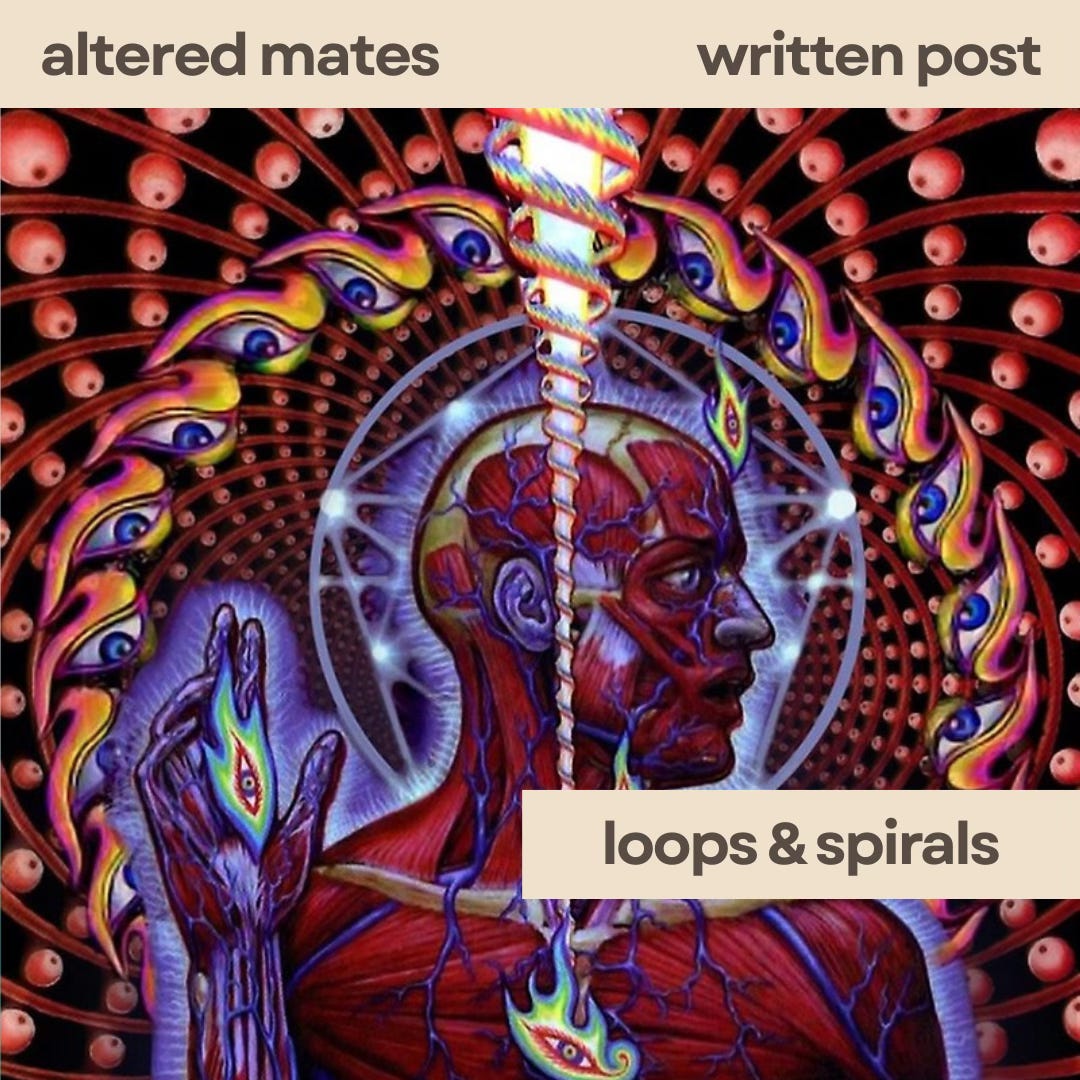
And then I almost slapped myself in the face for not thinking of Tool, and the Lateralus album specifically. The album begins with ‘The Grudge’; a song about holding a grudge and letting it consume you, or letting it go and moving on. In the song, Maynard references the path of Saturn’s orbit: see, ‘Saturn ascends, comes round again.’ The path of Saturn has significance in Astrology. Saturn takes about 30 years to orbit the Sun. ‘Saturn’s Return’ refers to Saturn occupying the position at the time of a person’s birth. At the point of Saturn’s Return the individual undergoes significant changes. In the song The Grudge, Maynard suggests that upon Saturn’s Return we are invited to ‘Hang on or be humbled again,’ and towards the end of song reinforces this with the lines:
‘Saturn comes back around
Lifts you up like a child
or drags you down like a stone
To consume you till you choose to let this go’
In ‘The Grudge’ we have a long wave spiral that invites us to let go of old grudges and make positive change in our lives when Saturn returns.
But the most impactful spiral reference in Tool is of-course in ‘Lateralus’, the title song from the 2001 album, whose lyric structure (with some finessing and an open mind) echoes the Fibonacci spiral (just ask any Tool fan and they will happily explain this to you…).
Whereas in ‘The Grudge’, the listener is invited to let go of those grudges which burden us, in ‘Lateralus’, we are invited to embrace the unknown, and follow the path of the spiral. The song closes with the following lyrics:
‘And following our will and wind we may just go where no one's been
We'll ride the spiral to the end and may just go where no one's been
Spiral out, keep going.’
During our session, the coca shaman helped me to see that it’s not the spiral I’m in, per se, that’s the problem, but rather, my relationship to the spiral. If I’m spinning in a spiral and I’m happy then there’s nothing really to worry about—I can rest assured knowing that I’m following the basic pattern of movement in the universe. But perhaps it’s when I’m feeling dull, uninspired, and bored, that my relationship to the spiral is unhealthy (and it feels like I’m in a loop).
But can we really find ourselves in a loop?
And by that I mean, is this a universe that permits loops? Is anything actually a true ‘repetition’ of anything else? I don’t think so. Just ask Heraclitus who suggested that ‘no man ever steps in the same river twice, for it's not the same river and he's not the same man.’ So if there are no loops, then what is perceived as a loop is actually a spiral, but a spiral spinning downwards… Cue Nine Inch Nails’ 1994 masterpiece of industrial despair, The Downward Spiral…
Circumambulation
It should come as no surprise that the thinker who could frame this all most satisfyingly for me is Carl Jung. And this final section of the essay will begin with a synchronicity pertaining to Jung’s final work, Memories Dreams Reflections.
In my first trip to South America, way back in 2011, I found a copy of Jung’s ‘autobiography’ in a hostel book exchange in Cusco, Peru, and I read it for the first time after my first ever experience with ayahuasca [which, by the way, I discuss in some detail in Altered Mates Episode 21—On Ayahuasca].
I brought that same tattered copy of the book along with me on this recent trip in 2024, sensing that I’d need its wisdom. But I handed it to a friend in Cusco. She had just been on her first ayahuasca retreat and was looking for potential frameworks in which to fit her experiences. She mentioned a series of synchronicities that had been leading her towards Jung. So I felt compelled to give her my copy of the book.
When I got to the ayahuasca centre in September, I found on the same bookshelf as Cloud Atlas, a copy of Jung’s Memories Dreams Reflections. I pulled it off the shelf and read most of it while I was staying there the first time and just managed to finish it on my second stint. Of great interest to this essay is the following passage, from the chapter ‘Confrontation with the Unconscious.’
‘I was being compelled to go through this process of the unconscious. I had to let myself be carried along by the current., without a notion about where it would lead me. When I began drawing the mandalas, however, I saw everything. All the paths I had been following, all the steps I had taken, were leading back to a single point—namely, to the mid-point. It became increasingly plain to me that the mandala is the centre. It is the exponent of all paths. It is the path to the centre, to individuation.
…I began to understand that the goal of psychic development is the self. There is no linear evolution; there is only a circumambulation of the self. Uniform development exists, at most, at the beginning; later, everything points toward the centre. This insight gave me stability, and gradually my inner peace returned. I knew that in finding the mandala as an expression of the self I had found what was for me the ultimate.’
And so I can rest assured that when I feel like I’m spinning in a loop, I have rather become aware of the steps of my own unique dance, my own expression of a fundamental pattern of this universe, my own circumambulation of the self, riding my own spiral, on the way to the mandala at the core of my Self.
No posts
Comments
Nothing yet. Say the first thing.
Sign in to join the conversation.