
Following on from my recent written post ‘Becoming Mercer, becoming Human’, I am including here an extended version of the second essay I developed for a university course this year. In the essay below I include a section concerning dreaming, and reference a paper by Iain McGilchrist that Tobias and I discussed in Episode 30 — Where are my minds? On the Left Brain / Right Brain Divide. In the end I ran too far over the word limit for the assignment and had to make some cuts. But I will include those missing paragraphs in this written post because it ties together a number of ideas that I have been playing with both at uni and in the Altered Mates lab…
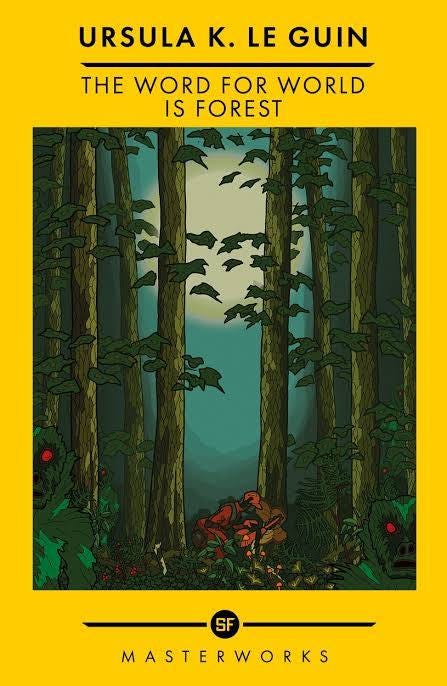
Having recently re-read David Tacey’s Edge of the Sacred, his ideas concerning Jungian psychology and ecology were front of mind in re-reading The Word for World is Forest (Forest) by Ursula Le Guin. Tacey argues the ‘so-called ‘environmental crisis’ is wrongly termed...for it is a crisis of human consciousness, a failure to view the physical world and its elements as sacred’ (10), and he links exploitation of the ‘earthly embodiment of the feminine’ (11) with the repression of the feminine across human culture. Roy supports this notion that exploitation of natural environments goes hand in hand with exploitation of people, and Savi supports the idea that dualism is at the core of the exploitative Terran worldview.
Fresh in my mind was Philip K. Dick (PKD)’s 1975 essay Man, Android and Machine, where he invokes Ursula Le Guin’s The Lathe of Heaven and discusses her treatment of the dream. Riffing on contemporary neuroscience regarding the functional lateralisation of the human brain, PKD suggests, ‘whereas we have one body we have two minds’, and speculates that dreaming facilitates communication between the two hemispheres. I found here a tantalising link to the Athshean dream-time.
I resonated with Watson’s connections between dream, forest, and unconscious in his paper The Forest as Metaphor for Mind, and after reading Le Guin’s essay The Child and The Shadow, I was set on a Jungian interpretation of Forest. Le Guin invokes Jung’s concept of the ‘shadow’—one of the archetypes of the collective unconscious (Archetypes, 37)—suggesting it to be, ‘on the other side of our psyche, the dark brother of the conscious mind.’ She writes, ‘we meet it in our dreams, as sister, brother, friend, beast, monster, enemy, guide. It is all we don’t want to, can’t, admit into our conscious self, all the qualities and tendencies within us which have been repressed, denied, or not used.’ Where Davidson refuses to face his shadow, I would argue that Selver confronts—in murder—a collective Athshean shadow: and with Debita I found support for the reading that ‘murder’ was not a wholly new concept introduced into Athshean culture but potentially an archetypal image drawn from a shared ancestry with the Terrans and Hainish.
Division
The Terran invasion of Athshea can be read not only as a conflict between an invading force and an indigenous population, but as a clash of fundamentally opposed worldviews: one of the ‘dominator’ (Eisler) and the other, if not ‘partnership’ a kind of cooperative, balanced culture—or as Watson suggests, a ‘sane society’ living in ‘psychological equilibrium,’ (232).
The Terran worldview is that of a racist (they enslave the Athsheans and refer to them as ‘humanoids’), misogynist (Davidson rapes Selver’s wife, and objectifies the human women sent to the planet), and Patriarchal, imperial society, with humans at the top: the repugnant army captain Davidson embodies this dominator worldview, stating: ‘I like to see things in perspective, from top down, and the top, so far is humans’ (4). The Terran system operates through an exploitative industrial capitalist economy which perceives the forests of Athshe as ‘standing reserve’ (Bestand: Heidegger) to be extracted, converted into lumber, and sent back to Terra. Watson writes, ‘having already reduced Earth to a poisoned wasteland, [the Terrans] regard the forests of Athshea purely as a source of lumber, and the native Athsheans as a pool of slave labour’ (231), and Roy points out that the Terrans’, ‘systematic deforestation of Athshea goes hand in hand with their enslavement and extermination of indigenous Athsheans,’ (447). It comes as no surprise that these objectionable qualities coalesce: as Tacey points out*:* ‘In the same way that patriarchy has devalued women and the human embodiment of the feminine, so has it devalued the earthly embodiment of the feminine’ (11). The Terrans have destroyed their home planet and rather than looking inward to address the source of this destruction, they turn outward and seek other planets to exploit. Tacey writes, ‘For Western consciousness landscape is barren, empty, unalive… seen as a dead background to our busy, ego-centred and self-propelling lives’ (146); a perspective which tracks onto Davidson. For instance, using free indirect discourse Le Guin presents Davidson’s perspective on the forest-covered planet: ‘when they came here there had been nothing. Trees. A dark huddle and jumble and tangle of trees, endless, meaningless’ (5).
Arguably, what ties these extractive and exploitative sociocultural, political and economic aspects together, is a philosophical belief in ‘dualism’: after all, there needs to exist a worldview of separation for there to be an ‘Other’ to exploit. Savi draws attention to the dualistic logic at the heart of the Terran worldview, suggesting that, ‘Terrans are quick to reproduce on Athshe practices that resonate with the dualistic logic that (1) understands humans as set apart from nature… (2) and establishes hierarchic notions of humanity’ (535). Separation is evident all through the Terran worldview: between Terrans and Athsheans; men and women; humans and nature; in stark contrast to the harmonious population they have invaded.
Harmony
At the core of the Terran worldview is the belief that their picture of reality is complete and accurate. When discussing the Athsheans, Gosse says to anthropologist Lyubov, ‘You know the people you are studying are going to get ploughed under, and probably wiped out. It’s the way things are. It’s human nature, and you must know you can’t change that’ (71). But Le Guin, through the Athsheans, provides an image of a culture that exists without the fundamental logic of dualism built into it, and the result is a culture of harmony, that challenges Gosse’s assertion that the drive to dominate and exploit is an unchangeable aspect of human nature.
Whereas the Terrans equate trees with lumber, anthropologist Lyubov notices the Athshean’s do not separate humans from the natural world when he observes ‘the Athshean word for world is also the word for forest’ (48). For the Athsheans, the extraction of resources from the natural environment is senseless: how could a culture cut down the world in which they inhabit; an extension of their own bodies and psyches? Tacey draws on Judith Wright’s observation that the English word for ‘landscape’ is inadequate to describe the Australian Aboriginal understanding of an ‘earth-sky-water-tree-spirit-human continuum’ which is the ‘cosmological and existential ground of the Aboriginal Dreaming’ (145). We could apply a similar brush to the Athsheans and refer to a world-forest-dream-human continuum.
And while Athshean culture operates as a Matriarchy with prescribed gender roles where women hold the positions of leadership, it is a balanced system as men are valued in their role as Dreamers. Athshean culture has swung the pendulum further towards equilibrium (compared to contemporary Western culture) in terms of a balance between the masculine and the feminine. The Athsheans have also achieved a psychological equilibrium: an inner psychological harmony between the conscious and unconscious mind.
Dreaming
In his 1975 essay Man, Android and Machine, PKD invokes Ursula Le Guin, discussing her science fiction novel The Lathe of Heaven and specifically her treatment of ‘the dream’. Based on the neuroscience of the time regarding the laterisation of function into two hemispheres of the human brain, PKD suggests that, ‘whereas we have one body we have two minds’. PKD argues that since our personality is largely constructed in the left hemisphere of the brain, if the right hemisphere of the brain, ‘finds something vital which we to its left remain unaware of, it must communicate during sleep, during the dream’.
More recent speculation on the roles of the two hemispheres in human consciousness can be found in Iain McGilchrist’s work. McGilchrist argues, ‘the right hemisphere provides a broad attention that takes in the whole of the available world, while the left hemisphere has a narrowly focussed beam of attention’. Further, he suggests that, ‘the left hemisphere specialises in a sort of piecemeal attention that helps us make use of the world, [whereas]… the right hemisphere subserves a broad open attention which enables us to see ourselves connected to—and in the human case, to empathise with—whatever is other than ourselves’.
As the language centres of the brain are largely localised in the left hemisphere, the right hemisphere must communicate largely in symbol: hence, the dream becomes an opportunity for the right hemisphere to present its picture of reality to the left hemisphere, which must then decode the symbolic meaning of the dream. PKD further speculates that what we refer to in psychological terms as the ‘unconscious’ is, ‘not an unconscious at all but another consciousness, with which we have a tenuous relationship’ (PKD). In Forest, I would argue that the Athshean culture has achieved, not a ‘tenuous relationship’ between the hemispheres, but an effective and collaborative relationship. The dream-time is essentially a metaphor for what we might call the ‘unconscious mind’, or if we follow Dick’s speculations regarding the dream; the picture of reality constructed by the right hemisphere of the brain.
The Athsheans have developed an anthropotechnical means for fluid communication between the conscious and unconscious mind; the dream. The Athshean ‘dream-time’ is essentially a metaphor for the ‘unconscious mind’, or if we follow PKD’s speculations regarding the dream in his essay Man, Android and Machine; the picture of reality constructed by the right hemisphere of the brain. Indeed, the forest itself can be read as a physical extension of the Athshean ‘collective unconscious’. Watson draws a comparison between the inner balance of the Athshean mind, with their outer balance with nature: ‘The Athsheans’ proficiency in the dream life is directly imaged by their physical residence in the dark tangled forests of the planet: these latter function metaphorically as a kind of external collective unconscious,’ (231). From Selver’s perspective, ‘The forest paths are ‘devious as nerves’ (17)— which, Watson points out, is a ‘neural simile which supports the impression that the forest itself is conscious,’ and later suggest that the forest itself, ‘functions metaphorically as mind: as the collective unconscious mind of the Athsheans’ (232). This point is reinforced by Debita, who draws attention to the ‘imagery of the forest paths as a complicated network, which immediately summons the picture of a neuron circuit, and by the explicit reference to ‘nerves.’ The forest, thus, as a physical presence, is the equivalent of the brain, while the Dream is the mind of this complex world’ (54).
Shadow
Selver believed the Terrans’ lack of ability in dreaming is what allowed them to ‘go about in torment killing and destroying’ (45). He suggests the Terrans are, ‘driven by the gods within, whom they will not set free but try to uproot and deny,’ and states: ‘If they are men they are evil men, having denied their own gods, afraid to see their own faces in the dark’ (45). But what are the gods within that have been denied? Jung suggests that ‘all ages before us have believed in gods,’ and in the modern world, due to what he calls an ‘unparalleled impoverishment of symbolism’ we have, ‘rediscover[ed] the gods as psychic factors, that is, as archetypes of the unconscious’ (Archetypes, 23). For Jung the ‘archetypes were, and still are, living psychic forces that demand to be taken seriously… Moreover, they are the unfailing cause of neurotic and even psychotic disorders (Archetypes, 156)’. For instance, Lyubov recognises the repression of Eros in the Terran psyche. He reflects that the colonists were unable to see in the complex Athshean ‘touch-exchanges…anything but their own erotism which, forced to concentrate itself exclusively on sex and then repressed and frustrated, invades and poisons every sensual pleasure’ (64). Along with the repression of the erotic, the Terrans have denied their own shadow. Davidson identifies with a kind of heroic frontiersman, even referring to ‘Man’ as the ‘old Conquistador’ (4), invoking the mindset of a dominating, world-conquering force. With introspection Davidson may recognize he is hardly a conqueror, and is rather a captain of a logging camp (let alone face the racist, misogynist shadow aspects of his personality). But when met with the darkness of the forest on Athshe—a mythopoetic opportunity to face his own shadow—rather than embrace it, he believes he must destroy it, reflecting: ‘Cleaned up and cleaned out the dark forests cut down for open fields of grain, the primeval murk and savagery and ignorance wiped out, it would be a paradise,’ (3).
Whereas Davidson fails to face his shadow, Selver confronts a collective shadow of the Athshean psyche to preserve their existence. Lyubov, in contemplating that the Athshean word ‘Sha’ab’ means both ‘god’ and ‘translator’ (72), begins to understand why the Athsheans see Selver as ‘a god, a changer, a bridge between realities’ (24). Selver’s invocation of the Terran practice of murder can be seen as the introduction of something new into the peaceful Athshean culture but it can also be seen as a ‘translation’ of the symbolic image of murder from the dream-time, across the ‘bridge’, into world-time. As Debita writes, ‘although Athshean society had never developed violent tendencies of its own, the fact that Athsheans and humans share a common ancestor suggests that perhaps the seed of violence had already been present, in a dormant state, and that it became activated when an act of desperate resistance was necessary’ (56). If we consider Jung’s concept of the shadow as ‘that hidden, repressed, for the most part inferior and guilt laden personality whose ultimate ramifications reach back into the realm of our ancient ancestors and so comprise the whole historical aspect of the unconscious’, (Aion, 266)’, and take into account that both Terrans and Athsheans were seeded by the Hainish, a kind of intergalactic Imperial force, it would follow that murder could exist in both the Terran and Athshean psyches, as an archetypal image—an aspect of the shadow—though where the Terrans had let it overwhelm them, the Athsheans had buried it in the psychic depths for untold generations. When faced with the existential threat posed by the Terrans, it falls upon Selver to become a ‘god’ and translate the image of murder from the dream-time into a physical manifestation in world-time, and to unleash this terrible force upon the invading Terrans, or fall under the boot of imperialism like so many cultures have on Earth.
But will the Athsheans be able to maintain their psychic equilibrium and peaceful existence after knowing such violence? Selver expresses his concerns to Lepennon, saying ‘there is no use pretending, now, that we do not know how to kill one another’ (112). And in the closing lines of the novel states, ‘Maybe after I die people will be as they were before I was born, and before you came. But I do not think they will’ (113). There is no doubt the invasion and resistance will have a lasting impact on the Athshean psyche but I would suggest—or perhaps hope—the Athsheans have a system to recover from such trauma: their relationship to the dream-time prevents repression and allows them to address arising psychic material, so they can face the trauma as a collective. The Terran invasion will likely become a warning of the perils of violence, but the Athshean resistance may well become a source of resilience for future generations, who will surely face adversity in this unpredictable universe, and will need memories of strength to draw upon.
Works Cited
Debita, Gabriela. ‘The Otherworlds of the Mind: Loci of Resistance in Ursula K. Le Guin’s “The Word for World Is Forest” and “Voices” (Book II of the Annals of the Western Shore).’ Cultural Intertexts, vol. 9, 2019, pp. 46–67.
Dick, Philip K. Man, Android and Machine. 1975. Philip K. Dick Official Site, https://philipdick.com/mirror/websites/pkdweb/Man, Android and Machine.htm.
Eisler, Riane. The Chalice and the Blade: Our History, Our Future. Harper & Row, 1987.
Heidegger, Martin. The Question Concerning Technology, and Other Essays (1954). Translated by William Lovitt, Harper & Row, 1977.
Jung, C. G. The collected works of C. G. Jung: Vol. 9 Part One: The Archetypes and the Collective Unconscious. 2nd ed. London: Routledge. 1991. (Archetypes)
Jung, C. G. The collected works of C. G. Jung: Vol. 9 Part Two: Aion: Researches into the Phenomenology of the Self. 2nd ed. London: Routledge. 1991. (Aion)
Le Guin, Ursula K. The Child and the Shadow. 1989.
Le Guin, Ursula K. The Word for World Is Forest. Gollancz. 1972.
McGilchrist, Iain (2011). Can the divided brain tell us anything about the ultimate nature of reality? Royal College of Psychiatrists.
Roy, Sneharika. ‘Capitalism, Ecosocialism and Reparative Readers in Ursula Le Guin’s “The Word for World Is Forest”.’ Literature, vol. 3, no. 4, 2023, pp. 446–456.
Savi, Melina Pereira. ‘Looking to Ursula K. Le Guin’s “The Word for World Is Forest” to Find Ways to Respond to the Dilemmas of the Anthropocene.’ Ilha do Desterro, vol. 74, no. 1, 2021, pp. 533–551.
Tacey, David. Edge of the Sacred: Jung, Psyche, Earth. Daimon. 2009.
Watson, Ian. ‘The Forest as Metaphor for Mind: “The Word for World Is Forest” and “Vaster than Empires and More Slow”.’ Science-Fiction Studies, vol. 2, no. 3, 1975, pp. 231–237.
No posts
Comments
Nothing yet. Say the first thing.
Sign in to join the conversation.