
Electric Contractors Sanyo Engineering & Construction (1960.T, ¥21bn mcap) and Fujita Engineering (1770.T, ¥17bn mcap)
Thesis: Deep value, scarcity value, data center growth, Kodensha comp
In late May, Kinden Corp. (1944) announced a takeover of Kodensha (1948) at a massive premium. Kodensha was trading around ¥2,500 per share in late 2025, then more than doubled before a Nikkei article came out in January 2026 suggesting that Mitsubishi Electric would sell its 50% stake in the company. By then, the stock was trading around ¥6,500. Kinden then announced it would take the company private at ¥11,501 per share. That values Kodensha at roughly 4x book and 22x adjusted EV/EBITDA. Travis on SmartKarma breaks down the transaction well, but the numbers are public and easy enough to check yourself.
4x book and 22x adjusted ev/ebitda seems expensive, but there’s demand for electrical work given the boom in datacenter construction in Japan. The acquirer provided the following justifications for paying up for Kodensha:
Skilled electrical construction capacity is scarce, and demand is strong.
Kodensha has valuable capabilities in extra high voltage construction, power transforming and generation, and semiconductor related construction.
Data center revenue opportunities
Against this backdrop, I think similarly sized small electrical contractors are interesting bets. Hokuriku Electrical Construction (1930) is probably the cleanest Kodensha-like comp, but given its strategic importance to its debt-laden parent company, it is a pass for me.
I settled on buying Sanyo Engineering & Construction (1960) and Fujita Engineering (1770). Even if neither company is ever sold, which is my baseline expectation, industry tailwinds should support better earnings and higher dividends over time. The valuations are also clearly cheap:

Sanyo Engineering is a net-net if we include investments, while Fujita is close to one. Both trade at much lower multiples than Kodensha: 3.6x EV/EBIT for Sanyo and 3.4x EV/EBIT for Fujita versus 25.2x EV/EBIT for Kodensha. They operate in the same broad sector and are decent comps, although Sanyo is the closer analog. It overlaps with Kodensha in electrical work, power work, and transmission/substation-related capabilities. Sanyo also appears to have real Asia data center exposure through its 28%-owned Malaysian affiliate, SECM which did mechanical-load electrical work for the hyperscale JHB1 facility. To be clear, Sanyo itself did not build the data center. Its affiliate performed electrical work on the hyperscale project, and the contract was worth about $20 million.
Sanyo Engineering’s net income is about the same as Kodensha while revenue is 30% higher. These are similar sized companies. Sanyo has international exposure though while Kodensha was almost entirely domestic.
Sanyo has also meaningfully reduced its share count since 2015 with shares outstanding falling from 21.2 million to 15.4 million (~27% reduction).
Fujita also overlaps with Kodensha in electrical work, but its exposure to power grid, EHV, transmission, substations, and data center-specific work is less clear. The tradeoff is that Fujita’s performance has been much more consistent than Sanyo’s. The company has been profitable every year as far back as Koyfin data goes, which is 1996.
Fujita’s share count has also declined by roughly 17% since 2015, although most of that came from a single transaction in 2016. Both also pay decent dividends (3.9% for Sanyo Engineering and 3.6% for Fujita).
The broader contractor/construction space looks cheap to me, but Sanyo and Fujita stand out because they combine cheap valuations with real industry tailwinds.
I sized 1960 a bit bigger than 1770, both are slightly above average basket bets.
I own a few other 1xxx stocks (contractors) as well including 1828 and 1798, but in smaller amounts.
Small updates on a few stocks I’ve written about before:
Mansei Corporation (7565)
I originally wrote Mansei up in late 2024 and still own it. It’s easily one of the most illiquid stocks I own but has performed well. I added a few hundred shares recently after looking at it again. It’s by far the cheapest of the publicly traded Mitsubishi Electric affiliated trading companies.
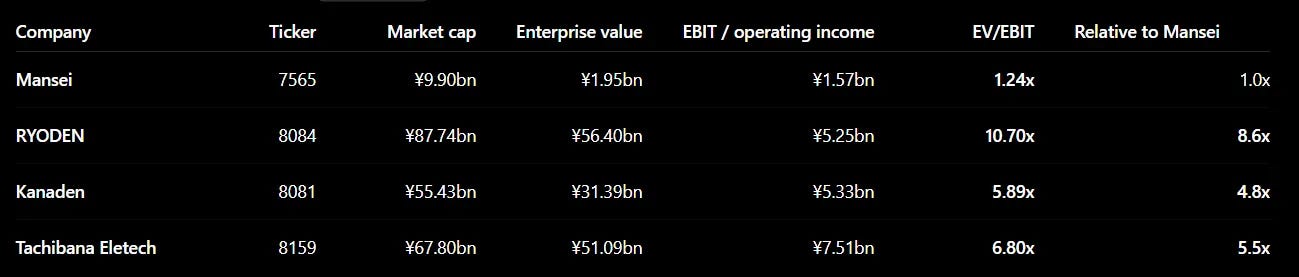
Mansei has been willing to buy back stock in the past, and it recently made an acquisition from Mitsubishi Electric that should improve profits in the coming year. Disclosure around the acquisition has been practically nonexistent, which is unusual. The acquired business will begin contributing to earnings starting July 1, 2026, so we should see the impact beginning in Q2. The only hard number we have is the ¥1.2bn purchase price. The company remains cash rich, so deploying cash into almost anything sensible should be accretive, especially adjacent businesses from Mitsubishi Electric.
Nippon Pigment (4119)
I added a couple hundred shares to my basket size bet around ¥5,000 (position remains average basket sized). Since my writeup, earnings have been resilient and have continued to grow after the transformative acquisition made in 2024. The company also released a mid-term plan targeting continued profit growth. They’re aiming for ¥3bn in operating profit by 2030 (up from ¥1.5bn in FY26. FY27 forecast is ¥1.7bn). The biggest risk in the initial writeup was merger integration. That seems to be going well.
Takigami Steel Construction (5918)
This one is looking like a value trap. Since my writeup, the company took out a potential activist by buying back the activist’s shares. Unfortunately, only part of the block was repurchased by the company. Much of it was bought personally by insiders, further cementing their control. Still, the company itself bought back about 7% of shares outstanding, which was extremely accretive.
While value trappy, I still hold this one as their securities portfolio has continued to grow in value. Rental real estate continues to perform as well. The core business itself remains bad, but has been marginally profitable. This company is basically a basket of securities and real estate at this point.
The stock closed today at ¥7,110. For that price, you get ¥23,691 per share of:
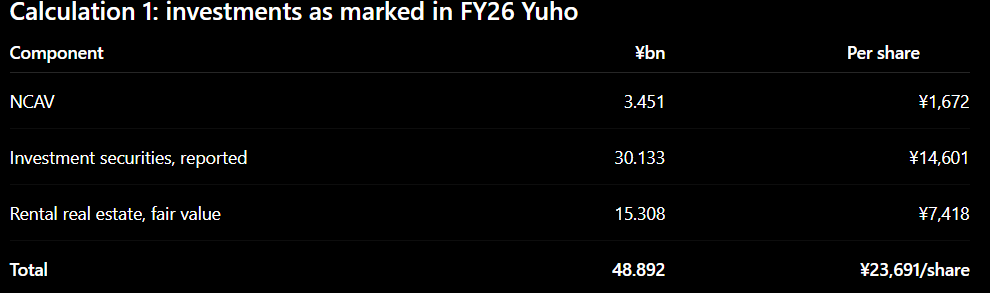
Since my initial writeup, the value of NCAV + investment securities + rental real estate has increased more than 20%, while the share count has fallen by about 7%. The investment securities are marked at March 31, 2026 values too, and they have since increased in value.
Yes, this is a value trap. But dang is it cheap. I am not buying more, but I am happy to sit on what I own. It is very illiquid and likely to go nowhere for years. The dividend yield is only 1.4%, so this remains only a basket-sized bet.
Disclosure: I own shares in all the securities mentioned in this post. These securities could be sold at any point in time without prior notice. These are all small positions as part of a broader basket of cheap Japanese companies so I haven’t dug too deep into any individual name. If I missed anything important, feel free to share in the comments. None of this is investment advice. Everything in this post is my own opinion and I could be wrong. Do your own due diligence.
No posts
Comments
Nothing yet. Say the first thing.
Sign in to join the conversation.