
Share Price: ¥4,815
Market cap: ¥53.2 billion
NCAV+Investments: ¥40.2 billion (Market values the company at just ¥14.4B ignoring non-controlling interests).
Non-controlling Interests: ¥9.2 billion
Nippon Carbon (5302) is a specialty carbon materials manufacturer founded in 1915. It’s priced as a slow-growth industrial legacy play at roughly 1x Book Value and ~13x FY24 & FY25 earnings. While the core carbon business isn’t terrible, it’s not particularly exciting, but 1x book seems fair given the high dividend (4.2%). The upside comes from the Silicon carbine (SiC) fiber division:
The SiC fiber position is the growth engine. Through its NGS Advanced Fibers JV (50% Nippon Carbon / 25% GE Aerospace / 25% Safran), the company holds an entrenched, qualification-moated position in Silicon Carbide continuous fiber which is the critical material enabling the shift from metal alloys to Ceramic Matrix Composites (CMCs) in jet engines. This is currently a small business, but has immense upside.
Investors are buying a profitable, cash-rich carbon materials business at a reasonable price, with a free call option on non-linear aerospace growth. The core business is not nearly as cheap as most of my writeups, but the 4.2% dividend protects our downside as Japanese investors love dividends and a “stable dividend policy” will keep it steady even in bad years. P/E fluctuates between 12-20x depending on how well the core carbon business performs, which means this isn’t particularly cheap on earnings or assets alone.
The market seems to give the company little credit for the aerospace business. The stock is only up 18% over the last 5 years (more if we include the sizable dividend).
This one isn’t a deep value pitch, but I own this because I’ve had success with aerospace adjacent names in the past. Another reason I like this company is that it’s a sleepy name that few people follow or care about. I couldn’t find any mentions on English X or Substack.
The Core Business: Fine Carbon & Electrodes
The “Carbon Products” segment (¥32.40 billion revenue, ¥2.99 billion operating profit) breaks into two distinct businesses:
Fine Carbon (¥20.23 billion revenue, down from 23.7 billion last year): High-purity isotropic graphite for semiconductor manufacturing equipment (susceptors, heaters), solar panel production (CZ pullers), and Li-ion battery anodes. This is a higher-value, structural growth market driven by semiconductor infrastructure buildout, not steel cycles. The company has been investing into this segment to be less reliant on graphite electrodes. Management attributed the sales decline to stagnation of power semiconductors (EV market).
Graphite Electrodes (¥12.17 billion revenue, up from 10.63 billion last year): UHP electrodes for Electric Arc Furnace steelmaking. Cyclical and currently facing headwinds from Chinese oversupply, but cash-generative. Growth came from strong exports to North America despite U.S. tariffs.
Carbon products revenue was down 5.7% YoY and operating profit declined 42.5% year over year. This is based on full year results which were released on February 10. The bad news here is that FY26 profits are expected to be weak. FY26 earnings are forecast to come in at just ¥244.19, which gives us a forward P/E of nearly 20. This may prove conservative though as it’s based on a USD/JPY assumption of 145. A weaker yen will boost their profits.

The Growth Engine: SiC Fibers (NGS Advanced Fibers)
NGS Advanced Fibers is a consolidated JV between Nippon Carbon (50%), GE Aerospace (25%), and Safran (25%).
FY2023: Revenue ¥2.3B, Operating Profit ¥508M (22% margin)
FY2024: Revenue ¥2.7B, Operating Profit ¥855M (31% margin)
FY2025: Revenue ¥4.1B, Operating Profit ¥1,480M (35.8% margin)
SiC fibers are still a small part of the business, but it’s growing more meaningful. Keep in mind though, only half of net income from this division belongs to Nippon Carbide.
SiC fiber CMC parts run at much higher temperatures than metal alloys while being far lighter and requiring less cooling air, improving thermal efficiency, lowering fuel burn, and boosting durability in the hottest engine sections. In aerospace, where material certification takes decades, being “designed in” to the GE/Safran engine architecture is a formidable moat. Competitors like UBE (Tyranno fiber) exist, but Nippon Carbon’s “Nicalon” fiber is the qualified material for this ecosystem. It was essentially locked into the ecosystem over a decade ago because it beat out all other competitors. The engine makers themselves also own a direct stake in Nicalon through their minority ownership in the NGS subsidiary.
Near-Term Catalyst: GE9X Volume Ramp (~2027)
Current NGS revenue is driven by the CFM LEAP engine (737 MAX / A320neo), which uses SiC fiber for only one component: static high-pressure turbine shrouds. The GE9X (powering the Boeing 777X, ~2027) expands CMC usage to five hot-section components: inner and outer combustor liners, Stage 1 shrouds, Stage 1 nozzles, and Stage 2 nozzles. The shift from one small static part to five parts (including large cylindrical liners) implies roughly 5x more SiC material per engine.
Let’s not get too excited though as the GE9X won’t approach LEAP volumes. LEAP delivered 1,802 units in 2025 and targets 2,500/year by 2028. The 777X has ~610 orders with Boeing expected to produce 36–60 planes/year initially (70–120 engines/year). Higher material content per unit helps, but this alone won’t transform the P&L. Near term profits from this division are tied mostly to the LEAP engine, but additional volume from GE9X will certainly help.
Long-Term Blue Sky: The RISE Engine (Mid-2030s)
The real upside is a decade out. The CFM RISE engine, the planned successor to the LEAP, is expected to use ~10x more SiC material per engine, including turbine blades. SiC blade feasibility was de-risked by GE’s XA100 adaptive cycle engine, which successfully demonstrated the technology before losing the F-35 re-engine competition. That XA100 tech is now the baseline for the NGAD (6th-gen fighter) engine program, further de-risking the RISE application.
All competing next-gen engine programs will likely use more SiC, but the blue-sky scenario is specifically if the GE/Safran RISE wins, as they have been the most aggressive CMC adopters. If a competitor wins, NGS growth will be more linear.
There’s huge potential in military application too, which is why GE opened their own factory in Alabama to produce this material (to qualify for DoD contracts and also meet rising demand). In fact, The Air Force provided $21.9 million in funding for GE to produce this material domestically, and GE explicitly said that they license the technology from Nippon Carbon’s NGS Advanced Fibers subsidiary, but unfortunately they haven’t provided any details on the terms of the license.
I’m not going to try and quantify the upside in the NGS subsidiary as I have no idea what it will look like, but it seems clear that modern engines are going to be using a lot more of NGS’s SiC material.
Valuation & Downside Protection
Nippon Carbon trades at ~13x FY24 and FY25 net income (¥4 billion & ¥4.8 billion). Backing out net current assets and investments, the implied price for the actual operating business is only ~¥14.4B. Adding back non-controlling interests brings it to ~¥23.4B, or roughly 6x FY 24’s net income. It’s even cheaper on FY25’s net income (¥4.8 billion), but this figure included a one time gain. Management’s FY26 net income forecast is just ¥2.7 billion though. 20x FY26 net income is expensive, but earnings are volatile in their line of business, with the company earning gangbuster profits of ~¥10 billion in both FY18 and FY19.
The ¥200/share annual dividend (4.2% yield) has been stable since 2019 and the company’s latest midterm plan reaffirms the “stable” dividend policy alongside a flexible buyback program. For a Japanese investor base that prizes yield, this provides a meaningful floor under the stock price. Alongside full year earnings on February 10 the company announced a 5.7% share buyback, the first repurchase plan in over a decade.
I also want to emphasize that Nippon Carbon seems to be a dynamic company that isn’t just resting on their laurels. The fact that they shifted their core business to growing industries and is working on cutting edge materials with GE and Safran is proof that management is ambitious.
Conclusion:
Nippon Carbon is reasonably cheap and has exposure to the booming aerospace business. You’re paying ~15x last 3 years average earnings for a semiconductor and steel supply chain company with a free option on the most significant material science shift in modern aviation. The 4.2% dividend yield and recent buyback limits downside, and the SiC fiber position which is entrenched, high-margin, and tied to a multi-decade aerospace transition offers upside. The core business is cash and securities rich, backing those out gets me comfortable with the valuation on the core carbon business. I own a 1.5x basket sized position here.
Disclosure: I own shares in Nippon Carbon (5302). The security could be sold at any point in time without prior notice. This is a small position as part of a broader basket of cheap Japanese companies so I haven’t dug too deep into this name. If I missed anything important, feel free to share in the comments. None of this is investment advice. Everything in this post is my own opinion and I could be wrong. Do your own due diligence.
Appendix:
GE Aviation and Ceramic Matrix Composition Revolution (Neat video showing the evolution CMCs in engines)
Major Shareholders:
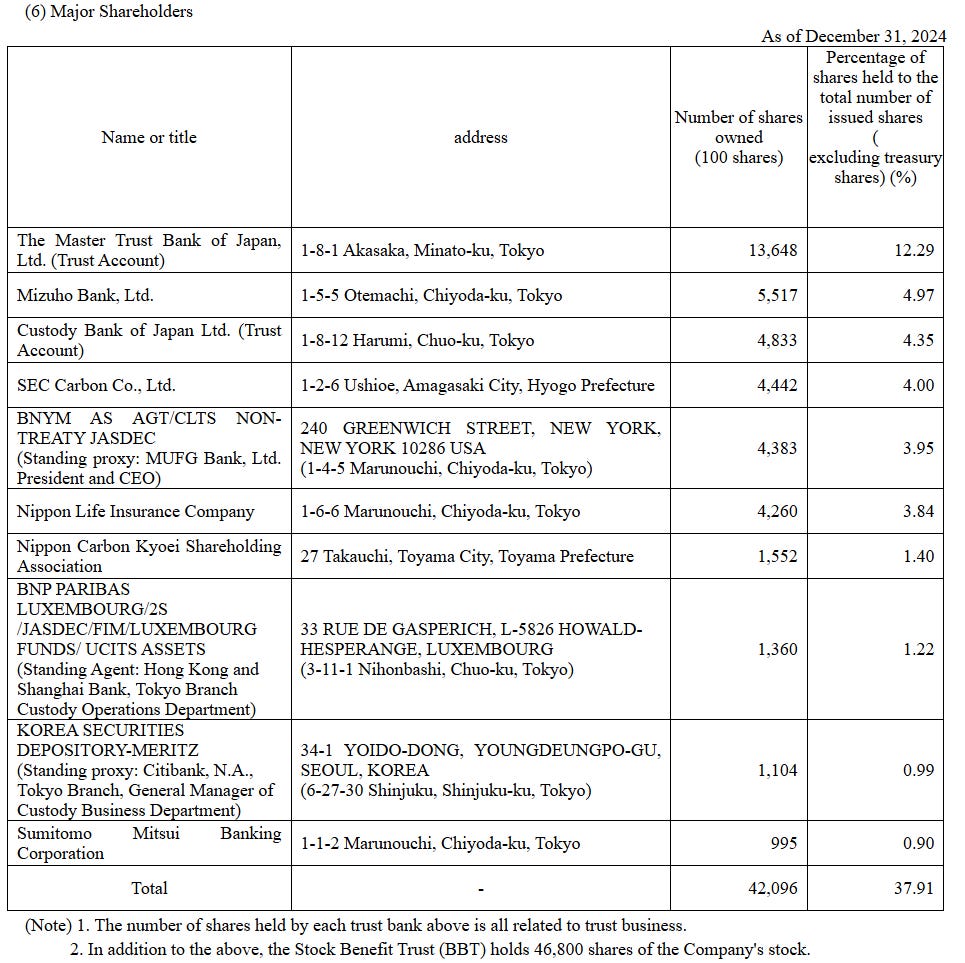
There is no major controlling shareholders here. It looks like ownership is diverse which means activism is possible, but with management maintaining a sizeable dividend and starting up a buyback program, I don’t think an activist is needed. The company does have a poison pill in place to prevent anyone from acquiring more than 19.99% of the company.
Worthwhile reading:
No posts
Comments
Nothing yet. Say the first thing.
Sign in to join the conversation.