
Share price: ¥1,480
Market cap: ¥13.3 billion ($83.4 million)
P/E (FY25): ~10.7x
Dividend: ¥60 (4%)
NCAV: ¥12.76 billion
NCAV+Investments: ¥15.55 billion (¥1,708/share)
Art Vivant (TYO: 7523) is a small-cap Japanese company that primarily sells art, especially limited-edition prints and illustration/anime-style works, through traveling exhibition-sales events across Japan. It controls the full value chain, from artist sourcing and product development to framing, sales, delivery, and after-sales service. The company also operates a smaller, non-core hot yoga business. The company also has a highly profitable finance arm that allows for customers to pay in installments. The finance segment serves both Art Vivant’s own customers and outside merchants, but the company does not disclose the current mix
1 sentence thesis: Art Vivant is a cheap adjusted net-net trading at roughly 11x estimated earnings and below the failed ¥1,670 per share MBO price, despite an activist building a 40.13% stake through aggressive open-market purchases, including while the stock traded above ¥2,100.
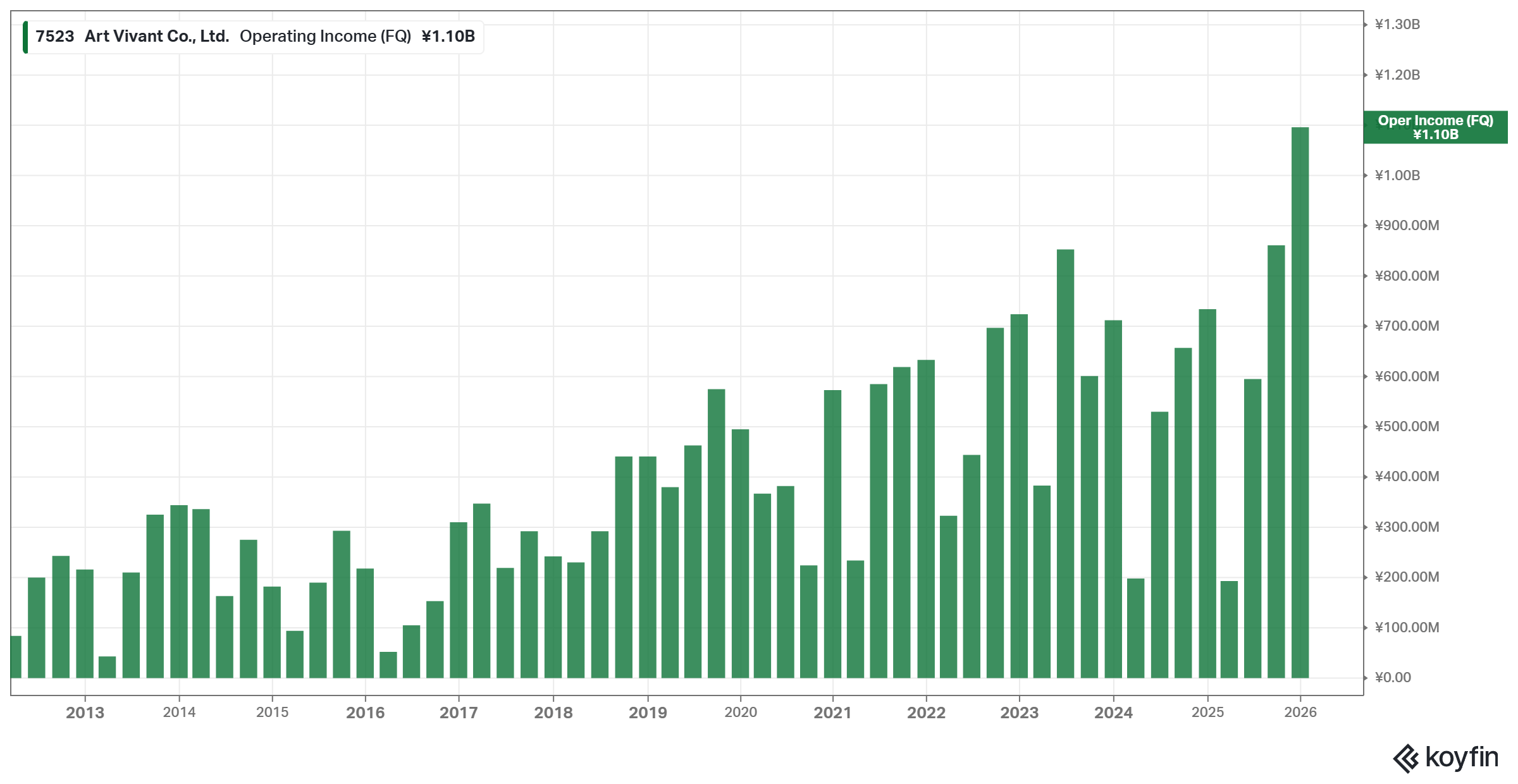
At today’s price, Art Vivant is effectively a net-net if investments are included. More importantly, the business is growing. The most recent quarter produced the highest operating profit in company history at ¥1.1 billion, at least as far back as 25 years of Koyfin data. Industry tailwinds like the increasing popularity of Japanese culture like anime are also on our side.
Through Q3, operating profit is already ¥2.55 billion versus a full-year forecast of just ¥2.1 billion, implying management expects a Q4 loss. That would be unusual, as Art Vivant has not reported a quarterly loss in 15 years. Management says it is keeping guidance unchanged because it expects to record expenses, losses, and valuation adjustments during the year-end closing process.
Founder Katsumi Nozawa, who owns 36.17% of the shares mostly through his asset management company, launched a ¥1,670 per share takeover bid on August 29, 2025. It failed after Hiroyuki Maki, president and CEO of Buffalo Inc. (TYO: 6676), disclosed a 33.97% stake on October 24, 2025 and chose not to tender, preventing the offer from reaching its minimum acceptance threshold. Maki’s initial September 2 filing described the investment as friendly, but after additional open-market purchases his stance became more control-oriented on October 22. By December 11, his stake had risen to 40.13% and the stated purpose had become “to acquire management control and participate in management.” See Appendix for the full disclosures in the large shareholder reports.
Maki built his stake through aggressive open-market buying, mostly at or above the ¥1,670 tender price. Regulatory filings show he was still purchasing shares in November 2025 even with the stock above ¥2,100. His cumulative cost basis appears to be about ¥1,677 per share.
On March 30, 2026, MAGO Creation, the holding company of artist and entrepreneur Mago Nagasaka, disclosed a 7.16% stake. Before that filing it had remained below the 5% reporting threshold. The increase came from the purchase of a 249,600-share block, or 2.73% of the company, at ¥1,680 per share, ¥10 above the original tender price and about 12% above the market price at the time.
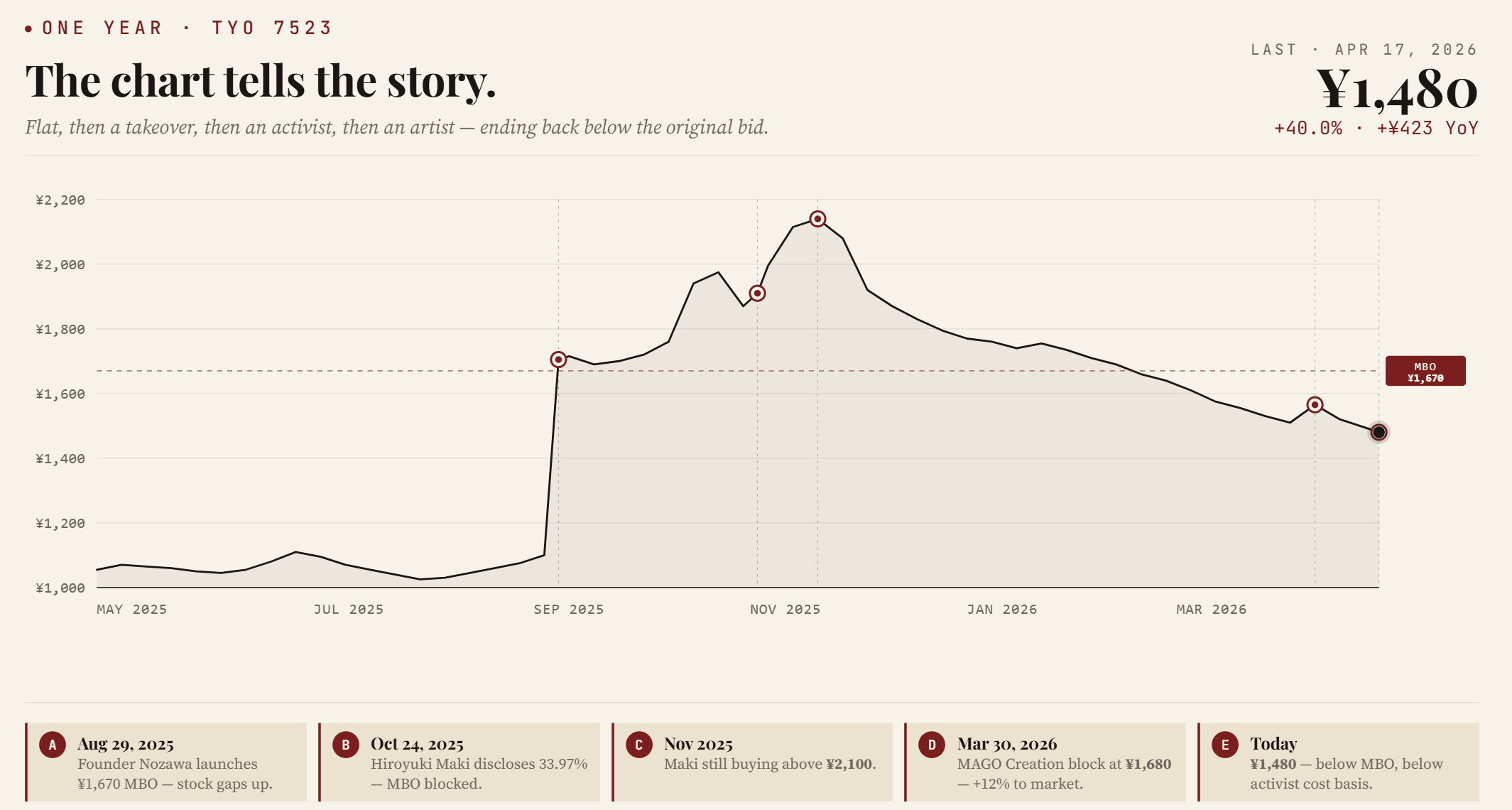
An external activist bought 40.13% of Art Vivant at prices above the original tender offer. Then, as recently as March 2026, an industry participant paid a 12% premium to the market price to acquire a block. Add together the founder’s roughly 36% stake, the activist’s 40%, and the artist’s 7%, and about 83% of the company is shares accounted for, leaving the float very tight.
So what’s going to happen next? I have no idea. But owning Art Vivant at below the initial tender price looks like a reasonable bet to me. Maki is a wealthy operator whose MELCO Group stake plus personal holdings amount to about 49% of Buffalo (TYO: 6676). He directly owns stakes in various other companies too. As CEO of Buffalo, Mr. Maki has implemented shareholder friendly policies over the years including large buybacks and dividend increases, which contributed to Buffalo’s over 400% stock appreciation in the last 2 years. Industry tailwinds played a big part in that too.
You do not need a DCF to see that Art Vivant is cheap. After backing out NCAV and investments, the market is valuing the operating business at less than free, even as the company posts its highest quarterly operating profit in 25 years. This is a cheap stock with improving momentum and an activist trying to gain control.
Conclusion:
I own an 2x average basket sized position here. The bet is simple: either the company remains listed and I collect a roughly 4% dividend yield, or it is taken private at a price above the last tender offer. A take-under is always possible, but the key activist has a record of shareholder friendly actions, at least as his own company. If Art Vivant stays listed, I think the improving fundamentals should eventually be reflected in the share price. What makes this compelling is that this is net-net if we count investments as current assets and the activist situation could get interesting. The business is also improving.
Worth emphasizing that while the market cap here is a bit larger than some of the nanocaps I write about, the float is much smaller.
While I still watch anime on occasion and love the anime aesthetic in video games, these artworks aren’t cheap! Still, perhaps I’ll buy one if this investment works out. The company has stores in Akihabara, Nihonbashi, and Nagoya. I’m fond of this piece on the global homepage for their anime illustrations/print business:

Update July 10, 2026: The company announced a new MBO at ¥1,900/share which is near guaranteed to succeed as our activist, Mr. Maki, agreed to tender all of his shares. While cheap, this was still a low risk good IRR bet given we got in below the old MBO price.
Disclosure: I own shares in Art Vivant (7523). The security could be sold at any point in time without prior notice. This is a small position as part of a broader basket of cheap Japanese companies so I haven’t dug too deep into this name. If I missed anything important, feel free to share in the comments. None of this is investment advice. Everything in this post is my own opinion and I could be wrong. Do your own due diligence.
Appendix:
Art Vivant select financials visualized:
Progression of Maki’s ‘Purpose of holding’ in large shareholder reports:
September 2, 2025 (15.58% holding):
The submitter respects Katsumi Nozawa, the founder and representative director of the issuer, as an art collector, and intends to hold the shares long-term as a friendly shareholder, regardless of whether the issuer remains listed or goes private. The submitter will not request an increase in the tender offer price for the ongoing tender offer. If friendly shareholder discussions take place between the tender offeror and the submitter, the submitter may tender its shares in the tender offer.
September 29, 2025 (21.7% holding):
We will maintain a stable holding position as a major shareholder, aiming not only to acquire a control premium but also to acquire management control. In addition to making important proposals, we may also engage in actions aimed at participating in management or similar actions in relation to art-related businesses (purchase and sale of prints, paintings, and works of art) and the management and disposal of contemporary art works held by the issuer. If the issuer proposes or announces a proposal that restricts shareholders' rights, discriminates against them, or is similar to such a proposal, we may oppose it. Please note that the shareholder negotiations between Orsay Co., Ltd., the tender offeror, and its representative director, Katsumi Nozawa, regarding the tender offer for which a tender offer statement was filed on September 1, 2025, were not concluded and the submitter will not tender shares in the said tender offer.
November 10, 2025 (39.95% holding):
With the goal of gaining management control and participating in management, we will hold the shares stably for the long term as the largest shareholder. In addition to important proposals (including, but not limited to, those related to art-related businesses and the management and disposal of contemporary art works held by the issuer), we may engage in activities aimed at participating in management or similar activities. If the issuer proposes or announces a proposal that restricts the rights of shareholders, discriminates against them, or is similar to such a proposal, we may oppose the proposal.
Shareholding jumped to 40.13% on December 11. Purpose of holding remained the same as November 10.
No posts
Comments
Nothing yet. Say the first thing.
Sign in to join the conversation.