
In prediction-market circles, a “bond” is a contract trading very close to $1 because the outcome looks decided:
The game is in the 9th and one team is up eight runs
The election has been called
The movie has already premiered, whatever.
A “bonding bot” systematically buys these near-certain contracts and collects the last few cents at settlement. Institutional bond traders typically call it pull to par, as you’re buying something at a discount to face value and clipping the yield as it matures.
The math on it is honestly seductive, at first:
Buy YES at $0.98.
Contract settles at $1.00.
Collect $0.02, roughly 2% on capital, often within minutes.
Recycle the capital into the next “decided” event.
Repeat across every market on the board, every night.
Run that loop across a full slate of outcomes and the equity curve looks gorgeous. Straight line up, win rate north of 99%, the kind of thing that screenshots well.
The problem, however, is the skew. When you buy at $0.98, you’re risking 98 cents to make 2, so one miss wipes out roughly 49 perfect trades.
The payoff profile (chart below) is a long staircase of two-cent steps up, and a trapdoor that gives back all of them at once:
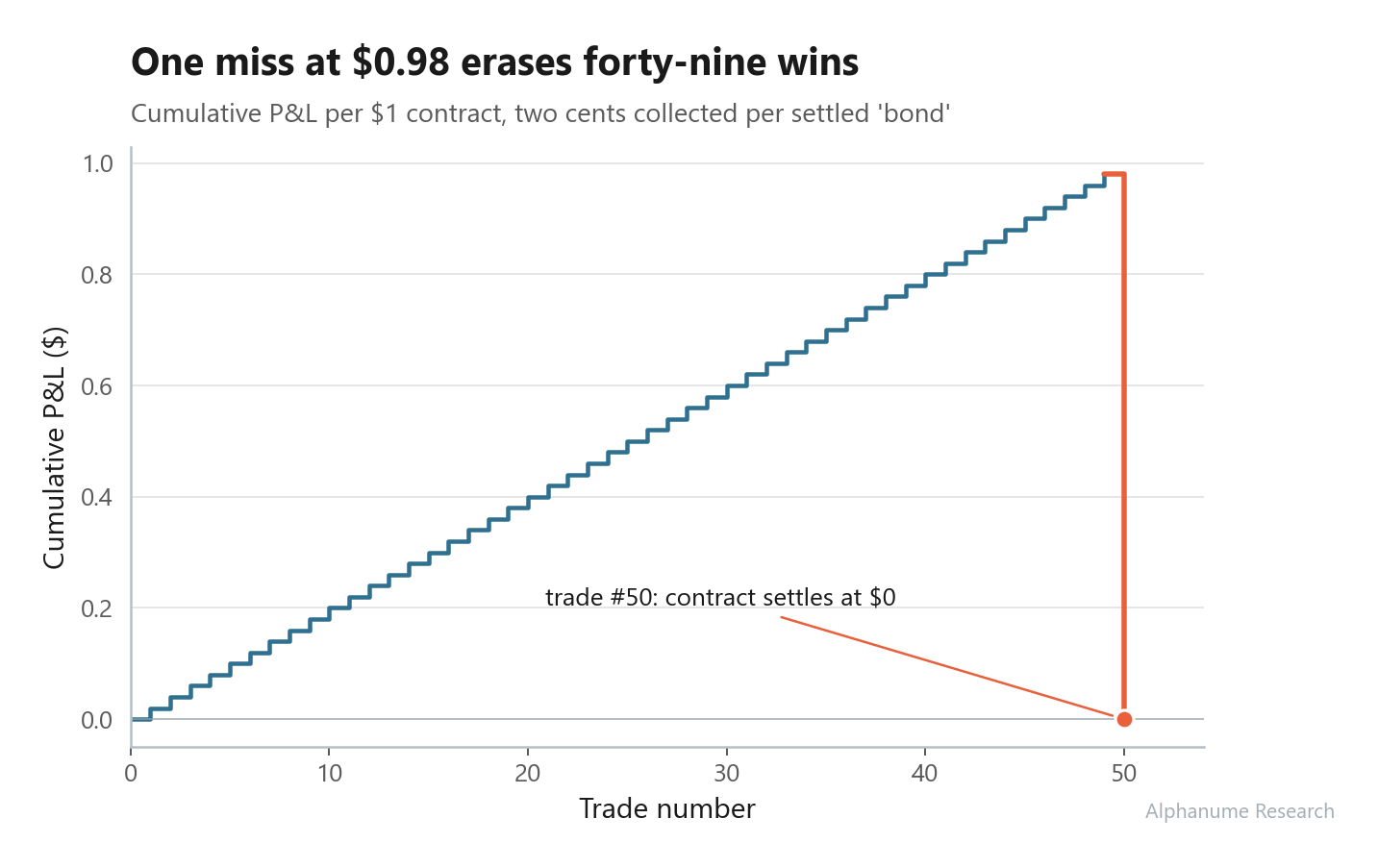
It’s the same profile as selling deep out-of-the-money puts: a long stream of small wins funding one occasional catastrophic loss.
On July 24, that trapdoor opened at Oracle Park, a little after 1 a.m. Eastern.

DataBasedBets@DataBasedBets
MULTI-MILLION DOLLAR RINSE: Full single-post summary for people with normal sleep schedules of the most insane rinsing of bond bots I've seen firsthand, in which PM bonders appear to have lost 7 figures🤯 Scene: Last MLB game of the night (Giants vs Angels) bottom of the 10th


DataBasedBets @DataBasedBets
I'm now processing the scale of what happened. If you have a friend with a bonding bot, please check in on their wellbeing because bonders lost MILLIONS, many while enjoying their Friday / sleeping Kalshi spread volume at 1:15am: 11,149 Kalshi spread volume at close: 5 million🤯 https://t.co/hnyhNKokFF
1:40 PM · Jul 25, 2026 · 205K Views
37 Replies · 19 Reposts · 249 Likes
We’re not a sports publication, so to keep things high-level:
In the final inning of a tie game, Team A made a play that visually won it by multiple runs
Data feeds posted the multi-run final and bots rushed the “win by 2+” contracts up to $1
The official scoring was subsequently corrected under an MLB rule
The “bond-like” contracts closed the market at $0, with aggregate bonder losses in the seven figures.
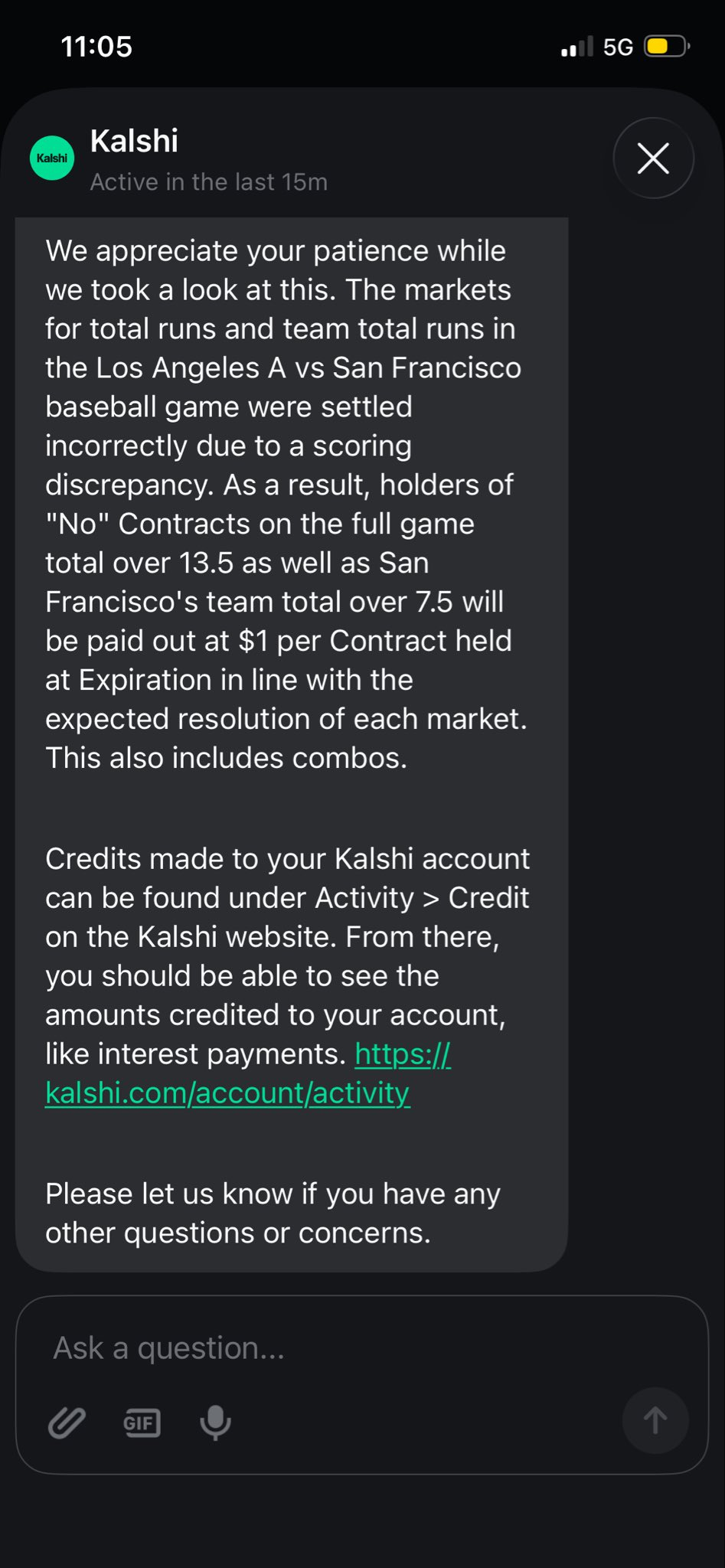
This was the last game of the night, so a good chunk of that carnage likely happened while the owners of those bots were asleep. Kalshi appears to have paid traders on both sides afterward, though there’s no official postmortem on the mechanics yet:
Now, believe it or not, even after a face-plant like that, running one of these can be genuinely profitable with a bit of sophistication.
A naive bonding program essentially buys anything with a high price:
while markets_open:
    for market in board:
        if feed_status == "final" and ask < $1.00:
            buy(everything)
In contrast, a more sophisticated operator knows which two cents are actually free, and it generally doesn’t even take that much.
Comments
Nothing yet. Say the first thing.
Sign in to join the conversation.