
“Hey, Claude, I want to create the highest-performing rain jacket possible. Please provide a comprehensive checklist of everything I need to do, including design steps, fabric suppliers, factories, and any other tools and resources I would need to complete the project.”
At first glance, what Claude gave me was amazing.
And, if I had no idea what I was doing in the fashion industry, I might have believed what it churned out was a professional document with shortcuts to creating the perfect product.
But I do know what I’m doing, and I’m going to point out all the holes in its plan.
This is what terrifies me about AI: it gives us just enough professional-sounding information to make us feel like we can do anything, but when you start following the steps, you realize they are mostly fluff that leads nowhere. And that all those people on social media who are making you feel bad because they are making millions by working 5 hours a week and you aren’t… were probably lying to you.
So, here is everything AI told me to do, and what I would do differently.
The product stack Claude recommended for my garment design process was Adobe, CLO 3D, and Gerber.
ADOBE
Adobe is getting easier to use with each update, but it’s still tough for a newbie. If you want to try using it on your own, you’re going to need to invest time in learning how.
Because of that, I recommend hiring someone cheap on Fiverr to use the program for you. Claude isn’t wrong to recommend this Adobe, because it is used in the industry regularly, but it isn’t necessarily going to make your life easier.
CLO 3D
I don’t love that Claude was pushing CLO 3D for digital pattern development and virtual fittings when, at the moment, that technology just isn’t there, IMO. I mean, look at the disaster that just happened for Nike at the World Cup.
GERBER
Gerber is often used to digitize or grade garment patterns. But it’s not just a computer program; you need physical equipment to do this, which is an investment.
Again, this is a skill that needs to be learned, not a simple solution. There are great companies I work with that will digitize your pattern and grade all your sizes for under $150 bucks.
Claude oversimplified the design process. Yes, it did share common industry tools to get the job done, but it forgot to mention that people spend years mastering them.
Claude recommended GORE-TEX for the waterproof membrane. This is a popular choice, but fyi, there has been some recent controversy around GORE-TEX and the toxicity of its products.
IMO, there are way more interesting waterproof membranes out there, and I’ll get more to that, and why Claude probably didn’t suggest them in just a minute…
For zippers, Claude suggested YKK. And, while I like YKK, again, since my goal is innovation, I wish it had shared some of the more niche zipper companies worth knowing about for a high-performance product.
The AI gave a few other suppliers, but they were all big names, and IMO had been marketed to death. Maybe to someone who had no idea what textiles were, the suggestions would sound cool, but to an industry insider, they were 10 years behind.
For my factory, Claude suggested Li and Fung, which I consider one of the wildest suggestions of the entire plan.
Li and Fung is one of the largest sourcing agents in the world; they work with almost every major brand. They are not interested in taking on my tiny order of 100-1,000 raincoats.
They also suggested factories in Taiwan, Portugal, and Vietnam, but again, these were completely inappropriate for the scale at which I am producing.
For testing and certification, which is super important when you’re creating a performance product, they suggested labs like SGS Global, Bureau Vistas, and Intertech. And, while yes, these labs can test your fabrics for performance, such as:
rain resistance
breathability
strength
and, a whole bunch of other things
It’s important to understand that testing is super expensive, and it’s actually your job as the brand to tell them what you want and need tested - you don’t just send your fabric to the lab and get a green check.
Also, the AI forgot to mention that most reputable suppliers will have this testing on hand for you to use, so you don’t need to repeat it (and pay for it).
Technically, yes, someone could make a raincoat using the supply chain and Claude's system suggestions. But they’d spend much more money than necessary and would likely be rejected by fabric and factory suppliers due to their smaller-brand needs.
I just read an amazing quote about AI the other day - AI is data, and data can only look backward. Creativity looks forward.
And nothing could be truer, especially when it comes to the world of fashion design and manufacturing.
This is the problem with AI-ifying your fashion brand. AI leans on the internet: it scrapes what’s most visible, so its suggestions are often outdated or the status quo.
If you want a truly new and innovative product, you have to go offline and explore where innovation is happening.
The first thing I would do if I wanted to create any type of product, including my hypothetical high-performing rain jacket, is attend a trade show.
Trade shows are the best places to meet industry professionals, learn from their experience, and discover cutting-edge technology that isn’t widely available yet.
For this rain jacket, I’d start at the Functional Fabric Fair.
And guess what? The next show is July 8–9 in NYC at the Javits Center!
***BTW, I am going to build this ultimate rain jacket in real time during the show, in my live stories, as I meet new suppliers***
And, if you want to meet me there, use this link below to get in for FREE!
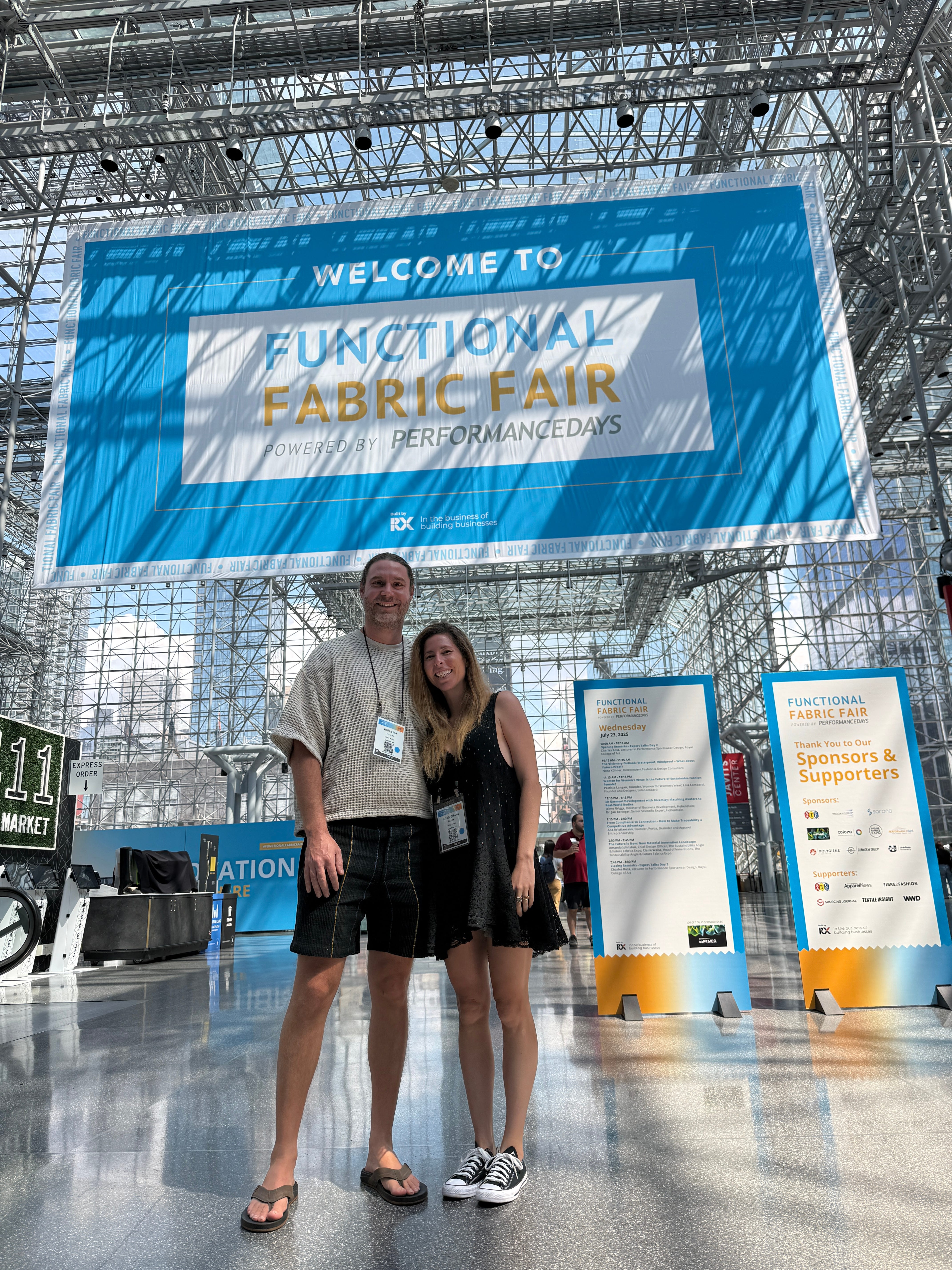
⬆️ Will and I last year at the Functional Fabric Fair show ⬆️
He is literally the definition of Instagram boyfriend running around filming me all day, and helping me come up with hooks and content ideas on the fly.
See you soon,
Melanie
This post was free for everyone because Functional Fabric Fair graciously sponsored it.
In the future, I plan to put my best content (think supplier contacts, how-to guides, and case studies) behind a paywall, with a very small $5 monthly subscription. Which I think is beyond fair for the value I provide.
If you’ve enjoyed reading and found it helpful, please consider subscribing.
I bet this brand is in your closet and you don’t even realize it…
It might be summer, but in fashion, we are currently designing winter 2027 - is this the warmest jacket in the world?
The easiest way to fix a zipper at home.
No posts
Comments
Nothing yet. Say the first thing.
Sign in to join the conversation.