
The DM’s
Yesterday I published the second article in my series about DJ Khaled. Within an hour, I received this DM on Substack. I’m not going to name the person because his identity isn’t the point.
Hey man I find it rather disappointing that your whole shtick is that you’re “telling human stories in the age of AI” and your articles are Claude generated
But he wasn’t finished. Minutes later, he sent another DM this time to the publisher of the magazine that had co-published the piece with me.
ALMOST GREENLIT is a reader-supported publication. To receive new posts and support my work, consider becoming a free or paid subscriber.
I wanted to make sure you were aware the Khaled article is like almost all Claude generated. I’ve enjoyed some of POWs non AI written articles so I’m disappointed this one is slop.
I was going to ignore him but after my publisher sent me a screenshot of that DM with a concerned note I gave in to my better angels and wrote him back:
Hey man, I write my own work and use Gemini for proofreading. I don’t even have a Claude account. AI detectors are notoriously unreliable, so relying on them to accuse writers is shitty.
There has been a viral claim that an AI detector identified a passage from Mary Shelley’s Frankenstein as AI-generated. The full story is more complicated and more revealing. One writer tested the passage across seven detectors: six identified it as human, while ZeroGPT called it 99 percent AI.
The fact is none of these programs has access to the only thing that would actually settle the question how the document was made.
Regardless, he wrote back:
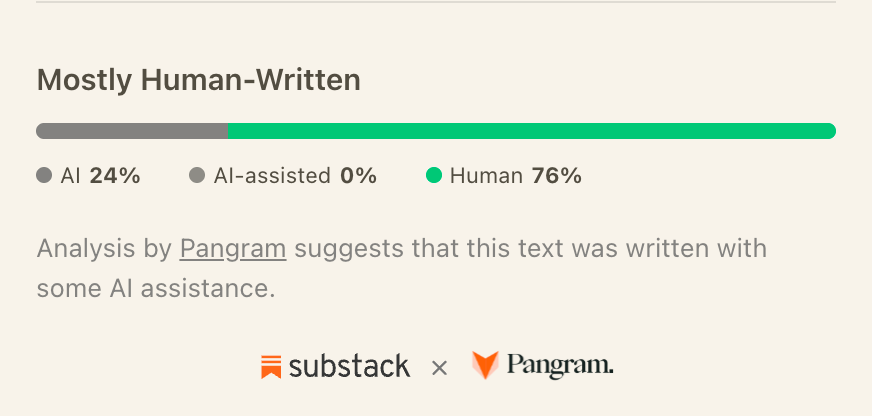
Pangram is so reliable that substack as a platform partnered with them, there are dozens of peer reviewed studies, etc.... also come on, you’re telling me this isn’t the most AI written paragraph ever?
“Not just a funny DJ Khaled movie. Not just a self-help movie. A real ending, a journey and a reason for the film to exist beyond famous friends, expensive cars, old footage, and Khaled yelling motivational things at people from increasingly luxurious locations.”
I wrote that paragraph. Myself. So apparently I wrote “the most AI-written paragraph ever.” I wasn’t sure what to do with that. Was I supposed to rewrite my own sentence until a stranger and the machine he had appointed as judge believed I sounded sufficiently human?
(Also, the program I am writing in (Pages) tells me there should be a comma after “journey” in the above sentence and I’m pretty sure if AI had written it it would not have made that mistake.)
Then he sent this:
if you don’t care about your integrity as a writer, fine, sell out for substack bucks, but given your response it seems like you care and I hope you have the internal pride to do the right thing here
If this is selling out, I fucking suck at it. What I earn from Substack each month covers roughly one-tenth of my rent. I’m not complaining. I started this because I wanted to write for fun and was bored over the summer. But honestly “Substack bucks” are not currently threatening to corrupt me.
The more interesting phrase was “do the right thing.”
What exactly is the right thing?
If your answer is, “Stop using AI entirely because it’s bad for the environment and contributes to climate change,” I see your point. I respect your point. But that wasn’t his point.
His point was that I had used AI to generate an article and passed it off as my own. I hadn’t. Still, I thought there might be a real conversation here about what counts as writing, what counts as assistance, and what readers deserve to know.
So I offered him an interview.
How about I interview you for my Substack over Zoom and you tell me what you think, and I detail the ways I use AI?
He responded:
I wanna be clear that I’m not anti AI on an abstract level, AI research is my day job lol and I use claude nonstop for productive tasks
Record scratch.
This motherfucker worked in AI. AI paid his rent. 100% of it I assume. And when I googled him I discovered he was the Head of Artificial Intelligence at a large company in San Francisco
That didn’t automatically make his criticism invalid. In fact, it made the boundary he was policing fascinating. Especially to a documentary filmmaker obsessed with the complexities of humans. He wasn’t against using AI, he was against using it to replace a writer and pretending otherwise.
Fair enough. So was I.
The problem was that he had already decided I’d done exactly that. Based on a detector score, he questioned my integrity, called the work slop, and contacted my publishing partner before reaching out man to man and asking a single sincere question about my process.
He continued:
also, there is just a flood of AI content everywhere and why I came out of the gate so hard (I’m normally not in a habit of being mean to strangers on the internet lol) is that I, and others, have this like pent up frustration about it bc we’re seeing the same shit all over… and then the other side is that as much as we wanna blame big tech and sam altman and all that (which I think we should in many ways...) we gotta hold ourselves to a certain standard too
Okay. Now we were somewhere more interesting.
He was angry about the same thing I was angry about: a world filling up with synthetic garbage while the people and companies responsible tell us it’s progress. I made an entire documentary about this called Deepfaking Sam Altman. I had thoughts. He had thoughts. Maybe we could get past the accusation and talk about the larger nightmare.
I told him I thought it could make a good interview. He could explain his position, and I could explain exactly how I use AI in my writing.
He declined.
im not a really public guy.
Was his reasoning. This struck me as BS. He had a public-facing personal website and was public enough to accuse a stranger of fraud and contact that stranger’s publishing partner, but not public enough to discuss the accusation on the record.
GETTING REAL ABOUT MY AI USE
Since he didn’t want to have the conversation, I’m going to lay out exactly how I have been using AI to make these posts.
1. Searching and cross-checking my archive
For each case file, including the DJ Khaled series, I begin with compiling the written record of the project: emails, texts, schedules, pitch documents and all other communications I can find. This takes many many hours to do. There can be years of material. My memory isn’t perfect, and I’m writing about famous people and people in my own industry. I need to get the details right. But more importantly: I also need to be able to produce the receipts if somebody says I got them wrong.
I use an LLM to help search and cross-reference that archive. But the LLM’s answer is not the receipt. If it points me to an email or text, I return to the original and verify it myself. It is a retrieval tool, not a witness and we’re all smart enough to know at this point LLM’s make mistakes.
I also use AI to challenge factual claims in a draft. For example, In my first draft I wrote: “DJ Khaled has never stood up to support Palestine and has completely ignored the Gaza conflict.”
That is a sweeping assertion, and I know it. So I run the draft through Gemini and ask it to challenge my factual claims. In this case, it tells me the statement is too absolute to verify and suggests qualifying it which seems wise if my goal is not to get sued.
So I rewrite it:
“As far as I know, Khaled has never used his platform to speak up for Palestine in the way I’d hoped. Maybe I missed a post. Perhaps he does things quietly in private. But publicly? Nada.”
Gemini isn’t confirming the truth or clearing me legally but it is flagging a claim that I need to examine more carefully.
2. Transcribing interviews
For the Khaled piece, I interviewed director Amman Abbasi. I recorded the conversation as a voice memo on my iPhone, uploaded the audio to Gemini, and asked it for a transcript.
This is enormously useful and saves hours of labor. It is also fallible. Transcription tools can mishear words, merge thoughts, and sometimes turn a summary into something that looks like a direct quotation. It also frequently attributes a line of dialogue that Amman said to me, and vice versa. Any quotation I publish I have to check against the original audio.
3. Proofreading, grammar and spelling
Sometimes I ask Gemini to flag spelling and grammatical mistakes. This is the least important use to me because the case files are supposed to sound like me, and “correct” prose is not always better prose. But I do enjoy spelling shit right most of the time.
4. Miscellaneous utility
I have asked AI questions like:
How far is Miami from LA?
Scandalous, I know.
The DJ Khaled articles, like all my articles, began in Pages. The experiences were mine, the memories I lived, not some robot. The reporting, interviews, judgments, jokes overall tone and original sentences - all mine. AI helped me search, transcribe, challenge claims and proofread. It did not generate the Khaled article.
That distinction matters to me.
“IT’S HONESTLY A NIGHTMARE”
Before publishing this piece, I asked a friend for guidance. Unlike me he is a professional writer, has published numerous books, articles for major magazines and does this for a living. We started talking about AI use in writing, and I asked him over text:
What do you, as a writer and editor, suggest we all do about this?
He responded:
I don’t know honestly
It’s super fraught
I used ai to transcribe my interviews
Because they wouldn’t pay for real transcriptions
But it wound up summarizing a lot of stuff I didn’t want it to summarize and when I used it thinking I was directly quoting, it flagged it as ai
It’s honestly a nightmare
Can ruin careers for false positives
I had literally a thing with one of my writers about this over the weekend. Same thing happened.
By “the same thing,” he meant that someone had accused one of his writers of using AI and called the writer out publicly.
Then he wrote:
I’m not sure what the move is. We are in the singularity.
That’s where we are, ladies and gentlemen. Even the most professional writer I know has no clue what the move is.
And then this article made the problem even messier.
THE PART WHERE IT GETS COMPLICATED
After finishing the first draft, I gave it to AI and asked a very direct question:
Do I come off as too much of an asshole here?
It said yes.
More precisely, it said I was justified for most of the piece, but that one section turned vindictive. In that section, I had investigated the man who sent the DMs and made fun of his whiteness, his masculinity and something he had written online about pomegranate salsa.
The AI told me to cut it.
It was right.
Which means this article is AI-assisted in a much more direct way than the DJ Khaled article was.
If I hid that fact, my accuser would have a point.
He was wrong about how I wrote the Khaled piece. But the question underneath his accusation where assistance ends and authorship begins is harder than I want it to be.
My line, for now, is this: using AI to retrieve documents, transcribe interviews, challenge a factual claim or catch a typo does not make the machine the writer. Asking it to write an article is different. At that point, it is producing the prose, and the reader deserves to know.
I’m pretty sure I could rewrite every single sentence of this article again in Pages and some of its suggestions will remain embedded in the architecture even after all the words change. And Pangram will flag it as AI written or assisted.
I don’t have a universal answer. I don’t think anybody does.
What I do know is that people’s careers will be damaged in both directions: for using AI and admitting it; for using AI and hiding it; and for not using AI but being publicly accused by someone screenshotting a detector score and yelling PROVE IT in their comment section.
The standard cannot simply be “the machine said so.”
For now, the most honest thing I can do is tell you what I did, tell you where the machine entered the process, and let you decide how much that matters.
That answer will probably change.
Everything else is changing by the day.
That is the one thing I truly do know.
ALMOST GREENLIT is a reader-supported publication. To receive new posts and support my work, consider becoming a free or paid subscriber.
Comments
Nothing yet. Say the first thing.
Sign in to join the conversation.