
After Miami, Amman went to the airport and I went to the ocean.
Neither of us said, “That went great.”
But neither of us said, “That is dead,” either.
I went back to Los Angeles and decided the meeting had just been… incomplete. Khaled had been guarded. He had not really engaged with the pitch had acted like my DSLR was a weapon given us one tiny flash of interest when Amman brought up Palestine, then immediately withdrawn.
But he had not said no.
More importantly, he had not even seen the finished deck yet.
That became the story I told myself: He does not dislike the movie. He just has not seen the movie.
Which is a very comforting thought when the alternative is: Maybe the person whose documentary you want to make does not particularly want you to make it.
So Amman and I got back to work.
We rebuilt the deck. We made it bigger, cleaner, more beautiful, more specific. We called it You The Best: A Self-Help Documentary Guided by DJ Khaled.
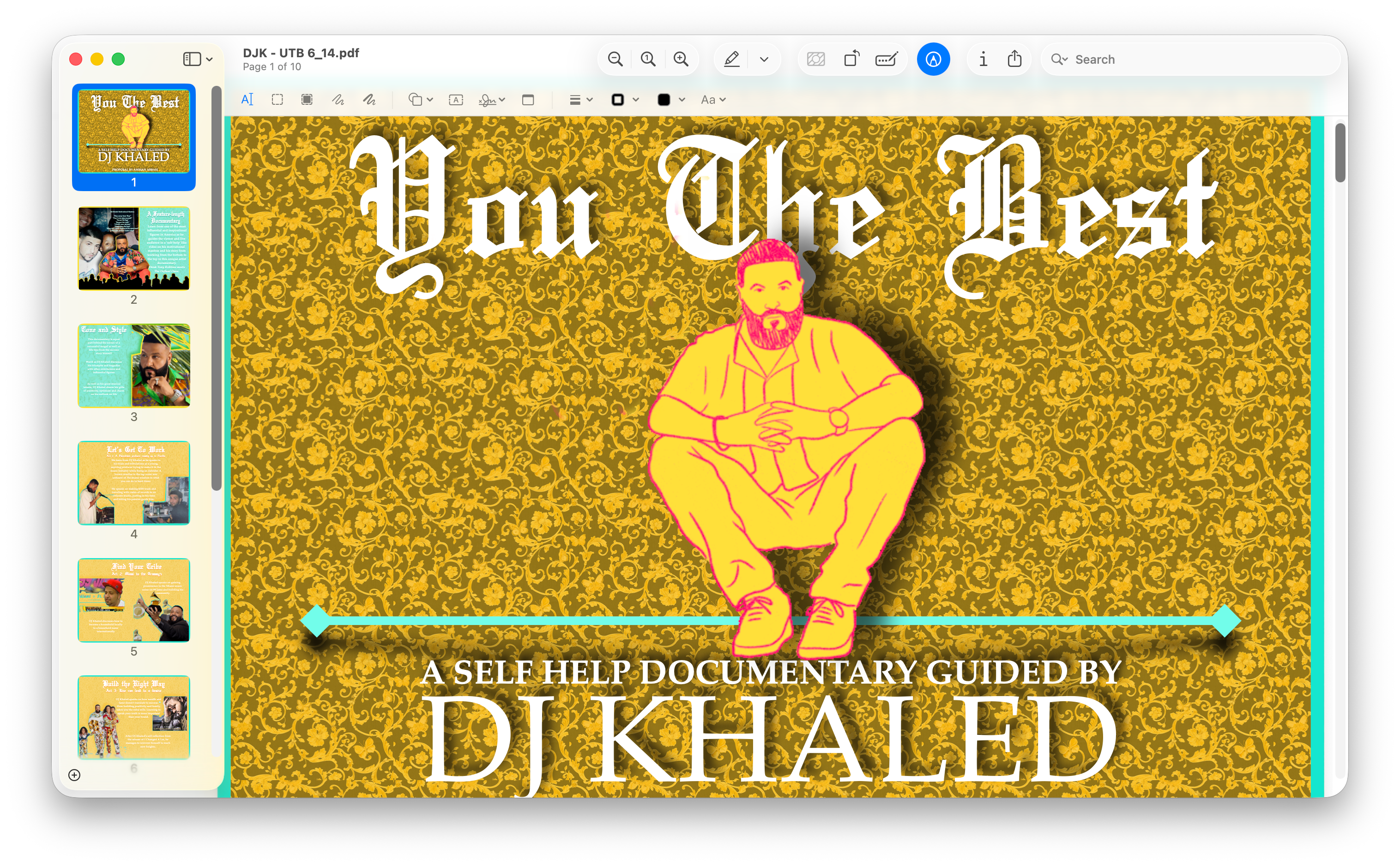
It was not a normal celebrity-doc deck.
It looked like a motivational gospel pamphlet had been designed by somebody who owned a Cricut machine, smoked a lot of weed, and believed deeply in the power of Gothic lettering.
The premise was simple:
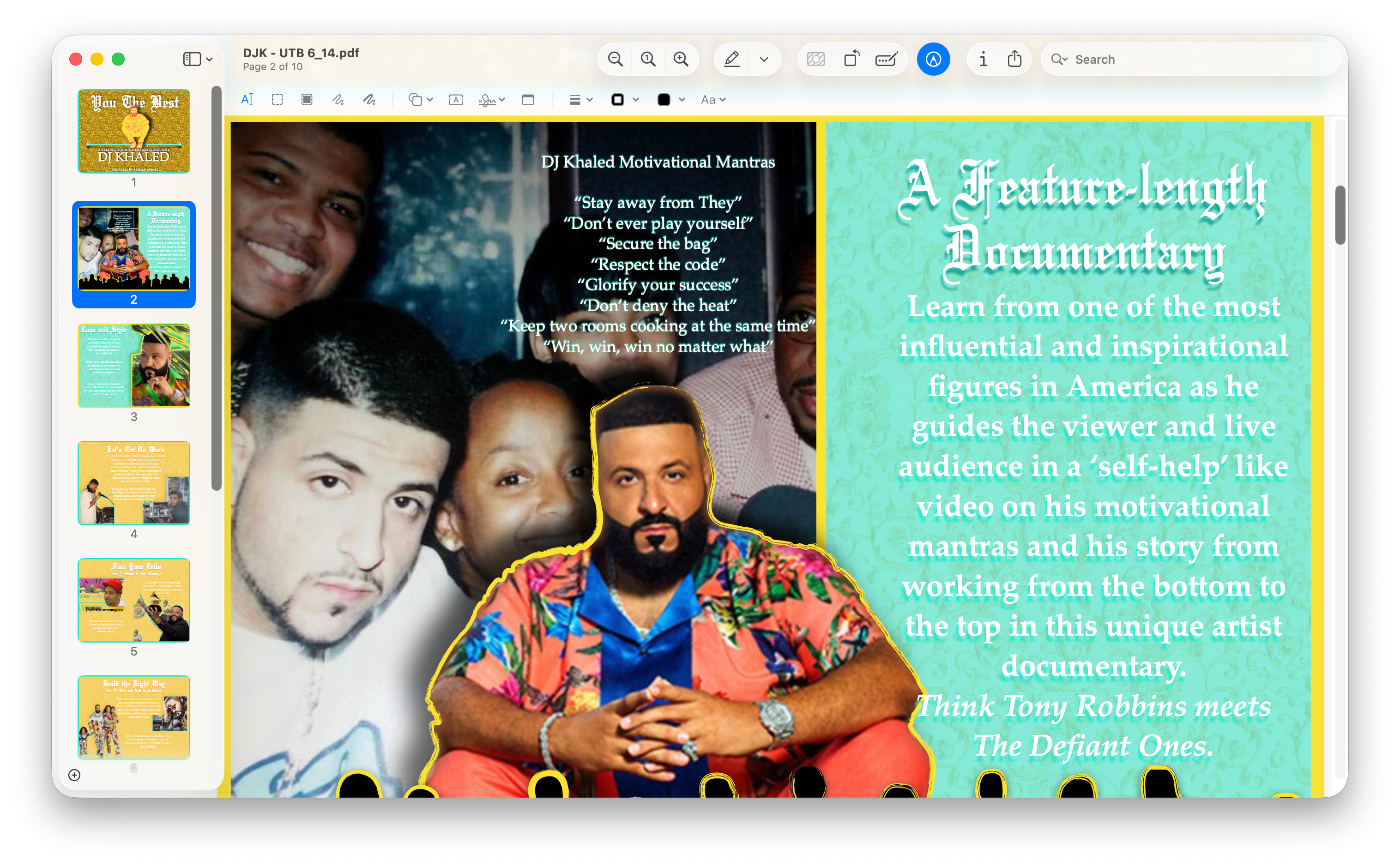
Tony Robbins meets The Defiant Ones.
DJ Khaled would guide an audience and the viewer through the principles that had carried him from a Palestinian kid hauling crates of records around Florida to a global music mogul.
The film would begin with
“Let’s Get to Work”: Khaled as a young Palestinian producer and DJ, making about a hundred dollars a week, driving records to Orlando, trying to find a place in a rap world as a brown Muslim kid.
Then
“Find Your Tribe”: 99 Jamz, Miami, the climb from local radio personality to a guy who could call Drake, Rick Ross, Jay-Z, and Justin Bieber for the same song and somehow make it sound normal.
Then
“Build the Right Way”: the moment Khaled had to reinvent himself after an album that underperformed and turn a potential career stumble into an entirely new version of DJ Khaled (the Snapchat philosopher, the jet-ski prophet, the man who could point at cocoa butter and generate a million comments).
Then
“Honor Your Roots.” This was the Palestine section Amman had pitched in Khaled’s backyard. Khaled would go back with his family, reconnect with his roots, meet musicians, and potentially put on a concert. Not a solemn heritage montage. The movie would end with a homecoming that made the whole strange self-help structure feel like it had been building toward a real emotional destination.
At the time, I thought the deck was great.
Honestly, I still think it was great.
The problem was that the deck was more confident about the movie than DJ Khaled was.
We had taken a few flickers of conversation a couple of encouraging messages from his team and turned them into a five-act feature documentary.
I cut a teaser.
It was mostly made from the best DJ Khaled viral moments, you know, the motivational videos, the memes, the absurd declarations, the famous public version of Khaled that had turned him into a one-man genre of internet inspiration.
But I mixed in the little footage I had shot in Miami before he asked me why the fuck I was filming him.
There was not much.
A few seconds. A fragment of the backyard. A glimpse of the actual human being behind the public myth.
But in a teaser, a few seconds can be enough.
You put the right music under it suddenly you are not looking at three minutes of footage. You are looking at the movie that is about to happen.
The original teaser
We watched it and got excited.
Rough House got excited too.
At that point, they were not treating this as some half-baked idea we had brought back from Miami in our shoe covers. They agreed to put money into a proper teaser shoot with Khaled.
We drafted a schedule for two six-hour days.
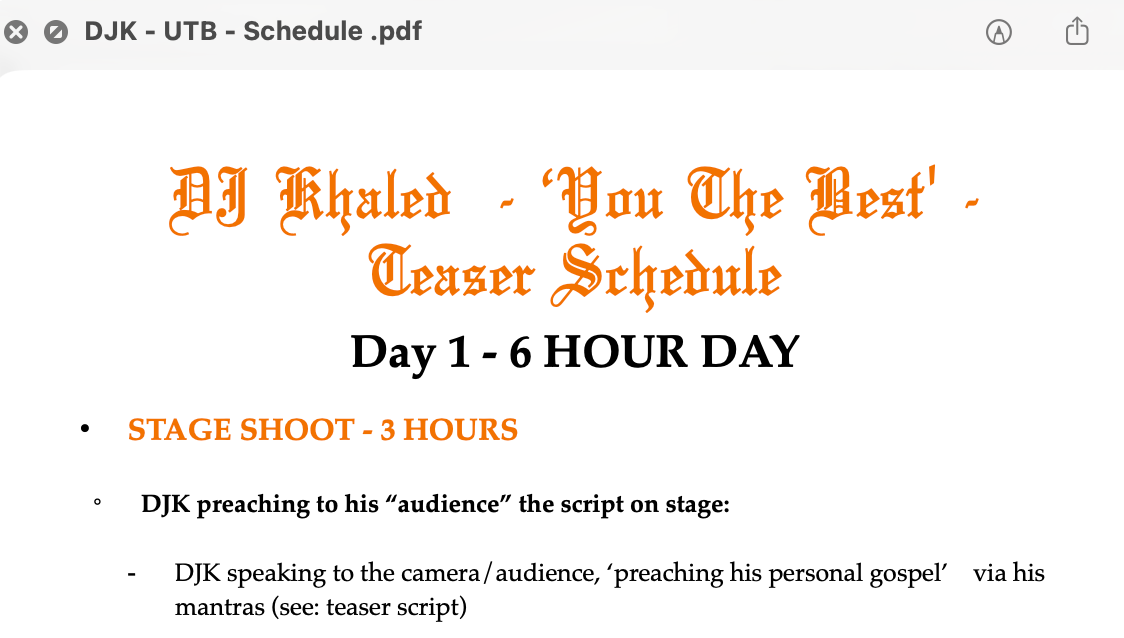
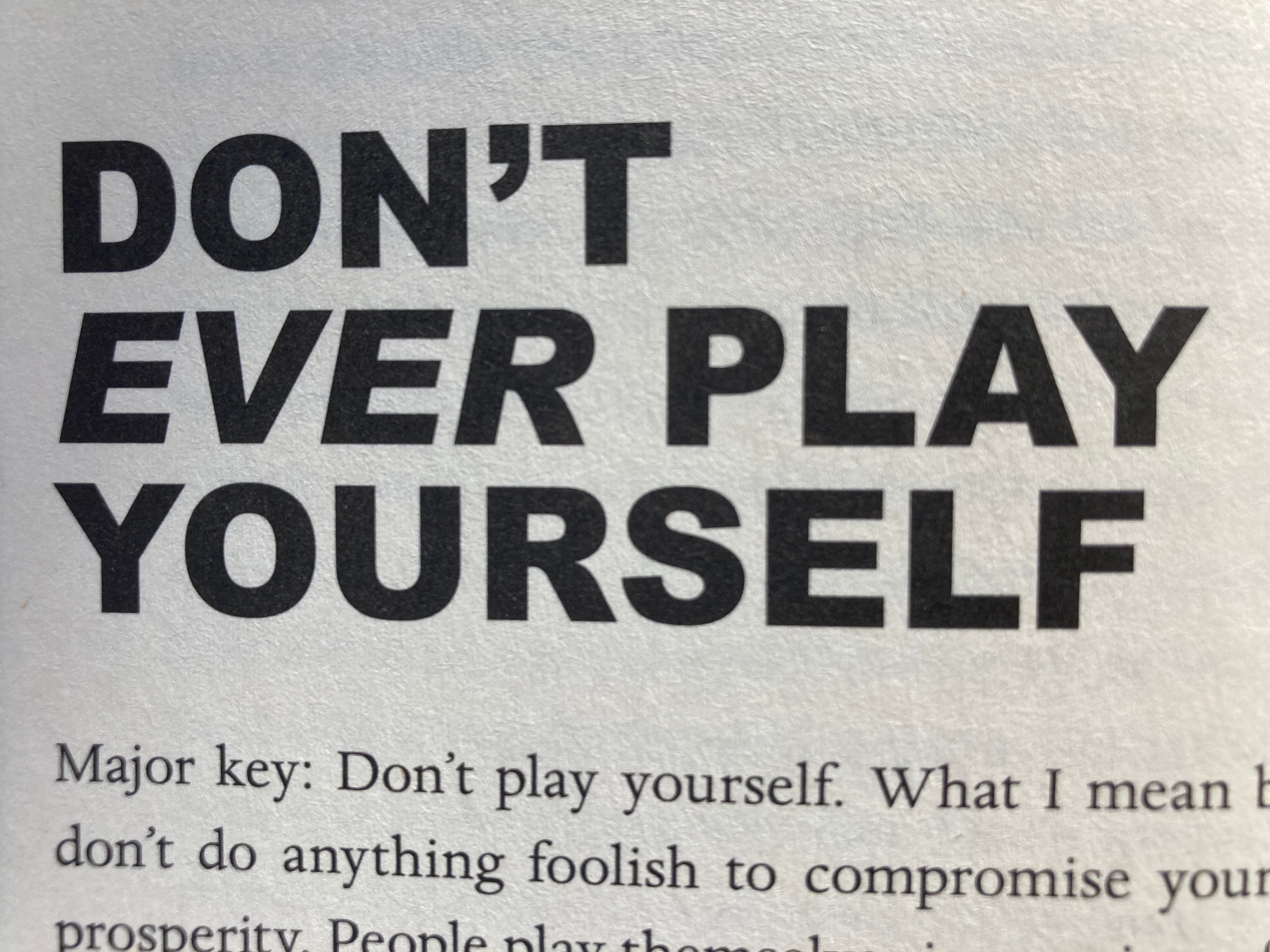
Day One would begin with Khaled on a stage, preaching his personal gospel to an audience: “Don’t ever play yourself.” “Stay away from they.” “Secure the bag.” “Win, win, win no matter what.”
Then we would follow him through the house.
A meeting with a designer. A strategy session with his managers. Family time. The kids in the pool. Khaled praying. Khaled meditating. Khaled moving through the little empire he had built and explaining how he kept his eyes on the prize while managing music, brands, family, and whatever department was responsible for the starfruit elixirs.
Day Two would be the studio and the city.
Khaled working on a track with a collaborator. Khaled coaching somebody through a feature. Khaled recording the phrases that had become part of the public language:
“DJ KHALED.”
“ANOTHER ONE.”
“WE THE BEST MUSIC.”
Then we would whip out the drone.
Khaled driving through Miami. Khaled filming Snapchats. Khaled on a boat with his entourage, listening to new music and looking like a man who had successfully escaped the laws governing normal people.
On paper, it was a lean little teaser shoot.
Twelve hours.
In reality, we were asking for access to almost every version of DJ Khaled at once.
The public Khaled.
The family Khaled.
The business Khaled.
The spiritual Khaled.
The studio Khaled.
The boat Khaled.
The Palestinian Khaled.
The Khaled who did not like strangers filming him in his backyard.
We called it a teaser.
What we were really asking for was immediate intimacy and that was the thing I still did not understand, I thought that once Khaled saw how good the deck and teaser were he would understand the movie. Then the access would follow.
But access is not the reward for making a good pitch.
Access is the relationship.
And Khaled and I still did not have one.
So I began the long, slow, humiliating process of trying to turn “maybe” into a calendar invitation.
I became annoying in the exact way every producer eventually becomes annoying: politely, professionally, and with an ever-increasing number of cheerful exclamation points.
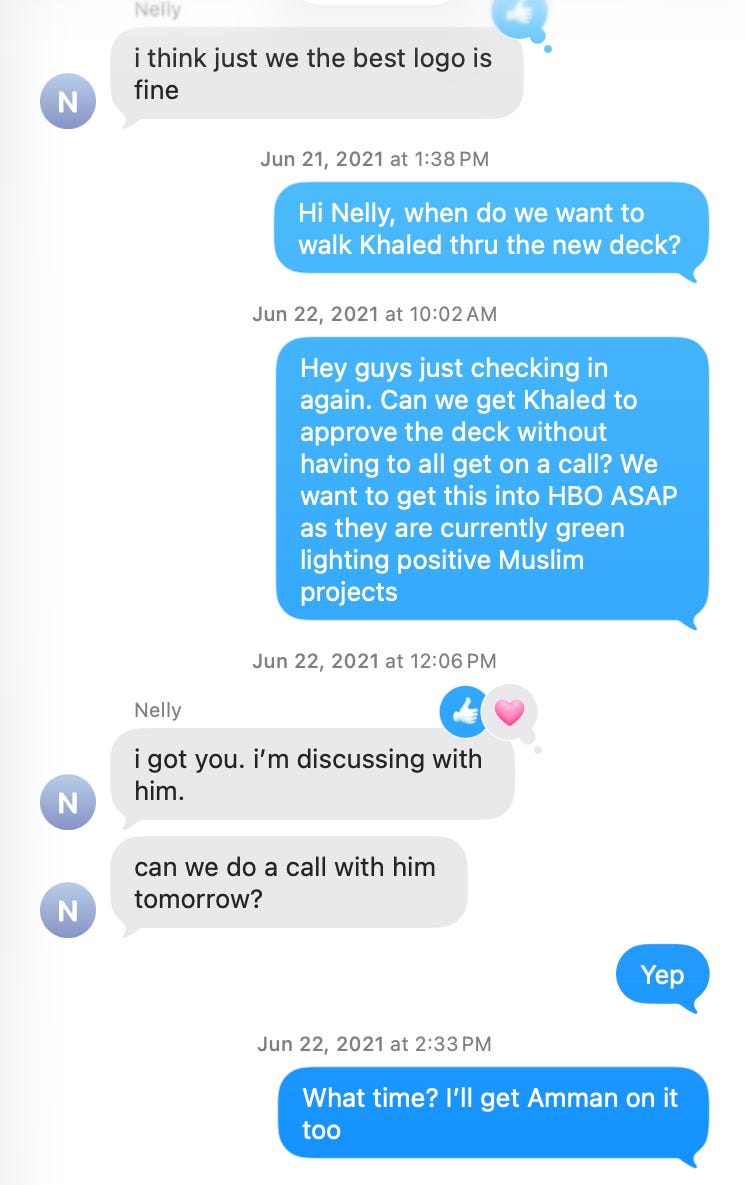
“Hey Nelly, just checking in.”
“Can we get Amman on the phone with Khaled?”
“Does he still want to walk through the deck?”
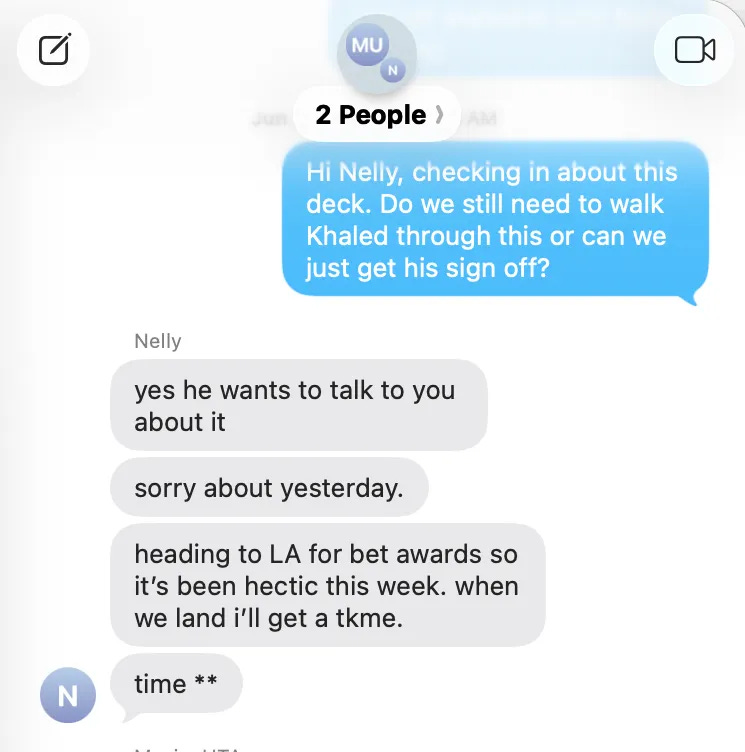
“Can we get his sign-off?”
“Would love to catch up.”
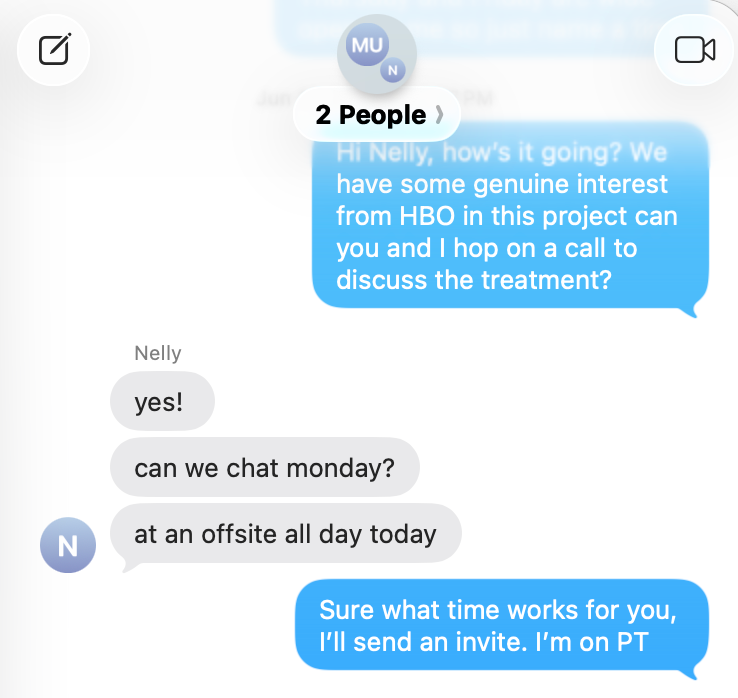
“Whenever works!”
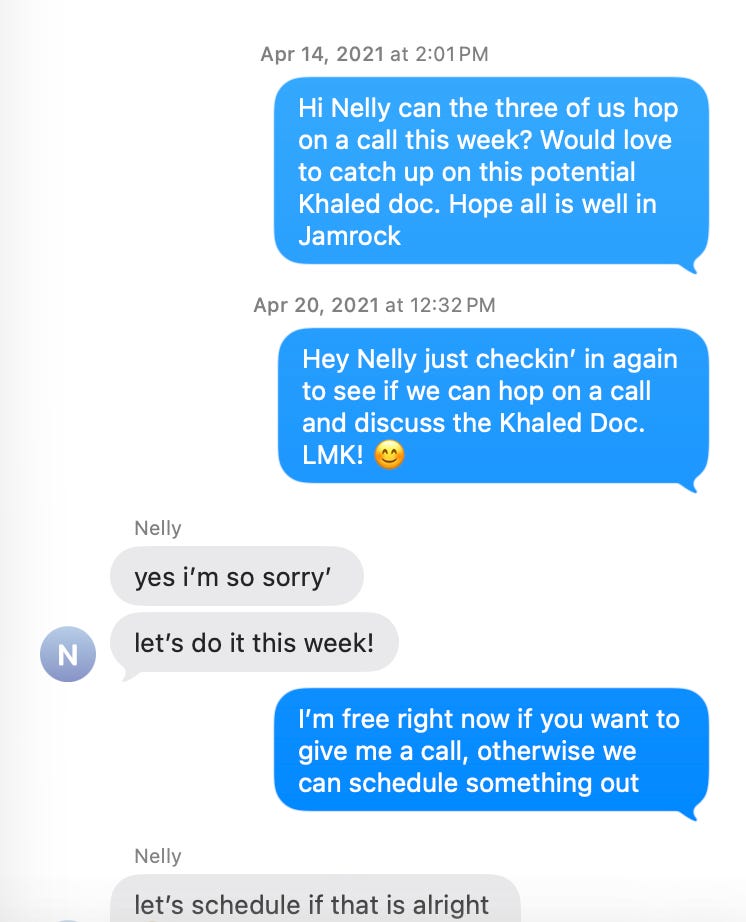
“No pressure!”
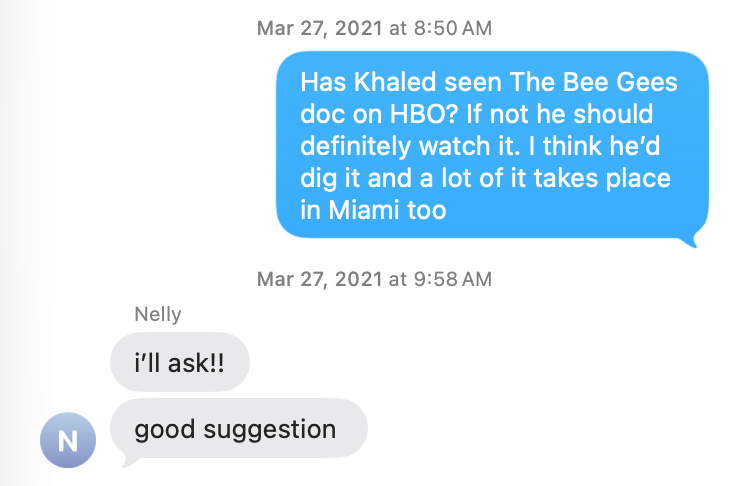
At one point I texted Nelly that Khaled should watch the Bee Gees documentary on HBO because I thought he would dig it. Seriously.
This is the part of filmmaking people do not really understand.
They think you are sitting at home, twiddling your thumbs, waiting for the next shoot to happen. They imagine the job is either glamorous production or total unemployment. You are either on set yelling “action” or wandering around your house in sweatpants.
But most of the job is this…
Being awake at 5:30 in the morning, already worried that a project is falling apart.
Managing your own anxiety while pretending to be chill.
Recommending a Bee Gees documentary to DJ Khaled’s team at breakfast while toasting frozen waffles for your kids because maybe, somehow, if Khaled watches the Bee Gees documentary on HBO that will unlock the entire project.
This is the real work.
Later, I asked whether they were going to a 2 Chainz and Rick Ross show in Miami.
“Nope!” Nelly wrote.
All of this, somehow, did not strike me as a sign that DJ Khaled might not be desperate to make a documentary with us.
Then the Kanye documentary news hit. Netflix had bought the Kanye doc. Nelly sent it to the group chat and wrote something like, “That’s exactly what I sent UTA two days ago. Let’s get to work!!!!”
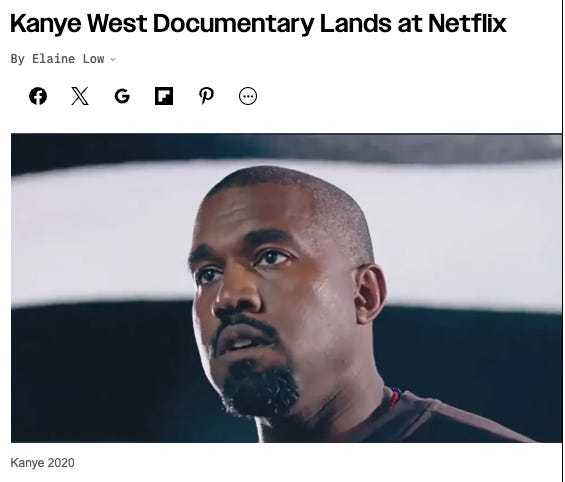
I replied, “Wowwwww.” Then I looked at the price tag: $30 million. That number gave me pause.
I secretely hoped Khaled would not see that press release.
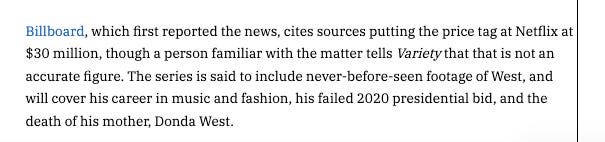
And that’s when Khaled’s team stopped talking about dates and started talking about the number.
Not the production budget.
The price Khaled wanted to participate in his own documentary.
Twenty million dollars.
Then, just when the DJ Khaled documentary had begun to feel like it was slowly dying in a group text, we got a massive bump.
Jay-Z.
The idea was simple: if Jay-Z came on as an executive producer, the project became real in a different way.
Not “real” in the sense that we suddenly had a deal.
Real in the way that makes buyers sit up straighter.
In the way that makes a deck feel less like something two filmmakers assembled in a hotel room after an uncomfortable backyard meeting and more like something with actual gravitational pull.
Lenny S told us Jay was down.
We got the go-ahead to put his name on the deck as an EP.
We put his name on the teaser too.
This was huge.
I cannot overstate how huge this felt to me at the time.
We had DJ Khaled, Rough House, Danny McBride, Amman, who was a real filmmaker with a real point of view and now, we had Jay-Z as an Executive Producer.
Surely that meant the guy at the center of the documentary was now ready to participate in the documentary.
It did not.
We still could not get Khaled on a call or a Zoom or a FaceTime.
We could not get him to walk through the new deck, watch the teaser.
We could barely get him to do anything other than exist as a very famous, very busy, highly protected person at the center of an increasingly elaborate document.
And then I had a long call with UTA. I don’t remember the specifics but afterward, I wrote Amman in email:
It seems like Khaled is fine with the deck/creative but wants a guarantee of money. $20 million dollars. Which is insane and never going to happen.
That was the first moment I understood the actual problem.
Khaled was not necessarily asking whether the movie was good.
He was asking whether the money was real.
And from his perspective that made perfect sense.
He had spent decades building DJ Khaled into a brand, a business, a personality, a source of music, a source of memes, a source of motivation, a source of custom furniture, a source of whatever one calls a person who can make “cocoa butter” feel like a life philosophy so why would he spend time giving us access to all of that without knowing what it was worth?
But from our side, it was insane.
Because documentary financing does not work like that.
You do not usually go to a buyer and say, “We have a great documentary with one of the biggest personalities in hip-hop. He is ready to pitch it to you as soon as you guarantee him twenty million dollars.”
Cause the buyer says, “Great. Can we meet him?”
Then you say, “No, not until you guarantee him twenty million dollars.”
Then everyone gets very quiet.
And the documentary dies in a room neither side ever actually entered.
I went to Charleston to sit down with Danny McBride and David Gordon Green.
At that point, I was looking for a way out of the stalemate and needed guidance from people older, wiser and more experienced in the ways of Hollywood than me.
David’s thought was practical: just make Khaled a guaranteed offer, then go try to sell it.
“That is how movies work“ was David’s argument: You take a leap. You attach the person formally. Then you go into the market and see whether somebody believes in it enough to finance it and cut that person a check.
But UTA did not want to do that.
They did not want us making an offer and then trying to sell the project around it.
To this day, I still do not know exactly why.
Perhaps they knew, on some level, that Khaled was not truly committed and did not want us attaching him to something he might disappear from two weeks later. Perhaps they were afraid of agreeing to a number then going out and getting an immediate “fuck no we’re not paying that” from all the streamers, thus “devaluing” Khaled in the marketplace. I don’t know.
But it left me in a perfect Catch-22:
Khaled wanted guaranteed money before he would really engage.
Buyers wanted Khaled to engage before they would guarantee the money.
And we were standing in the middle, holding a deck with Jay-Z’s name on it.
I started getting frustrated.
At one point, David emailed me to ask how the Amman documentary was going.
I wrote back:
David, UTA is being annoying. I told [OMITTED] and this guy [OMITTED] who works with Khaled at UTA what you wanted to do and they said no they’re not going to do that. You and I should talk strategically. You and I are on the same page but the agents are not.
Still, I kept pushing.
Because by then, the project had become too good in my mind to let go.
We had the Jay-Z bump after all.
So I soft-pitched HBO.
I told them we had DJ Khaled, Jay-Z and Roc Nation as executive producers, Rough House, Amman, the deck, the teaser, the whole thing.
I described it as:
The Defiant Ones meets Tony Robbins meets Dave Chappelle’s Block Party.
Which, to be fair, is still an incredible sentence.
I also made the argument that it could be a real positive story about a Palestinian Muslim artist, told with a Pakistani-American director. I believed that. I still do. Khaled’s story was bigger than luxury cars and catchphrases.
But before HBO could get too excited, I had to tell them the problem.
Khaled needed $20 million.
Ideally more.
And he needed the money guaranteed before he would get on a pitch.
Lizzie at HBO wrote back that, while she was certain it would make a great documentary, it was not right for their slate. They already had several high-profile musician docs in motion.
Then she added:
And I hope one day I can say that I’ll only join a pitch if I’m guaranteed $20M 😉
Honestly, fair.
I wrote back:
You have to BELIEVE you can get $20mil first! You have to manifest it!
Because at that point, what else was there to do?
The DJ Khaled documentary had entered the phase where motivational philosophy was no longer the subject of the movie.
It was the fucking financing plan.
HBO passed.
So I shifted to Hulu.
And Hulu was actually interested.
They looked at the deck watched the teaser agreed right away to take the meeting.
A major buyer wanted to hear the pitch.
But UTA stalled.
Hulu followed up.
UTA stalled more.
Then Hulu followed up again.
Kate at Hulu wrote:
Just popping back up to see if you all still wanted us to hear the pitch.
Hulu was chasing us.
Do you understand how rare that is?
A buyer had looked at a documentary deck, seen a teaser, and come back asking if we still wanted to pitch them.
And we could not take the meeting.
Not because Hulu was not interested.
or because the movie was not good.
or because Rough House had backed away.
or because Jay-Z had suddenly called and said, “Actually, I have concerns about y’all goin a little hard (pause) on the Gothic font in the deck.”
We could not take the meeting because the subject wanted $20 million before he would meaningfully participate in the process.
By then, I think everyone understood it was probably dead or at least dead in the modest budget version we had imagined.
Then, months later, in January 2022, UTA emailed again.
They were about to speak with Khaled’s manager, Lenny S, and wanted to know whether we were still interested if Khaled came “down to earth” financially.
Brandon James (President of Rough House) wrote back that we would entertain it if the deal made sense, but it would have to be “down and dirty for an upside.”
UTA replied that Khaled might be willing to shoot a sizzle without being paid, but wanted to pocket something “ridiculous” in the event of a sale (20 million dollars).
I wrote:
He also wants rights to Brandon’s next child.
Brandon replied:
Anything for you guys.
And then the email chain ends.
That is it.
No screaming match.
No dramatic breakup call.
Just a handful of people trying to figure out whether DJ Khaled could be made affordable without violating the basic laws of documentary economics.
And then, eventually, nobody sent another email.
The project did not explode.
It evaporated.
I had given up. But little did I know, I may soon be heading back to DJ Khaled’s mansion.
By the spring of 2022, roughly fourteen months had passed since I first put “DJ Khaled (motivational speaking tour doc?)” on a half-stoned UTA email.
We apparently still had buyers interested.
But we also had one enormous problem:
DJ Khaled still wanted twenty million dollars.
Then, somehow, I found myself back in Miami.
I was there shooting scenes for Telemarketers, working long days, doing the kind of production where your clothes smell bad by lunchtime and you forget what normal people do with their evenings. My hotel was maybe ten minutes from Khaled’s house.
And because I apparently had not learned a single fucking thing, I texted Nelly.
Something simple. I was in town. If Khaled was still interested in talking about the documentary, I would be down to meet.
Then my phone rang.
It was DJ Khaled.
I could not believe it.
I stepped away from set and took the call.
For a second, I thought maybe this was it. Enough time had passed. He had rewatched the teaser, perhaps shown it to Justin Bieber who told him “Dude this is dope! You gotta make this!”
Or he had finally realized the guy who came to his house with a DSLR and a bad porn joke was, against all odds, the person he wanted to make his documentary.
Or more likely he saw McBride on Righteous Gemstones while high AF and was like “what am I doing, I need to work with this genius.”
I’ll never know.
We chopped it up for a minute.
Then he got to the point.
He still needed twenty million dollars.
I asked him why.
He said because Kanye had gotten twenty million for the Netflix documentary.
I said, “Are you sure that’s true? Sometimes those numbers are made up for press releases.”
He said, again: if Kanye got twenty million, then he deserved twenty million.
And I understood the logic.
Kanye was Kanye.
Khaled was Khaled.
Why should one man’s life story be valued at twenty million dollars while another man’s life story was supposed to come in at a normal documentary number?
The only problem was that documentaries do not work that way. HBO does not work that way.
I told him the truth. Because I was on set, I was tired and cranky and I was not in the mood to beat around the bush…
“In all honesty, I could maybe get two and a half to three million for the entire fucking budget, dude.”
Not his fee.
The whole budget.
The director, crew, travel, archives, post-production, music, legal, insurance, everything.
He said, again, he wanted twenty million.
I said, “I’m not getting you twenty million.”
And that is when DJ Khaled turned the conversation into the most perfect ending imaginable for a documentary about DJ Khaled.
He told me I had to believe I could get him twenty million.
That I did not believe it, which was why I could not make it happen.
But if I really believed it, if I truly believed it, I would get it.
I do not remember the exact wording five years later. But that was the message.
The documentary producer had become the student.
The subject had become the motivational speaker.
And the lesson was: my inability to raise twenty million dollars for DJ Khaled was not an economic problem. It was a failure of faith.
I started laughing.
Because what else are you supposed to do when DJ Khaled tells you the obstacle to raising twenty million dollars is your own insufficient level of manifestation?
“You’re right, dude,” I said. “Let’s talk later. I’m in town like 10 minutes from your house.”
He told me to text him that night.
So I did.
Around eight.
He was busy.
Maybe later.
Around midnight, I texted again. I was in bed at my hotel, falling asleep after a long day on set. Khaled said he was still recording with somebody. I cannot remember who. Nas, maybe. Somebody big.
He said he would be ready around two or three in the morning.
“Wait for my call.”
And that was it.
That was the final test.
Twenty-five-year-old Adam would have stayed awake, no problem.
Thirty-something Adam probably would have stayed awake too after a couple Red Bulls.
But I was 45 and had spent the day shooting Telemarketers. I was exhausted. I had a flight the next morning. I was not in the mood for starfruit elixers at 3 in the morning.
I had finally run out of belief.
I shut off my phone.
I went to sleep.
The next morning, I flew out of Miami.
I never heard from Khaled again.
And somewhere after that, the project stopped existing and simply became one more project I had spent months trying to will into existence until reality finally got tired of humoring me.
Then Telemarketers took over my life.
The series premiered and blew the fuck up. Was the most watched documentary on HBO that year upon release.
The thing that had once felt on the backburner became real, and the thing I had tried to force into existence became a story about why forcing things doesnt work.
It could have been an incredible documentary.
But Khaled never came down from twenty million.
For years, I told this story as a funny story about DJ Khaled wanting twenty million dollars to make a documentary.
And it is funny.
It is objectively funny that we had a subject whose answer to every financial reality was basically: Have you tried believing harder?
But the deeper lesson is not that DJ Khaled was delusional.
The deeper lesson is that I had been delusional too.
I thought I had found the perfect documentary subject. I knew his mythology, understood the long climb, had a formal idea that was funny and commercial but also genuinely emotional.
I could see the movie so clearly that I mistook my ability to see it for proof that it was already there.
It was not.
A documentary does not exist because a producer has a great fukcing idea.
It exists when the subject actually wants to hand over access.
Not perform access.
Not flirt with access.
Not make you earn access through a chain of assistants, agents, managers, late-night texts, and impossible economic demands.
Actual access.
Khaled had spent decades building DJ Khaled into a massive, joyful, carefully managed public identity. He did not owe me the private machinery underneath it just because I thought it would make a great film.
And maybe twenty million dollars was not a number he truly expected anybody to pay.
It was a valuation.
Or it was leverage.
Or it was a shield.
But most likely: it was the most expensive way possible to say no without saying no.
That number finally taught me what the shoe covers had been trying to teach me from the beginning:
I had confused getting through the gate with being invited in.
Sometimes a subject does not say no.
Sometimes they put a price on yes that makes the project kill itself.
The end.
Curious about my AI use? Read this.
Because this series deals with real projects, real people, and real companies, here’s the boring but necessary note that AI wrote for me:
Almost Greenlit is written from my personal perspective and memory as a filmmaker and producer involved in the development and pitching of these projects. It is not intended to be a definitive account of what any buyer, executive, company, filmmaker, subject, agent, financier, distributor, or other participant thought, intended, or decided at the time.
Where I describe meetings, pitches, passes, development history, business decisions, or creative choices, I am describing my own recollection, interpretation, and opinion unless otherwise stated. Any quoted material is included from my own correspondence, public materials, interviews, or with permission where appropriate.
Materials such as trailers, teasers, pitch decks, posters, stills, artwork, clips, screenshots, and other project-related assets may be included for commentary, criticism, historical context, archival reference, and educational purposes. I do not claim ownership of any third-party copyrighted material included or referenced here. Unless otherwise noted, photographs included in this series are my own or are used with permission.
Nothing in this series is intended to attack, disparage, or misrepresent anyone involved. The goal is to examine how projects are developed, pitched, passed on, revived, abandoned, or made anyway and what other filmmakers can learn from that process.
If anything here is inaccurate, incomplete, or requires correction, I’m happy to correct the record.
No posts
Comments
Nothing yet. Say the first thing.
Sign in to join the conversation.