
The original deck for Strange Encounters had a tagline I had forgotten:
Because believing is just more fun.
Watching the teaser again years later, after HBO’s Neighbors became a hit, I realized that was either the entire appeal of our show or the thing that killed it:
In April 2026, I was going through my project archives: old decks, half-finished treatments, budgets I hadn’t opened in years, pitch materials for projects that had once felt very close to happening.
I started organizing old teasers.
The ritual was mostly what you would expect: Click play brace yourself watch thirty seconds close the tab move on…
Then I clicked on a teaser for a project called Strange Encounters.
It was a paranormal documentary series I had spent almost two years trying to get off the ground with Conde Nast, Rough House, Clay Tweel, and, somehow, Tim and Eric.
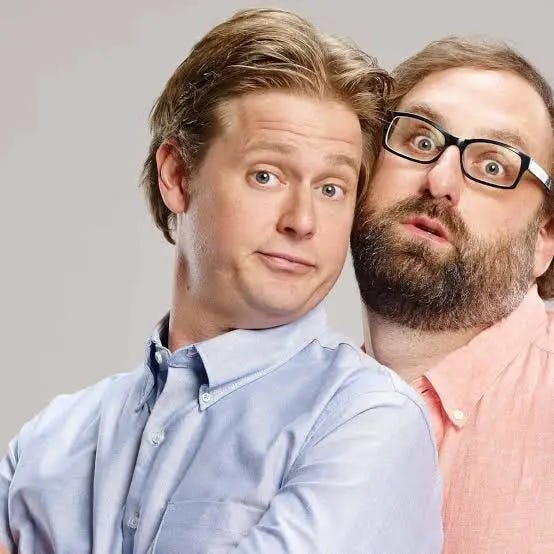
Tim and Eric were two of my idols, not in the casual Hollywood sense where everyone calls everyone an idol because they once liked a movie their work had genuinely shaped the way I thought about comedy: the dead air, the discomfort, the weird American loneliness underneath the joke, the way a person could be absurd without becoming less human. And most definitely influenced my interviewing style.
We had taken the project out to buyers, had a serious package, real access, a director I loved, and two of the funniest people alive attached (3 if you include Danny McBride, who was also attached as an EP).
And we had failed.
So when I clicked play in 2026, I expected the usual feeling: Ah, yes it makes sense why this one didn’t get made.
Instead, I had the opposite reaction.
I thought: Shit, this is pretty damn good.
Not perfect or secretly the lost masterpiece of nonfiction television but good enough that I immediately thought of Neighbors, the HBO show I had been watching about real people, bizarre behavior, and the strange, uncomfortable comedy of watching Americans take their own personal realities very seriously.
Neighbors was not our show. It was not about aliens, ghosts, elves, or people who claimed to have seen something impossible.
But it lived in a similar tonal neighborhood: real people, heightened situations, documentary sincerity, and the uneasy question of whether you were laughing at someone or recognizing something in yourself.
I emailed the old team almost immediately.
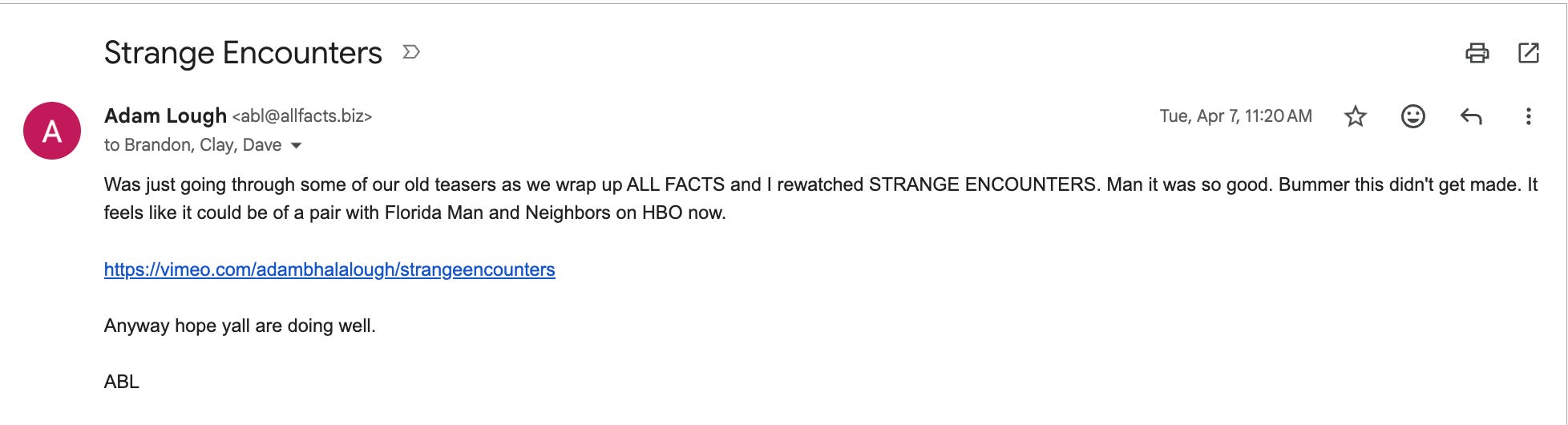
Did we miss this? Did they do what we were trying to do?
Everyone wrote back some version of the same thing.
Yeah. Strange Encounters was dope. That one should’a gotten made.
That was when the old project stopped feeling like a dead file and started feeling like a question.
What did we do wrong?
Or rather: what did they do better?
Had we been early?
Or had we simply been unfinished?
Then I reopened the original deck.
On the cover, underneath the title STRANGE ENCOUNTERS, was the tagline:
Because believing is just more fun
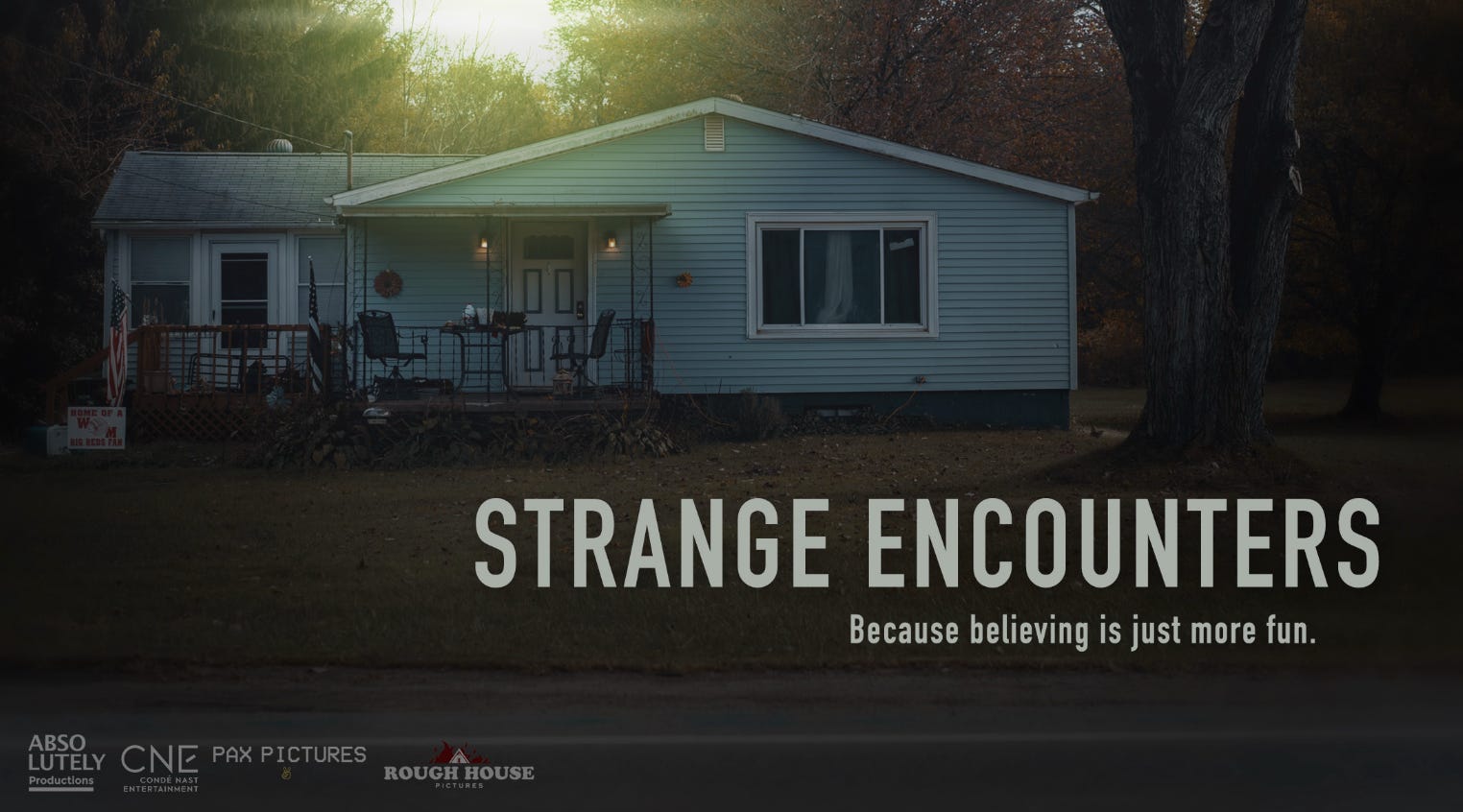
At first, I remembered it as a cute line.
Then I read it again and realized it might have contained the entire problem.
Believing is more fun for who?
The audience?
The filmmakers?
Or the person who has spent years trying to convince everyone around them that the thing they saw was real?
Before I could answer whether Strange Encounters came too early, I had to go back to the beginning.
Because the first version of the project had a host.
And the host was not the only thing standing between us and the people we claimed to care about.
In December 2020, my friend Lexy Altman, who was then an exec at Conde Nast Entertainment, reached out with a project.
Conde Nast had put real development money into a comedic paranormal show called Strange Encounters. It was host-driven, lightly funny, and built around real people whose experiences were considered too bizarre to be credible.
The premise was incredible.
A man who drank tea with elves.
A woman engaged to a ghost.
People who claimed they had encountered aliens, monsters, spirits, cryptids, and assorted supernatural beings that would make any normal unscripted executive say, “This is insane,” which, in documentary, is often the first sign that something might be worth pursuing.
It had a host. The host was Erin Ryder, who was great, and who had real access to this world. That part mattered. People trusted her she knew how to find them she knew how to talk to them she had spent years inside the paranormal space, which meant she could get to people most producers would never find.
But the format felt too familiar to me, personally (just my opinion).
I sent it to my partners at Rough House and they were, let’s say, not immediately levitating with excitement.
They basically said what everybody was probably thinking:
This feels like fairly standard reality TV; the host format creates a safe distance between the viewer and the subject; it gives you someone normal to stand next to while you watch someone strange explain their weird story.
And that was exactly the problem.
If this was going to work, it could not be a show about a host meeting weird people.
It had to be a show about people who had organized their lives around a story nobody - even their closest friends and family members - believed.
That was the part I could not stop thinking about.
Not whether the elf was real, the ghost fiancé had actually proposed or the alien had enjoyed the pepperoni pizza.
What happens to a person after they tell the world the strangest thing that ever happened to them, and the world decides the easiest response is laughter?
That felt like a real show and maybe even a great one.
But to get there, we would have to do the one thing that made the project much scarier to sell.
We would have to remove the person explaining the weirdness to us.
We would have to kill the host.
The first real creative decision was obvious to everyone.
The host had to go.
Not because Erin Ryder was bad. She was not. Erin was actually one of the most valuable parts of the package. She had the relationships, understood the paranormal world, could get to people who would never trust some random documentary crew parachuting in from Los Angeles with a camera and a release form.
But the host format created a problem.
Every time the host entered the frame, the show became about watching a normal person encounter a strange person and that distance killed the thing I thought was interesting.
Years later, when I asked Andrew Porter what he remembered about our thinking, he said the same thing in a much smarter way
The project, Andrew said, was “all about this person’s experience,” and the show needed to be experienced through them. The host created “a disconnect.” Instead of feeling like the viewer was interacting directly with the subject, you were watching the host interact with the subject.
That was the wall.
And once Andrew said it, I realized that was exactly what we had been trying to remove.
We did not want a guide, a skeptic or a comic buffer between the viewer and the believer.
We wanted the audience in the room with the person telling the story.
That is a much scarier proposition, because then the viewer has to do the uncomfortable work themselves. They have to decide what they think. Is this person funny? Is this person lonely? Are they performing? Are they telling the truth? Are they lying? Are they in pain? Are they completely sane and simply describing an experience the rest of us do not have language for?
The host gave the audience an answer before they had to ask the question.
Removing the host gave the question back to the audience.
And that was an interesting show.
Not: let’s watch someone investigate weird people.
But: let’s sit with people whose lives have been shaped by stories nobody believes.
Andrew put it another way too. If you spend enough time with someone, even someone who sounds “kooky” at first, you begin to feel empathy. You sit in their living room and eventually realize: no, this is a person. They have a story. They deserve your attention. They deserve the time of day.
That was the version of Strange Encounters we started chasing.
A believer-first show.
Not a show about proving ghosts were real, debunking aliens or laughing at someone because they believed they had fucked a ghost.
A show about what it feels like to carry a story that makes other people dismiss you.
And that is why the host had to go.
Because if we were going to ask the audience to laugh, cringe, doubt, wonder, and maybe even believe, we could not give them someone safe to hide behind. But removing the host did not solve the ethical problem.
It only exposed it.
The phrase that kept coming up was “a delicate tone.”
It was right there in the deck, a whole page devoted to explaining that we were not trying to mock the subjects, or make fun of their experiences, or treat them like carnival attractions.
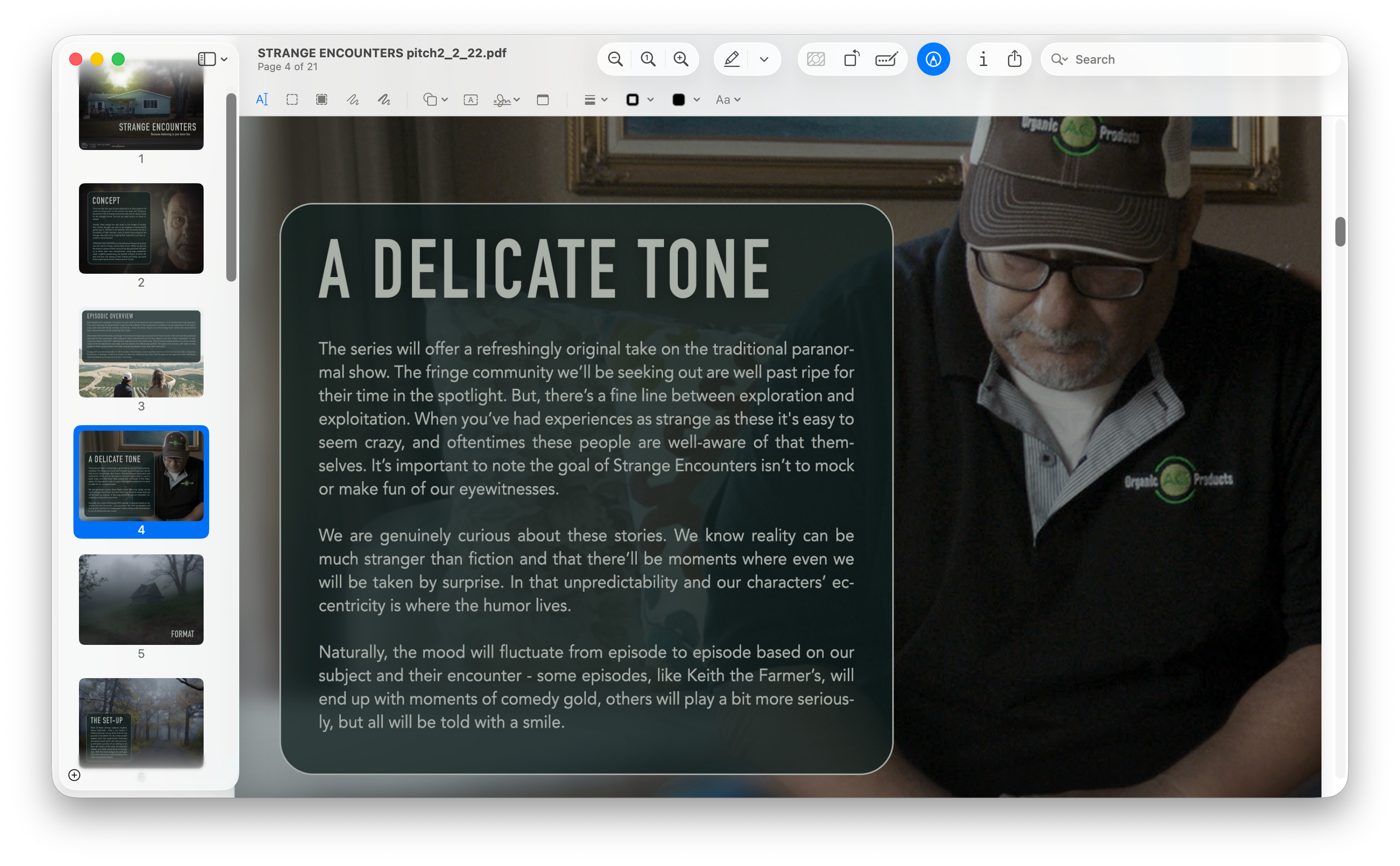
We were going to be curious but we were not going to be cruel.
That was the promise, anyway.
The problem was that the exact same project also depended on words that now make me wince a little.
Weird.
Crazy.
Outcasts.
Fringe people.
Kooky.
At the time, that language felt like shorthand. Development shorthand. But there is a trap inside that language. Calling someone “crazy” makes them instantly entertaining. It also lets you stop asking questions.
Crazy is a label.
It is not an explanation.
Andrew Porter remembered that tension too. When I asked him about it years later, he said the dignity of the subjects was “almost the entire name of the game.”
That line hit me.
Because that was exactly the thing we were trying to sell, even if we did not always have the cleanest language for it.
Andrew understood immediately why Tim and Eric made sense for this. He said they were great at standing in “awkward spaces with awkward people in awkward situations” and just letting it live. That was where the humor was. Not in a punchline. Not in a host making a face. Not in some cheap musical sting that tells you, “This person is nuts.” The comedy would come from presence.
From silence.
From behavior.
From a person being completely themselves on camera.
But Andrew also said something else that mattered: in order to achieve that kind of comedy, “you have to give the person some dignity.”
That became the whole ethical contract of the show.
If we failed at dignity, the show would be disgusting.
If we succeeded, maybe it could be beautiful.
And that is where the project became more complicated than a paranormal pitch.
Because what does dignity actually mean when someone is telling you they are engaged to a ghost?
Does dignity mean you believe them?
Does dignity mean you do not believe them, but you protect them from ridicule?
Or does dignity mean admitting that maybe you are not fucking qualified to know what is really happening to them at all?
These were the questions at the center of Strange Encounters:
How do you listen to someone whose story you may not believe without turning them into a liar, a diagnosis, or a punchline?
That was the show.
At least, that was the show we wanted it to be.
But wanting to protect the subjects and actually protecting them are not the same thing.
And there was one part of the format where that difference became impossible to ignore.
The reenactments.
The big formal idea of Strange Encounters was the reenactment.
That was the thing that in exec speak “elevated” it.
Every episode would build toward the subject recreating the impossible thing that had happened to them but not with a slick studio interpretation or cheesy basic-cable dramatization where an actor in a bad wig sees a glowing orb and screams into a commercial break.
The subject would help direct it.
That was key.
The person who claimed to have seen the alien, the ghost, the elf, the monster, the thing in the woods they would get to reconstruct the event on their own terms. They would help choose the details, props, setting, mood, way the light looked way the creature moved, etc. On paper, this was brilliant.
Instead of us saying, “Here is what we think your story looked like,” the show would say, “Show us what it looked like to you” and that is a huge difference.
Because most paranormal shows treat the subject as a witness. We wanted to treat them as an author.
The deck actually made this very clear. The reenactments were not meant to be throwaway gimmicks. They were the emotional climax of each episode a way for the person to finally externalize an experience that had been trapped inside them, dismissed by other people, laughed at, doubted, or turned into family lore.
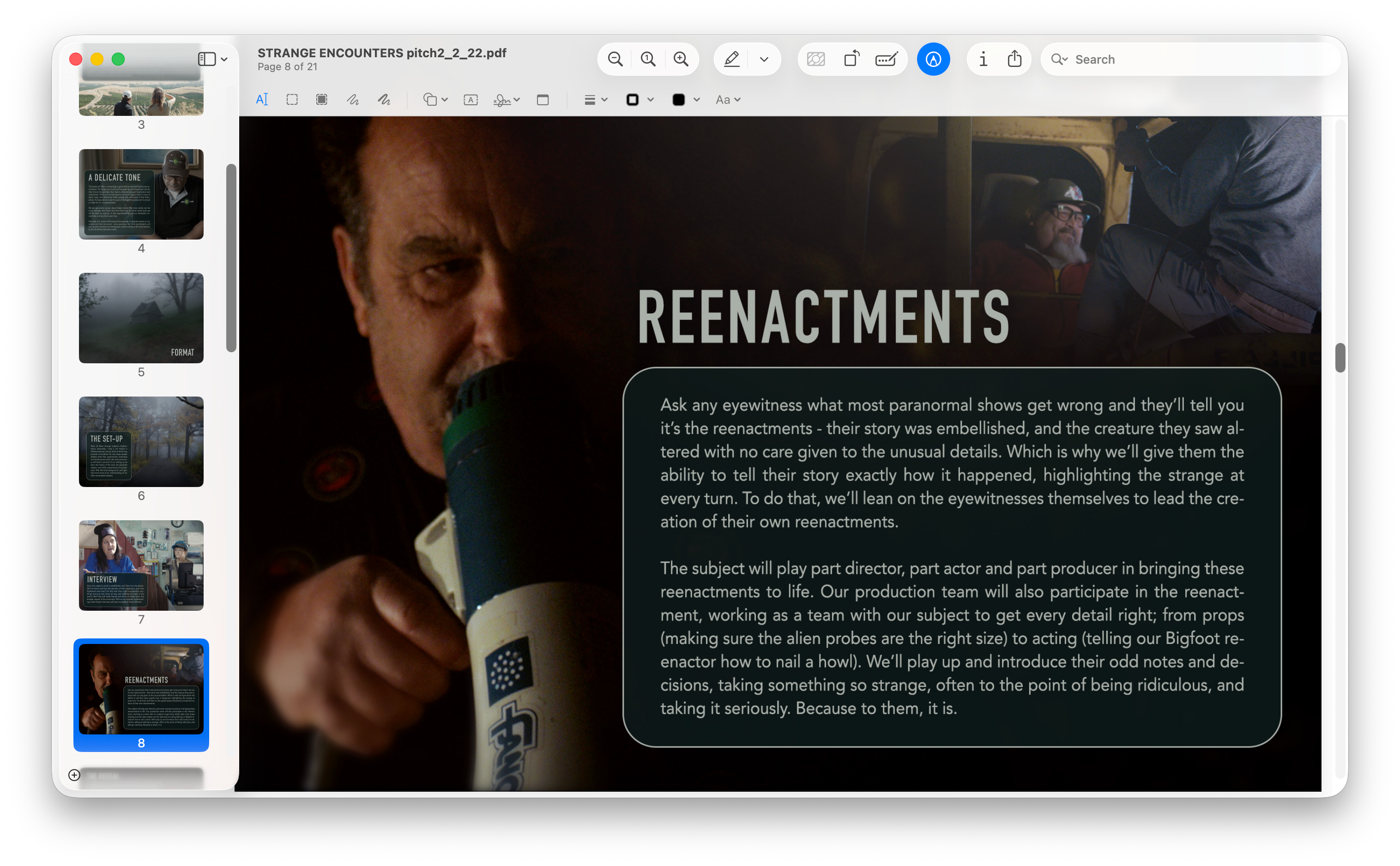
That was the beautiful version.
The complicated version was that we were still asking people to perform the strangest, most vulnerable story of their life for television.
And that is where the ethical problem got interesting.
Giving someone control does not automatically make something ethical.
It can.
But it can also make the exploitation feel more sophisticated.
That was the part I probably did not want to think about too hard at the time because the subject-led reenactment solved so many creative problems: It gave the show a structure gave each episode a destination made the paranormal belief cinematic let us enter the subject’s reality instead of standing outside it with a smirk.
But it also raised harder questions.
What if the reenactment made the person feel validated in a way that was not healthy?
What if their family participated because they loved them, but also secretly thought the whole thing was sad or ridiculous or just fucking dumb?
What if the audience found the reenactment bat-shit crazy and hilarious, but the subject experienced it as sacred?
Documentary subjects do not always understand how audiences will see them. None of us do, really. You can tell someone, “We are treating you with dignity,” and mean it but once the show reaches an audience, you cannot control the laugh.
That is what made Strange Encounters both exciting and terrifying. If we got it right, the reenactments could have been funny, strange, moving, and maybe even healing, could have given these people a way to show the world the thing they had been trying to describe forever.
If we got it wrong, they would become exactly what we claimed they were not:
a better-looking way to laugh at someone.
The more I think about it now, the more I believe the reenactments were still the right idea.
They were just not enough.
Because we had figured out how to let the subjects show us what they believed but had not yet figured out how to prove to buyers that the audience would understand how to watch it.
And next, we were about to bring that promise into the most serious possible room.
HBO.
By January 2022, Strange Encounters had somehow become a real package.
That is one of the strangest things about development. A few months earlier, something can feel like a half-broken ghost show sitting in someone else’s development folder. Then suddenly it has a deck, a teaser, a director, a production company, agents, lawyers, a pitch list, and a calendar invite with enough important people on it to make you briefly believe the universe is organized.
We had Conde Nast.
We had Rough House.
We had Erin Ryder’s access to this world of paranormal believers.
We had Clay Tweel attached to direct.
And, still unbelievably to me, we had Tim and Eric’s company involved.
For a minute, it looked impressive as hell.
The email subject line alone felt like a flex:
STRANGE ENCOUNTERS // ROUGH HOUSE // TIM & ERIC // CONDE NAST // CLAY TWEEL
That is the kind of subject line that makes you think: okay, someone is going to buy this fuckin thing.
I sent it to HBO.
The logline was clean enough:
After experiencing a “strange encounter” with aliens, ghosts, monsters, and other mythical beings, believers are given a chance to reenact their own stories and finally bring some closure to their life-changing experiences.
HBO wrote back:
“Thanks for this wild one. We’re intrigued!”
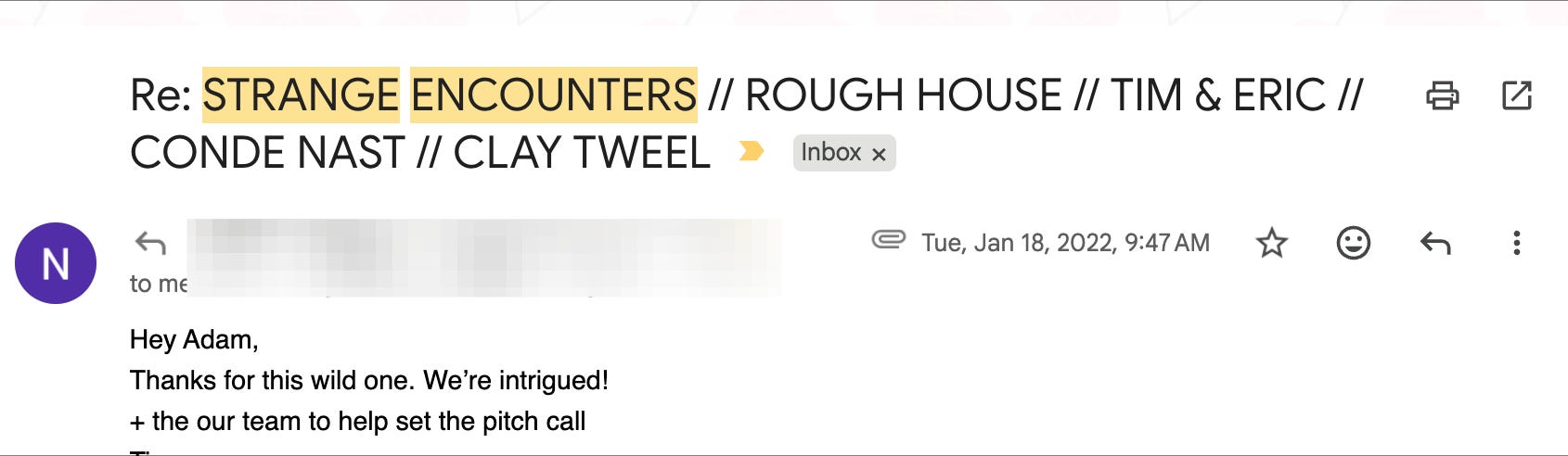
Those are dangerous words.
In this business, “we’re intrigued” is just enough to make everyone start behaving like the project is already halfway to air. Nobody says that out loud, of course. Everybody stays professional. Everybody says, “Great, let’s just see how the pitch goes.”
And then the pitch got scheduled.
And the room was insane.
HBO Docs. Rough House. Conde Nast. Clay Tweel. Erin Ryder. UTA. Andrew Porter. Dave Kneebone. Tim Heidecker. Eric Wareheim.
Our EP list was stacked.
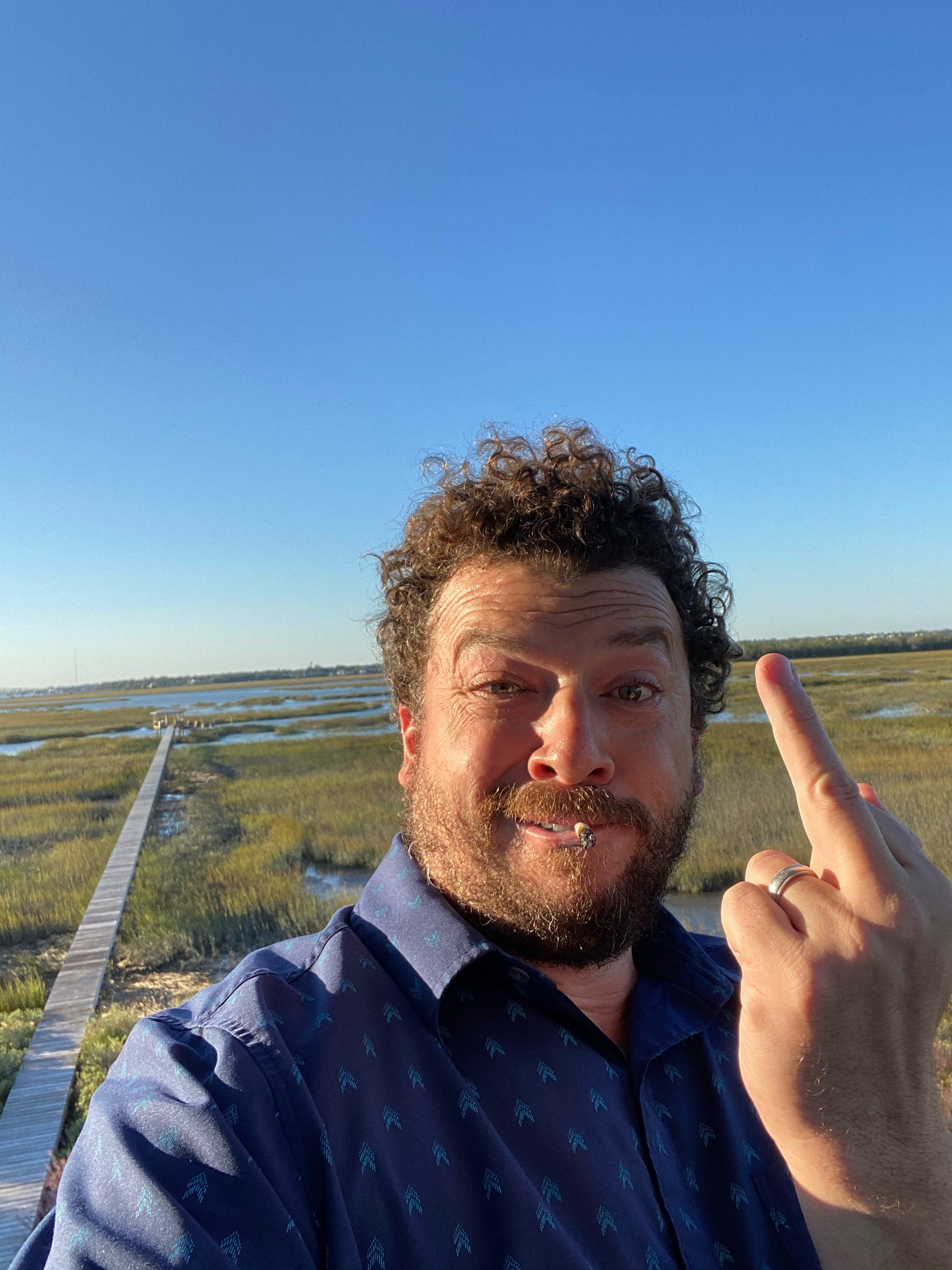
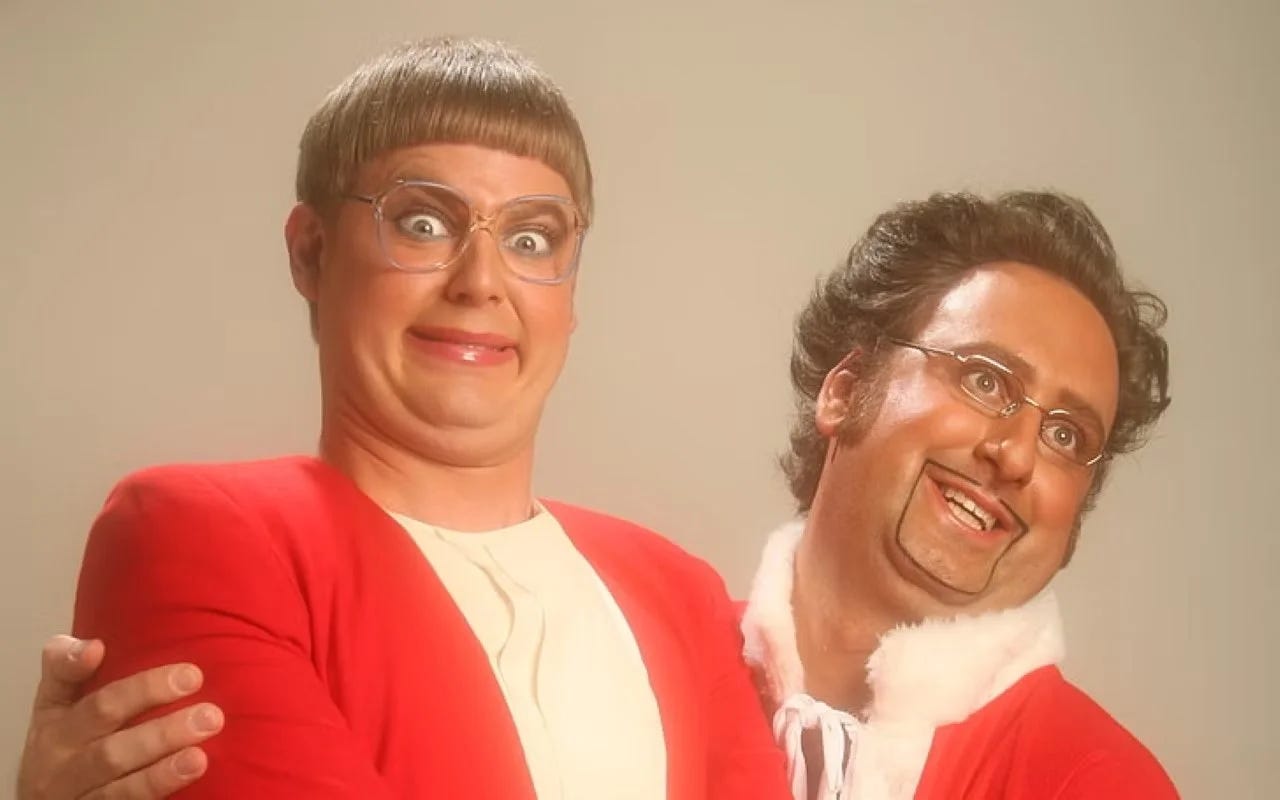
All of these seriously talented people, gathered on a video call, to discuss ghosts, monsters, alien pancakes, and the question of whether a person who believes they encountered something impossible could be allowed to direct their own reenactment of it.
This is the part of the business that is impossible to explain to normal people.
You spend years trying to convince your parents you have a real job, and then one day your real job is getting Tim Heidecker on a pitch Zoom with Nancy Abraham, Lisa Heller, and a paranormal investigator so you can talk about Italian aliens.
And honestly?
I loved it.
Every ridiculous second of it.
Before the pitch, we had a prep outline. Everyone had a job. Rough House would explain the origin of our involvement and why we thought this was less a paranormal show than a show about humans. Clay would talk about why he wanted to direct it. Erin would explain her access and why these people trusted her. Conde Nast would walk through the episode structure. Abso Lutely would talk about the “delicate tone” and how the characters would be treated.
I thought the pitch went well.
Andrew wrote that everyone did a great job.
I wrote back that everyone killed it, especially Erin.
Erin joked that she had been worried about how serious HBO was, but she knew she could win them over with “Italian aliens.”
That line has stayed with me because it captures the whole absurdity of the thing.
We were trying to win over the most serious documentary room in town with Italian aliens.
And for a minute, I thought we might have done it.
That is the hard part of a good pitch.
Not the bad ones, the bad ones are easy, you can feel them dying while you are still talking. Some exec’s camera goes off and never comes back on. Someone asks a question that makes it clear they have not watched the teaser. Someone says, “Interesting,” in a tone that means the total fucking opposite of “interesting.”
This was not that.
This felt alive.
The room was serious, yes, but HBO Docs is serious. That is the brand. You do not pitch HBO Docs and expect everyone to start clapping like you just landed a joke at the Comedy Store.
So I told everyone not to worry.
That is typical, I said.
Have a great weekend, I said.
And then we waited.
A few weeks later, the answer came in.
Not a phone call.
Not a big postmortem.
An email.
It was kind. She said it was good for them to meet the team and hear everyone’s vision. They were trying to find the right “thriller adjacent” content.
That phrase gave me half a second of hope.
Thriller adjacent.
Okay. Maybe we were adjacent, right?
But then came the sentence.
Unfortunately, we do not usually do anthologies.
There it was.
Not brutal.
Not insulting.
Not even really a rejection of the idea.
Just a programming reality quietly closing the door.
We had pitched a funny, eerie, humane, character-driven paranormal anthology series about belief, folklore, reenactments, dignity, and people whose stories nobody believed.
HBO heard it and basically said:
We like you and the team.
We see what you are trying to do.
But we do not have a shelf for this.
And in television, not having a place to put something is just as fatal as not liking it at all.
After HBO passed, Strange Encounters entered the next stage of development grief.
The buyer grid.
If you have never been lucky enough to stare at a buyer grid for one of your own dying projects, let me explain: It is basically a spreadsheet that allows you to watch hope leave your body in an organized fashion.
There are columns, names, dates, color coordination.
There are statuses like “Interested,” “Still Reviewing,” “Holding,” “Pitched,” “Passing,” and the most dangerous one of all: “Discussing internally.”
“Discussing internally” is Hollywood for: your project will be placed inside a conference room where no one who loves it has enough power to save it.
But for a while, the grid looked encouraging.
Hulu wanted to hear it.
Netflix wanted to hear it.
EPIX wanted to hear it because they needed paranormal.
Peacock wanted to hear it.
Freevee wanted to hear it, even though it was “not entirely up their alley,” which is the kind of phrase that sounds like interest until you realize its just a preemptive alibi.
Apple was reviewing.
Discovery+ was reviewing.
Showtime had already passed, but Showtime was also on the outs at this point.
The problem was, we soon discovered, nobody had a lane.
That was the strange thing about Strange Encounters.
It was too paranormal for some buyers.
Not paranormal enough for others.
Too funny for the serious documentary people.
Too documentary for the comedy people.
Too premium for the basic paranormal lane.
Too weird for the buyers who said they wanted weird.
Not enough “supernatural” for Freevee, even though the show literally involved the supernatural.
That one especially pissed me off.
We had somehow created a supernatural show that was too far from supernatural.
That is when you know you are in trouble.
The passes themselves were not cruel. That almost made it worse.
Nobody wrote back saying, “This is insane and everyone involved should seek help.”
Nobody said, “What the fuck were you thinking pitching us a show involving ghost sex.”
The notes were flattering.
People loved the team, the package.
They wished they could do something with it.
They just could not do this.
That is the most flattering way a show can die: rejected because people admire it from a safe distance, the way you admire an exotic animal at the zoo that everyone agrees should not be brought into the house.
Eventually, the grid became what all buyer grids become if you stare at them long enough:
a cemetery with fonts.
HBO: pass.
Apple: pass.
Discovery+: pass.
Netflix: pass.
EPIX: pass.
Peacock: pass.
Freevee: pass.
Hulu: pass.
At the time, I told myself the market was not ready.
Years later, after watching Neighbors, I wondered if that was true.
What if we had been early.
After the last pass came in, Strange Encounters went where old development projects go.
Not into a graveyard exactly.
More like a hard drive.
A folder.
A Vimeo link.
A deck no one opens anymore.
Every once in a while, I would think about it.
But mostly, I let it go.
Then, in April 2026, while I was organizing old teasers and pretending that organizing old teasers was the same thing as organizing my life, I clicked on Strange Encounters again. And it was still good. Not perfect. Not fully solved. But good.
And then I watched HBO’s Neighbors.
Again, Neighbors was not our show. It was not paranormal. It was not about ghosts, aliens, elves, cryptids, or people who believed they had been contacted by something from beyond the known world.
But it lived in a similar tonal neighborhood.
Real people.
Eccentric behavior.
Documentary sincerity.
Uncomfortable comedy.
The question of whether the audience was laughing at these people or recognizing something in them.
Watching it, I had the thought every filmmaker has eventually and pretends not to have:
Wait. Were we early?
It is a seductive thought.
But “early” is also one of the most comforting lies a filmmaker can tell himself.
Because sometimes “early” means the world was not ready.
And sometimes “early” means you had not solved the thing yet.
That is the part I do not fully want to answer.
I wanted to work with Tim and Eric. Badly.
I admired them. I still do. Their comedy had shaped the way I thought about awkwardness, dead air, performance, discomfort, and the strange loneliness of American life. The idea that I might get to make something with them something that lived near their world but was still a documentary was thrilling.
And I believed in the project.
Both things were true.
But looking back, I have to ask myself whether my excitement about working with two of my idols made me too eager to believe we had solved the ethical problem at the center of the show.
When your show is built around people whose stories are easy to dismiss, whose beliefs might sound absurd, whose lives may include loneliness, grief, faith, trauma, performance, mental illness, or simply experiences the rest of us cannot explain, dignity is not a vibe. It is the whole fucking job.
Neighbors had a cleaner container: Neighbor Disputes.
Everyone understands that immediately.
A person is mad at their neighbor.
That is funny, relatable, and legible before the show even starts.
Strange Encounters was harder.
American folklore.
Subject-led reenactments.
Comedy.
Sincerity.
Vulnerability.
Possible delusion.
Possible truth.
Possible poetry.
Try saying all of that in a buyer meeting and then watch everyone’s eyes politely beg for a simpler sentence.
So I do not think HBO, Hulu, Netflix, Peacock, Freevee, or anyone else was wrong to pass.
But years later, I clicked play expecting to feel relief that the show had died and Instead, I felt haunted by it.
Not by the aliens or the ghosts.
By the possibility that we had come close to something.
Close to a show about American folklore, comedy and belief.
And for a little while, I got to chase that with Tim and Eric.
That is not nothing.
Because this series deals with real projects, real people, and real companies, here’s the boring but necessary note:
Almost Greenlit is written from my personal perspective and memory as a filmmaker and producer involved in the development and pitching of these projects. It is not intended to be a definitive account of what any buyer, executive, company, filmmaker, subject, agent, financier, distributor, or other participant thought, intended, or decided at the time.
Where I describe meetings, pitches, passes, development history, business decisions, or creative choices, I am describing my own recollection, interpretation, and opinion unless otherwise stated. Any quoted material is included from my own correspondence, public materials, interviews, or with permission where appropriate.
Materials such as trailers, teasers, pitch decks, posters, stills, artwork, clips, screenshots, and other project-related assets may be included for commentary, criticism, historical context, archival reference, and educational purposes. I do not claim ownership of any third-party copyrighted material included or referenced here. Unless otherwise noted, photographs included in this series are my own or are used with permission.
Nothing in this series is intended to attack, disparage, or misrepresent anyone involved. The goal is to examine how projects are developed, pitched, passed on, revived, abandoned, or made anyway and what other filmmakers can learn from that process.
If anything here is inaccurate, incomplete, or requires correction, I’m happy to correct the record.
No posts
Comments
Nothing yet. Say the first thing.
Sign in to join the conversation.