
For years, I told myself this HBO pitch didn’t die because the movie wasn’t good.
It died because the deal between us and the filmmaker blew the fuck up at the worst possible moment.
That was the simple version.
It was also the version that made me feel better.
Then I went back through 500 pages of emails, contracts, budgets, invoices, legal drafts, and expense reports.
The truth was more complicated.
Before we begin, a note.
For this article, I am not naming the filmmaker or his agent.
Partly because many of the people involved are still working in the industry and I don’t have any desire to damage anyone’s career. And partly because this article is not intended to settle old scores.
I’ve also removed, condensed, or altered certain identifying details.
This article is not an attempt to relitigate past events, assign blame, or disparage anyone. My hope is that by sharing the reality of how a project can collapse, I can help the next generation of filmmakers avoid these same pitfalls.
What follows is my recollection of events based on roughly two years of involvement with the project, nearly $100,000 in development spending, and hundreds of pages of emails, contracts, legal drafts, budgets, invoices, and notes that I recently revisited while researching this piece.
Like any story involving a failed partnership, there are multiple perspectives. This one is mine.
I have no doubt that if the filmmaker, his representatives, or anyone else involved wrote their own version of what happened, it would read differently.
As I went back through the documents, I realized this wasn’t really a story about a filmmaker, an agent, or even a documentary it was a story about what happens when everyone agrees on the movie, but nobody agrees on who owns it.
And how, one week before what could have been a major HBO deal, that disagreement destroyed everything.
We had a dope teaser, incredible deck, a full budget and schedule and even a first act cut.
But the pitch never happened.
Instead, everyone involved became locked in a months-long fight over a simple question:
Who actually owns this movie?
In March of 2022, a friend forwarded me an email about a talented young documentary filmmaker living in a war zone.
He was American. He had been living there for years. He was not a household name, but he was not some kid with an iPhone either. He had a few short documentaries behind him, real journalistic instincts, and, most importantly, access.
The war had begun. The entire world was watching the same horrifying images: tanks, apartment blocks, subway stations turned into shelters, civilians learning the geography of missiles. It was all anyone was talking about.
This filmmaker had footage, characters, proximity to danger and courage to run right into it. And he had an incredibly unique angle on the story. What he did not have was money or the machinery around him to turn all that into a serious documentary package.
That is where we came in.
I forwarded the project to my producing partners at Rough House immediately.
There are emails you send because you are curious what others think.
This was not one of those.
This was one of those emails you send because you feel the clock start ticking the second you see the material.
The footage was raw, dangerous, alive, had the feeling every documentary producer is looking for and almost never finds: a world opening up in front of the camera before anyone has had time to overthink it.
We did not really know this filmmaker at all. But I partly started this company to help give first-time filmmakers a shot, because someone gave me one two decades ago.
And my partners and I could already see the movie.
So we decided to move immediately.
That decision would eventually cost us almost a hundred thousand dollars, months of legal fees, and an HBO pitch that never happened.
We moved fast as a motherfucker.
That’s the part people outside the business don’t always understand. Development is not just sitting around saying, “This could be cool.” Development is calls, wires, PDFs, budgets, links, decks, scripts, lawyers, editors, translators, favors, introductions, calendars, invoices, and a thousand tiny decisions that slowly turn “some footage” into “a project.”
The first thing we did was put paperwork in place.
Not perfect paperwork. And definitely not the kind of paperwork that would eventually save us from months of legal hell. An independent contractor agreement for the director. A W-9. Payments. The basic stuff you do when a production company is hiring someone to render services and start creating materials for a documentary.
At the time, it felt simple.
He was the filmmaker on the ground. We were the production company. He had access. We had infrastructure. He needed money and support. We could provide both. Nobody was confused about that in the beginning.
At least I didn’t think anyone was…
Then we started building the thing, fast. I wrote a teaser script. I hired Jesse Atlas to help make the teaser. We paid for that. The teaser gave the thing shape. It took the raw chaos of what was happening in the war zone and made it into something you could send to people who are busy, distracted, cynical, and constantly being pitched urgent documentaries about the most urgent thing happening in the world with constant urgency.
That teaser helped get a a major magazine-affiliated production studio interested in partnering on the project.
Suddenly this wasn’t just a filmmaker in a war zone sending us footage. This was a real package starting to form around a timely subject.
And every time the project needed something, we paid for it.
The filmmaker needed money for a new shoot. We sent money.
There was footage that needed to be organized and cut into rough scenes. We hired an editor in LA.
There was foreign language dialogue that needed to be translated. We hired a translator.
There was a deck that needed to look professional. We paid designers.
There was a budget that needed to show what this thing would actually cost if a network wanted to make it. I put together the budget myself.
There were grant opportunities. We submitted to Sundance.
There were creative calls, edit notes, scheduling conversations, hours of conversations about tone, structure, music, characters, access, danger, archive, and how much context an American audience would need to understand what they were watching.
In other words, a lot of fucking sweat equity and real equity was being spent.
And this is where documentary development gets weird.
The more real the project feels, the easier it is to forget that nothing is actually real yet.
We were spending money against possibility.
By late summer, documentaries about this war were starting to hit the marketplace. Other people were moving fast. We knew we were not the only ones with dope footage, telling stories about the war. If we waited too long, the window could close.
So we kept pushing.
We pushed the edit, the materials, we pushed the team to move faster and work harder.
And every time we pushed, we were also putting more value into the project.
That’s the part I keep coming back to.
Because every dollar we spent made the project more real and every step that made the project more real also made one question more dangerous.
Who owned what?
At the beginning, the answer felt obvious.
We were the production company. He was the filmmaker. We had an independent contractor agreement. We were paying him.
But nobody was fighting yet, so nobody had to say it out loud.
That was the mistake.
Then the filmmaker went back to the front lines.
And this is where I want to give him his props.
Whatever happened later, he was not sitting somewhere safe talking about making a war documentary. He was there putting himself in real danger, moving through checkpoints, following soldiers with loaded guns, filming people whose lives had been completely blown apart by the invasion.
And honestly, I saw a younger version of myself in him. I recognized the hunger. The stubbornness. The belief that if you put yourself close enough to the story, the movie will reveal itself.
So I was rooting for him.
And I think that is part of why I got so emotionally tangled up in it later.
I had gone to bat for the kid.
I had defended him when my partners questioned whether the footage was enough, whether the story was coming together, whether the project was moving quickly enough, whether we were putting too much money behind someone we barely knew.
I kept saying: give him time. He is out there doing the hard part. He is getting the material. We need to support him.
But looking back, I have to ask myself something uglier.
Was I rooting for him as a filmmaker?
Or was I rooting for the version of him that fit inside the movie I thought we were building?
Luckily, he kept coming back with footage.
Raw footage. Dangerous footage. Footage that felt alive because the person holding the camera was close to things most people would run from.
Every time new material came in, the project got bigger:
New characters. New locations. The story was expanding because the war was expanding.
For a while, we were fucking stoked.
This is the dream version of documentary development.
You bet on the access.
You bet on the filmmaker.
And for most of 2022, it felt like the bet was working.
But the question remained:
Were we building his movie? Or was he shooting ours?
Then our window started closing.
In December, another similar documentary was announced in the trades. This one had a big celeb narrating, true it was a different tone and angle than ours, but that almost didn’t matter. The headline alone was enough to make the point:
We were not the only people making a documentary about this war.
You know that feeling when one of your partners sends a link to a trade announcement with no message attached?
Just the link.
No “have you seen this?” No “this is interesting.” No explanation at all.
Because the explanation is obvious.
What the fuck are you waiting for, Adam?
Do you realize how much money we’ve spent?
We are getting beat to the punch here.
That’s when shit becomes real.
Suddenly, every delay felt heavier and every week that passed made the project feel a little more fragile.
Now the clock was no longer theoretical.
Now we needed to fucking move.
And right at the exact moment we needed speed, we got the rough cut that slowed everything down.
Around this time, the edit started getting complicated.
This was not shocking. Documentary edits are always complicated. Especially when the story is unfolding in real time, in another language, during a war, with new characters appearing every time someone comes back from a shoot.
Some people thought it should be a feature. Some thought it could be a series.
Some wanted more characters, more storylines, yet everyone wanted more focus.
Some people wanted more context and others wanted less explanation and more immersion.
All normal problems.
Annoying, expensive, time-consuming, yes. But normal.
But I had to admit to myself: the edit kinda sucked.
For a minute, I wondered if this would be the thing that killed the project. Maybe we had great footage but not a movie. Maybe the story was too sprawling, too many characters and the director and his editor were not experienced enough to figure it out.
But that wasn’t what killed it.
The edit was a problem but…
The deal was the bomb.
Then I soft-pitched it to HBO on another call.
Not a real pitch. Not a deck meeting. Just one of those quick, “By the way, we have this war zone project with a very unique angle…” mentions.
And they perked up immediately.
They wanted to hear more. I let the team know the good news and suggested we set the pitch ASAP. Get on their calendar at least.
And that’s when the filmmaker brought in representation. A dude he had just met. At first, this did not seem insane.
We were about to pitch HBO, they were stoked, and we were all talking shit like they were going to buy it, gassing each other up. So he wanted to know what he was getting paid, what his credit would be, what his role was, and what happened if the project sold…
Fair enough.
So at first, I thought: okay, here we go. Standard Hollywood pain in the ass. Agent enters. Lawyers talk. Everyone huffs and puffs. We burn a few thousand dollars. Then we make the deal and go pitch HBO.
That is not what happened.
The framing immediately changed.
Suddenly, the project was being described as his project. Not ours, together.
That may sound like a small distinction, but in actuality, that distinction is everything.
Because from his side, I can understand the argument:
He had originated the access, been on the front lines in a war, risked his life. He had shot the footage. He had relationships with the people on camera. Without him, there was no front line, no characters, no danger, no movie.
BUT…
We were the production company. We had paid him, paid for shoots, the teaser, the deck, the editor, the translations. We had built the budget, brought in first-class partners. Celebrity EP’s. A magazine-affiliated prodco with promise of P&A spend. And CAA to sell it. We had taken all the financial risk and turned raw access into a package that serious buyers could understand.
Without him, there may not have been footage.
Without us, there was no project headed to HBO.
And this is the thing a lot of first-time filmmakers do not understand.
HBO, Netflix, Hulu, Apple (any serious buyer) is not buying a director. They are buying the production company, the producers and their ability to deliver the very expensive thing they are paying for.
They want to feel protected.
They want to know that if they say yes, the project will actually get made, finished, delivered, insured, cleared, and turned in without exploding in their hands.
That was the value we were bringing to the project.
And here is where it gets dangerous.
Both versions were true enough to fight over.
And that was when the whole thing stopped feeling like a business dispute and started feeling personal.
From his perspective, maybe we were the people with the money, the lawyers, the partners, the agency, the HBO relationship the people who had taken his footage and built a structure around it.
From our perspective, maybe he was the person we had backed, funded, protected, and built around who now seemed to be saying the thing we had all built belonged to him.
Both sides could tell themselves a story in which they had been generous.
Both sides could tell themselves a story in which the other side had changed.
And once that happens, nobody is really negotiating a deal anymore.
They are negotiating a betrayal.
That is the nightmare zone in negotiations. Not when one side is obviously wrong or when someone is clearly lying, but when everyone has just enough truth on their side to believe they are the one being screwed.
For a few days, I still thought we could solve it.
We would make him a fair market-rate offer, acknowledge his contribution, protect our investment, paper the deal and get right to pitching.
Then the actual terms came in.
And that was when I realized we were no longer negotiating a director agreement.
We were negotiating the history of the project itself.
On March 3, the terms came in.
I’m going to describe them as neutrally as I can, because this is the part where the reader should make up their own mind.
The filmmaker’s representative proposed that the filmmaker would receive a directing credit and an executive producer or producer credit and a directing fee of fair market rate.
Then came the larger ask.
For the rights, he wanted to share in the producer and company fees. Not just a line-item directing fee. A split of the producing economics. And some creative control.
He also wanted participation in backend, margin, and derivative rights. If the film cost one number and sold for a higher number, he wanted to share in that upside.
There were also consultation rights, press obligations, insurance protections, travel terms, and approvals I wont get into.
Again, in another context, maybe some of this would have made sense.
If a filmmaker walked into a production company with a fully formed documentary, a clear chain of title, and a package ready to sell, a producer fee split might not sound crazy.
But that was not how we saw this project.
We saw a project we had spent a year plus building and paying for.
And now, right before we were supposed to take it out, the negotiation was no longer about how much the filmmaker should be paid to direct.
It was about whether the entire project had been his all along.
That was the moment everything changed.
Because once the argument became about ownership, there was no small fix anymore.
There was only one question left:
Who actually had the right to sell this thing?
Understand the pressure on me to get the project to market was immense. We’d put nearly 100k behind development, more than any other project before (or after), everyone thought it was a sure home run sale so what the fuck were we waiting for?
Then, on a group email with everyone copied, the conversation got personal.
I am not going to share the exact line that set me off, but I will tell you how it felt: like the floor dropped out and all the trust I thought we had built was either gone, or maybe had never existed in the first place.
In other words, the representative said something that hit me the wrong way, and I did not respond kindly.
That one is on me.
By that point, I was too close to the project, too stressed, too pressured by my own partners. Too angry about how far we had gotten and how quickly it all seemed to be slipping away. I felt like the work we had done was being rewritten in real time, and instead of taking a breath, I fired back.
It didn’t help.
In fact, it made everything worse.
That was the moment it became obvious I needed to step off. Not because I no longer cared about the project, but because I cared too much. I was no longer helping the negotiation. I was becoming part of the problem.
Everyone could see it.
So the decision was made: I would back away, and other people on my team would handle it from there.
And that’s when the movie started disappearing.
Not all at once.
Not in some big dramatic meeting where everyone slammed a laptop shut screamed ‘go fuck yourself’ and stormed out.
It died the way a lot of projects die in Hollywood:
Slowly, over months and over email.
Lawyers talked to agents, agents talked to lawyers. Drafts went out, comments came back, language was revised. Terms were softened. Then hardened. Then softened again.
And meanwhile, the actual movie kept drifting away. Like Homer Simpson into the bushes.
Nobody was talking about the characters anymore, what they were up to, how they were doing.
The HBO pitch kept getting pushed.
Then pushed again.
Then pushed again.
And eventually, there was no pitch.
That may have been the most humiliating part.
Because from the outside, we looked ridiculous. We had gotten people excited, told HBO there was something coming. Stirred up momentum and real urgency.
We had a timely project in a crowded market where every week mattered and then we could not even get the project into the fucking room.
But the lawyers kept going, the agents kept going, the emails kept going but the film was long gone.
That is the part people outside the business never really understand. A project can still technically exist while being completely dead. The footage is still there on a hard drive, the deck, the budget, the email thread is still alive. Lawyers are still being paid $800 an hour to sit on calls.
But the thing you were trying to make?
That thing is already buried.
After the dust settled, I did what producers eventually have to do: I tallied up all the receipts.
At that point, the project had become so abstract it almost felt imaginary.
But the money was not imaginary.
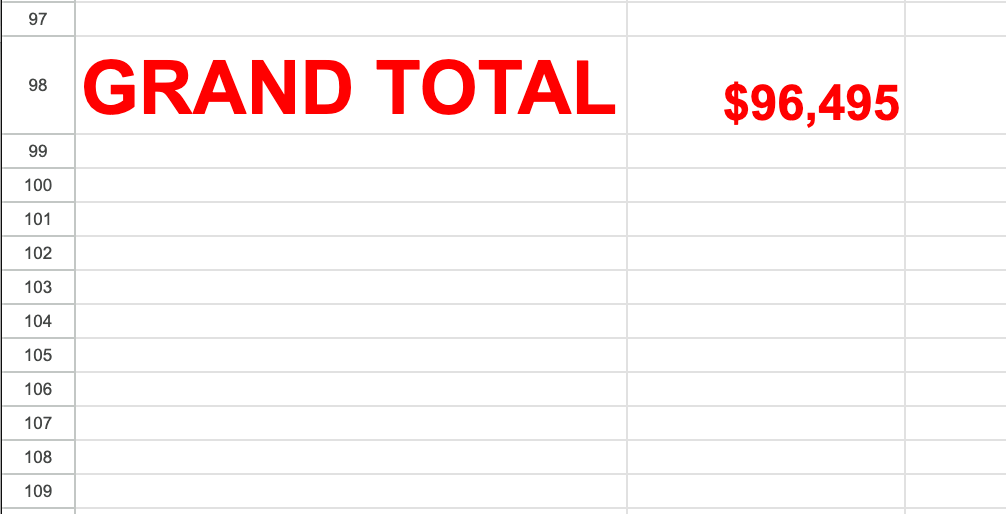
The final number was close to $100K.
That is what we spent developing a documentary that never made it into the room at HBO.
Nearly a hundred grand.
Some of it went to production. Money wired to the filmmaker so he could shoot in an active war zone, travel, keep moving, keep filming, keep chasing the story.
Some of it went to editing. Weeks and weeks of trying to turn the footage into a film.
Some of it went to the teaser and deck. The materials you need before anyone at a network even understands what you are pitching.
Some of it went to translations, because a war documentary in a foreign language isn’t easy for an American editor to cut.
And then there was legal.
That one still kills me.
We spent 15 grand arguing over who controlled a project that had not even sold yet.
A pitch that never happened.
That is the part I keep coming back to.
And when I looked at the final ledger, the whole story suddenly became very simple.
We had paid to shoot it shape it package it then fucking fight over it and walk away with nothing.
For years, I told myself this was the story of a first-time filmmaker who killed his own HBO opportunity.
That was the version that made me feel better.
“The filmmaker got a new representative. The representative changed the frame of the negotiation. The HBO pitch kept getting pushed.” And I could tell myself: “this wasn’t on us. We were ready. We had done the work. Someone else blew it up.”
That was the story I told myself because it protected me from the more uncomfortable one.
Because the more I went back through the documents, the harder it became to keep the blame that clean.
That is the part that scares me now.
Was it his movie?
Was it ours?
Was it both?
I don’t know. But I’m less interested now in who was right than in what the rest of us can learn from this debacle.
The marketplace didn’t kill this movie.
We did.
We killed it because we let the excitement outrun the paperwork.
And looking back, that is the part I own.
When the pressure started building, I should have slowed the whole thing down.
Instead, I tried to speed it up.
My partners wanted answers. The agents wanted to take it out. Everyone wanted momentum. Everyone wanted the pitch. Everyone wanted to know why we weren’t already in Hudson Yards pitching.
And I buckled under that pressure.
And maybe I was not only buckling under other people’s pressure.
Maybe I was addicted to the feeling that we had found something before everyone else and I wanted to be the guy who saw the movie early, backed the young filmmaker, assembled the team, got it to HBO, and proved that all the chaos had been worth it.
That is not a great thing to admit.
But it is probably true.
Because when you are producing, momentum can feel like proof that you are right.
So instead of saying, “Stop, we need to settle the deal before we do anything else,” I kept pushing toward the marketplace, trying to solve the paperwork while also preserving the momentum, which is basically how you create the exact disaster we ended up in.
That is on me.
I should have protected the project from its own momentum.
Because once a project like this starts moving, everyone wants to run.
But sometimes the producer’s job is to be the asshole in the room who says: not yet.
And if you make documentaries long enough, you eventually learn that this is how a lot of projects die.
Not from one catastrophic decision.
From a hundred reasonable ones.
These are the lessons I wish I had learned earlier.
Money is not ownership.
A teaser you wrote and paid for is not ownership.
A first look deal with HBO is not ownership.
A magazine-affiliated prodco offering up P&A is not ownership.
And celebrity EP’s are definitely not ownership.
If you are producing a documentary right now, especially one built around a young, first-time filmmaker ask the ugly questions early.
Who owns the footage?
Who owns the underlying idea?
Who controls the rights?
Who has the authority to sell it?
What happens if a buyer says yes?
What happens if the filmmaker walks?
What happens if the production company walks?
What happens if the thing suddenly becomes valuable?
Because that is when everyone remembers the conversation differently.
And by then, the movie may already be gone.
I don’t actually know what happened to the movie after that.
If the filmmaker ever wants to reach out and tell me, I would be happy to update this piece. I mean that sincerely. I don’t expect him to, but if the project continued, changed shape, found new partners, or became something else, I’d be glad to include that.
What I do know is that we made it very clear that we were not going to stop him from finishing his film.
Whatever had happened between us, he had risked himself to capture that footage. He cared about the story. He had relationships with the people on camera. If he wanted to keep going and make the movie without us, I was not interested in standing in the way of that.
But there was one very real problem.
By that point, the project had nearly $100,000 in development costs attached to it.
So even if he moved forward without us, any new buyer, financier, or production partner would eventually have to understand that history.
In practical terms, the project carried a roughly $100,000 lien or recoupment obligation. Not because we wanted to punish him, but because that money had been spent and the project did not enter the world clean.
It is a little like trying to sell a house with a six figure lien on it.
Maybe the house is still incredibly valuable.
But the lien does not disappear just because everyone wishes the previous deal had gone differently.
And that was not the only problem.
A new partner would also have questions.
Why did the prior deal fall apart?
Why was the original producing team no longer involved?
Why did a project with serious producers, major partners, celebrity executive producers, CAA ready to sell it, and a path toward HBO suddenly have to start over?
That is the tragic part.
Even after the project left our hands, the dispute kept following it.
Now the project carried a history. And history, in this business, can become its own kind of debt.
Because this series deals with real projects, real people, and real companies, here’s the boring but necessary note:
Almost Greenlit is written from my personal perspective and memory as a filmmaker and producer involved in the development and pitching of these projects. It is not intended to be a definitive account of what any buyer, executive, company, filmmaker, subject, agent, financier, distributor, or other participant thought, intended, or decided at the time.
Where I describe meetings, pitches, passes, development history, business decisions, or creative choices, I am describing my own recollection, interpretation, and opinion unless otherwise stated. Any quoted material is included from my own correspondence, public materials, interviews, or with permission where appropriate.
Materials such as trailers, teasers, pitch decks, posters, stills, artwork, clips, screenshots, and other project-related assets may be included for commentary, criticism, historical context, archival reference, and educational purposes. I do not claim ownership of any third-party copyrighted material included or referenced here. Unless otherwise noted, photographs included in this series are my own or are used with permission.
Nothing in this series is intended to attack, disparage, or misrepresent anyone involved. The goal is to examine how projects are developed, pitched, passed on, revived, abandoned, or made anyway and what other filmmakers can learn from that process.
If anything here is inaccurate, incomplete, or requires correction, I’m happy to correct the record.
No posts
Comments
Nothing yet. Say the first thing.
Sign in to join the conversation.