
Issue No. 59
This week’s topic brings together three ideas from different disciplines.
Idea 1. I was reading a passage about film editing from the early 1900s in which a filmmaker is retelling the story of an experiment he and his collaborator (Kuleshov) once carried out. The two of them take a close-up shot of an actor with an expressionless face and then combine that close-up with shots of various other things.
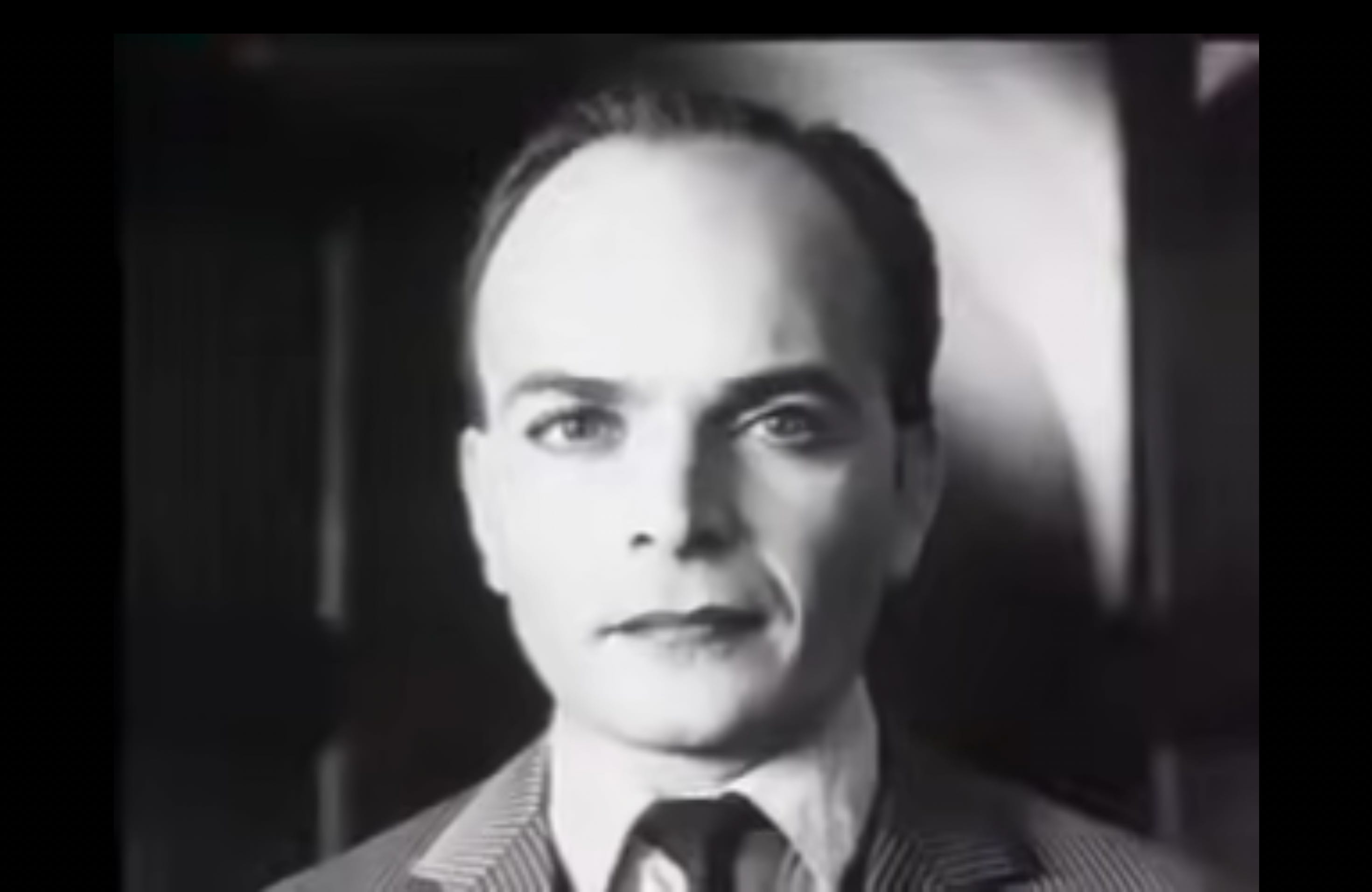
In the first one, the expressionless face is followed by a bowl of soup. In the second, it’s followed by a woman in a coffin. And in the third, it’s followed by a little girl playing with a teddy bear. They then show the film to an audience without telling them it’s the exact same close-up in every combination.
When we showed the three combinations to an audience which had not been let into the secret the result was terrific. The public raved about the acting of the artist. They pointed out the heavy pensiveness of his mood over the forgotten soup, were touched and moved by the deep sorrow with which he looked on the dead woman, and admired the light, happy smile with which he surveyed the girl at play. But we knew that in all three cases the face was exactly the same.
—Vsevolod Pudovkin (Film Technique and Film Acting)
If we take Pudovkin’s account as read, viewers animated the expressionless face into an expressionful one based on their interpretation of what the face surely ought to have been feeling. This is referred to nowadays as the Kuleshov effect and shares some qualities with what we covered in an earlier issue about pictures of facts.1
In an interview many years later, when Alfred Hitchcock is asked whether he cares more about storytelling or about stories, he touches on a theme that to my ears feels similar.
Interviewer: You’ve said that you’re more interested in the technique of storytelling by means of film than in the content of film itself?
Hitchcock: I’m sure that the painter is not interested in the apples for themselves alone. But in the technique of his work, which stimulates the emotion of the viewer of his picture.
After all, all art is experienced. People look at an abstract and say, “I hate it” … or they like it. It’s not the story but what you do with it … I find that with many people, they look at a film and look at its content only, and never seem to study … what was there in the film to make an audience go through various emotions.
So to bring the two thoughts together, the way we derive meaning from a film is based not only on the content of the film, but on what we think the content of the film ought to be.
Idea 2. A couple of issues ago, we talked about Grice’s maxims and about how meaning is constructed not only by a speaker but also by a listener. Particularly when something is implied rather than literally expressed. For instance, let’s say two people are in a car and one is hungry.
Person 1: I’m starving. Good thing the grocery store’s a few miles from here.
Person 2: It’s too late though.
Person 1 would understand that person 2 means that it’s late, and therefore the grocery store is closed. But to an alien sitting in the back seat, would they get that connection? Or would they assume person 2 missed the mark with their answer, or that they somehow answered a completely different question?
Nothing in the words “it’s too late” says anything about the grocery store, or about it being closed, or even about how the two sentences are at all related. Person 1 assumes person 2 is being cooperative, and they work backwards to a reading that, in their mind, makes the response make sense.
Person 2 could have been explicit by saying, “The store closes at 10, and now it’s 11, therefore we won’t be able to buy anything from it.” But that too leans on a common understanding about stores having fixed hours, closed meaning you can’t go in and buy things afterward, that this particular store follows that pattern, that 11:00 comes after 10:00, that a closed store is relevant to being hungry.
So the thought here is that communication isn’t a one-way flow where meaning goes from one person to the other. It’s a collaborative, cooperative process of construction.
Idea 3. A clip made the rounds last week in which Richard Feynman is asked why magnets repel each other. It’s from a BBC interview I’d watched two decades ago and this reminder about it actually made me go and watch the whole thing again.
So he’s asked a question about why magnets repel each other and his answer is that, well, they just do.2 The interviewer, understandably, isn’t satisfied and presses more, hoping for something deeper. He’s annoyed even that his question wasn’t worthy apparently of a proper answer.
Feynman goes on to explain that when you’re asked a why question, you have to then explain the thing in terms of something else the other person is already familiar with. He gives the following analogy, which I’ve edited for brevity and readability.

How does a person answer why something happens?
For example, Aunt Minnie is in the hospital.
Why? Because she slipped on the ice and broke her hip. That satisfies people. But it wouldn’t satisfy someone who came from another planet and knew nothing about things, who wouldn’t understand why when you break your hip do you go to the hospital?
How do you get to the hospital when the hip [is] broken? Well, because her husband called the hospital up and they sent somebody to get her. All that is understood by people. When you explain a why, you have to be in some framework [where] you allow something to be true. Otherwise you’re perpetually asking “Why?”
Why did the husband call the hospital? Because the husband is interested in his wife’s welfare. Not always, some husbands aren’t.
Why did she slip on the ice? Ice is slippery. Everybody knows that. But you ask,
Why is ice slippery? That’s kind of curious. Ice is extremely slippery. You could either say, “I’m satisfied that you’ve answered me. Ice is slippery, that explains it.” Or you could go out and say, “Why is ice slippery?” There aren’t many things as slippery as ice. A solid that’s so slippery? In the case of ice, when you’re standing on it, they say, momentarily the pressure melts the ice a little bit, so you get a sort of instantaneous water surface on which you’re slipping.
Why on ice and not on other things? Because water expands when it freezes so the pressure tries to undo the expansion and is capable of melting it, but other substances contract when they’re freezing and when you push them they’re just satisfied to be solid.
Why does water expand when it freezes and other substances don’t expand when they freeze? I’m not answering your question, but I’m telling you how difficult a Why question is. You have to know what it is … you’re permitted to understand and allow to be understood and what it is you’re not. We could even go further and say,
Why did she fall down when she slipped? That has to do with gravity and involves all the planets and everything else … It goes on and on.
My takeaway from this exchange is that whether an answer counts as an answer has less to do with the world and more to do with what the two people who are in conversation already treat as obvious. Think back to how you might explain something from your own field to a colleague compared to how you might explain it to a child who knows nothing about any of the assumptions or prior work on which your field stands.
So answers to why questions can be thought of as reductions to the familiar. They kick off a regress that stops once we get to an idea the other person already understands. Otherwise, we keep going on and on and on.
All three ideas together
Taking those three ideas together, we have
A receiver animating a face based on what they know about people.
A listener (person 1) filling in what a speaker (person 2) means based on what they know about language.
A questioner learning something new based on what they already know about how things work.
When you’re on the flip side of those things (you’re the filmmaker, you’re the speaker, you’re the teacher), and regardless of whether or not you’re doing it deliberately, it seems to me that you can’t transfer an idea into someone’s head. The best you can do is work out what’s already in there, put the new idea beside it, and hope they connect the two.
Kuleshov or Hitchcock can’t transfer grief to their audience. But they can put a face next to a coffin, and hope the audience does the rest.
The person saying “It’s too late” in response to “There’s a grocery store close by” is placing that reply next to everything the other person already knows about grocery stores, about closing times, and about how a reply is supposed to relate to what came before it.
Feynman can’t explain to a journalist why magnets repel each other by connecting it to something that’s familiar to the journalist based on their everyday experiences, which is why he ends up talking at length about the word why instead of about magnets. With a student he’d have kept walking the regress until he hit something the student already accepted.
So a thought to take away from this issue might be that communicating something to someone we hope will understand us has less to do with what we say and more to do with how we couple what we say with what they already know.
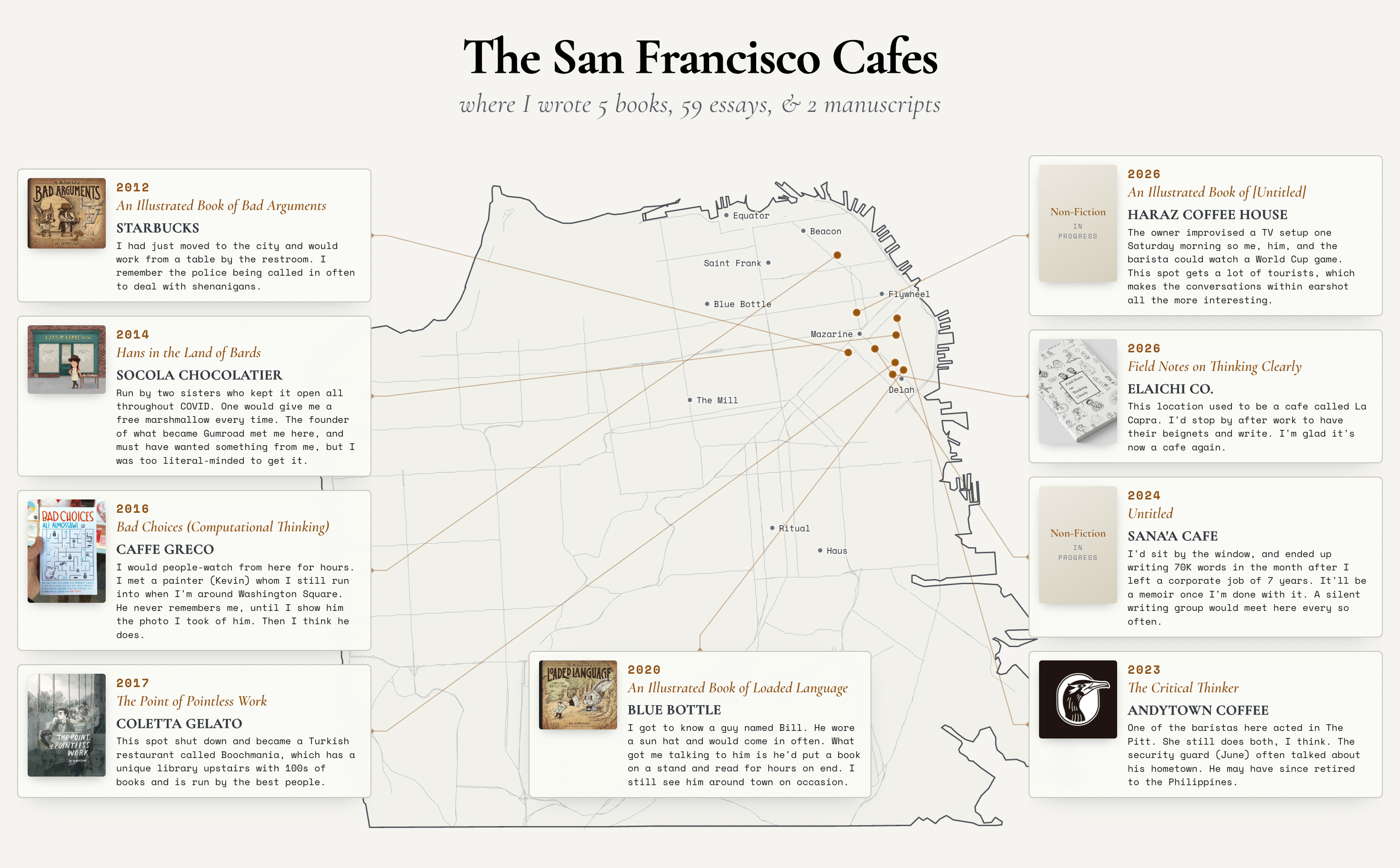
The cafes I’ve written from
Here’s something I put together last weekend. At a cafe fittingly. These are the places where 5 books, 59 essays, and 2 manuscripts largely came together over the past decade and a half. I hadn’t realized until I mapped them out that coupling a project with a place has helped with discipline over the years.
Above all, do not lose your desire to walk.
—Søren Kierkegaard
Until next time.
Be well,
Ali
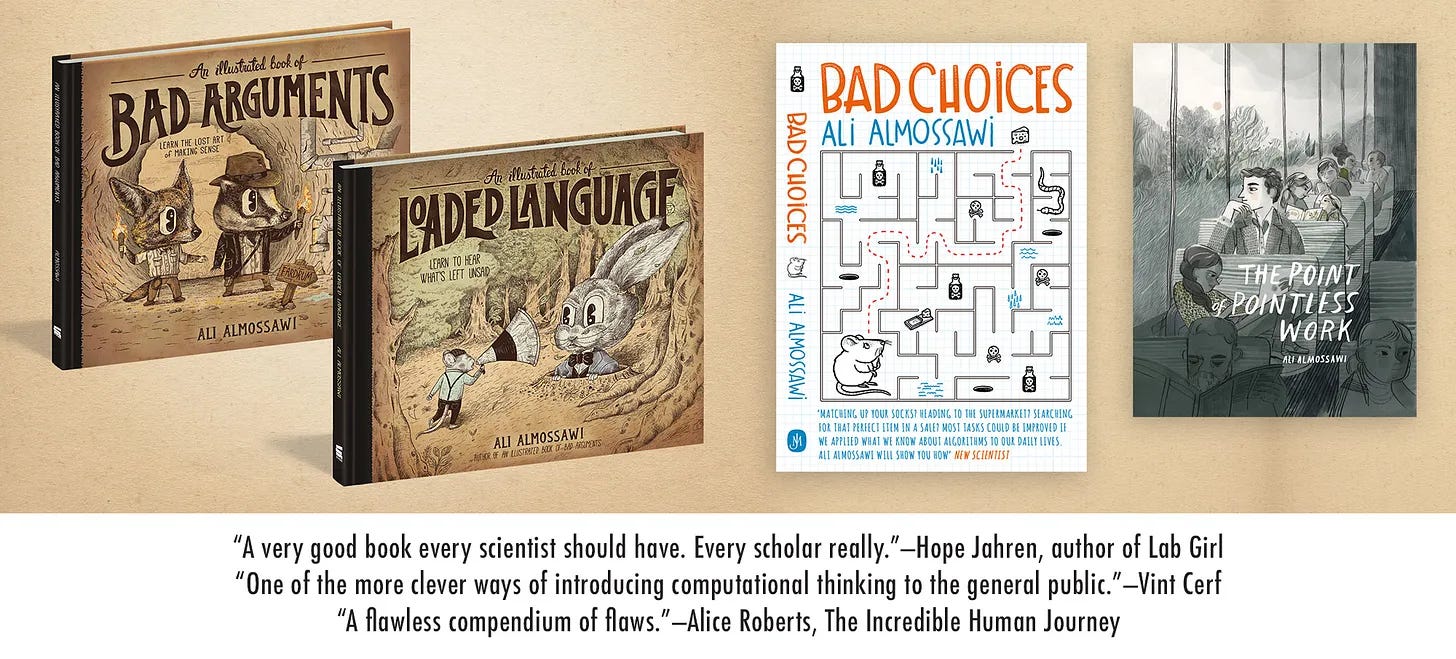
P.S. Some past issues to read through in case you missed them.
Studies have attempted to verify the effect experimentally with mixed results.
I’d watched the full BBC documentary in my last year of grad school when I discovered Feynman for the very first time. His approach to thinking left such an immediate impression on me that I read everything I could get my hands on by him or about him at the time, even buying six cassette tapes from a seller on eBay with recordings of his introductory to physics lectures.
Comments
Nothing yet. Say the first thing.
Sign in to join the conversation.