
If you know me, you know that no one would describe me as patient. I attribute it—perhaps wrongly—to my time working as an intel analyst on fast-moving issues like internal conflicts. When there are U.S. boots on the ground, you’re expected to work quickly and efficiently. No time to lose your cool.
So how in the world do I manage not to lose my mind editing a book for the umpteenth time?
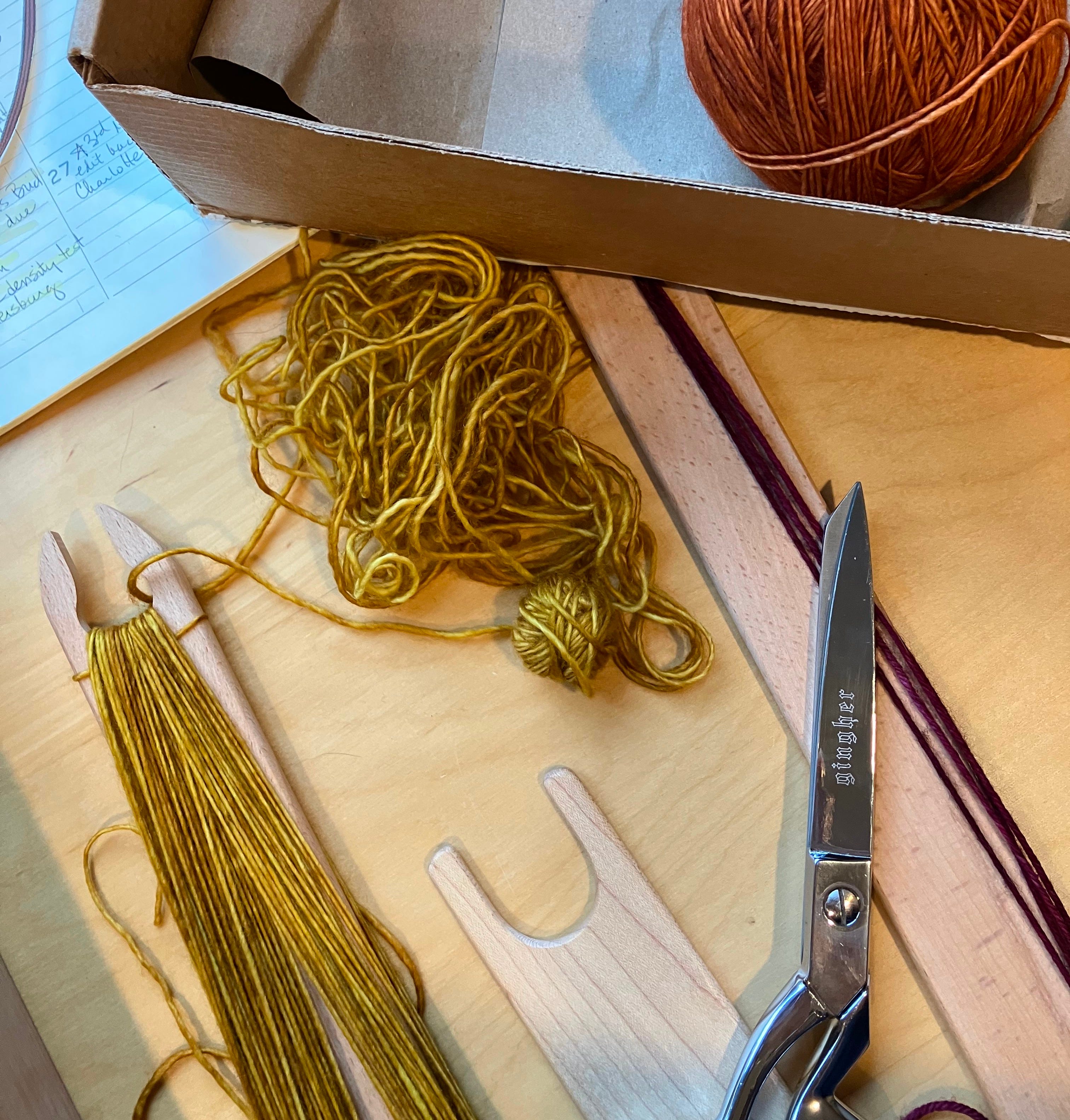
Weaving is a practice that requires lots and lots of patience. I’ve come to think of “must love knots” (or at least “must not mind knots”) as the craft’s motto. Right now, I’m working on a scarf that uses a precious hand-painted yarn in the warp, a limited edition that I suspect is long unavailable, and I chose the wrong yarn to pair with it. It is ugly, and I’m agonizing over whether to unweave it.
Unweaving is tedious work. It’s exactly what it implies: using a blunt tapestry needle to unpick the rows you’ve already made. If you try to preserve your weft yarn, it quickly becomes a tangled mess. It becomes a test of patience. You’re not going to be able to save all the yarn in one nice, continuous length. Do you sacrifice the weft in order to save the warp, which is like the piece’s skeleton? The structural part. What do you sacrifice in order to save the beautiful bits?
It’s not such a hard choice if you’re not far into your project, but I’m past the halfway mark. I already unwove ten inches, gave up unweaving any further, and decided to try adding new colors in an attempt to rescue the entire project. It’s not working. Now I only have tough choices ahead.
It’s a parallel universe to writing. Because: writing comes down to editing. The story is born out of writing that first draft but it’s in the editing that the story comes alive (or fails to). At some point, every writer is going to be faced with a tough editing job. It might be major surgery, needing to cut entire chapters, to excise a character or two, drop a sub-plot or completely rethink the main plot, or realizing your ending doesn’t work. Among minor surgery (IMO) are relatively easy things to fix like changing verb tense or switching from first person POV to third.
I did easily over a dozen major revisions to The Taker, my debut, in the ten years I worked on it before selling it to Gallery Books. When you’re starting out, you’re alone, no professional editor to guide your hand. You don’t know what you’re doing. You try this, you try that. Also, The Taker was an ambitious book for a beginner. The upshot is that at one point, the novel felt less like a coherent collection of words than froth, foam held together by air, fragile and, frankly, seemingly impossible to fix.
That’s where patience comes in. It’s mandatory.
In intel analysis, every day you must sift through hundreds (if not thousands) of tiny pieces of information, looking for the one piece that makes everything fall together. You want to throw your hands up and walk away. Your nerves may feel like they’ve been shredded. It’s the same way, sometimes, with editing. You feel like if you have to read that passage one more time, you’re going to scream. Somehow, you have to reach down and find the patience to do it, bringing all the focus you have left in you to bear.
Your job as the artist, whether as a writer or a weaver, is to make the best possible piece of art that you can. That means knowing when to take it apart, how much to take apart, which pieces to keep and which to reluctantly shear away. That old chestnut, “kill your darlings”, doesn’t begin to cover what’s required. The truth is that you can’t shy away from it, that you must accept this as part of the territory every bit as much as birthing those new words. You must somehow find the patience inside you to examine your work, face your mistakes, and figure out how to fix them—even if that means unweaving nearly everything you’ve done.
Writing is rewriting.
No, nobody who knows me would describe me as patient, but honestly it’s a reserve so deep that at times it feels bottomless. Once you find your way to it, trust that you’ll be able to find it again. It may be known only to me, but that’s okay.
“Must love knots”.
Winner, winner: Vasiliki S. of NC is the winner of last week’s contest! Thanks to everyone who entered. We’ll have another contest soon, so stay tuned.
Comments
Nothing yet. Say the first thing.
Sign in to join the conversation.