
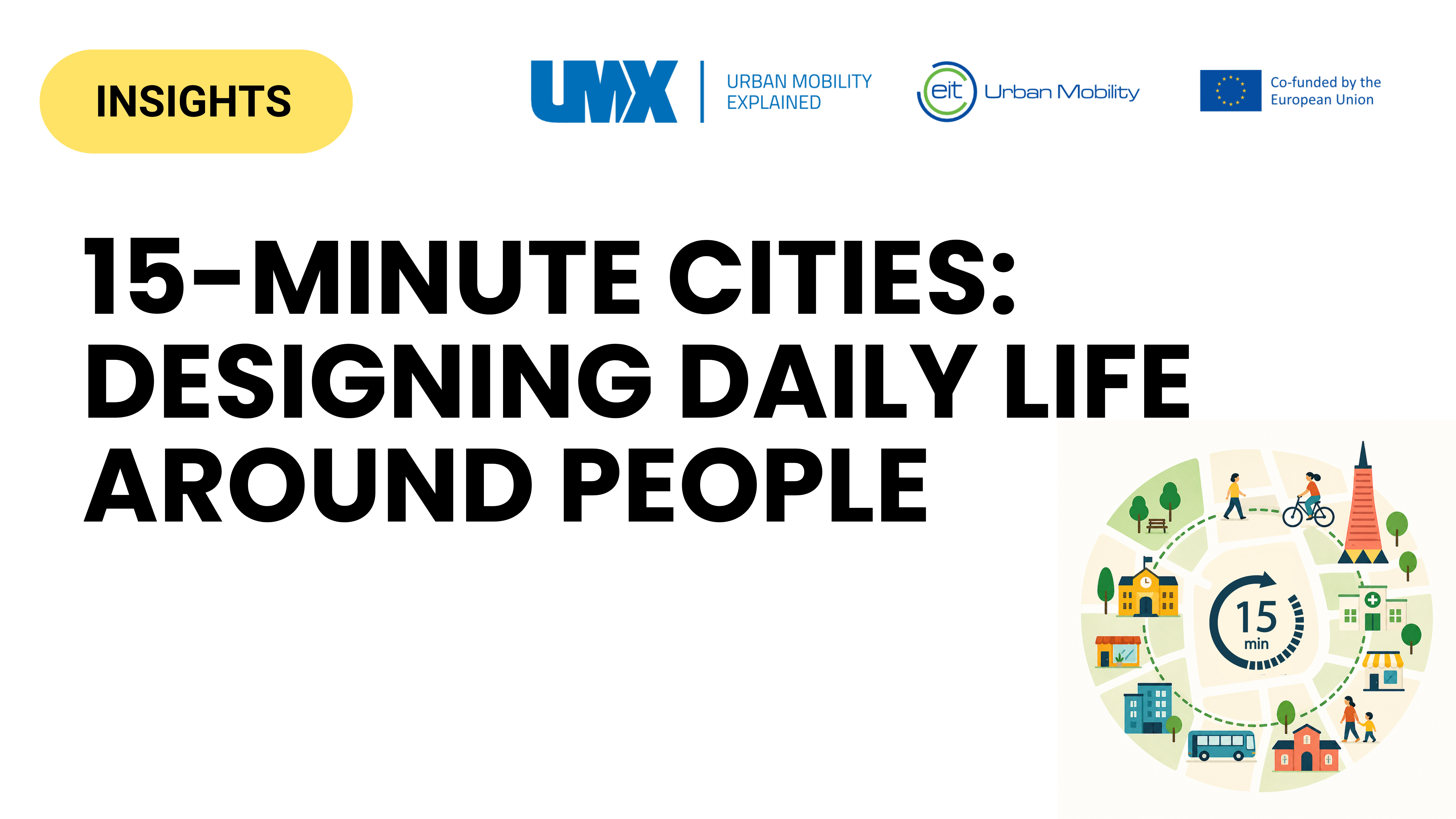
A 15-minute city means being able to reach daily needs such as education, healthcare, shops, and everyday services within a 15-minute walk or bike ride.
The idea is simple: daily needs within reach. But making it work is where things get interesting.
In practice, most cities were not designed this way. Urban systems have long been shaped by separation, distance, and efficiency, while everyday life depends on proximity, time, and local access.
And that’s where the gap appears.
Some neighbourhoods have essential services within reach. Others rely on long trips for basic needs. What often appears as a mobility issue is, in reality, a question of access. And that distinction matters.
Because this is not just about convenience. It shapes how people live, work, and participate in the city.
The 15-minute city is not a fixed model. Some cities apply it as 10, 15, or even 20 minutes. But the principle remains the same: bringing daily life closer.
What makes it works? The 15-minute city is not only about distance. It is built on four interconnected principles:
👥 Density
Enough people and services to support everyday life locally
🔀 Diversity
A mix of functions, uses, and communities within neighbourhoods
📍 Proximity
Daily needs accessible within short walking or cycling distances
💻 Digitalization
Smart systems that connect services, data, and people
Together, these elements create a system where urban services and data support accessible, local, and efficient everyday life.
So how do we move from concept to practice?
This is exactly where this month’s collaboration between All Things Urban and UMX (Urban Mobility Explained) by EIT Urban Mobility comes in.
Every month, All Things Urban publishes a special edition developed in collaboration with UMX by EIT Urban Mobility. This month’s focus: 15-Minute Cities.
The free course “±15-Minute Cities: Putting People’s Needs First” breaks down what the concept really means and provides practical tools to apply it in real urban contexts. Now available in French, Spanish & Portuguese.
🚦 1. Designing Around Distance Instead of Proximity
Many urban systems still separate housing, services, and work across the city. This often increases travel time and limits everyday accessibility.
📌 What can help:
More balanced distribution of essential services
Mixed-use neighbourhoods
Better alignment between land use and daily needs
Stronger local accessibility
When daily needs are far away, cities become less efficient.
🚶 2. Focusing on Mobility Instead of Accessibility
Cities often measure how people move, but less often whether they can reach what they need.
Mobility does not always translate into access.
📌 How to fix it:
Mapping access to services, not only transport networks
Identifying gaps between neighbourhoods
Improving proximity alongside connectivity
Better integration across planning sectors
If people can move but not reach what they need, the system is not working.
⚖️ 3. Overlooking Spatial Inequalities
Access to services is not evenly distributed. This creates unequal opportunities across the city.
📌 What needs to change:
Identify underserved areas
Prioritise local service provision
Apply accessibility-based planning
Integrate equity into decision-making
If access depends on where you live, cities create unequal opportunities.
Cities that move beyond theory typically:
Design around everyday routines, not only commuting
Strengthen walking and cycling networks
Support local services and economies
Combine land use, mobility, and housing strategies
Use data to guide accessibility decisions
The result:
✔ More accessible cities
✔ Better quality of life
✔ Lower emissions
✔ Stronger local communities
If you want to understand how to move from concept to implementation, this course offers a clear and practical starting point. Take the free course to learn how 15-minute cities actually work and build skills you can apply in your own context.
For the first time, the course is available in Spanish, French, and Portuguese, so you can learn in your own language and focus on understanding, not translating.
Upon completion, you can also add a recognised certificate to your portfolio.
Find out more and enrol for free
✔ Understand the benefits and challenges of 15-minute cities
✔ Identify mobility and accessibility inequalities
✔ Learn how proximity shapes everyday urban life
✔ Explore tools to assess your city
✔ Apply an implementation roadmap
Urban planners, mobility professionals, policymakers, researchers, consultants, and anyone shaping proximity, accessibility, and everyday urban life.
✅ 100% free access
🎤 Join our exclusive webinar with Dr. Benjamin Büttner later this month and deepen your understanding of 15-minute cities. Complete the course by then and come more prepared! Stay tuned for the webinar announcement.
🎓 Optional certificate available upon completion (for a small fee)
⏱ Designed to be completed in just ~2 hours
🌍 Available in Spanish, French, and Portuguese
If you prefer to study in English, click “Register” below.
At the end of this month, join an exclusive webinar with Dr. Benjamin Büttner, the course instructor and a leading expert in accessibility and mobility.
💡 Learn directly from the expert behind the course and deepen your understanding of 15-minute cities.
📌 Complete the course in advance to get the most out of the session.
These free courses are offered by UMX by EIT Urban Mobility, supported by a network of 750+ European cities, researchers, and industry partners working to shape the future of mobility through accessible, high-quality learning.

Urban Mobility Explained (UMX) by EIT Urban Mobility offers a variety of free, self-paced courses available for urbanists worldwide. UMX helps professionals like you level up your skills and become urban mobility insiders. Backed by their extensive network of 750+ top European entities and experts, including city planners, academics, and consultants, they offer a diverse array of courses, short videos, and other tailored learning resources to help you stay on track and refine your desired skill set.
Join us on this journey. Apply for your first UMX course today and drive the change!
Warm regards,
The All Things Urban Team
Comments
Nothing yet. Say the first thing.
Sign in to join the conversation.