
I do harp on about expressive technologies quite a bit, I’m aware of that. But in my defence, it’s a persistence rooted in love. A love for creative endeavours that make use of tools, platforms, and technologies, with the possibility of reflecting something of you — perhaps even hidden parts of you, where incredible ideas and connections have been fermenting in the background for many years.
Such yearnings are usually expressed through some form of art, and typically not through technology. Yet during my final year as a mechanical engineering student, an unusual moment convinced me that art and engineering overlap in profound ways, a connection that often goes unnoticed in the usual discourse. I want to bring this to light, because there is much to be discovered in this shared space.
A quick sidenote, some of you will rightfully point out that the shared creative roots can diverge rather quickly, as technical projects can rarely be undertaken by an individual. But that’s starting to change. We can point to open source software, and digital twins focused on co-creation, as technologies that give individuals a chance to infuse large-scale projects with their creative sparks.
Anyhow, let's get back to how this shared space was made clear to me.
I received my bachelor's degree from one of the toughest mechanical engineering departments in the world, a point our instructors were happy to make during our first week of “orientation”. I’m not sure they fully understood the meaning of the word. That point was driven home many times over the years, until a dreaded final project brought my highly rewarding, but often arduous, journey to its climax.
This final hurdle before I could proudly call myself a mechanical engineer was, in fact, a two-term project that would end in a competition. My team of three was to compete against others by building a robot that could move on a glass surface, one that could be tilted to a selected angle. The team whose robot moved at the steepest angle would win.
We were expected to do pretty much everything from scratch: design the robot, its gearbox, its control system, build and assemble everything by hand, and give it a rousing pep talk as it faced its brethren on the glass arena. I still think that cutting gears of your own design is the ultimate geek-meets-grizzled-machinist crossover.
Up to this point, our experience as engineering students was mostly about solving problems with well-structured constraints. I’ve also discovered over the years that such constraints extend beyond school for engineers, and this is another contributor to the gap between us and artists. Although they also have their restrictions, I’m sure they face many more dreadfully liberating moments of staring at blank canvases and lumps of untouched clay.
For our final project, most of the shackles were off. Yes, the surface was fixed, and the robot had to move on glass, but beyond that, we were mostly free. One of the biggest pitfalls in such situations is the pull of familiar solutions, the well-worn grooves of engineering, the ones that keep grabbing your pants legs like a demented toy dog. In this case, nearly every team had visions of mini-robots with tank tracks, since they offered a fine, if predictable, solution for navigating slopes.
My intuition about tank tracks was confirmed on the day of the competition, but I shouldn’t rush ahead of myself.
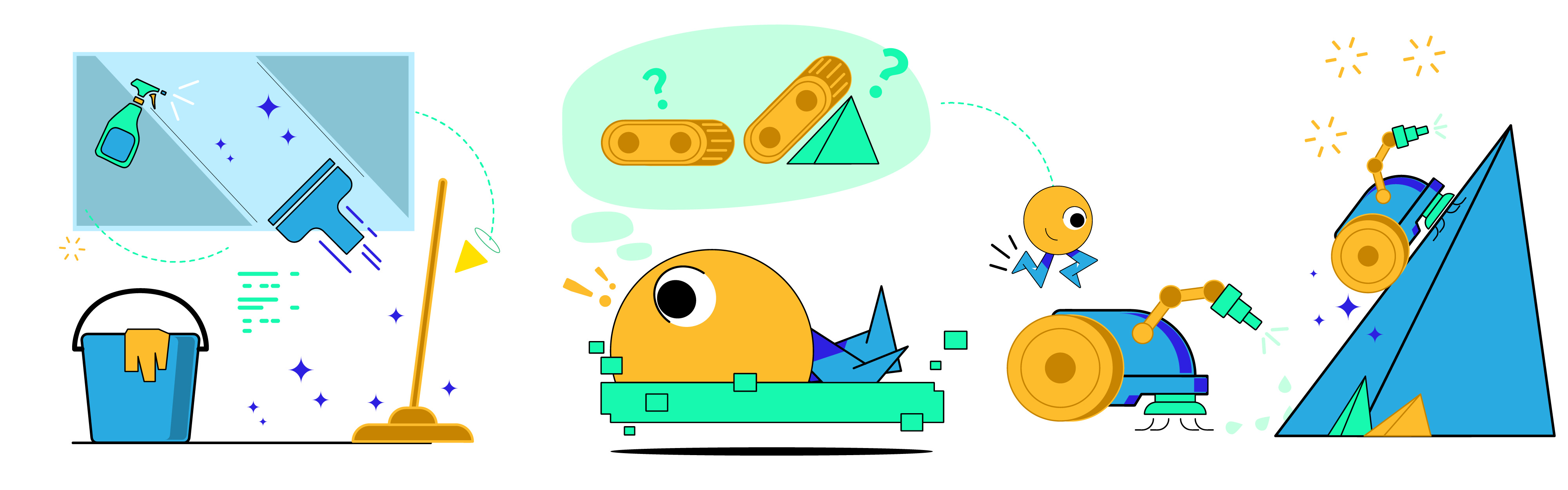
So I found myself not in animated discussion with my teammates, punctuated by sketches on a whiteboard, but rather pacing in my living room, at times lying on my back, staring at the ceiling. Definitely not movie montage material. Just as a quick note though, brainstorming, in my experience, and as some experts will confirm, is a solitary activity. It’s what we gather after the storm that should be fused and nurtured as a team. Anyhow…
As I paced cluelessly, trying to erase the tank tracks from my mind, a strange visual took its place — a clean, wet marble surface, in some unidentified, naturally lit kitchen. There was a bowl on that surface, face down. I could picture the bowl sliding with the lightest touch, but when I mentally tried to lift it, it stuck. The wet surface created a vacuum, one that allowed for lateral movement but resisted any attempt to pull the bowl upward.
This is the second most vivid image seared into my memory from that time, nearly thirty years ago. The most vivid one is still to come.
I felt instantly that I was on to something, part of me was so sure that it was itching to call my teammates. But the engineer in me stepped in, as it often does, and asked for proof. The imaginary canvas in my mind wasn’t enough to unleash this idea on my teammates, I had to try it out first.
The following day, my living room was no longer a free pacing ground, but a makeshift lab. The glass door of my bookcase held a large suction cup on one side, fixed by a string to a bag of oranges hanging on the other. At first, nothing happened — I suppose that could be considered some form of success (I’m just a born optimist). Just how many living rooms on the planet could boast a suction cup, string, and orange setup? I had the modern art part of things down.
I needed to add the final component of my mental image to the setup — the wet surface. As I sprayed some water on the glass and coaxed the suction cup along its path, the whole setup transformed from (terrible) art to (less terrible) engineering. In other words, the suction cup started moving up as the oranges headed down.
When I finally outlined my idea, my teammates weren’t as thrilled as I’d hoped, but in hindsight, there was something better — an implicit, shared understanding that this might actually propel us to a win. But they pointed out something I had missed, one of many reasons why you need a team. Would we be allowed to create a wet surface during the competition?
The next day, we knocked on the door of the assistant in charge of the competition. Our nervousness was rooted in a combination of pitching an oddball idea and the fact that the assistant had a reputation as a loose cannon. Oddly enough, she told us that we could try different things, as long as the surface was clean for the next team. How very rational, and very fortunate for us.
After several more days of work, our final concept was a robot with a big, industrial suction cup, two (relatively) large wheels, and a setup that would spray Windex on the surface, prepping it for the motion to come. We figured this guy could conceivably move at any angle — the difficulty would now shift to the assistants, who had to adjust the setup to something suitably challenging.
I don’t know how artists cross that chasm, the one I believe reveals itself after an idea has been conceived, pushed, and stretched inside the creator’s mind, until it reaches the point where inspiration and willpower are finally enough to realize it. For an engineer, that chasm between a dreamer and a creator usually requires a capable, dependable team. And I had a great one.
The three of us calculated, designed, machined, welded, filed, assembled, documented, and helped each other with a bunch of other verbs that end with “ed” as we went through some of the most tiring weeks of our lives. Now this was worthy of a movie montage — as we took turns sleeping to the sound of keyboard clicks in the background, made frequent runs to the machine shop for tweaks, and tried to keep our spirits up as the gears, quite literally, started to turn.
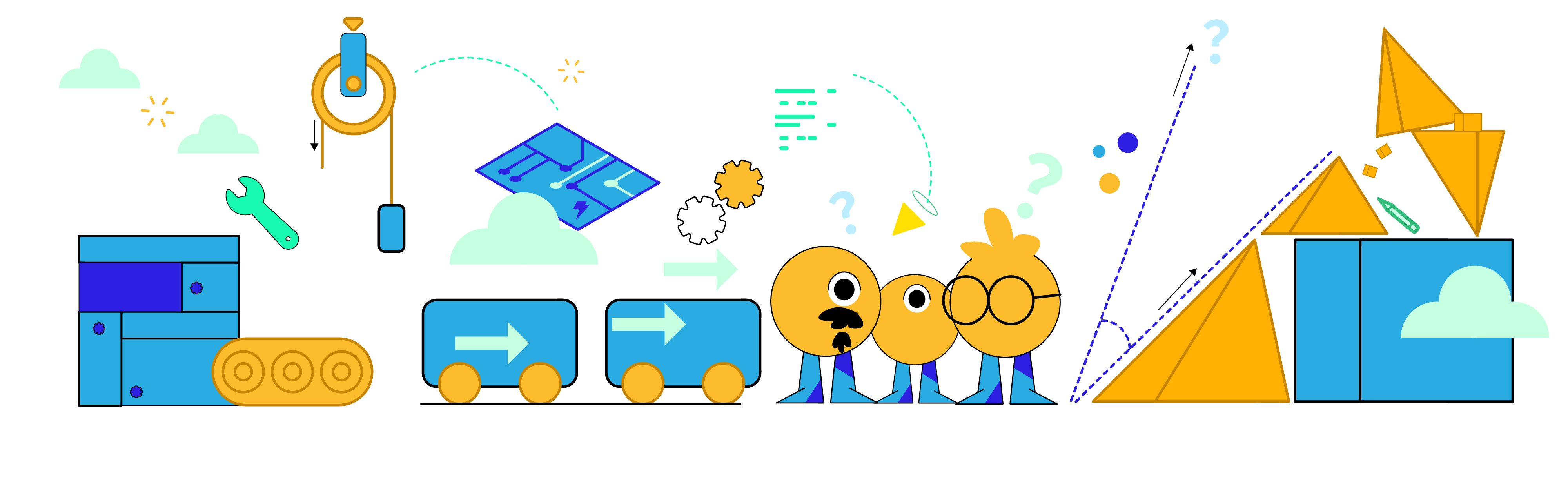
The day of the competition arrived. We cradled the robot like a metallic toy dog, confident enough to wear custom-made team t-shirts as we waited with bated breath. A number of teams went before us, and I recall most of the robots being quite similar — tiny tanks chugging along at angles hovering around 30 to 45 degrees. It seems the persistent image of the tank tracks had caught them by the pants too, and never let go.
Our turn came. When the assistant asked what angle we wanted to attempt, I’m pretty sure we were insufferably smug when one of us said, “Doesn’t matter, how about we just go under the glass surface?” We stuck the robot under the glass (at this point it still felt like a machine to me), and watched it hang on and move along with no worries.
As we removed the robot from the glass, it was clear that we had won. But the assistants had quietly declared us something a bit more; a showcase for the year. Our robot was called on to perform as each high-ranking university official dropped by to visit the competition. We just kept putting it up to different angles, proud as mother hens after each run.
It was the final run when this thing became more than a machine to me. This was our run for the University Rector; I knew it was the last, because there wasn’t a higher-ranking official left. We set the robot at the 90-degree glass wall and turned it on. Just then... something went wrong.
The tube that was spraying the surface with Windex snapped off, a single drop landing dramatically, some twenty centimeters from the robot.
As the robot wasn’t built to run on dry glass, we were ready to take it off the wall and apologize to the waiting officials. But something held us back for a second, as the robot began to struggle. It heaved itself a bit forward, swiveled from side to side like a silent but desperate beast. The gearbox churned, and the wheels slowly turned. We once again felt the need to intervene — this time, not out of embarrassment, but with a desire to ease the robot’s suffering.
The next moment, and how it felt, I recall clearly. Through its mechanical thrashing, the robot managed to touch the single drop that had landed in its path. The drop spread quickly across the suction cup, and the robot pulled itself to the finish line with gusto.
It felt so unusual. This idea, this twist on the formula, this system of parts that had occupied my mind — and then the energy, sweat, and efforts of my team — for the last few weeks. This thing, meant to move forward on a glass surface as a simple machine, had done something unexpected, something that felt strangely organic.
It had struggled. Yes, I know this wasn’t a sentient thing, but even without that faculty, it had utilized its capacity, thrashing around like a desperate living creature. It had pushed its limits until a small stroke of luck let it reach its purpose.
What had started as a concept, an idea, a set of sketches had managed to move me, to surprise me in ways I hadn’t expected. I won’t push this theme so far that it sounds like I’m claiming to wade the same waters as artists, but it did make me realize something.
The creative process — with the right set of tools, the right team, and perhaps most importantly, the freedom to pursue ideas that emerge only after we’ve shaken off the dogs of the status quo from our pants — is an experience like no other. This is a constant source of motivation as I work on the digital twin. It is a platform that invites that creative spark and gives it a hearth where it may grow into a lasting flame.
No posts
Comments
Nothing yet. Say the first thing.
Sign in to join the conversation.