
Neon to Dot-Com, the Party Lives On
Most people over 40 (as of the writing of this piece in 2025) would probably agree that the 1980s were peak colorful, cheesy, synthetic fun in music and pop culture. There was no neon too bright, no clothing too tight or stretchy to appear in a music video. And as music turned more serious, thanks to a group of misfits from Seattle who traded their neon tights for flannel, the spirit of 80s MTV culture seemed to find a new home: the dot-com boom of the 1990s.
The 90s were a great time. You could join tens of millions of volunteers building the greatest collective knowledge project in human history — Wikipedia — and, while taking a break, fire up another browser window (tabs really weren’t a thing yet) to watch startups like Flooz.com and Boo.com fail in spectacular fashion. It sometimes felt like anyone who could register a short dot-com name felt obligated to try and change the world.
Thanks for reading Yavuz’s Substack! Subscribe for free to receive new posts and support my work.
The fusion of web-based technology — which could reach anywhere — and boundless entrepreneurial spirit — which believed it could reach anywhere — gave us some of the era’s most iconic brand names: Razorfish, LoudCloud, Ask Jeeves. A unique and catchy name certainly helped startups stand out in the crowded venture capital landscape. But what I find curious is how this branding-first mindset moved beyond companies and began to shape how we name entire fields of emerging technologies.
Put Down the Foam Finger and Rush the Field
Technologies like Blockchain, Non-Fungible Tokens (NFTs), XR, or the more obscure Frozen Sand aren’t proprietary to any one company, yet their names feel like the work of a savvy advertising agency. This is somewhat confusing, such well-crafted names imply a desire to sell something accessible or exciting, but many of these technologies are still years away from practical use. In some cases, I’d argue it’s not even clear whether there’s any meaningful utility to be found, like answers looking for questions.
When a new technology starts to gain traction, whether due to a catchy name or media buzz, a financial ecosystem tends to form around it. Experts begin speaking and championing its potential, investors try to position themselves early, and then there’s a much larger group of people left wondering what the fuss is about. One of the times I found myself in that latter group was when I tried to make sense of how NFTs were supposed to usher in a new creator economy, a process that reminded me of being a teenager trying to “get” jazz.
I did get it eventually, not NFTs, but jazz. It took hours of listening, and learning to improvise on the guitar, until I reached that moment when it all suddenly made sense. I’m sure this isn’t the only — or even the most practical — way to understand complex music, but how wonderful it was to find that understanding came coupled with the ability to express myself. Not only could I understand a new language, I could also speak it.
That’s part of my frustration with many emerging technologies today: the general public is expected to sit on the sidelines and wait for a story to unfold, with the only real choice being whether or not to buy the final product. I would argue that technologies which invite participation, like the World Wide Web or the early Internet, were far more exciting. Not only did we wait with bated breath as the next revolutionary idea took shape, we also had the chance to contribute. From personal web pages to massive collaborative efforts like the Human Genome Project or OpenStreetMap, these technologies offered people a way to help shape something meaningful.
Defining the Digital Twin in Three Movements
I believe that the next frontier — one that blends the potential for active participation (albeit with a slightly higher entry point) and offers nearly boundless possibilities to reshape the human experience — goes by one of the most unbrandable names imaginable: the Digital Twin. Despite the bland label, it has remained a mainstay on lists of top emerging technologies for years. I’d argue this is partly because of its capacity to be disruptive at an immediate, local scale across sectors like manufacturing, smart cities, healthcare, and more. What makes it even more exciting, in my view, is that it can be paired with an equally blandly named technology, Semantic Knowledge Graphs, to scale that impact almost indefinitely at a global level.
To me, the definition of a Digital Twin that has the most traction — and holds the most potential, thanks to one of its core mandates — is the following: a Digital Twin is a digital representation of a real-world phenomenon (my focus is on locations), with the ability to access real-time data and a capacity to improve the real-world phenomenon on which it is based.
Before moving on to the incredible potential this enables, I’ll first unpack each element of the definition:
a) digital representation,
b) real-time data, and
c) improving the phenomenon on which the Digital Twin is based.
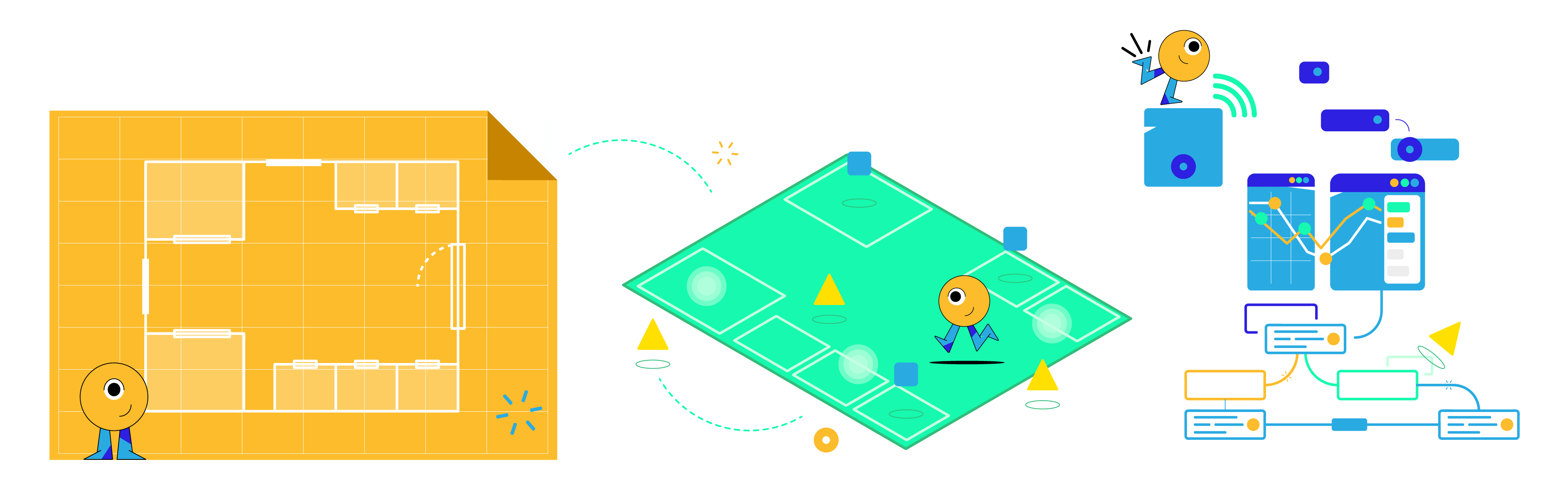
In a nutshell, a digital representation of a real-world phenomenon can be understood as descriptive information stored in a form that computers (or similar devices like smartphones, I’ll simply use “computer” from here on) can meaningfully process and transmit. At the most basic level, one might think of a photo taken of a floorplan posted in a hotel corridor or on a university campus. It’s digital in the sense that it can be stored, shared, and displayed — and it does represent something real.
But the word “meaningfully” requires that we raise the bar. For a digital representation to be meaningful, a computer must be able to transform or analyze the information in ways that humans find useful. In other words, it needs structure and context.
Without further processing, a computer program won’t be able to ascertain any meaningful knowledge from the floorplan image, such as the number of rooms, whether the rooms are of similar size, how the rooms are connected, or where the fire exits are.Therefore, the most basic starting point for a location-based digital twin must include vector data (like room corner points), attributes (such as room numbers), and some semantic data (like which elements are exits).
Thanks to advances in serious gaming technology — not about people who take games seriously, but rather using gaming tech for serious things — we can rapidly build on this foundation to achieve a more detailed twin. We can represent 3D walls, virtual furniture in the rooms (viewed with realistic colors and textures), and hyperrealistic — and semantically related — building elements such as electrical infrastructure, individual switches, and even stains on the carpets.
For Digital Twin builders, it is quite tempting to go overboard with all the visually appealing bells and whistles. An elaborate virtual replica does draw attention and may even bring new audiences to the Digital Twin world. But there is a cost associated with the creation process — detailed scanning, adding a high number of individual components, and so forth — and this cost usually also carries over in the form of high-cost hardware to render and display the twin.
The extra effort and resources, in my humble opinion, should be dedicated to implementations that confer greater return on investment, things like real-time asset tracking, simulation-based planning, co-creation tools, and more.
I should note that there are some exceptions to this rule, though not as many as one would hope. One of the most impressive demonstrations I’ve seen involved a highly detailed drone scan of an ancient German church. It was possible to zoom in and examine the finest details, even detecting minor wear on a relic suspended from the high ceiling. But that was precisely the point: the purpose of the project was to detect water droplets that could gradually damage these priceless relics.
In this case, the fancy bells and whistles were fully justified. I must admit to being more than a bit jealous of the project team.
For most Digital Twin projects, I believe in a simple heuristic: the level of detail should match the expectations placed on the twin — in other words, the real-world value it’s expected to deliver back to the phenomenon it represents.
There’s much more to unpack around data representation, particularly the distinction between digital data and digital models. I’ll return to this in a later section, using a light-hearted analogy I’ve found surprisingly effective for explaining the concept of entropy in communication theory.
I’ll be picking up the pace somewhat for the last two elements of the definition, with the promise that I’ll return to them later, in greater detail and with real-world examples. Alongside that promise is the hope that we’ll continue this journey together.
A point I’ll revisit relentlessly is that this journey should be one of participation. If I can convince even a few of you to start building your own Digital Twins — however modest at first — and to push them through multiple iterations, each one reflecting a little more of you and your goals, that would be an absolute joy for me.
I digress, let us continue with the definition. The second element requires a Digital Twin to be infused with real-time data from the real world. Most sensors and sensor networks today have online access, so we can use the blanket term IoT (Internet of Things) to refer to this capability.
Continuing with our hotel floor example, such IoT data might include room temperature readings, the current location of cleaning or maintenance staff, the operational status of smoke detectors, and much more.
This part of the definition pushes the twin beyond a static simulation environment and into a technology that hovers somewhere between a superpower and a major paradigm shift. It’s a bold claim — and one that may be difficult to justify in an introductory text — but it’s a line of thought I’ll explore in more depth later.
The final element in the definition is the expectation — I’d go as far as to call it a mandate — that the Digital Twin creates a positive change. If this part isn’t acted upon, it’s easy to waste considerable effort and resources creating a model that ends up spinning its wheels in the “visualization” and “analysis” phases.
Our hypothetical hotel floor model — aided by simulations and AI — can show that the exit signs are inadequate. Our IoT setup can detect poor ventilation or a water leak. Yet if insights like these, and countless others we might imagine, don’t result in change, it’s just analysis for its own sake, and an expensive one.
Potential issues or opportunities identified by the model (again through simulations and AI), or flagged by sensors, must go through a digital decision-making process and be communicated to all relevant parties: hotel maintenance staff, administrators, and — in some cases — even the guests.
Virtuous Cycles, New Frontiers and Beyond
It isn’t hard to imagine that these three elements have the potential to generate some very interesting — hopefully virtuous — cycles. In our hotel example, the IoT real-time sensor data may reveal poor air ventilation in the rooms, which in turn can trigger an investment in more modern air conditioners. When the digital twin is updated with these new units, administrators might notice that they support remote control. The digital twin can then be extended to activate the air conditioners based on room occupancy — so guests are always greeted with fresh rooms, but no energy is wasted when a room is unoccupied. Although not in a hotel room, my team implemented a very similar setup in a university laboratory, so the theoretical and practical are well aligned in this example.
At this point, I believe I’ve pushed the boundaries of what an introductory text should cover — you may chalk it up to my excitement about the topic. As I stated earlier, I hope this introduction entices you to continue with me through a wide range of digital twin–related topics — and before too long, to dive into a twin of your own creation, and hopefully share your experiences with me.
Thanks for reading Yavuz’s Substack! Subscribe for free to receive new posts and support my work.
Comments
Nothing yet. Say the first thing.
Sign in to join the conversation.