
This is an edited and somewhat expanded version of an essay I published on my WordPress blog long ago. Now, over a decade later, I no longer feel the least bit “silly” having written these words….
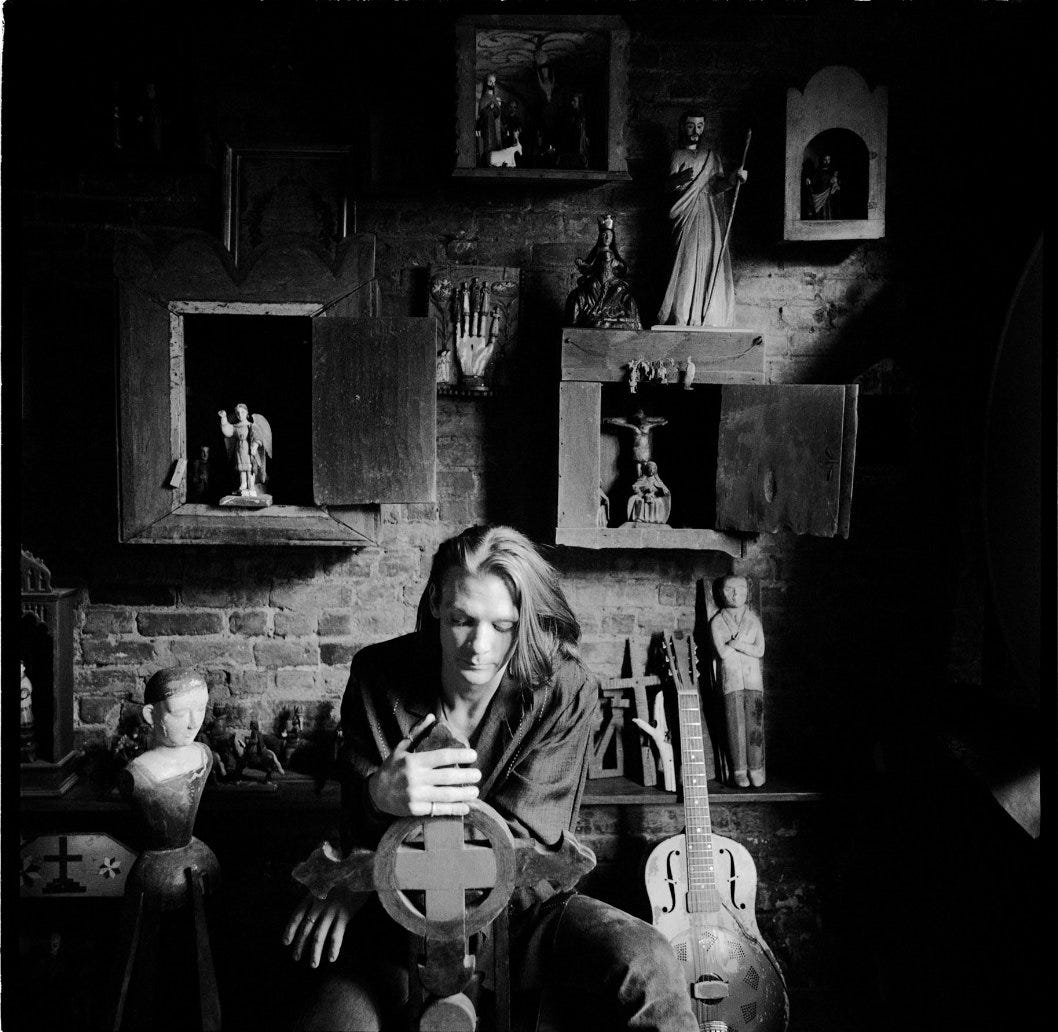
This morning, I began looking for a specific comment Chris Whitley had made about how living in Europe, and specifically Dresden, had shaped his personal/musical philosophy. Because I have amassed what must be hundreds of pages of Whitley interviews, reviews, and articles, this search entailed an hours’ long descent into all things Chris Whitley, including not only scanning printed materials and checking bookmarked websites, but also occasional “Oh, I haven’t played that song in a while” forays into my CD and bootleg collection.
I’ve yet to find that one telling comment, but, as I scanned dozens of interviews and articles in search of that one true thing, I was amazed anew by the depth and insight of Chris’s comments about music, media, culture, spirituality, Camus, French surrealism, the destruction of what had once been a vibrant alternative community in the Village …, you name it. The man was not only deep but broad. I was also struck by the reverence with which many of the writers described him and his music — the same reverence with which so many of us fans describe our reaction upon first hearing Living with the Law or seeing him in a live venue, or (devoutly to be wished) talking with him between sets.
And I realized that what we who “got” him experienced was a baptism in the Church of Chris Whitley. A sacred rite fondly, devoutly remembered that made us congregants, communicants sipping life from and transformed by his often obtuse lyrics, his voice that ran the gamut from a resonating bass to an ethereal falsetto, and the jaw-dropping sound of his whatta-fuck-is-that resonator guitar. Chris and his music spoke to that not-quite-conscious something that we tamped down so we could get on with life, but that gnawed at the edges of our insomniac anxiety; he answered our prayers that surely there’s something more, this can’t be — in the words of Peggy Lee — “all there is.”
I almost (but not quite) feel silly having written these words. But, at some level, I believe that Chris would have agreed that our devotion to his music is a kind of spirituality:
Spirituality doesn’t have to have rules or names. …. I think spirituality is more serious than something that can be classified, especially by religions defined by man. …. Spirituality can be expressed in the way someone builds a house. …. It’s not about a specialized thing you do once a week. It’s how you value life. It’s about keeping both feet on the ground, but your head in the sky. [from Anil Prasad, Innerviews, p. 281]
And I think that creating music was a spiritual experience for Chris. Below are a few examples that illustrate the devotion of those who were baptized.
From Jeff Miers’ The Few, the Chosen: Those who have been blown away by the music of Chris Whitley form a cultlike club, The Buffalo News, September 13, 2002:
Some moments are frozen forever into the folds of our memory, be they tied to some particular period of time we’re nostalgic for or simply burned into our being because of their profound initial impact. The first time I heard Whitley sing is one of those times. I remember the room, the wood molding surrounding the fireplace, the dust on the mantel where the stereo rested, the few candles burning in my peripheral vision, the people partying in the background, one of whom would become my wife, though neither of us knew it yet.
It was my birthday, and my friend Nelson had seen fit to lay Living With the Law on me as a gift. “You’ll like this, Miers,” he said. “He sings like a cross between Springsteen, Dylan and Bono.” With that, he slapped the plastic in the carriage, something still relatively new to us then, for we’d all grown up with vinyl. And he hit the play button.
Suddenly, I was gone, blown clear out of that Bailey-Kensington district house and straight into some heretofore unknown vista of the Mississippi Delta, except it looked like Greenwich Village, too, and somehow a street corner in Belgium that I’d never visited and the rural majesty of the Berkshire mountains in Massachusetts, where I’d grown up. This music was rustic and modern, prayerful and solemn and profane and sweaty, mythic, rhythmic, Dylan, Guthrie, Leadbelly in one. I heard, logic be damned, a Faulkner novel implied in Whitley’s National steel guitar, Carson McCullers’ otherness in his swampy-yet-sophisticated vocal, deep New Orleans grit in the subterranean rhythmic shifts of the band, the primal stuff that can only be imparted by wood and steel and wire.
It was voodoo, plain and simple, I decided, and never being one to question the magic of unsuspected moments, I dove.
From Geoff Ashmun’s Fantastic Damage: Live at Martyrs’, Chicago Tribune, May 15, 2003, writing about a gig Whitley played (with The Vast Combo) at Martyrs’ in May 2003:
Chicago’s storefront nightclub, Martyrs’, is now legendary to fans who saw Whitley record Live at Martyrs’ over three unforgettable nights in August of 1999. I remember them well, nearly every moment of raw, punishing beauty. I walked out sweat-stained, hoarse, feeling borderline arthritic. With any luck, tonight would inflict similar damage. But with Whitley, there’s always damage of one kind or another. ….
If there exists something like the art of musical ellipsis, Whitley is undoubtedly a master. To close out his main set, he drags out the most recognizable instrument in his collection, the National steel dobro featured on the cover of his 1991 debut, Living with the Law. It looks like it was unearthed somewhere in Cambodia or dragged behind a Volkswagen over the Rockies, but when you see him play it, you have that much more respect for the instrument’s survival.
The crowd knows what’s coming. For several years, Whitley has flirted with performing “Big Sky Country” a capella, which seems appropriate for what is probably the closest attempt at a gospel song in his repertoire. But tonight, he’s not quite there. I for one am glad he doesn’t lay the guitar down completely, instead opting to punctuate choice images in the song by bending notes and firing them out like bullets. I’m thinking something has to break, has to, but nothing. There’s just the dozen or so signature notes stripped from everything else, the ones turning each corner and maintaining the song’s integrity. In this way, Whitley demands a lot from an audience that could be uninterested in straining its ear to recognize strange renditions of already obscure songs. It’s a typical Whitley risk, but he knows he’s playing to an anything-but-typical crowd. These people seldom come out to see him on a whim, and tonight they are finding plenty of reward.
Here’s “Big Sky Country” as Chris sang it that night, but listen to the whole bootleg and renew your baptism vows :
0:00
-5:05
From a blogger (Break the City Sky) on Tumblr, recalling a gig on October 6, 2004 — just two days after Whitley’s mother died (October 4):
It’s Chris Whitley I remember most, though. He played there more than once, but this is what I remember. October, 2004. The last show he would play in Minnesota. I was helping out with merch for that show, got there early and he was running late. His mom had died, that morning, the day before, I can’t remember but I do remember how much sadder he looked, how soft his words were. I remember sitting in the basement of the 400 Bar, signatures lining the walls, sharing cigarettes and drinking coffee out of paper cups. He played this gorgeous, gut-wrenching set that night to a crowd that was nowhere as big as it should have been. [We don’t have this bootleg, but this one from October 20 probably is good stand in for that “gorgeous, gut-wrenching set”]
We packed up the van afterward and he told me a few stories that made me cry. I gave him a hug and he was gone, one moment to the next. He was staying at the Holiday Inn up the hill from the bar, and I remember standing at the street corner watching him, his shoulders hunched as he walked, braced against the wind and he was probably sick even then, certainly heartbroken and it physically hurt to watch him move. It was the last time I would ever see him.
. . . .
There was a kid there that night taking pictures, scrabbled down his name and a website that I’m not sure exists anymore but I found a picture he’d taken the next day that was everything about Whitley I remembered and everything about the 400 that I loved. I saved it, and it’s traveled with me ever since. The photographer’s name was Joe Cunningham, and this picture is his.
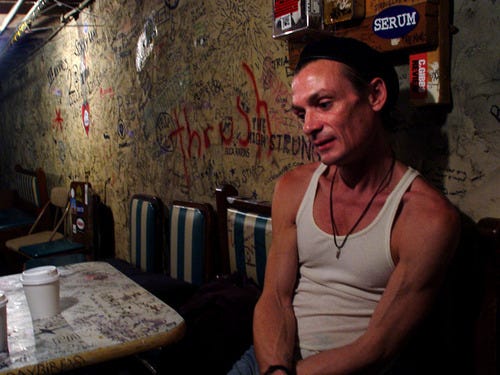
Hope you’re resting easy, Chris. Thanks for this memory and so many more, 400 [Bar].
from http://breakthecitysky.tumblr.com/post/39478796838/the-music-as-remembered
And, the best of many excellent obituaries, from Cree McCree (Off Beat Magazine), in its entirety - I sob every time I read it:
Chris Whitley always played as if his life depended on it. Sometimes, as in his 2004 manifesto War Crime Blues, the emotion was so raw you could practically taste the blood on the strings of his National steel guitar. Other times it was more of a throbbing ache, as in this year’s Soft Dangerous Shores, his last dispatch as an expat in Dresden, Germany. He came home to die in Houston, Texas, where he was born in 1960, and passed on November 20, of lung cancer.
The news of his death came hard on the heels of Katrina and out of left field, like She did. The intensity of the last few weeks as he lay dying, smack in the middle of the Houston diaspora of New Orleans evacuees, was straight out of a Chris Whitley song. A menacing “City of Women” where “everywhere I go is wet and red.” A city of “Soft Dangerous Shores,” where “no one lives to tell of paradigm shifts you know so well.” A city not unlike New Orleans, where Whitley recorded his classic 1991 Columbia debut Living with the Law in Daniel Lanois’ fabled Kingsway studio. Malcolm Burns produced both his first and his final album, which bookend a career that was born on the streets of New York, honed in juke joints and Euro dance clubs, and produced a wildly eclectic, emotionally consistent body of work that was sometimes uncannily oracular. He always told the truth.
When I watched him coming up in New York on the cusp of the ’90s, he was a driven, driving, incredibly sexy guitar slinger and the only serious rival to John Campbell, who was making a heavenly noise with his National steel around the same time. (There were even a couple to-die-for double bills). What set Whitley apart were his songs. The sepia-toned portraits on Living with the Law, which cast him as a Sam Shepard antihero, had the harsh, bright beauty of “Big Sky Country” with just enough Big Easy ooze to make a lot of smart chicks want to “Kick the Stones” out of his bed. Then he disappeared for four years. He came back with a bang on Din of Ecstasy (Sony, 1995), turning the volume up to 11 with screaming existentialist blues that anticipate 9/11. Later, in a fine series of albums for Messenger records, he followed his muse wherever she led him, from his father’s Vermont barn, where he recorded Dirt Floor in a single day, to the Hotel Vast Horizon of his adopted home of Dresden, where dreadful memories of the Allied firebombing linger to this day. “No one was spared and nothing was learned,” he sings on “Fireroad,” a cautionary tale for post-K New Orleans. But it doesn’t have to be that way. Faced with “the news how the world gave way tonight,” he sets a “Medicine Wheel” spinning and tells us to “sustain your heart protect your light.” Fortunately, we have Whitley’s music to help us do that. He, and it, will be mightily missed.—Cree McCree
As you read these words, did you feel a chill down your spine or tears forming in your eyes or, as is sometimes my response, a sudden sob erupting from that not-quite-conscious something inside you that listening to Chris’s music and realizing there will never be more unleashes? If so, you, dear reader, are a fellow congregant in the Church of Chris Whitley.
Want to read more beautiful writing about the gift of Chris Whitley? I also recommend these:
http://theecotone.blogspot.com/2006/02/chris-whitley.html
http://syzygus.wordpress.com/2008/01/23/the-someday-legendary-chris-whitley/
Comments
Nothing yet. Say the first thing.
Sign in to join the conversation.