
The browser landscape is undergoing a fundamental transformation driven by AI integration. Traditional incumbents like Google Chrome and Microsoft Edge are racing to add AI features, while innovative startups like Arc (The Browser Company), SigmaOS, and Perplexity are reimagining what browsers can be. The market is witnessing significant investments, acquisitions, and new business models entered around AI-powered browsing experiences.

The web browser has remained fundamentally unchanged for decades - a linear model of opening tabs, searching, reading pages, and repeating. This static approach dominated from the early days of Netscape and Internet Explorer through the modern era of Chrome, Safari and Firefox.
The web browser has been the gateway to the digital economy. Each era of browsers has shaped how we discover, consume and monetise the internet.
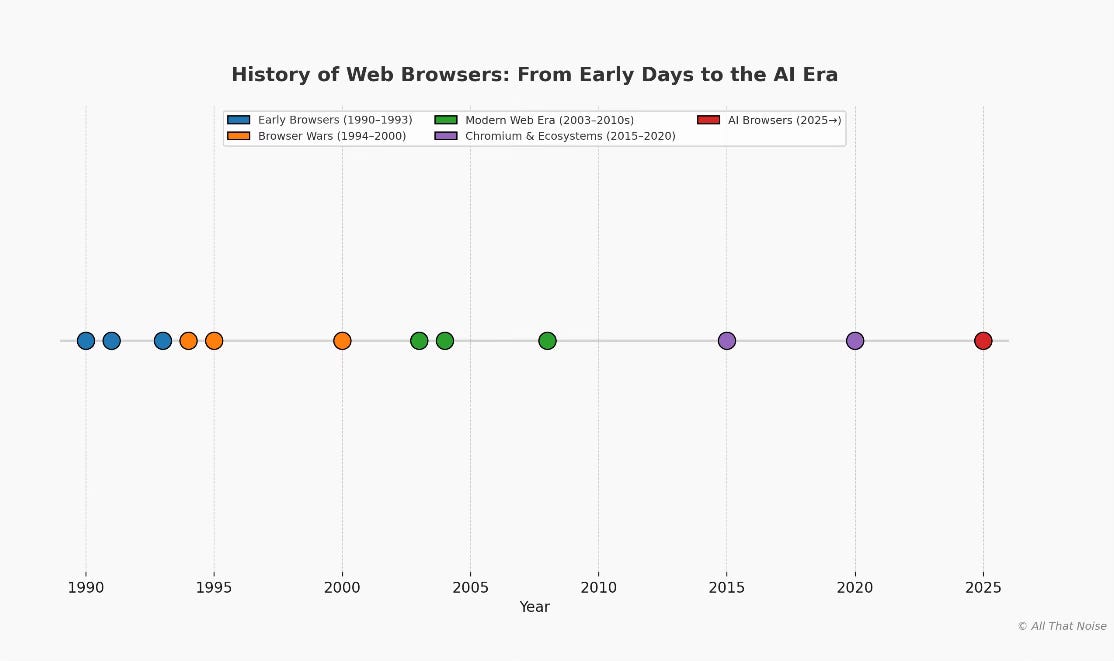
1990: Tim Berners-Lee at CERN created the first browser/server combo, WorldWideWeb (later renamed Nexus). It introduced clickable hypertext.
1991-1992: Early experiments like the Line Mode Browser and Erwise (first GUI browser from Finland).
1993: NCSA Mosaic, built by Marc Andreessen’s team, added inline images and cross-platform support - the “killer app” that popularised the web.
1994-1995: Netscape Navigator’s meteoric rise (90% share by 1995). Microsoft bundled Internet Explorer with Windows 95, igniting the “browser wars”.
Late 1990s: Microsoft’s integration strategy cursed Netscape; IE held 99% by 2000. Netscape open-sourced its code → Mozilla project.
2000s: Firefox launched (2004) with privacy and extensions. Safari (2003) tied tightly to Apple devices, Chrome (2008) rewrote the game with speed and simplicity, quickly dominating.
2010s-2020s: Chrome extended dominance (65%+ share by 2025). Microsoft killed IE for Edge (now Chromium-based). Browsers became “thin shells” with focus on performance, security, extensions and mobile usability.
2024-2025: Marks a pivotal shift as AI begins to reshape every aspect of digital interaction, including how we browse the web.
If the first browser war was about distribution and defaults, the second will be about intelligence and agency.
AI browsers aren’t just portals to the web - they are assistants living inside the web. They integrate LLMs and autonomous agents to analyse pages, answer questions, and even act on your behalf.
Core features:
Intelligent Tab Management: Auto-renaming tabs, organising them based on content similarity
Content Summarization: AI-powered page summaries, link previews, and “pitch-to-summarize” functionality
Contextual Assistance: Understanding what users are working on and providing relevant help
Task automation: AI agents that can perform complex browsing tasks autonomously
Personalization and conversational search: Voice commands and conversational interfaces
Privacy & security: On-device AI, advanced phishing/malware detection
Examples (2025): Browsers are no longer passive viewers of pages, they are evolving into proactive, agentic systems.
Perplexity Comet: Agentic workflows, enterprise integrations
Arc Max/Dia: ChatGPT-powered on-page Q&A, smart tab tools
Brave Leo: Privacy-first AI answers, no account required
Opera Aria: Generative sidebar for content and images
Dia (Apple beta): Writing and productivity AI with privacy controls
Fellou: Workflow automation across 50+ platforms
Incumbents: Chrome + Gemini, Egde + Copilot, Safari + Apple Intelligence, Firefox + summaries
Big tech incumbents are layering AI into their browsers to protect market share, rather than rebuilding the browser from scratch.
Google Chrome: Gemini AI powers conversational search, automatic tab grouping, and visual search via Lens. With 65%+ share, even incremental AI shifts affect billions of users.
Microsoft Edge: Copilot sidebar provides a page-aware chat, summarisation, and multimodel (text + vision) tools; tight integration with Microsoft 365.
Mozilla Firefox: AI-driven tab organization, translations, and previews - optional, privacy-focused features consistent with Mozilla’s ethos.
Apple Safari: Apple Intelligence (on-device) supports article summaries, highlights, and seamless integration across iOS/macOS.
Opera: Aria AI sidebar offers generative text/image tools, plus built-in VPN and messenger.
All these AI ‘enhancements’ are safe and incremental but are slower than startups.
Startups are betting that AI-native experiences can outpace incremental add-ons:
OpenAI (coming later 2025): Chromium-based browser with ChatGPT-native interface; integrates sponsored responses, ad stack, and agentic task execution.
Perplexity Comet: Launched July 2025 (premium tier, $200/mo enterprise-focused); excels at complex, multi-step queries and source-cited answers.
The Browser Company (Arc/Dia): Arc Max for productivity + Dia Pro ($20/mo) with always-on assistant features.
Brave Leo: Real-time analysis and summaries with strong privacy posture.
SigmaOS: Browse for Me functionality similar to Arc Search mobile features. Using AI-powered monetization ($20/mo subscription for premium AI features).
Others: Dia (privacy-first), Fellou (enterprise workflows), Sidekick (team/productivity browser).
AI browsers borrow from old models but add new levers:
Ads & Sponsorships: AI answers insert sponsored results. OpenAI and Perplexity are testing ad formats; some share revenue with publishers.
Subscriptions & Freemium: Perplexity’s Comet ($200/mo enterprise), Brave Leo Premium ($14.99/mo), Arc Dia Pro ($20/mo).
Data Utilization: Anonymised query + browsing data improves model training, personalisation, and monetisation.
Partnerships & Enterprise: Integrations with Slack, Gmail, and enterprise SaaS (e.g., Fellou for workflow automation).
Ecosystem Lock-in: OpenAI, Google and Microsoft aim to fold the browser into broader AI ecosystems.
The first browser wars shaped distribution. This one will reshape discovery.
If AI browsers become the default interface for knowledge, shopping, and productivity, they could:
Reshape the $200B+ search ad market
Redistribute traffic flows away from publishers
Accelerate the shift toward agentic AI - software that acts, not just answers
In 1993, Mosaic was called the “killer app” of the internet. In 2025, AI browsers might become the “killer platform of the AI-native web”.
The views expressed are those of the author and do not necessarily reflect the views of any investment firm or portfolio company.
Comments
Nothing yet. Say the first thing.
Sign in to join the conversation.